
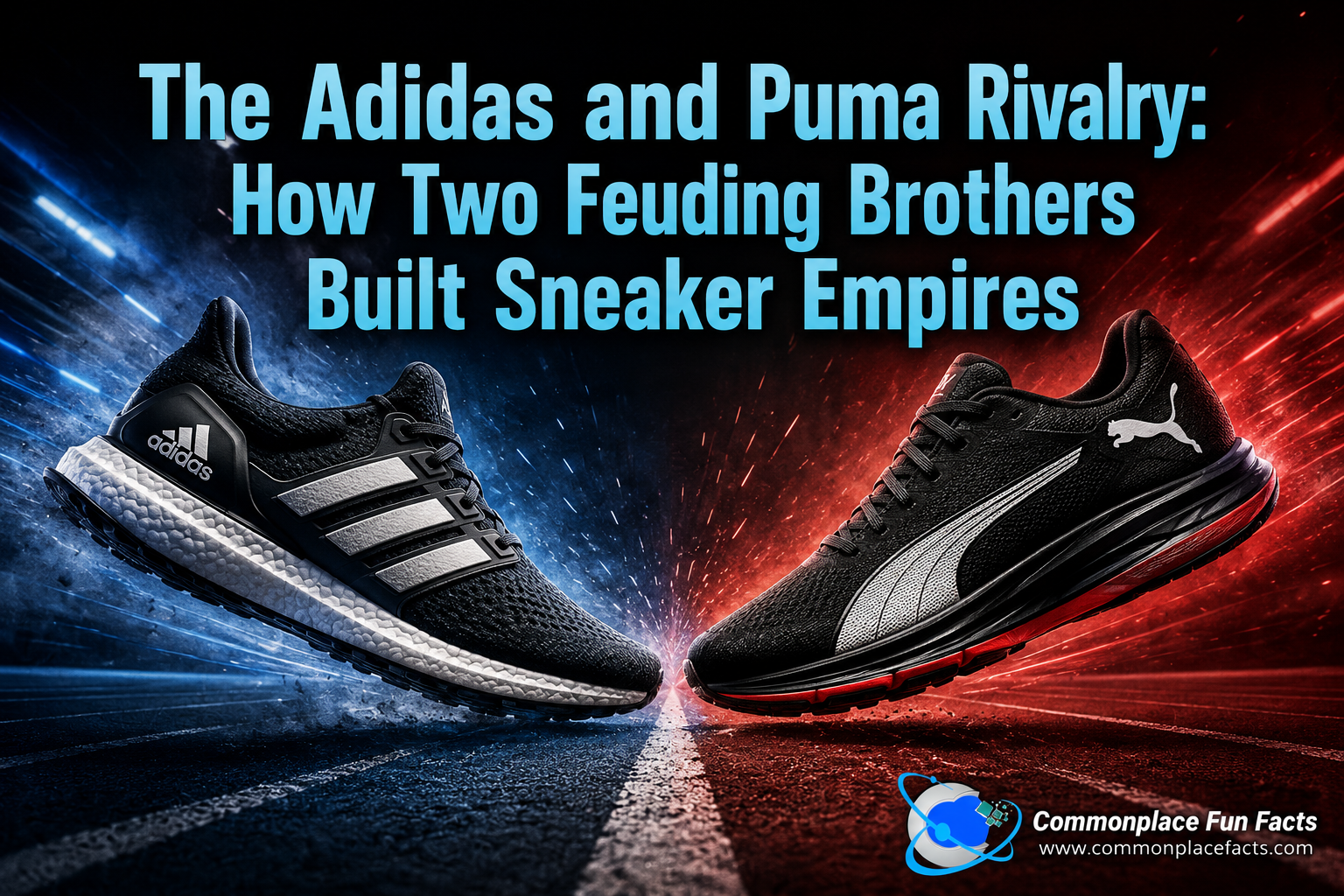

Most family feuds end with cold mashed potatoes, one aunt leaving early, and someone saying, “Well, that went better than last year.” The Dassler family went in a slightly different direction. Their brotherly blowup produced Adidas, Puma, decades of corporate rivalry, and one Bavarian town where people reportedly checked your shoes before deciding whether you were socially acceptable.
Which, to be fair, is still less judgmental than some homeowners’ associations.
The Adidas and Puma rivalry began not in a boardroom, not in a marketing department, and not in a glossy sneaker campaign involving slow-motion athletes leaping over fog machines. It began in Herzogenaurach, Germany, where two brothers — Adolf “Adi” Dassler and Rudolf “Rudi” Dassler — built a successful athletic shoe company together before tearing it apart so completely that each man created his own global brand from the wreckage.
Adi founded Adidas. Rudi founded Puma. Their companies became giants. Their hometown became a footwear Cold War. And the modern sportswear industry learned a valuable lesson: nothing motivates innovation quite like unresolved sibling resentment with access to leather, spikes, and trademark lawyers.
Contents
Before Adidas and Puma, There Was the Dassler Brothers Shoe Factory
Long before the three stripes and the leaping cat, there was the Gebrüder Dassler Schuhfabrik — the Dassler Brothers Shoe Factory. The company started small, because all “humble origins” stories are legally required to begin in cramped quarters with someone’s mother nearby trying to keep the household from turning into an industrial accident.

Adi Dassler began making sports shoes after World War I. His brother Rudi joined him, and by 1924 the two had formally registered their company in Herzogenaurach, a town in Bavaria that would eventually become famous for athletic shoes, bitter loyalties, and looking downward at people’s feet with the intensity of a border inspection.
The brothers made a good team, at least at first. Adi was the craftsman and inventor. He cared about fit, traction, weight, and how shoes actually performed on athletes. Rudi was the salesman. He had the outgoing personality, the business instincts, and presumably the ability to say, “These shoes will make you faster,” without immediately adding, “assuming you also train and stop eating refined sugar in mass quantities.”
Their timing was excellent. In the 1920s, athletic shoes were still a specialized product. People did not yet wear sneakers to run errands, attend business meetings, appear in court, or signal that they were “definitely going to start working out again next week.” Sports footwear was equipment. The Dasslers understood that if athletes could be convinced that better shoes meant better performance, they had a business.
They were right. Annoyingly right, as history likes to be when it is setting up a later catastrophe.
Olympic Gold and the Dassler Breakthrough
The Dasslers’ big break came through competitive sports, especially track and field. Their spiked running shoes gained attention in the late 1920s and 1930s, when Olympic athletes began wearing them. At the 1928 Amsterdam Olympics, German athletes wore Dassler spikes, helping establish the company’s reputation beyond the small-town workshop.
Then came 1936.

The Berlin Olympics were supposed to be a propaganda showcase for Nazi Germany. Adolf Hitler wanted the Games to demonstrate German superiority, because dictators have always had a touching faith in the public relations value of track and field. Instead, American athlete Jesse Owens won four gold medals and humiliated the central racial myth of the Nazi regime in front of the entire world.
Owens did it wearing Dassler spikes.
That detail became one of the great ironies of sports history. A German shoe company received international attention because a Black American athlete used its product while dismantling Nazi racial propaganda one sprint at a time. One imagines the Dassler brothers enjoying the publicity and trying not to look too closely at the moral contradiction, which is generally how business history gets through breakfast.
It would be a mistake to say the shoes made Jesse Owens great. Jesse Owens made Jesse Owens great. The shoes, however, were part of the story. They helped give the Dassler company global credibility and showed that athletic footwear could be more than something you strapped on before jogging around a cinder track and regretting your life choices.
The Business Was Growing. So Was the Tension.
Success did not solve the Dasslers’ problems. It merely provided better lighting.
The brothers were different men with different instincts. Adi was focused on product development. Rudi was focused on selling, expanding, and building relationships. That division of labor worked beautifully when the company was small and everyone needed everyone else. But as the business grew, so did the number of opportunities for resentment, suspicion, bruised egos, and the special kind of family tension that only comes from mixing relatives, money, and close quarters.

There were also wives, which history sometimes treats as a delicate way of saying, “The men were difficult, but let us blame the women for organizational purposes.” Adi and Rudi’s families lived and worked in close proximity, and later accounts suggest there was friction between the households. Business disagreements became personal. Personal disagreements became business disagreements. Eventually, the whole thing began to resemble a corporate merger conducted inside a Thanksgiving argument.
The exact cause of the split is still disputed. That is important. The Adidas and Puma rivalry is surrounded by stories, accusations, and family folklore, much of it delicious but not always provable. One version says Rudi had an affair with Adi’s wife, Käthe. Another says wartime suspicion poisoned the relationship. Another centers on a misunderstood insult during an Allied bombing raid. Like many great historical feuds, it has several possible causes, all of them wearing heavy boots.
What we can say with confidence is this: by the 1940s, the partnership was cracking badly. And then World War II arrived, because apparently the situation was not already cheerful enough.
World War II Made Everything Worse, Which Is One of Its Lesser-Known Brand Contributions
The Nazi era is an unavoidable part of the Dassler story. Both brothers joined the Nazi Party in 1933. Later explanations have often framed this as a business decision, the kind of thing companies say when history asks uncomfortable questions and the conference room suddenly gets very quiet.
The company operated in Nazi Germany, benefited from the sports culture promoted by the regime, and became entangled in the wartime economy. During the war, Rudi served in the military while Adi remained connected to the factory. After the war, both brothers faced the Allied denazification process. The combination of politics, war, suspicion, and business control only deepened the rupture.

One famous story claims the brothers’ relationship suffered a major blow during an Allied air raid in 1943. According to the tale, Adi and his wife entered a bomb shelter where Rudi and his family were already waiting. Someone allegedly made a remark about “the swine” being back. Adi supposedly meant Allied bombers. Rudi supposedly believed Adi meant him and his family.
This may or may not be the exact spark. Family legends are not always reliable witnesses. They tend to arrive late, embellish freely, and act as if they have documentary evidence when really they have a grudge and bruised feelings.
Still, whether or not that moment caused the feud, it captures the emotional temperature. These were not two brothers who merely had a professional disagreement over quarterly projections. They had reached the point where even a comment made during a bombing raid could be interpreted as a personal attack. When the bombs are falling and you still have time for sibling suspicion, the relationship may have exited the “healthy communication” phase.
The Split: Rudi Creates Puma, Adi Creates Adidas
In 1948, the Dassler brothers finally split the company. The family business was divided. Employees chose sides. Machinery, assets, loyalties, and probably at least one very uncomfortable coffee pot had to be sorted out.

Rudi moved first. In January 1948, he registered a new company called Schuhfabrik Rudolf Dassler. He initially used the name RUDA, formed from Rudolf Dassler, which sounds less like a sportswear empire and more like a small appliance warranty company. Later that year, he changed the name to Puma. Much better. Sleeker. Faster. Less likely to appear on a carburetor.
Adi followed with Adidas in 1949. The name came from “Adi” and “Dassler,” not, as generations of playground scholars have insisted, “All Day I Dream About Sports.” This is disappointing, but facts often are. In the same year, Adi registered a shoe featuring the three stripes that would become one of the most recognizable marks in sports history.
Thus, from one ruined family business came two global brands. This is either an inspiring story of entrepreneurial resilience or a warning label about going into business with relatives. Possibly both.
Herzogenaurach: The Town Where Shoes Were a Loyalty Test
The brothers did not merely create competing companies. They created competing worlds.
Adidas and Puma both remained in Herzogenaurach, with factories on opposite sides of the Aurach River. The rivalry divided the town socially, economically, and emotionally. People associated with Adidas tended to stick with Adidas people. Puma workers did the same. Shops, pubs, butchers, bakers, sports clubs, and even social circles developed brand loyalties.

Herzogenaurach became known, famously, as a place where people looked down before speaking to you. Not out of shyness. Not out of humility. They wanted to see what shoes you were wearing.
This gave rise to the nickname “the town of bent necks,” which is both hilarious and deeply unsettling. Imagine moving into town, introducing yourself to the neighbors, and watching them immediately check your footwear like customs agents searching for contraband loyalty.
There were stories of Adidas families avoiding Puma families, Puma employees avoiding Adidas establishments, and romance across the sneaker divide being treated like a Shakespearean tragedy with better arch support. The Montagues had Adidas. The Capulets had Puma. Everyone had opinions about laces.
Even the brothers’ deaths did not fully soften the symbolism. Rudi died in 1974. Adi died in 1978. They were reportedly buried on opposite sides of the Herzogenaurach cemetery, because even eternity requires brand separation.
The Rivalry Helped Build Modern Sports Marketing
The Adidas and Puma rivalry was not only personal. It was commercial, technical, and deeply competitive. Each company wanted better athletes, better shoes, better visibility, and better proof that its products could help champions win. If the other side had a star, your side needed a bigger one. If the other side had a better boot, your side needed a better feature. If the other side sneezed near a soccer field, your side probably considered building a stadium.
Adidas scored one of its defining victories in 1954, when West Germany won the World Cup in what became known as the “Miracle of Bern.” Adidas boots with screw-in studs became part of the legend, especially because the match was played in wet conditions. The story helped turn Adidas into a major name in international soccer.
Puma, meanwhile, built its own football legacy. The company launched the Atom football boot in 1950 and followed with the Super Atom in 1952, which Puma describes as the world’s first boot with screw-in studs. Puma later became associated with stars such as Pelé, Eusébio, Diego Maradona, and others. If Adidas had the three stripes, Puma had speed, flash, and the leaping cat — an image much more elegant than “angry brother with a grudge,” though historically less complete.
The competition pushed both brands. They invested in athlete endorsements, specialized footwear, technical improvements, and global sports visibility. Their feud helped turn athletic shoes from niche equipment into cultural objects. Shoes became performance tools, fashion statements, identity markers, and eventually things people collect in boxes without ever wearing, which would have confused every practical shoemaker in Bavaria.
The Pelé Pact and the Most Profitable Shoelace in Soccer History
No discussion of the Adidas and Puma rivalry is complete without the famous Pelé story, because apparently even shoelaces can become acts of corporate warfare if the marketing department has enough caffeine.
By 1970, Pelé was the biggest soccer star in the world. Adidas and Puma both wanted him. Badly. The problem was that if both companies got into a bidding war, the price could become ridiculous, even by the standards of sports marketing, where “reasonable spending” is a phrase often found decomposing quietly behind the hospitality tent.
So the two companies reportedly reached an informal understanding: neither would sign Pelé. This became known as the “Pelé Pact,” which sounds dignified and diplomatic until you remember it involved two brands born from a family feud so bitter that an entire town learned to check people’s shoes before making eye contact.
Puma broke the pact.
According to the oft-told version of the story, Puma arranged a six-figure endorsement deal with Pelé — commonly reported as $120,000 — and built one of the most brilliant little marketing ambushes in sports history into the agreement. Before Brazil’s 1970 World Cup match against Peru, Pelé asked the referee for a moment to tie his boots. The cameras obligingly zoomed in, because when Pelé paused, the world paused with him. There, filling television screens around the globe, were his Puma boots.
It was not exactly a shoelace emergency. It was product placement with studs.
The cleaner version is not that Pelé received $120,000 solely to tie his shoes, as if Puma had invented the world’s strangest piecework system. The money was part of an endorsement arrangement, and the pre-kickoff boot-tying moment was the camera-friendly flourish that made the whole thing legendary. Pelé got paid. Puma got exposure. Adidas got annoyed. Somewhere, a marketing executive probably saw the future and immediately asked whether athletes could be paid to adjust socks, drink water, or develop a bruise in the shape of a logo.
Brazil went on to win the 1970 World Cup, Pelé became even more immortal than he already was, and Puma enjoyed a publicity moment that could not have been purchased through ordinary advertising without first mortgaging several castles. The Pelé boot-tying stunt showed exactly where sports marketing was headed: athletes were no longer merely wearing equipment. They were selling stories, loyalties, identities, and extremely expensive leather wrapped around very famous feet.
What the Dassler Feud Really Changed
The easy version of the story is that two brothers hated each other and created Adidas and Puma. That is true, but incomplete. The more interesting version is that their rivalry helped shape how the entire sportswear industry works.
Before companies like Adidas and Puma became global lifestyle brands, athletic shoes were largely functional. They were tools for athletes. The Dasslers helped change that. They understood that performance mattered, but so did association. If champions wore your shoes, your shoes became part of the victory. If the public saw the shoes, the shoes became symbols. If enough symbols accumulated, congratulations: you now have a brand, and probably a room full of people discussing logo placement with unbearable seriousness.
Their rivalry anticipated much of modern sports business: athlete sponsorships, technical product claims, team partnerships, global tournament visibility, and the idea that athletic footwear could cross from sport into everyday life. Today, sneakers are fashion, identity, nostalgia, investment, and occasionally even exercise equipment.
That last use remains optional.
Of course, athletic shoes are only half the story of humanity’s complicated relationship with exercise. Once we had the footwear, we still needed machines on which to suffer indoors voluntarily. For that delightful detour, see our look at the treadmill origin story, where a device that began as a form of prison punishment somehow became the thing people buy in January and use as a laundry rack by March. History is inspiring like that.
The Feud Fades, but the Brands Remain
Over time, the personal intensity of the Adidas and Puma feud faded. The companies grew beyond the families. Ownership changed. Executives came and went. Global markets became more important than local grudges. The sneaker world expanded, and new giants — especially Nike — changed the competitive landscape.
Herzogenaurach is no longer quite the divided town it once was. People are less likely to choose their spouses based on shoe allegiance, which is probably healthier for civic life but less profitable for marriage counselors. Adidas and Puma remain headquartered there, still close enough for historical awkwardness, but the rivalry is now more corporate than personal.
Still, the origin story endures because it is almost too perfect. Two brothers build a company. They fall out. They split the business. They create rival empires. Their hometown divides. Their products reshape sports and fashion. Their bitterness becomes branding. It is family dysfunction with a global supply chain.
Conclusion: The Family Fight That Changed What the World Wears
The story of Adidas and Puma is not just a tale about sneakers. It is a story about ambition, innovation, ego, family, war, marketing, and the alarming human ability to turn a personal grudge into a multinational enterprise.
Adi Dassler and Rudi Dassler failed spectacularly as business partners. As brothers, they did not exactly stick the landing either. But from their feud came two of the most famous sportswear companies in the world. Adidas and Puma changed athletic footwear, helped pioneer modern sports marketing, and transformed shoes into cultural objects that could signal performance, style, loyalty, and occasionally poor financial decision-making.
The Adidas and Puma rivalry reminds us that history is not always shaped by grand ideals and noble visions. Sometimes it is shaped by jealousy, suspicion, wartime trauma, family resentment, and two men who absolutely refused to let the other brother win.
Not every family argument changes the world. Most just ruin dessert. The Dassler brothers managed to do both — except instead of dessert, they left us Adidas, Puma, and a Bavarian town that learned to judge people from the ankle down.
You may also enjoy…

Seeing Red: Does Wearing Red Make You Win in Sports?
Does Wearing Red Make You Win in Sports? Explore the psychology, Olympic research, and modern findings behind the “red advantage” in sports performance.

The Treadmill Origin: How a Torture Device Became the World’s Favorite Workout Machine
Discover the strange history of the treadmill origin—from Victorian prison punishment to modern fitness favorite—and how it became today’s workout essential.

Track and Field Predictions: How Wrong Were They and What’s Next?
Explore the historical track and field predictions, from Brutus Hamilton’s 1934 estimates to today’s world records. Discover how technology and athletic evolution have continuously shattered expectations.






Leave a Reply