
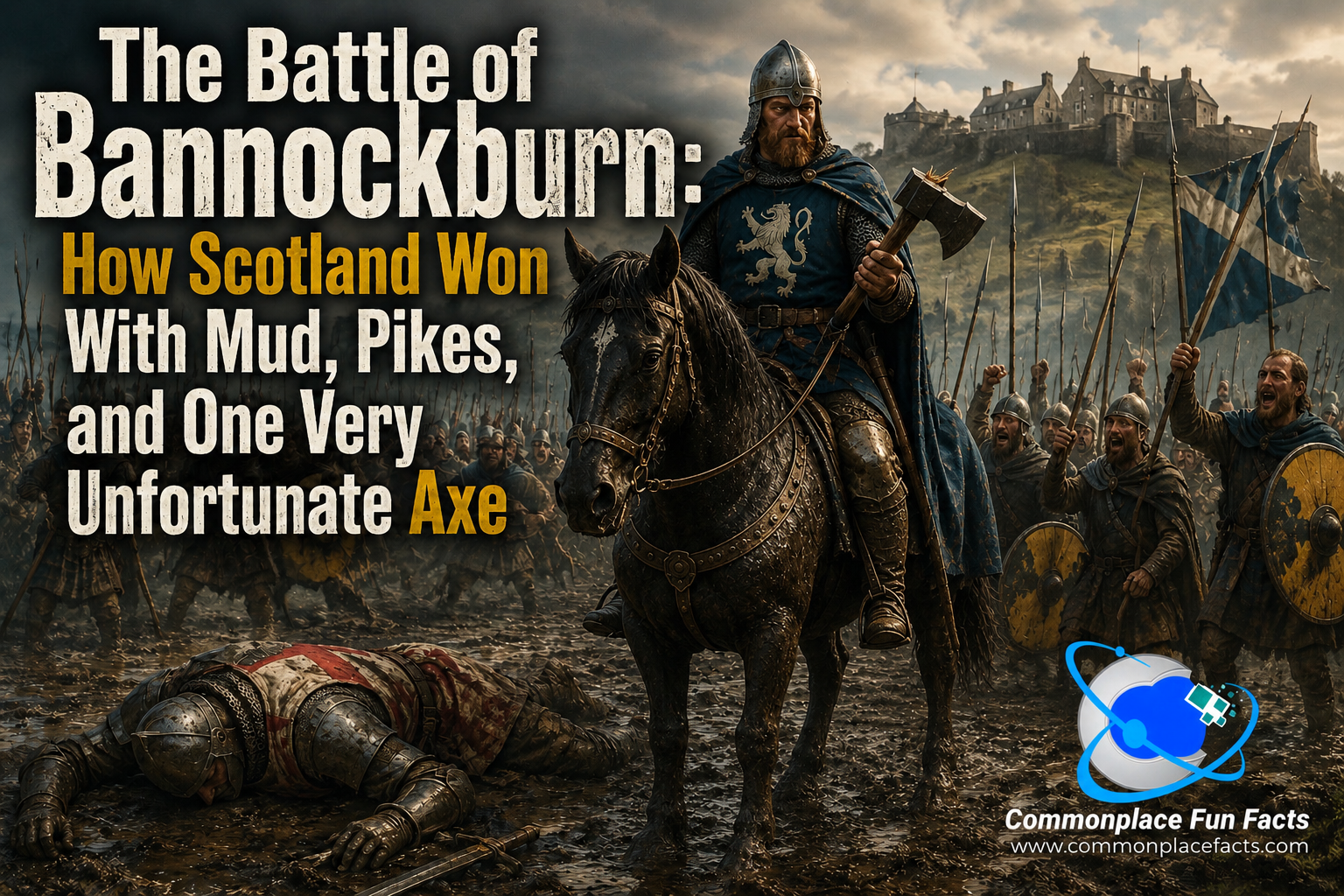

If medieval warfare teaches us anything, it is that being heavily armed, richly dressed, and seated on an enormous horse does not automatically mean you are about to have a good day. Sometimes it means you are about to ride confidently into a swamp while several thousand angry Scotsmen point sharpened sticks at you.
That, in extremely reduced form, is the Battle of Bannockburn.
Fought on June 23 and 24, 1314, near Stirling, Scotland, the Battle of Bannockburn was one of the defining clashes of the First War of Scottish Independence. On one side stood King Edward II of England, leading a large army north to relieve Stirling Castle. On the other stood Robert the Bruce, King of Scots, a man whose career up to that point had included murder in a church, excommunication, defeat, exile, guerrilla warfare, and what we might politely call “some image-rehabilitation challenges.”
And yet by the end of two days, Bruce had turned the larger English army into a panicked crowd-control problem and secured one of the most celebrated victories in Scottish history.
This is the story of how the Battle of Bannockburn became Scotland’s great underdog triumph — not because the Scots had more men, better horses, or shinier armor, but because Robert the Bruce understood the battlefield, the timing, and the ancient military principle of not letting your opponent do the one thing he came there to do.
Contents
Why Stirling Castle Mattered So Much
To understand the Battle of Bannockburn, you first have to understand Stirling Castle. Otherwise, the whole thing starts to sound like two kings decided to have a catastrophic disagreement in a damp field because medieval people had poor conflict-resolution skills. Which is not entirely wrong, but it leaves out the geography.
Stirling Castle was one of the most strategically important fortresses in Scotland. It guarded a crucial crossing of the River Forth, the kind of place where armies, merchants, messengers, and tax collectors all had to pass if they wanted to move between northern and southern Scotland without taking the scenic route through inconvenience.

Control Stirling, and you controlled movement. Control movement, and you controlled the kingdom. Medieval kings were very interested in this sort of thing, largely because “control movement” was the fourteenth-century version of owning the Wi-Fi password.
By 1314, Robert the Bruce had recovered much of Scotland from English control. Edinburgh Castle had been taken. Roxburgh Castle had been taken. English garrisons were being squeezed out one by one. But Stirling remained in English hands, and that made it the castle-sized pebble in Bruce’s boot.
Bruce’s brother, Edward Bruce, had been besieging Stirling Castle. The castle’s keeper, Sir Philip Mowbray, made a deal: if an English army did not arrive to relieve the castle by midsummer 1314, he would surrender it to the Scots.
This was not merely a gentlemanly scheduling arrangement. It was bait. Edward II now had to come north or watch one of England’s most important Scottish strongholds fall. Robert the Bruce had created a deadline, and Edward II walked right into it with an army.
Robert the Bruce: Not Exactly a Polished Inspirational Poster
Robert the Bruce is remembered today as one of Scotland’s great national heroes, but he did not begin his career as a spotless statue waiting patiently for a plinth. His path to the throne was messy, violent, politically complicated, and occasionally the sort of thing that makes historians take off their glasses and rub the bridge of their noses.

Bruce had once supported the English position. Then he shifted. Then shifted again. Scotland in this period was not a simple drama of brave Scots versus villainous English, no matter what later patriotic retellings may prefer. It was a civil conflict, a dynastic struggle, a war of independence, and a family feud wearing chain mail.
The most infamous moment came in 1306, when Bruce met his rival John “the Red” Comyn at Greyfriars Kirk in Dumfries. The meeting ended with Comyn dead, stabbed before the altar. This was frowned upon, even in the Middle Ages, which was not exactly an era known for its gentle HR policies.
Bruce was outlawed by Edward I and excommunicated by the pope. Shortly afterward, he was crowned King of Scots anyway, because apparently once you have committed sacrilege, treason, and homicide, you may as well aim high. And in true Scottish fashion, he was crowned not once, but twice. See “A King So Nice They Crowned Him Twice” for the reason for the double coronation.
His early reign went badly. He was defeated at Methven, members of his family were captured, three of his brothers were executed, and Bruce himself was driven into hiding. This is the part of the movie where the hero stares dramatically into the rain, except in real life it probably involved more fleas.
Then Edward I died in 1307. That mattered. Edward I, known as the “Hammer of the Scots,” was a formidable and ruthless opponent. His son, Edward II, inherited the crown but not necessarily the full operating manual. Bruce seized the opportunity. He returned, fought a guerrilla campaign, picked off enemies, destroyed castles before the English could reuse them, and slowly rebuilt his power.
By 1314, Bruce was no longer a fugitive improvising survival. He was a battle-tested king who had learned the hard way not to give the English army the kind of fight it wanted.
The English Army Arrives, Because Nothing Says “Good Idea” Like Marching Into Scotland
Edward II assembled a large force to relieve Stirling Castle. Exact numbers are debated, because medieval chroniclers approached statistics the way fishermen approach trout length. Still, the English army was clearly much larger than Bruce’s force. Modern estimates often place Edward’s army in the range of several thousand cavalry and many thousands of infantry, while Bruce commanded a smaller army of mostly foot soldiers, supported by a modest cavalry force.
This mattered because medieval heavy cavalry was terrifying when used properly. Armored knights on powerful horses could smash through poorly organized infantry and turn a battlefield into a very short argument. English armies also had archers, who in the right position could do appalling things to enemy formations.
But armies are not dangerous in the abstract. They are dangerous in actual places, on actual ground, with actual mud, streams, trees, panic, confusion, and commanders who occasionally make decisions that seem less strategic than optimistic.
Robert the Bruce understood this. He did not need to destroy Edward’s army in open country. He needed to stop it from reaching Stirling Castle and force it to fight in terrain where its size and cavalry were liabilities rather than advantages.
Bruce Picks the Ground
Bruce positioned his army near the New Park, a royal hunting park south of Stirling. This was not open jousting ground. It was broken, wooded, constrained terrain, crossed by burns and marshy areas. In other words, it was a terrible place to conduct a grand cavalry charge, which was precisely the point.

The Scots improved their position by digging pits and filling them with sharpened stakes, then covering or disguising them. These pits were designed to disrupt cavalry, which tends to perform poorly when the horse discovers that the ground has been quietly upgraded into a murder trap.
Bruce also relied on formations called schiltrons. A schiltron was a dense body of spearmen or pikemen arranged so that cavalry could not simply ride through them. Picture a porcupine with a national grievance, and you have the general idea.
Schiltrons had been used before, including by William Wallace. But Bruce’s innovation at Bannockburn was not merely using them defensively. He trained his men so they could move in formation. That made them more than a static wall of spear points. It made them a disciplined infantry weapon.
This is one of the key facts that makes Bannockburn more than a lucky upset. Bruce did not win because the Scots were plucky and the English forgot how horses worked. He won because he prepared his army, selected the ground, and forced the English to fight on his terms.
Day One: Robert the Bruce and the Axe Incident
The first day of the Battle of Bannockburn, June 23, 1314, produced one of the most famous scenes in Scottish history.
As the English army approached, an English knight named Sir Henry de Bohun spotted Robert the Bruce riding ahead of his troops. Bruce was not heavily mounted like a tournament knight. He was on a smaller horse, armed with a battle axe, and apparently close enough to tempt fate into making an appointment.

De Bohun saw his chance. If he could kill or capture Bruce before the battle properly began, the Scottish army might collapse. He lowered his lance and charged.
This was a reasonable plan in the same way that “I will personally eliminate the enemy king before lunch” is always reasonable right up until the enemy king objects.
Bruce waited, turned aside at the last moment, rose in his stirrups, and struck de Bohun with his axe. The blow killed the English knight and, according to the famous story, broke the axe shaft. Bruce’s men were horrified that he had risked himself so recklessly. Bruce, we are told, was more annoyed about breaking the axe.
That detail may come to us through later storytelling, and medieval accounts should always be handled with tongs, gloves, and a cautious expression. But even if polished by legend, the moment captures something true about Bannockburn: Bruce had nerve. He was not managing the battle from a distant hill while an assistant updated the royal spreadsheet. He was in front, visibly leading.
The psychological effect mattered. For the Scots, it was a thunderclap of confidence. For the English, it was an early hint that this campaign might not unfold as advertised.
The Other Fight on Day One: Randolph Holds the Line
While the Bruce-and-de-Bohun episode gets the statues and the dramatic paintings, another action on the first day may have mattered even more militarily.
A force of English cavalry attempted to move around the Scots toward Stirling Castle. If they reached the castle, the English could claim they had relieved it, undermining Bruce’s entire strategy. Thomas Randolph, Earl of Moray and Bruce’s nephew, was tasked with stopping them.
Randolph’s men formed a schiltron and intercepted the cavalry. English knights tried to break the formation, but the Scots held. After hard fighting, the English attack failed.
This was not merely a tactical skirmish. It showed that Bruce’s infantry could stand against cavalry in the field, not just hide behind obstacles and hope for the best. It also prevented the English from achieving their immediate objective before the main battle had even begun.
By nightfall, Edward II still had not relieved Stirling. His large army was intact, but it had been checked, frustrated, and forced into an awkward position. In military terms, this is bad. In camping terms, it was about to become worse.
The English Spend the Night in the Wrong Place
After the fighting on June 23, the English army camped on low ground near the Carse of Stirling, in the area of the Bannock Burn and Pelstream Burn. The exact location of the second day’s battle remains debated, because history enjoys making things difficult for people who like maps. But the general picture is clear: the English were crowded into difficult terrain with limited room to maneuver.
The Carse was low-lying ground, crossed by watercourses and marshy areas. Some accounts suggest the English army was squeezed together by streams, pools, and soft ground. This was not ideal for a huge force that included heavy cavalry, baggage, wagons, and thousands of men who had just marched into hostile country.
Imagine an entire medieval army trying to sleep in a damp field while realizing that tomorrow’s schedule includes spears. Morale was not likely soaring.
According to later tradition, a Scottish noble named Alexander Seton, who had been serving with Edward’s army, defected to Bruce that night and reported that English morale was low. Whether every detail of that story can be nailed down with modern precision is another matter. But Bruce seems to have concluded that the English army was vulnerable.
So instead of waiting defensively, he made a bold decision: on the second day, the Scots would advance.
Day Two: The Scots Attack
On June 24, 1314, the English army expected the Scots to remain in their defensive position. That would have made sense. The Scots were outnumbered. Their infantry formations were best known for resisting cavalry. A smaller army usually does not look at a larger army and say, “Let’s walk toward that.”
Bruce did anyway.
The Scottish schiltrons advanced out of the cover of the New Park and toward the English. This was the moment when Bruce’s preparation paid off. A schiltron that stands still can be avoided, isolated, or hammered by archers. A schiltron that advances in good order becomes a moving wall of sharp consequences.
The English cavalry had too little space to maneuver properly. Their lines were crowded. The terrain was difficult. The Scots pressed forward. The English army’s great size, instead of being an advantage, became a problem. Men and horses jammed together. Command and control suffered. Knights could not charge effectively. Infantry could not deploy cleanly. Archers could not dominate the field the way English archers would later do at battles such as Crécy and Agincourt.
There is an old military saying that amateurs talk tactics while professionals talk logistics. Bannockburn adds a third category: people trapped in mud talk mostly in alarmed noises.
The English did attempt to use archers, and they might have caused serious damage to the Scottish formations if properly positioned and protected. But Bruce’s small cavalry force reportedly disrupted them before they could decide the battle. With the archers neutralized and the cavalry unable to break the schiltrons, Edward’s army began to lose cohesion.
Then cohesion became panic. Panic became rout. And rout, in medieval warfare, was often where the real killing began.
The “Small Folk” and the Moment Panic Took Over
One of the most memorable traditions about Bannockburn involves the so-called “small folk.” These were camp followers, servants, local people, and lightly armed support personnel who were not part of Bruce’s main fighting force. According to later accounts, they appeared from behind the Scottish lines during the battle.
The English, already under pressure and probably not pausing for careful demographic analysis, mistook them for fresh Scottish reinforcements. That may have helped turn a bad situation into a full collapse.
Whether the story happened exactly that way is uncertain. But it is too good not to mention, carefully. Imagine being an English knight who has survived the spears, the mud, the chaos, and the growing suspicion that Edward II’s travel brochure left out several important details. Then you look up and see what appears to be another wave of Scots coming over the hill.
At that point, “strategic withdrawal” starts sounding very attractive.
The English Rout
Once the English army broke, the battlefield became a disaster. Men fled toward the Bannock Burn, the Pelstream, and other obstacles. In a controlled march, watercourses are annoying. During a rout, they are lethal.
Some English nobles were killed. Others were captured. The Earl of Gloucester died in the fighting. The Earl of Hereford was captured. Edward II himself escaped, eventually making his way to Dunbar and then by ship back to England.
Edward had come to relieve Stirling Castle. Instead, he left behind a shattered army, a ruined campaign, and a public-relations problem large enough to be visible from orbit, assuming one had medieval orbit.
Stirling Castle surrendered. Bruce later had its defenses destroyed so the English could not simply reoccupy it and restart the whole unpleasant process. It was a practical decision, though it must have been emotionally confusing for castle enthusiasts.
Did Bannockburn Make Scotland Independent?
Yes and no. This is history, so naturally the answer has to come with footnotes and a small headache.
The Battle of Bannockburn did not immediately end the war. Edward II did not suddenly announce, “Fair enough, Scotland, excellent spear work, best wishes in your future endeavors.” England did not formally recognize Scottish independence until the Treaty of Edinburgh-Northampton in 1328, fourteen years after Bannockburn.
But Bannockburn changed everything. It confirmed Robert the Bruce as the effective King of Scots. It destroyed Edward II’s attempt to reassert English power in Scotland. It gave Bruce enormous prestige. It proved that a Scottish army could defeat a much larger English royal army in open battle when the conditions were right.
In political terms, Bannockburn did not write the final sentence of Scottish independence. But it changed the paragraph.
Why Bannockburn Became a Legend
Bannockburn became more than a battle because nations do not remember events purely as events. They remember them as stories. Bannockburn offered Scotland a magnificent story: a smaller army, a determined king, clever tactics, impossible odds, and a humiliating defeat for a much larger invader.

It also came with memorable scenes. Bruce killing de Bohun with an axe. Schiltrons bristling with spears. English knights trapped by terrain. Camp followers mistaken for reinforcements. Edward II fleeing the field. Stirling Castle falling. The whole thing has the structure of a national epic, which is convenient because Scotland has never lacked for poets willing to notice such things.
Robert Burns visited Bannockburn in 1787 and later wrote “Scots Wha Hae,” placing imagined words in Bruce’s mouth before the battle. The poem helped cement Bannockburn not merely as a military event, but as a symbol of liberty, resistance, and Scottish identity.
That symbolic power is still visible today. The Bannockburn battlefield is commemorated near Stirling with a visitor center, monuments, and the iconic equestrian statue of Robert the Bruce. It is one of those places where landscape, memory, tourism, and national identity all stand around together trying not to contradict each other too loudly.
The Battlefield Nobody Can Quite Agree On
One of the stranger facts about Bannockburn is that historians still debate the exact location of the second day’s fighting. The general area is known, and the first day’s action is usually associated with the New Park area near the modern visitor centre. But the precise location of the main battle on June 24 remains contested.
This is not because historians enjoy uncertainty, though some do seem suspiciously comfortable there. It is because the landscape has changed. Wetlands were drained. Land was developed. Roads, buildings, and modern boundaries altered the area. Medieval sources describe features that are not always easy to match with the present terrain.
There are competing theories involving the Carse, the Dryfield, and other nearby locations. Archaeological evidence has not yet provided the final, argument-ending answer. And so Bannockburn remains one of those famous battles where everyone knows what happened, but not everyone agrees precisely where some of it happened.
History is helpful like that.
Fun Facts About the Battle of Bannockburn
1. The famous spider story does not belong here
One of the most enduring and inspiring stories about Robert the Bruce has him hiding in a cave, watching a spider try again and again to spin its web, and taking inspiration from its persistence. It is a wonderful story. It also does not belong at Bannockburn.
The stubbornly Scottish spider actually showed himself in a cave near the coast of Ireland shortly after Bruce was crowned in 1306. Read “When Scottish Independence Hung By a Spider’s Web” for more about this arachnid’s role in the history of Scotland.
2. Bannockburn was not just Scotland versus England
The battle is often remembered as a clean national showdown, but the politics were messier. Some Scots fought with the English. Bruce had Scottish enemies, especially among families tied to John Comyn. Medieval loyalties were shaped by land, family, ambition, fear, vengeance, and whatever arrangement seemed least likely to get one’s castle confiscated by Thursday.
3. The schiltron was basically infantry saying “no” to horses
A disciplined schiltron could stop cavalry by presenting a dense wall of spear points. Horses are brave animals, but even a brave horse is not eager to gallop into a hedge made of knives. Bruce’s success came from training these formations to move, not merely stand still and hope for the best.
4. Bruce’s broken axe became part of the legend
The story of Bruce killing Henry de Bohun and then complaining about his broken axe is one of the great character moments of medieval history. It may be embellished, but it is wonderfully revealing. Some kings lose a battle and blame the weather. Bruce wins a duel and complains about equipment damage.
5. The English army’s size may have hurt it
On paper, Edward II had the advantage. In practice, his large army had to operate in cramped, difficult terrain. A huge army is only useful if it can deploy, move, and communicate. Otherwise, it becomes a very expensive crowd trapped in a drainage problem.
“Flower of Scotland”: Bannockburn With a Chorus
Centuries after the mud dried, the pikes splintered, and Edward II made the executive decision to be somewhere else, Bannockburn found new life in song. Scotland does not have an official national anthem by act of Parliament, because apparently even national identity occasionally gets stuck in committee. But if you have ever watched a Scottish rugby or football crowd sing “Flower of Scotland,” you know technicalities are not really the point.
Written in the 1960s by Roy Williamson of The Corries, “Flower of Scotland” is not a medieval battle hymn. Robert the Bruce did not hum it while checking his axe for warranty coverage. It is a modern patriotic song looking backward to Bannockburn, where Bruce and his army stood against Edward II and, in the song’s most famous jab, “sent him homeward tae think again.”
That line is why the song belongs in the Bannockburn story. It captures the emotional afterlife of the battle better than any casualty estimate or battlefield diagram ever could. Bannockburn was not merely remembered as a military victory. It became Scotland’s great national “no, thank you” — delivered with spears, mud, and sufficient force to make an English king reconsider his itinerary.
The song also shows how Bannockburn moved from history into identity. The battle was fought in 1314, but “Flower of Scotland” lets modern Scots step into the memory of it, even if only for a few minutes before kickoff. It is less about recreating the exact tactics of schiltrons and more about reclaiming the feeling of defiance: the smaller nation, the larger invader, the impossible odds, and the stubborn insistence that Scotland was not England’s northern storage closet.
That is the power of Bannockburn. It gave Scotland not just a victory, but a story it could keep singing. And when thousands of voices rise together on “Flower of Scotland,” the message is still clear enough: Edward may have gone home in 1314, but Scotland has been reminding him about it ever since.
Bannockburn: The Day Scotland Refused to Be Managed
The Battle of Bannockburn was not just a military victory. It was a national refusal. Edward II came north with a massive army, royal confidence, and the apparent belief that Scotland could be corrected by cavalry. Robert the Bruce answered with mud, pikes, discipline, and the deeply Scottish conviction that being outnumbered is not the same thing as being beaten.
The English had the larger army. They had the armored knights. They had the banners, the horses, the baggage train, and all the expensive accessories of medieval overconfidence. What they did not have was the battlefield. Bruce had that. He had chosen it, prepared it, and turned it into a damp, miserable lesson in why invading Scotland should never be scheduled without reading the terrain notes.
Bannockburn did not end the war overnight, but it changed the story. It proved that Scotland was not merely a rebellious province waiting to be tidied up by London. It was a kingdom with its own king, its own will, and an impressive talent for making English armies regret their travel plans.
In the end, Bannockburn remains one of history’s great reminders that power is not always measured in numbers. Sometimes it is measured in nerve, preparation, home-field advantage, and the ability to make an invading army discover, far too late, that Scotland had read the land better than England had read the room.
Robert the Bruce won because he understood something Edward II had to learn the hard way: Scotland is not easily conquered, especially when its people have had time to sharpen the pikes, soften the ground, and develop a healthy dislike of being told what to do by an English king.
You may also enjoy…

The Haunting Legend of Sawney Bean: Scotland’s Scary Cannibal Clan
Discover the chilling legend of Sawney Bean, the Scottish cannibal who may—or may not—have eaten over 1,000 people. Truth, myth, and dark folklore collide.

When Scottish Independence Hung By a Spider’s Web
The winter of 1306 found Scotland’s Robert the Bruce on the verge of giving up. Having just been crowned King of Scots on March 25 (and again on March 27) of that year, his fortunes had turned. Instead of sitting on a throne in a castle, he was hiding in a cave on the Island…

Wearing the Crown Takes a Lot of Heart
Robert the Bruce (1274-1329) reigned as King of Scots from 1306 to 1329. He led a ragtag bunch of Scottish farmers to defeat England’s Edward II’s professional army that was four times the size of Scotland’s. He unified the Scots and secured their freedom from England and is remembered as the greatest of Scotland’s monarchs. Such…


Leave a Reply