
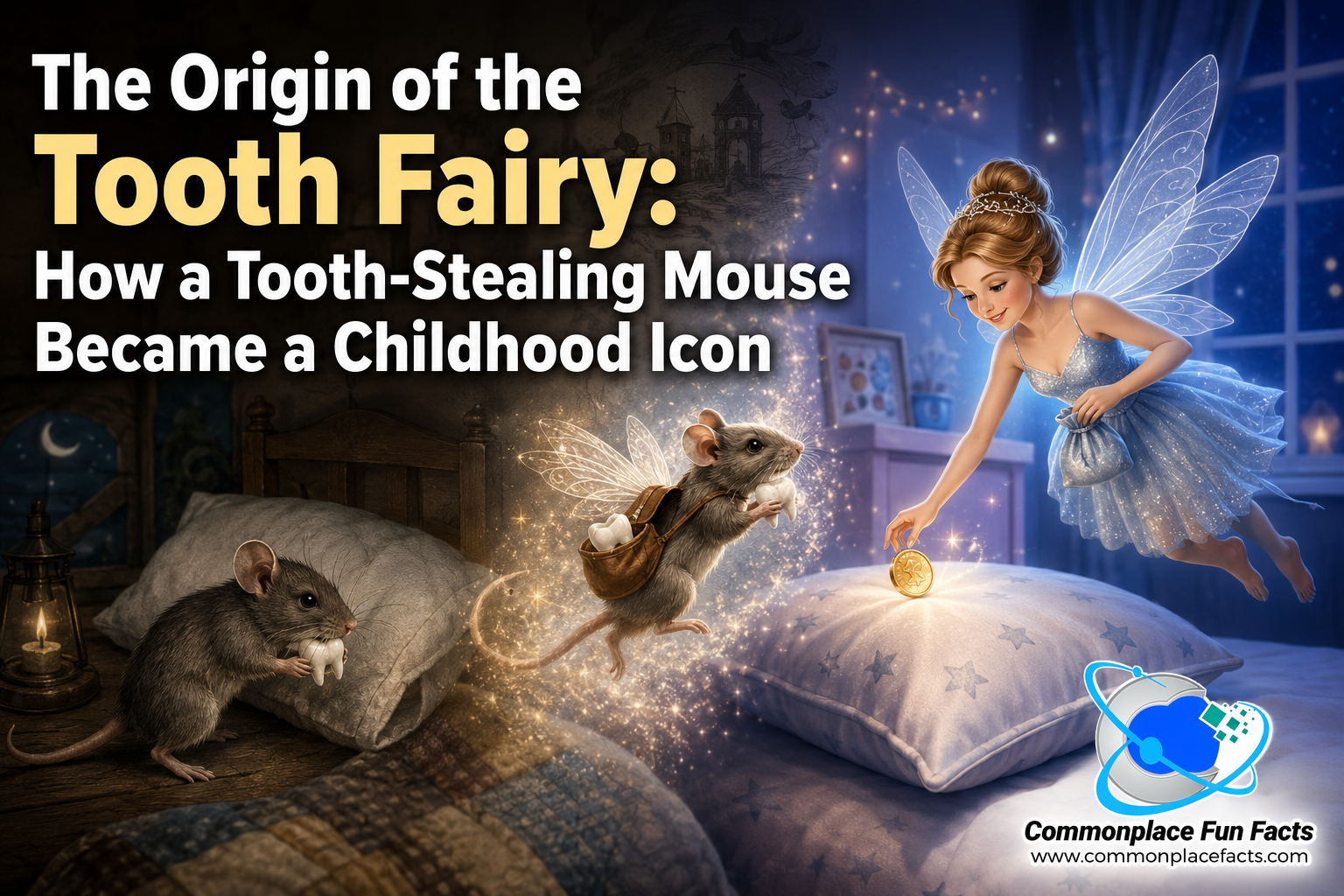

Imagine a young, innocent child sleeping peacefully in his bed.
His breathing is soft. His blanket is tucked beneath his chin. His exhausted parents have finally managed to get him to sleep and are enjoying several precious minutes in which no one is asking for water, complaining about the darkness, or remembering an urgently required school project that was assigned three weeks ago.
Then, sometime after midnight, a disease-ridden rodent slips into the room.
It crawls onto the bed, scurries toward the child’s face, removes a small piece of his body, and carries it away for reasons no one has yet been able to comprehend.
That sounds like the opening scene of a horror movie parents would be strongly advised not to show their children. Instead, for centuries, parents in many parts of the world told their children to look forward to it.
Eventually, someone apparently decided the story would be less alarming if the rodent had wings.
And that, more or less, is the origin of the Tooth Fairy.
Contents
Losing a Tooth Was Once Serious Business
Today, losing a baby tooth is generally treated as a minor childhood milestone. The child wiggles it obsessively for several days, refusing all responsible adult assistance, before finally dislodging it while eating something that was not supposed to end up with human remains.

In earlier cultures, however, a lost tooth was not merely a souvenir suitable for storage in a small plastic container shaped like a molar. Teeth were widely regarded as objects of power. They were part of the body, yet they could survive outside it. They were associated with strength, health, identity, and, in some traditions, magic.
That created an obvious problem: what should be done with a tooth once it had fallen out?
Simply dropping it on the ground seemed reckless. What if an animal found it? What if a witch obtained it? What if some wandering supernatural busybody used it to cast a spell on the child?
Parents therefore devised an impressive assortment of tooth-disposal procedures. Depending on where and when a child lived, a lost tooth might be buried, burned, hidden in a wall, thrown into a fire, tossed toward the sun, pushed into a tree, placed in an animal’s nest, or launched onto the roof.
Human beings have never been especially comfortable admitting that they do not know what to do with something. Give us a discarded tooth, a confusing dream, or nuclear waste that will remain lethal for millennia, and we will develop a ceremony, appoint an official, or blame the whole thing on witches.
Why Were Children Throwing Teeth Onto Roofs?
Many traditional tooth rituals were attempts to influence how the child’s permanent teeth would grow.
In parts of Asia and the Middle East, children traditionally threw lower teeth upward—often onto a roof—and upper teeth downward toward the ground. The idea was that the new tooth would follow the direction in which the old one had been thrown.
It was primitive orthodontics, although considerably less expensive and only slightly more mysterious than modern dental insurance policies.
Elsewhere, children appealed to the sun, birds, squirrels, beavers, dogs, or other animals believed to possess admirable teeth. A child might offer the old tooth while asking for a stronger, straighter, or more durable replacement.
Among all these animals, however, one creature emerged as the overwhelming favorite.
The mouse.
Before the Tooth Fairy, There Was the Tooth Mouse
Mice have incisors that grow continuously throughout their lives. They must constantly gnaw on things to keep those teeth worn down, which explains both their impressive dental reputation and why storing important documents in a barn is rarely a sound archival strategy.
To people looking for a model of strong, dependable teeth, the mouse was an obvious candidate. Children across large portions of Europe and beyond were instructed to offer their baby teeth to mice in hopes that the animals would provide better teeth in return.
The precise ceremony varied. A child might leave the tooth near a mouse hole, toss it behind a stove, place it under the bed, throw it onto a roof, or recite a short rhyme asking the mouse to exchange the old tooth for one made of iron, silver, or gold.
The underlying logic was a form of sympathetic magic: give your weak, temporary tooth to an animal famous for powerful, endlessly renewable incisors, and perhaps some of that dental excellence would transfer to you.
Folklorist Tad Tuleja identified the tooth mouse as the most persuasive ancestor of the modern Tooth Fairy. Mouse-related tooth customs appeared across a vast geographical range—from the Baltic region to the Mediterranean and into the Americas. No other proposed predecessor enjoyed anything close to that distribution.
In other words, long before American children were placing teeth beneath pillows in exchange for quarters, children elsewhere were offering them to rodents in exchange for improved replacement parts.
The earlier arrangement was arguably more practical. The child received a new tooth. The mouse received building materials. No currency was required, and neither party had to explain the transaction to the Internal Revenue Service.
Given that mice have historically taken our food, spread disease, and ruined furniture, it’s not unreasonable to expect something nice from them for a change.
The Mouse That Became a Fairy
There is no single documented moment when the traditional tooth mouse put on wings, obtained a wand, and diversified into financial services.
Folklore rarely develops that neatly. Traditions travel, overlap, borrow from one another, and gradually change until everyone assumes the latest version has existed since the invention of childhood.
One possible bridge between mice and fairies appeared in a French literary fairy tale written near the end of the seventeenth century by Marie-Catherine d’Aulnoy. Her story, commonly translated as The Good Little Mouse, featured a helpful mouse who was actually a fairy in disguise.
The mouse-fairy assisted an imprisoned queen, knocked four of the wicked king’s teeth out by pushing him from a tree, later tormented him in bed, and helped set in motion the events that ended with his death.
Children’s literature used to be less concerned about emotional gentleness. Modern editors might suggest that the fairy teach the king to share. Madame d’Aulnoy went directly to dental assault and regicide.
The tale does not prove that the Tooth Fairy evolved directly from this character, but it contains an intriguing collection of familiar ingredients: a mouse, a fairy, missing teeth, and nighttime activity around a bed. At the very least, it demonstrates that Europeans were already experimenting with the concept of magical rodents involved in unauthorized dentistry.
Ratón Pérez Enters the Royal Palace
In Spain and much of the Spanish-speaking world, the creature who collects children’s teeth is still not a fairy. He is a mouse known as Ratón Pérez, Ratoncito Pérez, or simply Pérez the Mouse.
 Cover of the 1911 illustrated stand-alone edition of Ratón Pérez by Luis Coloma, with artwork by Mariano Pedrero
His most famous literary appearance came in 1894, when the Spanish queen regent María Cristina asked Jesuit priest and writer Luis Coloma to create a story for her eight-year-old son, the boy king Alfonso XIII, who had lost a tooth.
Coloma wrote a story in which the young king, called Buby, placed his tooth beneath his pillow and met Ratón Pérez. The mouse lived with his family in a box of cookies at a confectionery shop in Madrid and traveled through pipes to visit children who had lost their teeth.
Ratón Pérez then took the young king on a journey through Madrid, allowing him to see how poor children lived. The story was not merely an explanation for missing teeth. It was intended to teach the young monarch about compassion, inequality, and the lives of his subjects.
Most children get a coin when they lose a tooth. Alfonso XIII received an illustrated lesson in social responsibility. Royal childhood apparently came with a heavier curriculum.
Coloma’s story was first published in 1902 as part of a collection titled Nuevas Lecturas. A stand-alone illustrated edition followed in 1911 and helped make Ratón Pérez one of the best-known figures in Spanish children’s folklore. He remains the traditional tooth collector in Spain and in many Latin American countries.
France has La Petite Souris, or “the Little Mouse.” In various other countries, children also expect a mouse or rat to retrieve their teeth. The American fairy may have captured the English-speaking market, but internationally, rodents continue to maintain a strong position in the tooth-acquisition industry.
The Tooth Fairy Finally Gets a Name
The modern Tooth Fairy appears to be a distinctly American creation, and she is much younger than most people assume.
The earliest known printed use of the term “Tooth Fairy” yet located appeared in the Chicago Sunday Tribune on September 27, 1908.

The reference did not appear in a grand collection of ancient legends or in a scholarly examination of European folklore. It appeared on the newspaper’s “Practical Housekeeper’s Own Page.”
A contributor named Lillian Brown offered mothers a helpful suggestion for dealing with children who refused to allow anyone to pull a loose tooth. Tell the child about the Tooth Fairy, she advised. If the child placed the tooth beneath the pillow, the fairy would take it during the night and leave a small gift.
Brown recommended that mothers visit the five-cent counter and stock up on inexpensive items for this purpose.
Thus, the earliest known printed appearance of one of America’s most familiar magical beings was essentially a parenting hack combined with a shopping recommendation.
The Tooth Fairy did not arrive trailing stardust. She entered American culture through the bargain aisle.
A second early reference appeared in a Kentucky newspaper in 1911, in a story written by a fifteen-year-old girl recalling how her aunt had persuaded her to surrender a tooth by promising a visit from the Tooth Fairy.
By the 1920s and 1930s, newspapers occasionally mentioned the Tooth Fairy alongside an assortment of other invented childhood visitors, including a measles fairy, a chicken pox fairy, and a vaccination fairy.
Those characters failed to achieve lasting popularity, possibly because “the Chicken Pox Fairy is coming tonight” sounds less like a promise and more like a threat.
Why a Fairy?
The traditional mouse explains why a creature would want the tooth, but why did Americans replace the rodent with a fairy?
No one knows with certainty. The most likely answer is that several traditions gradually merged.
Americans inherited European customs involving magical beings, nighttime gifts, hidden coins, and elaborate precautions surrounding children’s teeth. By the nineteenth and early twentieth centuries, fairies had also become common figures in children’s books, theater, art, and popular entertainment.
A fairy was small enough to enter a bedroom unnoticed, magical enough to transform a tooth into a gift, and respectable enough that parents could mention her without explaining why a rat had been granted unsupervised access to the nursery.
The fairy also made the custom gentler. Losing a tooth can be unsettling for a child. There may be blood, discomfort, and the disturbing realization that body parts can simply fall out during breakfast.
By turning the event into a magical exchange, parents transformed something frightening into something exciting. The child was not losing a piece of himself. He was conducting business with an invisible nocturnal purchaser.
From Household Trick to National Tradition
Although scattered references to the Tooth Fairy appeared during the early twentieth century, the custom did not immediately become universal.
Tuleja concluded that the familiar pillow-tooth-money ritual became firmly established in the United States only after World War II. He suggested several reasons for its sudden rise.
First, postwar families generally had more disposable income. A household struggling to pay for food, clothing, and shelter was unlikely to waste a perfectly good nickel on a tooth that the child was going to lose anyway.
Second, American parenting became increasingly child-centered. Parents were encouraged to acknowledge children’s fears, nurture their imaginations, and soften difficult transitions. The Tooth Fairy converted a mildly traumatic biological event into a celebration.
Third, popular culture was crowded with benevolent female magical figures. Glinda appeared in The Wizard of Oz. The Blue Fairy guided Pinocchio. Cinderella had her Fairy Godmother. Tinker Bell supplied the pixie dust in Peter Pan.
By the 1950s, American children were fully prepared to accept that any domestic difficulty could be resolved by a tiny woman with wings and a flexible understanding of the laws of physics.
Children’s books, magazines, advertisements, dentists, and schools helped spread the custom. By the 1960s, the Tooth Fairy had become a familiar part of childhood in the United States and was spreading rapidly in Britain.
What Does the Tooth Fairy Look Like?
Santa Claus has a fairly standardized appearance. He is an elderly, bearded man in a red suit with a documented chimney problem.

The Tooth Fairy has never achieved that level of visual consistency.
She has been portrayed as a tiny winged girl, a graceful adult woman, a grandmotherly figure, a glowing ball of light, a male fairy, a rabbit, a mouse, and various other creatures whose principal qualification appears to be access to loose change.
Even the fairy’s method of operation remains unsettled. Some children place the tooth directly beneath the pillow. Others use an envelope, a glass, a special box, or a small pillow with a pocket sewn into it.
The specialized tooth pillow was presumably developed after generations of parents discovered that reaching beneath the head of a sleeping six-year-old without waking him requires the dexterity of a safecracker and the emotional composure of a bomb-disposal technician.
Why Does the Tooth Fairy Pay Cash?
The earliest Tooth Fairy exchanges did not always involve money. The 1908 newspaper suggestion referred to a small gift. Other children received candy, toys, or trinkets.
Coins eventually became the standard payment because they were small, convenient, and easy to place beneath a pillow. Money also allowed the child to choose his own reward, while sparing the Tooth Fairy from maintaining a warehouse full of dolls, marbles, whistles, and five-cent-counter merchandise.
Once cash became standard, however, parents created an economic problem from which the mythical community has never recovered.
Children compare notes.
One child receives a quarter. Another receives a dollar. A third announces that the Tooth Fairy left twenty dollars, a handwritten certificate, and what appears to be a small contribution to a college savings plan.
Parents are then forced either to increase the local rate or explain why the Tooth Fairy operates a discriminatory compensation system based largely on ZIP code and parental exhaustion.
The Tooth Fairy has consequently become one of the few supernatural figures whose performance is routinely evaluated against inflation. See “Tooth Fairy Prices Fall for Second Straight Year: What’s Behind the 2025 Decline?” to find out the going rate for a discarded molar.
The Tooth Fairy’s Strange but Useful Job
For all its peculiarities, the Tooth Fairy tradition serves a useful purpose.
A child’s first lost tooth is a visible sign of growing up. That can be exciting, but it can also be frightening. A familiar body part has become loose, fallen out, and left a bloody gap. Adults assure the child that this is perfectly normal, although adults say the same thing about taxes, colonoscopies, and staff meetings.
The Tooth Fairy gives the event a story. She turns loss into exchange, fear into anticipation, and a discarded biological object into something worth celebrating.
She also gives parents a socially acceptable reason to creep into their child’s bedroom after midnight, grope beneath his pillow, and add a tiny human tooth to a secret collection they will keep in a drawer for the next twenty years.
When stated plainly, none of this sounds healthy.
But childhood depends on a certain amount of carefully managed nonsense. Santa Claus monitors behavior from the North Pole. The Easter Bunny distributes candy-filled eggs despite being a mammal. The Tooth Fairy purchases body parts through anonymous nighttime transactions.
Of the three, she may actually have the most believable business model.
The Origin of the Tooth Fairy: From Disease-Ridden Rodent to Beloved Fairy
The Tooth Fairy was not created by one author, borrowed from one ancient god, or imported fully formed from a single European legend.
She developed gradually from old beliefs about the magical power of teeth, rituals intended to ensure healthy replacements, widespread traditions involving tooth-collecting mice, literary fairies, changing ideas about childhood, and the willingness of American parents to pay their children for something nature was already going to remove free of charge.
Her closest ancestor was probably not a delicate ballerina with translucent wings. It was a mouse with excellent incisors and an unexplained interest in children’s mouths.
Somewhere along the way, the mouse acquired wings, the replacement tooth became a coin, and an alarming story about a nocturnal rodent was transformed into one of childhood’s most comforting traditions.
That was probably for the best.
Children already have enough trouble sleeping without being told that a rat is coming for their teeth.
You may also enjoy…

Tooth Fairy Prices Fall for Second Straight Year: What’s Behind the 2025 Decline?
How much does the Tooth Fairy pay for a tooth, and what is the trend in Tooth Fairy prices? Discover the going rate and find out which parts of the country expect the most payout.

Little Red Riding Hood’s Dark and Scary Origins: Where Grandma Gets Eaten and Somehow That Was the Edited Version
Explore the dark origins of Little Red Riding Hood, from Charles Perrault’s grim ending to the Brothers Grimm’s wolf surgery, folklore symbolism, and disturbing older versions.

Snow White: The Fairytale That Might Just Be a True Crime Story
Was Snow White a real person? Explore the dark origins of the classic fairy tale, from Grimm brutality to real-life German nobility, child miners, and poisoned apples. Discover the truth behind the fairest tale of them all.




Leave a Reply