
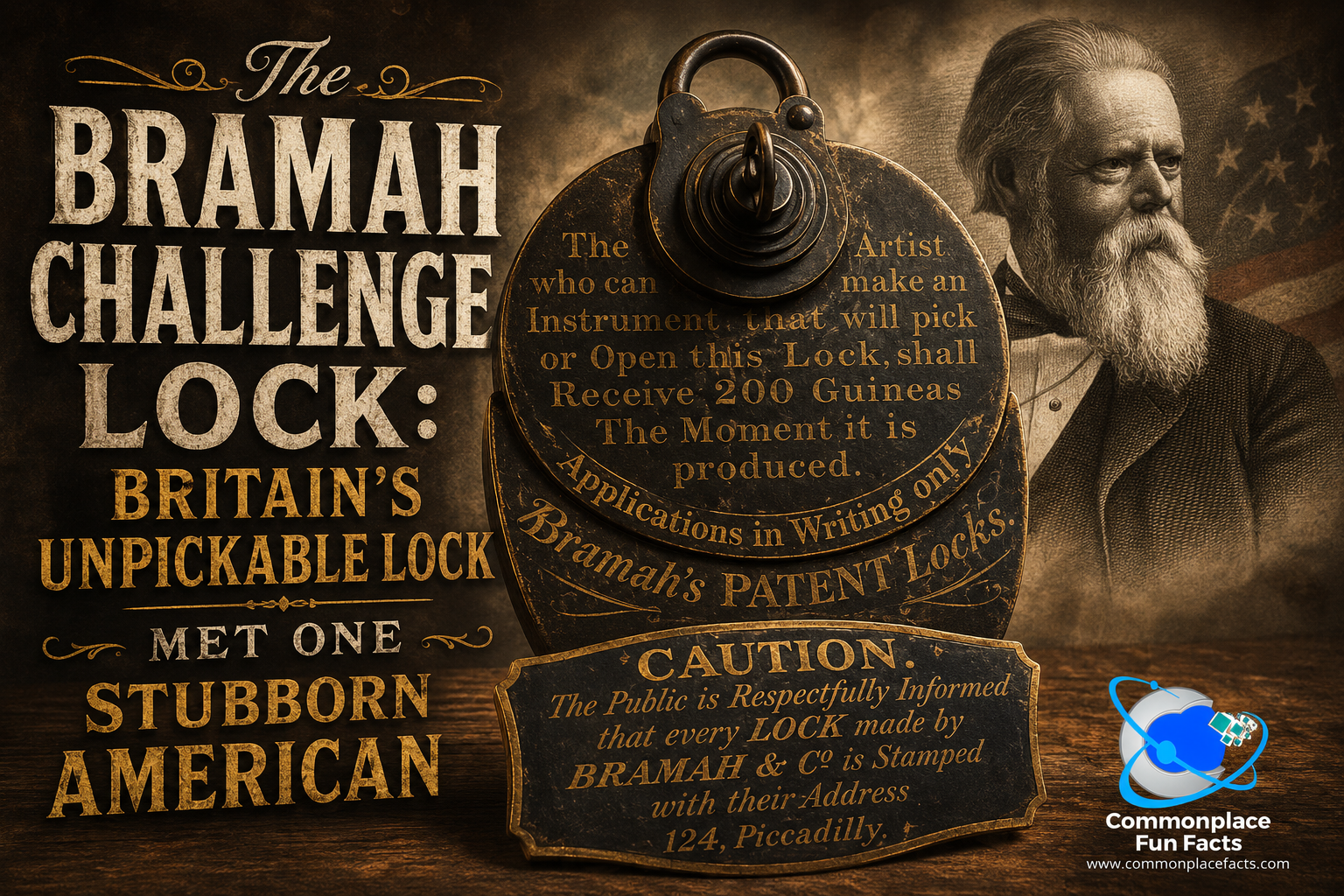

There are few things more dangerous than telling the public that something cannot be done. Somewhere nearby is a man with specialized tools, an alarming amount of patience, and a personal dislike of the word impossible.
Joseph Bramah unknowingly arranged a posthumous demonstration of this principle when he displayed an “unpickable” lock in his London shop window and offered 200 guineas to anyone who could open it. For roughly six decades, the challenge went unanswered. The lock sat there, silently radiating confidence while generations of Londoners walked past and declined to humiliate themselves.
Then, in 1851, an American locksmith named Alfred Charles Hobbs arrived in London.
Hobbs did not believe in unpickable locks. More importantly, he had crossed the Atlantic carrying tools and apparently had nothing else scheduled for August.
Contents
Joseph Bramah Builds a Better Lock
Joseph Bramah was the sort of inventor who looked around at ordinary objects and concluded that nearly all of them were being made incorrectly.
Born in Yorkshire in 1748, Bramah began his working life as a carpenter before moving to London and becoming one of the great mechanical inventors of the Industrial Revolution. He improved the flushing toilet, developed a machine for numbering banknotes, invented a beer pump, and created the hydraulic press.

In other words, Bramah helped humanity secure its valuables, move heavy machinery, brew beverages, and dispose of the consequences. It was a remarkably comprehensive career.
In 1784, he patented a new kind of lock. Most locks of the period depended on wards, levers, or other internal obstacles that the correct key had to navigate. Unfortunately, many could also be opened with skeleton keys or manipulated by anyone who possessed the right tools, knowledge, and flexible attitude toward property rights.
Bramah’s design was different. It used a cylindrical key with a series of slots cut to varying depths around its end. When inserted, the key pressed a group of internal sliders to precise positions. Only when every slider was properly aligned could the lock turn.
The principle was simple enough to explain and fiendishly difficult to defeat. A wrong key might move some sliders correctly, but “some” is not a particularly helpful number when a lock requires “all.” It is the same distinction that separates remembering most of your password from actually accessing your bank account.
Bramah opened a lockmaking business at 124 Piccadilly and recruited a gifted young mechanic named Henry Maudslay. Maudslay was only about eighteen when Bramah hired him, but he possessed the precision-engineering skills needed to turn Bramah’s design into an extraordinarily sophisticated lock.
The resulting device contained eighteen sliders and a matching key of fearsome complexity. It was not so much a padlock as a small metal bureaucracy. Everything had to be submitted in the correct order, at the correct depth, to the correct department, or nothing moved.
The Challenge Lock
By about 1790, Bramah was sufficiently confident in his creation to place it in the window of his Piccadilly shop. Beside it appeared a black placard bearing a challenge in gold lettering:
“The artist who can make an instrument that will pick or open this lock shall receive 200 guineas the moment it is produced.”
The word artist referred to a skilled mechanic rather than a watercolorist, although after several unsuccessful days either profession might have produced essentially the same result: a grown man staring at an object while questioning his life choices.
The promised 200 guineas equaled £210 in 1851—roughly £38,000 in 2026 purchasing power, although comparisons across 175 years are necessarily approximate. This was not a commemorative plaque and a polite handshake. Bramah had placed a genuinely painful amount of money in his shop window and invited the world to take it.
Year after year, the Challenge Lock remained in the window. People examined it. Locksmiths studied it. Presumably, a few overly confident gentlemen went home, made curious little tools, and eventually developed headaches.
Joseph Bramah died in 1814, but his sons continued the business, and the lock continued issuing its silent challenge. Decades passed. Britain built an empire, fought Napoleon, crowned Queen Victoria, and developed a national confidence that its locks were as dependable as its navy and considerably less likely to get seasick.
Then came the Great Exhibition of 1851.
The American Arrives
Alfred Charles Hobbs was born in Boston in 1812. He became a locksmith, inventor, and expert salesman for the New York firm of Day & Newell, which manufactured a sophisticated security device known as the Parautoptic lock.

Day & Newell sent Hobbs to London to promote its products at the Great Exhibition, the enormous celebration of industry, invention, and Victorian confidence held inside the Crystal Palace.
The exhibition displayed machinery, textiles, scientific instruments, manufactured goods, artwork, and nearly every other object the world could produce and Britain could arrange beneath an astonishing quantity of glass.
Hobbs’s official assignment was to sell American locks. He quickly recognized that the most effective way to advertise his employer’s product was not to explain why it was good, but to demonstrate that the competition was vulnerable.
This remains a popular marketing strategy, although modern companies generally use comparison charts rather than publicly dismantling a rival’s sense of self-worth.
British manufacturers regarded two locks as especially secure: the Bramah lock and the Chubb Detector lock. One contemporary description claimed that Bramah and Chubb were considered “quite as impregnable as Gibraltar.”
Hobbs heard that statement and said, “Challenge accepted.”
Hobbs Picks the Chubb Detector Lock
The Chubb Detector lock had been patented by Jeremiah Chubb in 1818. Its great innovation was that it did not merely resist picking. It could detect an attempted intrusion and jam itself, thereby alerting the owner that someone had been probing around where he had no business probing.

It was the mechanical equivalent of a homeowner who not only catches you opening the medicine cabinet but locks the bathroom door and announces what you were doing to everyone downstairs.
On July 21, 1851, Hobbs notified Chubb & Son that he intended to attempt opening one of their locks the following morning. The lock was attached to the iron door of a strongroom in Westminster that had once been used to store valuable railway papers.
The Chubb company was invited to attend. No member of the firm came, although a representative was reportedly sent to observe, presumably to gloat over the invevitable failure.
On July 22, witnesses watched Hobbs open the six-tumbler Chubb lock in twenty-five minutes. When asked to lock it again using his instruments, he did so in another seven minutes.
The lock had taken decades to build its reputation and approximately the length of a leisurely lunch to lose it.
Chubb disputed whether the demonstration had been fair, which was understandable. When a man opens your supposedly impregnable lock before noon, the afternoon is usually devoted to locating technicalities.
Hobbs, meanwhile, turned his attention to the bigger prize waiting in the Piccadilly shop window.
“Is That a Real Lock?”
A later account of Hobbs’s life describes him entering the Bramah shop and asking an employee whether the Challenge Lock was real.

The employee assured him that it was. Hobbs asked to examine it and, without immediately identifying himself as the American who had just caused a national lock-related disturbance, began testing parts of the mechanism with his penknife.
The employee became understandably concerned. There are few reassuring explanations for a stranger prodding a high-security lock with a knife while insisting that he is merely curious.
Hobbs eventually revealed his identity and announced that he wanted to accept the challenge. The Bramah company hesitated, and the parties disagreed about precisely what the wording on the sign required.
The placard promised the money to anyone who could produce “an instrument” capable of opening the lock. Hobbs intended to use several instruments and spend as much time as necessary studying the mechanism. Bramah’s representatives argued that this was not what Joseph Bramah had originally contemplated.
Hobbs’s position was essentially that the sign had been hanging in public for roughly sixty years and was a little late to start adding conditions.
The dispute attracted newspaper attention. Eventually, Bramah agreed to let Hobbs proceed under rules established by three arbitrators: engineer George Rennie, Professor Edward Cowper of King’s College London, and Dr. J.R. Black of Kentucky.
The Rules of the Challenge
The Challenge Lock was removed from the window, enclosed in a wooden block, and fastened to a door. The screws were sealed so Hobbs could not take the lock apart. Only the keyhole and hasp remained accessible.
Whenever Hobbs stopped working, the keyhole was covered and sealed. The original key was sealed separately and would not be used until the attempt ended. If Hobbs opened the lock and the original key still operated it afterward, that would prove he had succeeded without damaging the mechanism.
The rules were careful, elaborate, and unmistakably British. Hobbs could attack the lock, but first everyone needed to complete the appropriate paperwork and determine who would be responsible for the wax seals.
Hobbs began on July 24, 1851.
Fifty-One Hours of Extremely Patient Annoyance
Opening the Bramah lock was nothing like forcing an ordinary padlock with a crowbar. Hobbs had to manipulate eighteen separate sliders, each of which needed to be positioned at exactly the right depth.

He used small, specially made instruments to apply pressure, probe the sliders, and measure their positions. Each day, he recorded whatever progress he had made so he could resume the next session without starting entirely from scratch.
The lock also contained false notches designed to mislead anyone attempting to pick it. Hobbs could align all eighteen sliders, feel the cylinder begin to move, and then discover that the mechanism had politely guided him into a mechanical dead end.
At that point, he had to begin again.
This is the sort of experience that causes ordinary people to throw an object across a room. Hobbs continued calmly, possibly because the object was securely attached to a door and surrounded by witnesses.
On his fifth visit, he reportedly succeeded in aligning the mechanism well enough to begin turning the cylinder. Then the tool he was using slipped.
For anyone who has ever lost an hour of work because a computer failed to save a document, this may be the most relatable moment in nineteenth-century engineering history.
Hobbs had to realign the lock and manufacture a stronger instrument. He returned to the task, working in sessions over the next several weeks.
Altogether, he spent fifty-one hours with the lock over sixteen working days. On August 23, he finally opened it.
The lock that had defied challengers for generations stood open.
Did Hobbs Really Pick It?
Opening the lock was only the first step. Hobbs still had to prove he had not damaged it.
He locked and unlocked the padlock with his instruments in front of the arbitrators and representatives of the Bramah company. The sealed original key was then produced and tested. It still operated the lock normally.
The arbitrators unanimously concluded that Hobbs had fairly opened the Challenge Lock without injuring it. On September 2, they awarded him the 200 guineas.
Bramah & Co. paid the prize, although not without pointing out several reasons why everyone should remain impressed with the lock anyway.
The particular Challenge Lock was decades old. Its sliders were iron rather than the steel used in newer models. Its keyhole was larger than necessary, and some internal components were shorter than those found in improved Bramah locks. These features had made Hobbs’s work somewhat easier.
There was also the question of whether using multiple tools over fifty-one hours truly satisfied a challenge asking for “an instrument.” A burglar, Bramah’s defenders observed, was unlikely to enjoy sixteen days of uninterrupted access to a front door while the occupants stepped carefully around him.
This was true. Hobbs had not shown that the Challenge Lock was useless. He had shown that it could be picked—the exact contingency for which the placard promised 200 guineas.
The distinction was narrow but expensive.
The Great Lock Controversy
Hobbs’s victories ignited what became known as the Great Lock Controversy. Newspapers, engineers, manufacturers, and members of the public debated whether he had really defeated Britain’s finest locks or merely exploited unusual conditions that no ordinary criminal could reproduce.
National pride also entered the discussion. Britain had invited the world to the Great Exhibition to admire its industrial superiority, only to have an American arrive and begin opening the display cases.
Hobbs’s timing could hardly have been better for Day & Newell. He had come to London to promote an American lock, and nothing promotes a security product quite like demonstrating that the other fellow’s product is secure only when you are not present.
Yet the controversy did not destroy Bramah or Chubb. If anything, the difficulty Hobbs experienced opening the Challenge Lock confirmed that it remained an extraordinary piece of engineering. It had taken one of the world’s most skilled locksmiths fifty-one hours, custom-made tools, repeated measurements, and the sort of concentration usually associated with monks illuminating manuscripts.
Most burglars would have abandoned the effort sometime during the first hour, possibly after leaving a note asking the homeowner to purchase less interesting possessions.
The Victorian Version of a Security Hacker
Hobbs was not merely showing off. His demonstrations helped establish an important principle of security: secrecy is not the same as safety.
Lock manufacturers had long worried that publicly discussing weaknesses would educate criminals. Hobbs argued that criminals were already quite capable of discovering vulnerabilities for themselves. Concealing defects merely prevented honest customers from understanding the risks.
In a treatise published after the controversy, Hobbs observed, “Rogues are very keen in their profession, and know already much more than we can teach them.”
That statement could appear almost unchanged in a modern debate about computer security. Hobbs was performing the nineteenth-century equivalent of penetration testing: identifying flaws before criminals could quietly exploit them.
Today, technology companies offer “bug bounties” to researchers who discover weaknesses in software. Joseph Bramah offered what may have been one of history’s earliest mechanical bug bounties. The principal difference is that modern companies generally do not leave the bounty in a shop window for sixty years beneath a sign daring Americans to come and collect it.
What Happened to Alfred Charles Hobbs?
Hobbs remained in England after the Great Exhibition and became a prominent lock manufacturer in his own right. He helped establish a London company that produced high-security locks and later published detailed work on the history and construction of locking mechanisms.
In 1854, the Institution of Civil Engineers awarded him a Telford Medal for a paper on the principles and construction of locks. He eventually returned to the United States, settled in Bridgeport, Connecticut, and pursued other mechanical inventions.
The original Bramah Challenge Lock also survived. It became part of the Science Museum’s collection in London, where it remains a monument to both exceptional craftsmanship and the hazards of overly confident advertising.
No Lock Is Truly Unpickable
Alfred Charles Hobbs did more than open a padlock. He punctured the comforting idea that any security system could be declared perfect and then left unexamined forever.
His success embarrassed British manufacturers, but it also pushed the lock industry to improve. Bramah and Chubb studied the weaknesses he exposed, refined their products, and continued producing formidable locks. Security advanced because someone had been willing to prove that the existing technology was not as invincible as everyone preferred to believe.
That is the real legacy of the Bramah Challenge Lock. Every lock is ultimately a contest between the person who designed it and the person who refuses to accept the designer’s confidence as evidence.
Joseph Bramah created one of the finest locks the world had ever seen. It resisted every known challenger for decades and required fifty-one hours of work from an extraordinarily skilled expert before it finally surrendered.
That is a remarkable achievement.
Unfortunately, the sign did not say, “This lock is extremely good and will waste a burglar’s entire month.” It said someone would receive 200 guineas for opening it.
Alfred Charles Hobbs opened it.
And if history teaches us anything, it is that whenever someone places a large reward beside the word impossible, an American will eventually arrive with a toolbox.
You may also enjoy…

Fermats Theorem: World’s Most Difficult Math Problem Took 357 Years to Solve
Fermats Theorem, presented by Pierre de Fermat in the 17th century, left behind an unfinished proof next to the equation xn + yn = zn. It remained unproven for 357 years until Andrew Wiles provided a proof in 1994, earning recognition as “The Most Difficult Mathematical Problem” by Guinness World Records.

Make $1 Million With Math
If you are good at math and you could use a few extra bucks, you should consider putting your skills toward the Millenium Prize Problems. On May 24, 2000, the Clay Mathematics Institute announced prizes of $1 million each for the first person to solve any of seven math problems that have stumped the experts.…

The World’s Smallest Prison Keeps Sark’s Shadiest Characters Under Lock and Key
For such a small piece of real estate, the island of Sark has proven to be a treasure trove of interest for us at Commonplace Fun Facts. As previously detailed, it was once attacked by an invasion force of one person, and the entire island is rented from the British crown for £1.79 — an…







Leave a Reply