
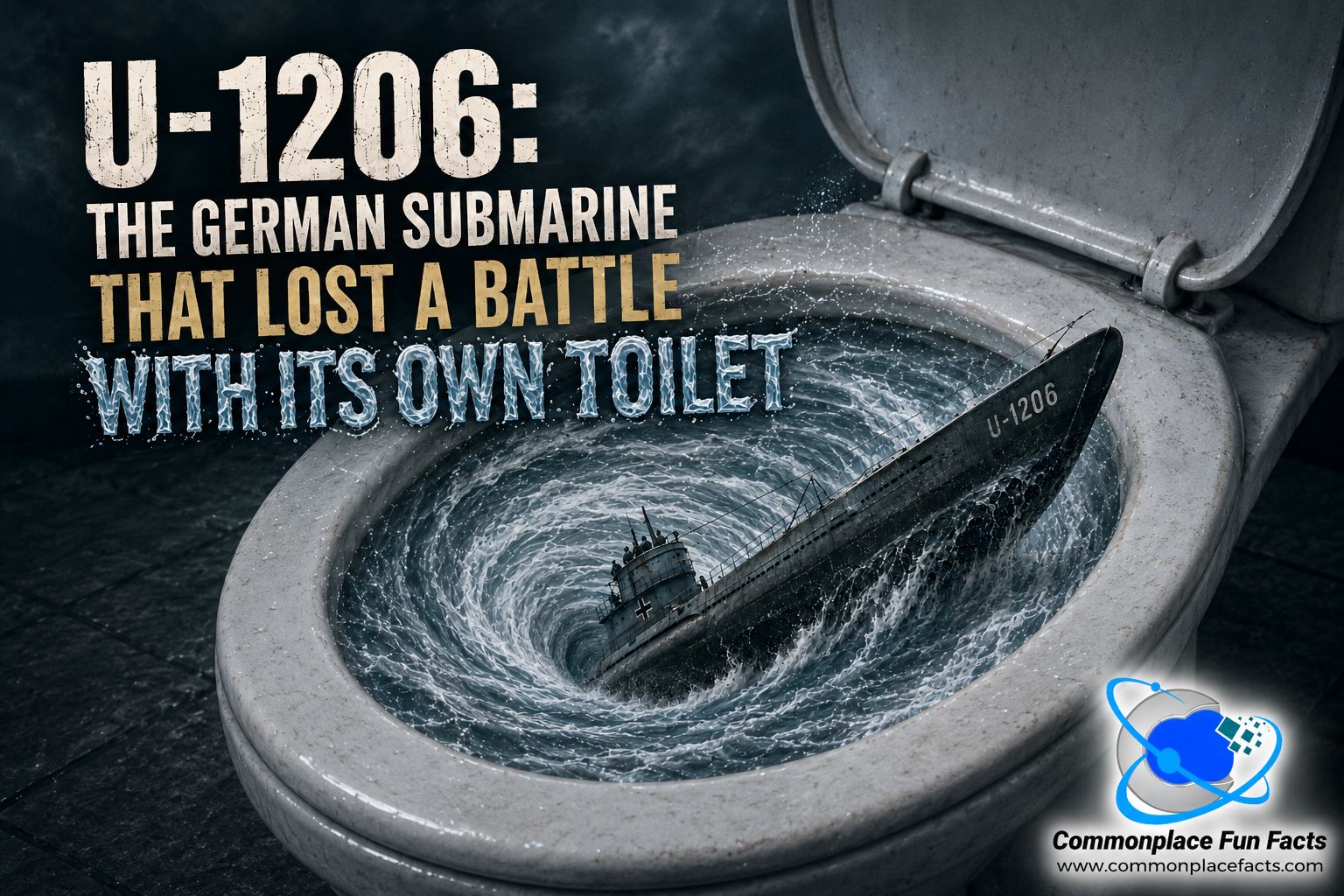

There are many perfectly respectable ways to lose a submarine during wartime. It can be torpedoed, depth-charged, bombed, mined, rammed, or stolen in an elaborate bait-and-switch by a Russian commander with a suspiciously Scottish accent. Looking at you, Sean Connery.
The German submarine U-1206 was different. Its downfall began with a toilet.
It was not flushed out by the enemy, caught in a whirlpool, or sent swirling helplessly around the North Sea before disappearing down history’s drain. No Allied destroyer delivered the decisive blow, and no torpedo sent it to the bottom. Instead, a badly behaved flushing system opened the submarine to the sea, flooded its batteries, filled the boat with poisonous gas, and forced the crew to surface in enemy waters.
From there, everything went straight down the tubes. What began as a routine visit to the head became an engineering crisis, a chemical emergency, and one of the most humiliating losses in naval history. U-1206 had survived mines, patrol aircraft, and the Royal Navy, only to discover that its most dangerous enemy had been sitting inside the boat all along, quietly waiting beneath a cold, unforgiving toilet seat.
So settle in as we plumb the depths of the story, separate fact from bathroom folklore, and determine how one of Nazi Germany’s newest submarines went from hunting Allied ships to being wiped out by its own plumbing.
Contents
Germany’s Underwater Workhorse
U-1206 was a Type VIIC U-boat, the most widely produced combat submarine design in history and the workhorse of Germany’s submarine fleet during World War II. More than 500 Type VIIC boats were built, each capable of carrying torpedoes, mines, antiaircraft weapons, and dozens of men into a steel tube with less personal space than the average office elevator.

The submarine was laid down at the F. Schichau shipyard in Danzig on June 12, 1943, launched on December 30, and commissioned on March 16, 1944. It measured approximately 220 feet (67 meters) long and displaced about 769 tons while surfaced and 871 tons while submerged.
When U-1206 entered service, it initially operated as a training vessel under Oberleutnant zur See Günther Fritze. Command later passed to 27-year-old Kapitänleutnant Karl-Adolf Schlitt.
The submarine eventually received a snorkel, allowing it to run its diesel engines and recharge its batteries while remaining mostly submerged. It also received one of the German navy’s latest technological improvements: a toilet that could be flushed at considerable depth.
One of these innovations extended the submarine’s ability to remain hidden. The other would make remaining hidden unexpectedly difficult.
The Surprisingly Difficult Problem of Submarine Plumbing
Ordinary household toilets rely heavily on gravity and on the comforting assumption that the room surrounding them is not under several atmospheres of external water pressure. A submarine toilet has no right to make either assumption.

At shallow depths, early U-boats could discharge waste overboard through comparatively simple systems. At greater depths, however, the pressure outside the hull became much stronger than the pressure inside. Opening a direct route to the sea under those conditions did not encourage waste to leave the submarine. It encouraged the North Sea to come inside and inspect the facilities.
Other navies commonly relied on holding tanks, keeping waste aboard until it could be expelled safely. This worked, but holding tanks consumed valuable space and added weight. Innovative German naval engineers developed a high-pressure system capable of ejecting waste directly into the sea while the boat remained deep underwater.
The system worked somewhat like a small airlock. Waste passed from the toilet bowl into a sealed chamber. Valves then isolated the chamber from the submarine’s interior. Compressed air pressurized it sufficiently to overcome the water pressure outside, and another valve released the contents into the sea.
It was clever. It saved space. It allowed the crew to use the toilet without bringing the submarine close to the surface. It also required several valves to be opened and closed in precisely the correct order.
Operating the system was complicated enough that designated crewmen received special instruction in its use. Popular accounts have transformed these sailors into full-time “toilet specialists,” which may overstate the prestige of the position but accurately conveys the problem: flushing the toilet aboard U-1206 was not necessarily a task to be attempted through confidence, intuition, or memories of having watched someone else do it.
Anyone who has ever tried to program a thermostat—or teach a boy that flushing is the final step of using a toilet rather than an optional bonus feature—can already sense where this is going.
The First—and Last—Combat Patrol
On April 6, 1945, U-1206 left Kristiansand, Norway, on its first active combat patrol. The assignment was already grim.
By this point, Germany’s once-feared U-boat campaign was collapsing. Allied radar, sonar, aircraft, escort vessels, intercepted communications, and improved antisubmarine tactics had turned the Atlantic into an increasingly inhospitable workplace for German submariners. Germany would surrender in Europe little more than a month later.
Nevertheless, U-1206 headed toward the eastern coast of Scotland in search of Allied shipping. It would spend nine days at sea, sink no ships, and encounter no target more dangerous than its own plumbing.
On April 14, the submarine descended to approximately 200 feet, about eight to ten miles off Peterhead, Scotland, while the crew attempted to repair its malfunctioning diesel engines. Because the diesels could no longer recharge the batteries through the snorkel, the condition of those batteries had become especially important. This was unfortunate because they were located directly beneath the forward toilet compartment.
Naval architects presumably had reasons for this arrangement. The Tidy Bowl Man was not consulted, however.
Who Flushed the Toilet?
This is where the story divides into two versions.
In the famous version, Captain Schlitt used the forward toilet and attempted to operate the flushing system himself. When the complicated sequence of valves proved beyond him, he summoned the trained crewman responsible for the apparatus.

The specialist arrived, assessed the situation, and opened the wrong valve. Instead of ejecting the toilet’s contents into the sea, the system allowed seawater—likely accompanied by everything that had been intended to travel in the opposite direction—to blast into the compartment.
It is a wonderfully memorable account. It has appeared in books, articles, television programs, and countless online retellings. It also has one significant problem: Captain Schlitt told a different story.
In Schlitt’s account, the diesel engines were malfunctioning, and he was in the engine room helping with repairs when word arrived that water was entering the forward section. He said a mechanic had been working on the outboard vent for the forward toilet and suggested that a faulty indicator may have given an incorrect reading about whether the outer valve was open or closed.
In other words, Schlitt maintained that he was nowhere near the toilet and had not touched it. He was in an entirely different compartment, surrounded by witnesses and engaged in responsible captain-like activities.
This may be perfectly true. It is also precisely the sort of account one might expect from the only U-boat commander in history required to explain to his superiors how a bathroom incident cost him a submarine.
No surviving primary account conclusively establishes that Schlitt personally initiated the trouble. The safest conclusion is that something went disastrously wrong while the forward toilet’s discharge system was being operated or repaired. A valve opened when it should have remained closed, allowing the sea to enter the submarine.
Whether Schlitt was occupying the captain’s seat or the toilet seat at the time is one historical question best left unflushed.
From Plumbing Emergency to Chemical Attack
Under approximately 200 feet of water, the leak was not a gentle drip. The pressure drove seawater into the boat with considerable force. The crew struggled to stop the flooding, but the water spread downward into the battery compartment.
That transformed an embarrassing plumbing failure into a deadly chemical emergency.
The submarine’s lead-acid batteries contained sulfuric acid. When seawater reached the damaged battery system, the resulting reactions released toxic chlorine gas. Chlorine attacks the eyes and respiratory system and can become fatal in a confined space—which describes nearly every location aboard a submerged submarine.
The crew could not simply open a window.
With water flooding the boat and chlorine gas spreading through it, Schlitt ordered an emergency ascent. The crew blew the ballast tanks and used what power remained to bring U-1206 to the surface.
It also left the submarine exposed on the surface approximately nine miles off the Scottish coast.
Possibly the Worst Place to Surface
Once above water, the crew began ventilating the submarine and trying to clear the chlorine gas. Later accounts frequently say British aircraft spotted and bombed the U-boat. Schlitt’s own account says only that British aircraft and patrol vessels discovered them, however, and surviving records do not conclusively confirm an attack. What is certain is that U-1206 had surfaced in enemy waters at precisely the moment when it had lost the ability to dive or maneuver effectively.
Even without the British intervention, U-1206 was in desperate condition. Its engines were unreliable, its batteries had been flooded, seawater had entered the hull, and the boat could no longer dive safely. The submarine was a slow, badly shaped surface ship whose occupants had recently been poisoned by a conspiracy between their bathroom and batteries.
Schlitt concluded that escape was impossible. He ordered the destruction of classified documents and sensitive equipment before directing his men to abandon ship. The crew opened valves to flood the submarine deliberately, and U-1206 slipped beneath the North Sea.
The advanced toilet did not technically administer the final blow. The crew scuttled the boat to prevent its capture. Still, arguing that the toilet did not sink U-1206 is rather like arguing that the iceberg did not sink the Titanic because water and gravity completed the paperwork.
The Crew’s Escape
The sinking did not end the danger. The crew abandoned the submarine in rafts and attempted to reach the Scottish coast through rough water.
Records generally list four crewmen dead and 46 survivors, although the circumstances of the fourth death are inconsistently reported. Schlitt specifically identified Hans Berkhauer, Karl Koren, and Emil Küpper as the three men who died while attempting to negotiate the steep shoreline in heavy seas.
British vessels rescued many of the survivors. Fourteen men, including Schlitt, were picked up by the Peterhead fishing boat Reaper, operated by Alec John Stephen and his teenage assistant, John Smith—a convenient name that suggests to us that Doctor Who had something to do with the whole thing.
They initially believed they had encountered survivors from an Allied or neutral vessel and learned only later that their passengers were German submariners.
Several men who reached land appeared at Whiteshin Farm near Cruden Bay, cold, soaked, exhausted, and presumably unsure how Scottish civilians would receive members of an enemy submarine crew. Mary Pratt, the farmer’s wife, responded by inviting them inside and giving them tea.
It was an exceptionally British conclusion to the incident: an enemy submarine had appeared off the coast, poisoned itself with its toilet, sunk, deposited German sailors on a farm, and created an immediate need to put the kettle on.
All 46 survivors became prisoners of war. Germany surrendered in Europe on May 8, just 24 days after U-1206 went down.
Finding the Wreck
For decades, U-1206 remained on the seabed off the Scottish coast. Surveyors working on a possible route for the BP Forties oilfield pipeline detected the wreck during the mid-1970s, with early reports placing it at a depth of approximately 230 feet (70 meters).

After years of searching, the Buchan Divers team located and examined the wreck in 2012 at a depth they recorded as approximately 282 feet (86 meters). The submarine remains remarkably intact. Its conning tower is still attached, although the antiaircraft platform, guns, and periscopes were torn away by fishing gear and now lie nearby on the seabed. Its distinctive emblem—a white stork on a black shield—helped confirm the identification.
The wreck still contains evidence of its final emergency. Most of its torpedo tubes are empty, consistent with reports that the crew jettisoned torpedoes while attempting to lighten the boat and reach the surface.
Presumably, its toilet is still overflowing.
It now rests permanently in the North Sea, a monument to the risks of combining seawater, sulfuric acid, compressed air, and a flushing mechanism that seemed to require an advanced degree for operation.
Was U-1206 Really Sunk by a Toilet?
The phrase “sunk by a toilet” simplifies the chain of events, but it does not fundamentally misrepresent them.
The toilet itself did not explode. It did not tear open the hull. It did not attack the submarine with a porcelain torpedo. The failure involved the high-pressure waste-disposal system connected to the forward toilet. That failure allowed seawater to enter, which flooded the batteries, produced chlorine gas, forced an emergency surfacing, exposed the boat to British aircraft, and led to its scuttling.
Remove the toilet malfunction from that sequence, and U-1206 probably does not sink on April 14, 1945.
Remove the toilet altogether, and U-1206 probably never made it out of port.
The basic story is therefore true, although it is frequently attached to the wrong submarine. Some retellings identify U-120, a much smaller Type IIB training boat that was scuttled three weeks later, on May 5, 1945. The submarine with the fatal bathroom problem was U-1206. Even historical toilets deserve accurate attribution.
The more questionable detail is whether Schlitt personally caused the accident while trying to flush. His own account says no, while later retellings say yes. Without better evidence, we prefer to let imagination fill in the blanks.
He should also receive recognition for achieving what no Allied warship managed during U-1206’s brief career: bringing its first and only combat patrol to a decisive conclusion.
The Ultimate Warning Against Overengineering
The loss of U-1206 is often presented as a story about incompetence. It is more accurately a story about complexity.
The high-pressure toilet was not a foolish invention. It addressed a genuine military problem by allowing a submarine to remain submerged longer without devoting valuable space to waste storage. When operated properly, it was a useful piece of technology.
Its weakness was that a routine human activity depended on an unforgiving sequence of valves, pressure chambers, indicators, and compressed air. One error could open the submarine directly to the sea. Placing the batteries immediately below the system added a particularly creative second act.
U-1206 carried torpedoes, mines, antiaircraft guns, sophisticated navigation equipment, a snorkel, and dozens of trained sailors. None of those things determined its fate. The decisive mechanism was the one piece of equipment every crewman needed but nobody wanted to discuss.
History is filled with examples of mighty machines undone by tiny defects. A loose bolt can stop an engine. A faulty seal can destroy a spacecraft. A seat cushion can cause a country to lose a nuclear weapon. A poorly designed valve can sink a submarine.
And sometimes the difference between a successful military patrol and becoming one of history’s most embarrassing shipwrecks is remembering which handle to pull after using the toilet.
You may also enjoy…

In Need of Toilet Paper Alternatives? Here’s a Reason Your Goose Might Be Worried
Ever find yourself inconveniently needing quick toilet paper alternatives? We suggest the unconventional insights from Sir Thomas Urquhart, who has some interesting things to say about using the neck of a goose.

Toilets on the ISS: Clogging Up the Diplomatic Channels
How do astronauts deal with clogged toilets on the ISS? Find out here!

The U.S. Navy Uses Xbox 360 Controllers on its Submarines
At $2.6 billion, you would think there is nothing cheap about the Virginia-class submarines of the U.S. Navy. The massive subs are 114.9 meters (377 feet) long and displace 7,800 tons of water. They are armed with four 21-inch torpedo tubes, and two Virginia Payload Tubes, capable of holding 6 Tomahawk missiles each, for a…






Leave a Reply