
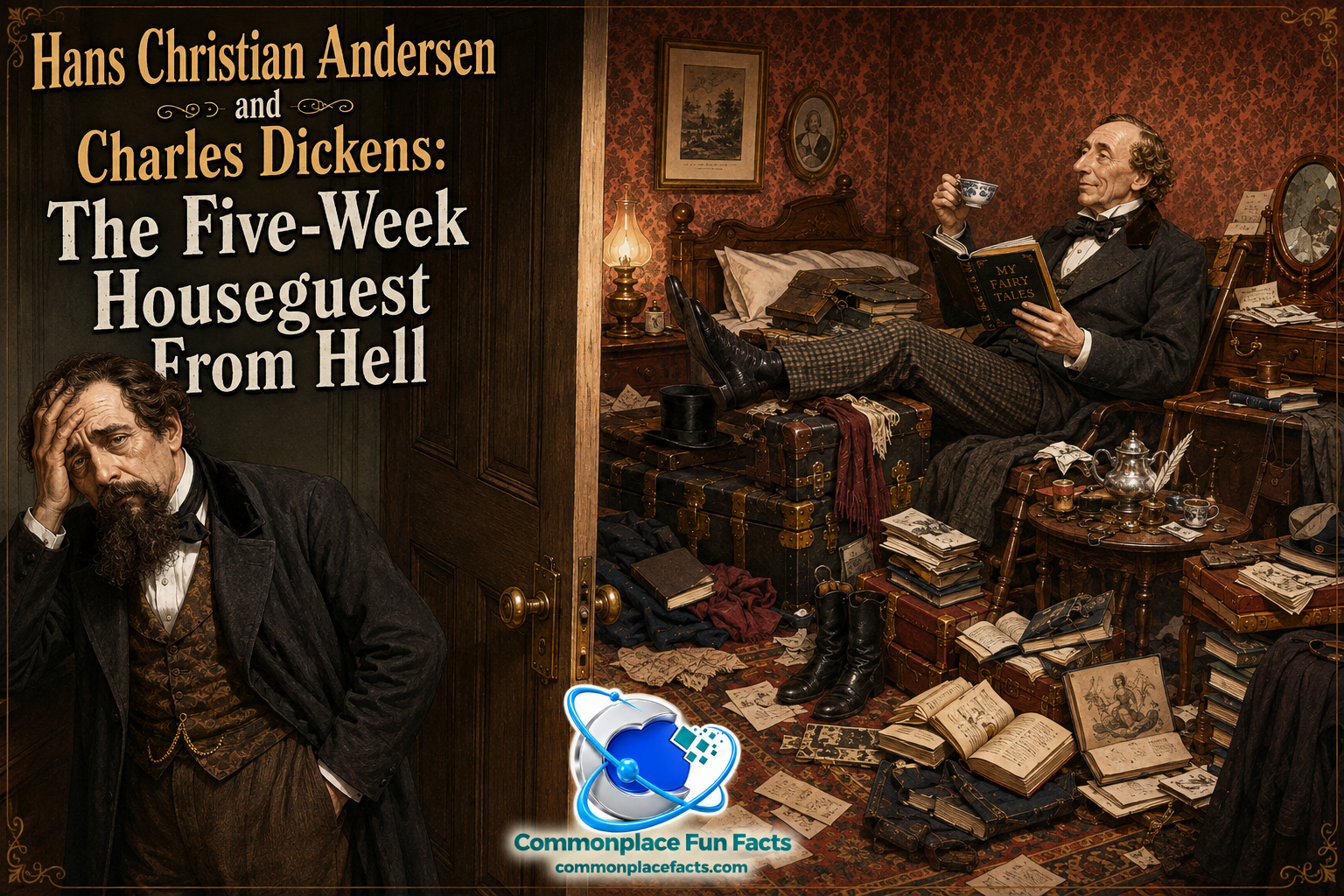

A quick note before we begin: we first tackled this story in 2022 in our article, “The Horrible Five-Week Visit That Destroyed a Friendship.” Renewed interest in the subject—and the realization that there was more to the story than we had originally explored—prompted us to take another stab at it. After all, if Hans Christian Andersen could stay five weeks after promising two, we can certainly revisit the subject four years later.
Many factors contribute to a successful friendship: common interests, intelligent conversation, a shared sense of humor, and the simple pleasure of spending time together. Some friendships thrive when two like-minded people are rarely apart. There are also friendships that are best practiced safely at a distance and exclusively by mail.
Hans Christian Andersen and Charles Dickens spent nearly a decade discovering the advantages of the latter arrangement.
The two literary giants admired each other’s work, exchanged affectionate letters, and apparently got along splendidly. Then, in the summer of 1857, Andersen came to stay at Dickens’s country home. He was supposed to remain for no more than two weeks.
He stayed for five.
By the time he finally left, Dickens had learned an important lesson about friendship, hospitality, and the wisdom of specifying a checkout date in writing.
Contents
Hans Christian Andersen and Charles Dickens: Mutual Fans
Hans Christian Andersen first met Charles Dickens in London in July 1847. By then, both men were international literary celebrities, although they had achieved fame by somewhat different routes.

Dickens had created Oliver Twist, A Christmas Carol, The Pickwick Papers, and enough memorable characters to keep English literature teachers gainfully employed for generations. Andersen was famous for stories such as “The Little Mermaid,” “The Emperor’s New Clothes,” “The Ugly Duckling,” and “The Princess and the Pea,” although calling him merely a writer of children’s fairy tales seriously undersells a man who also wrote novels, poetry, plays, travelogues, and autobiographical works.
Andersen was especially excited about meeting Dickens. In his diary, he described Dickens as the living English writer he loved most. Dickens apparently liked him, too. A surviving copy of Dickens’s The Chimes, now held by the Charles Dickens Museum, carries a dedication from Dickens to Andersen identifying Dickens as his “friend and admirer.”
The two writers corresponded for years. This worked beautifully. Andersen remained in Denmark, Dickens remained in England, and the North Sea quietly performed an invaluable service to Anglo-Danish relations.
An Invitation That Would Come Back to Haunt Dickens
At some point, Dickens suggested that Andersen should stay with him if he returned to England. Andersen eventually decided to take him up on the offer.
In March 1857, Andersen informed Dickens that he was coming. He promised that the visit would last “a fortnight at the most” and wrote, “My visit is intended for you alone,” adding the rather emotionally loaded request, “Above all, always leave me a small corner in your heart.”
This was either a touching expression of friendship or the opening dialogue from a Victorian psychological thriller. Dickens chose to interpret it as the former.
On May 12, Dickens sent Andersen detailed instructions for reaching his new country home, Gad’s Hill Place near Rochester in Kent. He assured Andersen that the language barrier would not be a problem. Andersen wrote English surprisingly well, Dickens observed, and the household collectively possessed enough French, Italian, and German to compensate for whatever difficulties arose.
“So I am not in the least afraid of our failing to be talkative,” Dickens confidently wrote in the letter preserved by the Hans Christian Andersen Centre.
There are sentences that improve considerably with age.
The Timing Was Already Spectacularly Bad
Andersen arrived at Gad’s Hill Place on June 11, 1857. Even if he had been the easiest houseguest in Europe, his timing would have been less than ideal.
Dickens was forty-five years old and extraordinarily busy. He had recently finished Little Dorrit, was giving public readings, organizing benefit performances, and throwing himself enthusiastically into amateur theatricals. His friend Douglas Jerrold died just days before Andersen’s arrival, prompting Dickens to help organize fundraising events for Jerrold’s family.

His home life was worse. Dickens’s marriage to Catherine Hogarth Dickens had badly deteriorated. The couple would formally separate the following year after more than twenty years of marriage. During 1857, Dickens was also performing in Wilkie Collins’s play The Frozen Deep. Later that summer, professional actresses were brought into the production, including eighteen-year-old Ellen Ternan, who would become enormously important in Dickens’s private life.
In other words, Dickens already had marital problems, professional obligations, bereavement, theatrical productions, fundraising responsibilities, nine children at home, and assorted emotional complications occupying his attention.
What he clearly needed was an internationally famous Danish author moving into the guest room.
Day One: About That Shave…
According to later Dickens family recollections, Andersen began testing the limits of hospitality almost immediately.
On his first morning, Andersen reportedly explained that it was customary in Denmark for a male houseguest to be shaved by one of his host’s sons. There are several possible responses to being informed by a fifty-two-year-old visitor that one of your children is expected to report for facial-hair duty every morning. Dickens settled on the diplomatic option and arranged for a barber from nearby Rochester to attend Andersen instead.
The visit was approximately one breakfast old, and Dickens was already outsourcing it.
For Andersen, this may have seemed perfectly reasonable. He was a lifelong traveler accustomed to servants, hotels, aristocratic hosts, royal courts, and customs that varied considerably from country to country. Unfortunately, the cultural exchange taking place at Gad’s Hill was rapidly becoming less “international fellowship” and more “what has he asked for now?”
Charles Dickens Discovers the Limits of International Communication
The language problem that Dickens had confidently dismissed before Andersen’s arrival turned out to be more substantial than anticipated.
Shortly after Andersen left, Dickens wrote to former British prime minister Lord John Russell with a description of his guest’s linguistic talents. According to Dickens, Andersen spoke French “like Peter the Wild Boy” and English “like the Deaf and Dumb School.” Dickens’s eldest son, Charley, tried communicating with Andersen in German and reportedly concluded that whatever Andersen was speaking, German was innocent of all charges.
Dickens even joked that Andersen’s translator was prepared to swear he could not speak Danish.
This was obviously comic exaggeration. Andersen was, after all, one of Denmark’s most important writers, which would be a difficult profession to sustain without at least passing familiarity with Danish. Still, Dickens’s July 27, 1857, letter leaves little doubt that conversation had not flowed with quite the effortless international sophistication he had predicted in May.
Hans Christian Andersen Nearly Falls Victim to a Completely Imaginary Crime
The same letter contains one of the best surviving stories from the visit.

While traveling through London by cab, Andersen noticed that his driver was taking an unfamiliar route. The sensible explanation was that the driver knew a shortcut. Andersen apparently preferred the more exciting possibility that the cabbie intended to rob and murder one of the most famous writers in Europe.
Andersen responded by concealing his valuables.
This was not limited to slipping his wallet somewhere discreet. According to Dickens, Andersen stuffed his watch, money, penknife, pencil case, newspapers, railway timetable, snuffbox, and various other possessions into his boots.
The thought process here is magnificent. A hypothetical robber prepared to commit murder would presumably search Andersen’s coat pockets but then become baffled by unexpectedly bulky footwear and conclude, “Well, I suppose the newspapers got away.”
The Bad Review and the Lawn
Andersen was enormously successful, but success had not given him a particularly thick skin. Quite the opposite. Criticism could devastate him.
According to Dickens’s daughter Katey and later family accounts, Andersen received an unfavorable review during his stay at Gad’s Hill. He responded by going outside, throwing himself face down on the lawn, and weeping.
There is a temptation to treat this solely as evidence that Andersen was an exhausting drama queen, and the Dickens family certainly seems to have regarded it that way. There was more going on, however. Andersen had grown up poor, awkward, deeply self-conscious, and painfully aware of being an outsider. He had spent much of his life craving recognition while simultaneously fearing ridicule.
One of his most famous stories, The Ugly Duckling, was deeply autobiographical in spirit. Andersen knew what it felt like to be the ungainly creature everyone laughed at while waiting hopefully for the day someone noticed he was actually a swan.
Understanding this makes the lawn episode more sympathetic. It probably did not make it more convenient for the people trying to get through the afternoon.
And Then Queen Victoria Shows Up
During Andersen’s visit, he accompanied Dickens to a performance of The Frozen Deep. This was not merely a neighborhood theatrical production with three folding chairs and somebody’s uncle operating the curtain. Queen Victoria and Prince Albert attended.

Andersen was delighted when Dickens informed him that the queen was familiar with the famous Danish writer. This was understandable. Even very successful authors tend to perk up when somebody says, “By the way, Her Majesty heard you would be here and immediately knew who you were.”
The good mood apparently did not survive the social gathering afterward. Accounts of the evening describe Andersen becoming sullen when attention shifted elsewhere.
This seems to have been one of the recurring problems. Andersen admired Dickens enormously and wanted closeness, reassurance, and attention from him. Dickens, meanwhile, had the unreasonable expectation that a houseguest might occasionally entertain himself without requiring the emotional resources of a small government ministry.
A Fortnight at Most
All of these difficulties might have remained amusing anecdotes if Andersen had adhered to his original schedule.
Remember the promise: a fortnight at most.
Two weeks came and went.
Andersen remained.
A third week passed. Then a fourth. The once-anticipated social visit was quickly turning into a Danish occupation of Gad’s Hill. It entered its fifth week with no indication of becoming anything but permanent.
Benjamin Franklin is famously associated with the observation that fish and visitors begin to smell after three days. Whether Franklin originated the sentiment is another matter, but Andersen had now gone well beyond the recommended freshness date and entered territory that Franklin apparently did not consider necessary to discuss.
Dickens’s daughter Katey later remembered Andersen as “a bony bore” who “stayed on and on.” The phrase may lack the measured neutrality we generally expect from historians, but it does communicate the household consensus efficiently.
The Five Weeks That Seemed Like Ages

At last, on July 15, Andersen departed. Dickens personally took him to Maidstone and arranged the next stage of his journey toward Folkestone. Whatever his private irritation, he remained outwardly courteous to the end.
Then he went home.
According to Katey Dickens’s later recollection, her father placed a card above the mirror in Andersen’s room: “Hans Andersen slept in this room for five weeks — which seemed to the family AGES!”
The capitalization is doing admirable work there.
It was the Victorian equivalent of creating a museum exhibit commemorating a tragic disaster, with the understanding that no one is to speak about it again.
The Strange Part: Andersen Thought the Visit Went Pretty Well
Perhaps the most remarkable part of the story is that Andersen does not seem to have understood just how thoroughly he had worn out his welcome.
He certainly recognized moments of tension, but his surviving letters and his later account of the visit show that he also remembered Dickens warmly. In 1860, Andersen even published a travel sketch about his time with Dickens. The Hans Christian Andersen Centre lists A Visit to Charles Dickens in the Summer of 1857 among his travel writings.
Dickens’s assessment was rather less nostalgic.
The correspondence that had sustained their friendship for years rapidly dwindled. Andersen wrote again in August. He wrote in September. Dickens sent a restrained reply on September 2. Andersen continued trying to maintain contact afterward, but the old intimacy was gone. The correspondence database at the Hans Christian Andersen Centre records later letters from Andersen to Dickens, but the friendship never returned to what it had been before those five memorable weeks.
Andersen, apparently bewildered by the change, remained an admirer of Dickens.
In modern terminology, Dickens had ghosted him. In Victorian terminology, Dickens simply stopped answering the mail, which required substantially more determination because there were no read receipts to passive-aggressively stare at.
Did Hans Christian Andersen Inspire Uriah Heep?
There is one final twist to the story: a popular version of it gets the chronology spectacularly wrong.
For years, articles about Andersen’s disastrous stay have repeated the claim that Dickens took revenge by using his irritating houseguest as the model for Uriah Heep, the oily, obsequious villain of David Copperfield.
It is a wonderfully satisfying story. Andersen spends five weeks annoying Dickens; Andersen finally leaves; Dickens sits down at his desk, cracks his knuckles, and invents one of literature’s most unpleasant characters.
There is only one minor difficulty.
David Copperfield had already been written.
Dickens published the novel in serial form between 1849 and 1850. Andersen’s disastrous visit took place in 1857. Unless Dickens had access to a time machine — admittedly the sort of development that would make Victorian literature considerably more interesting — the five-week visit could not have inspired Uriah Heep.
There is, however, a small piece of the story that remains possible. Dickens first met Andersen in 1847, before writing David Copperfield, and some writers and scholars have suggested that Andersen’s tall, awkward appearance or mannerisms may have contributed something to Heep. That possibility is difficult to prove, and Dickens never left behind a helpful note reading, “Uriah Heep = Hans Andersen, obviously.”
What we can say with confidence is that the famous five-week houseguest disaster was not the inspiration. Sometimes historical trivia survives because it is true. Sometimes it survives because it is such a good story that nobody bothers to check whether the novel in question was published seven years earlier.
Is Five Weeks in the Country Based on a True Story?
The strange friendship between Andersen and Dickens attracted renewed attention in 2026 with the publication of Francine Prose’s novel Five Weeks in the Country.
Published by Harper on May 5, 2026, the novel is a fictionalized treatment of the real 1857 visit. It places Andersen inside the already troubled Dickens household and uses those increasingly uncomfortable five weeks to explore the writers, Dickens’s marriage, family tensions, artistic ambition, and the peculiar relationship between humiliation and creativity.
So yes, the basic event behind Five Weeks in the Country really happened. Andersen really did visit Dickens. He really did intend a much shorter stay. He really did remain for five weeks. Dickens really did complain privately about him afterward, and the friendship really did fade.
The novel supplies the interior conversations and motivations that history cannot. Fortunately, the surviving facts are bizarre enough that history did not require much assistance.
The Moral of the Story
It would be easy to reduce Hans Christian Andersen to the Houseguest from Hell, but that probably does him an injustice. He was extraordinarily sensitive, socially awkward, insecure despite his immense fame, and intensely attached to people whose affection mattered to him. The same qualities that made him difficult company may also have contributed to the emotional imagination behind stories that have endured for nearly two centuries.
Dickens was hardly uncomplicated himself. He was temperamental, relentlessly energetic, increasingly unhappy at home, and perfectly capable of being merciless when describing people who irritated him. The summer of 1857 brought together two brilliant men with very different personalities at an especially bad moment, then removed the usual protective barrier of several hundred miles.
For nearly ten years, correspondence had allowed Charles Dickens and Hans Christian Andersen to appreciate one another in carefully measured doses. Five weeks under the same roof demonstrated that some friendships work best when everyone involved needs postage.
You may also enjoy…

Did Hans Christian Andersen Base ‘The Ugly Duckling’ On a True Story?
Discover the secret royal heritage of Hans Christian Andersen. From an awkward boy bullied for his appearance to a literary legend, his life holds more mystery than his famous tales.

The Disaster That Haunted An Unlikely Hero
The weather couldn’t have been better for travel. As Charlie made his way home by train, neither he nor his fellow passengers had any clue that they were headed toward an unspeakable tragedy that would go down in history as the terrible Stapleton rail crash. It was June 9, 1865. Passengers arriving from across the…

Lincoln Gets Burned By Red-Hot Stove Story
No one appreciated a funny story better than Abraham Lincoln. Whenever he heard something that made him chuckle, he filed the story away in his memory to use again when the opportunity presented itself. Occasionally, those to whom he told the stories were not as amused as he was. Shortly after winning the 1860 presidential…





Leave a Reply