
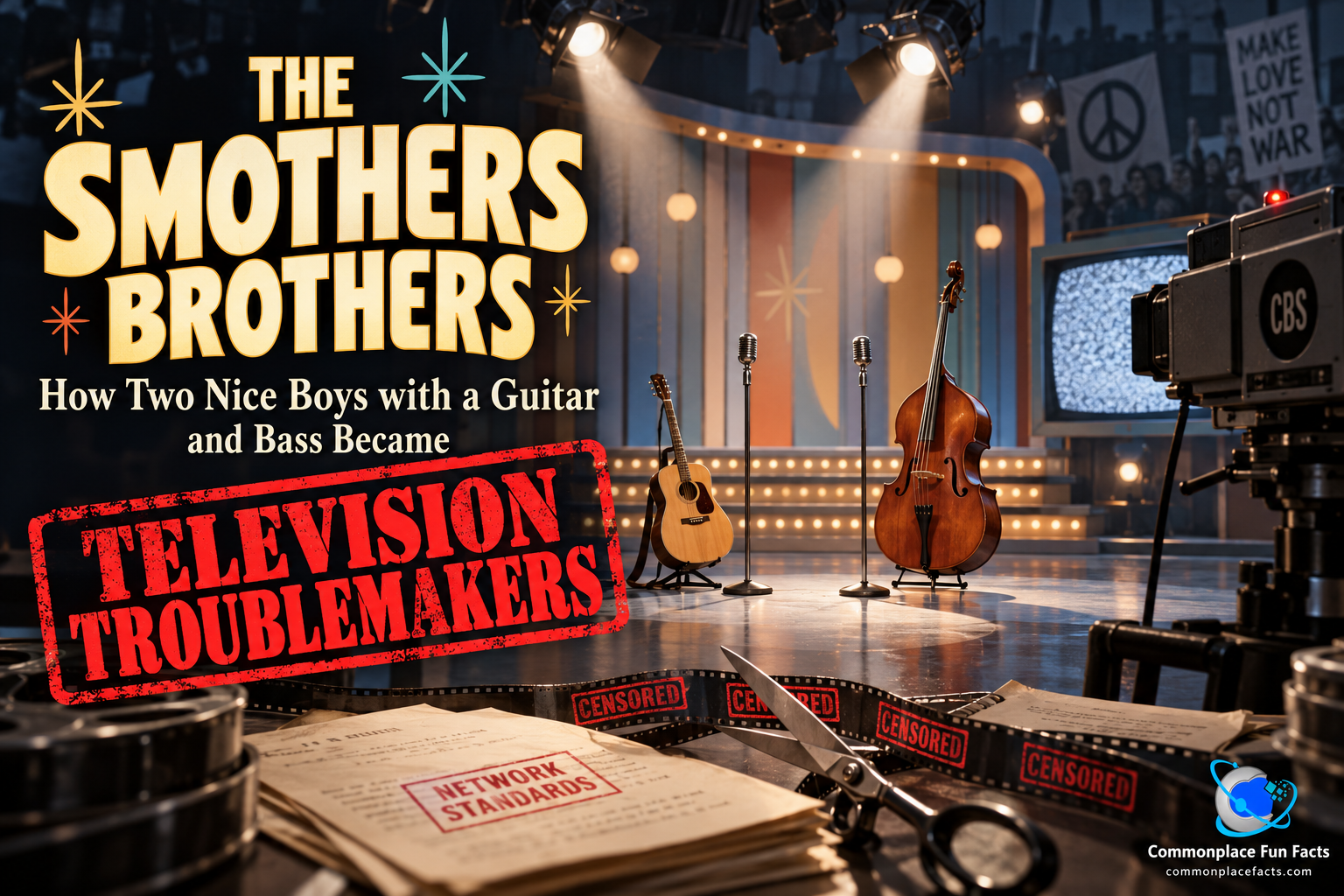

There may never have been two less threatening-looking revolutionaries than Tom and Dick Smothers.
They wore matching suits. They sang folk songs. Dick stood politely behind an upright bass while Tom played guitar and appeared to have only recently discovered that conversations were supposed to have a point. Their signature comedy consisted largely of Tom getting confused, Dick trying to straighten him out, and Tom eventually retreating to the unanswerable argument that “Mom always liked you best.”
Then, somehow, these two wholesome-looking brothers ended up at the center of one of the biggest censorship battles in American television history.
From 1967 to 1969, The Smothers Brothers Comedy Hour brought rock music, youth culture, political satire, antiwar sentiment, racial issues, religious humor, and a remarkable collection of young comedic talent into American living rooms. CBS repeatedly cut material it considered too political, controversial, sacrilegious, or simply in bad taste. Eventually, the network fired the brothers, the brothers sued, and a jury concluded that CBS had breached its contract.
That history has produced a tidy modern summary: “The Smothers Brothers were canceled because of their politics.”
There is quite a bit of truth in that sentence. There is also considerably more to the story.
Contents
Before They Became Dangerous, They Were Folk Singers
Thomas Bolyn Smothers III and Richard Remick Smothers were born in New York, Tom in 1937 and Dick in 1939. Their father, Major Thomas B. Smothers Jr., was a West Point graduate and Army officer who died in Japanese captivity during World War II. Their mother eventually settled the family in California, where the brothers attended Redondo Union High School.

Music initially interested them more than comedy. While attending San Jose State College, Tom assembled a folk group and recruited Dick. By the late 1950s, they were performing in clubs around the San Francisco area. When the third member of their group departed, the act became simply the Smothers Brothers.
That turned out to be an excellent career move, although probably a disappointing development for anyone who had already ordered stationery for the trio.
Their original act was supposed to be musical. Tom, however, had a tendency to wander off script, botch introductions, confuse facts, and argue with his brother. Audiences laughed. Dick learned that correcting Tom only made things funnier, and gradually the music became the framework around which their comedy operated.
The characters they created were deceptively simple. Dick was the competent, slightly exasperated older-brother figure, despite actually being the younger brother. Tom was the childish, insecure innocent who could derail a song by misunderstanding practically anything. One night, during an argument onstage, Tom produced the line that became their trademark: “Mom always liked you best.”
They got their first major national exposure in 1961 on Jack Paar’s Tonight Show. Television appearances multiplied, comedy albums followed, and their 1961 debut album, The Smothers Brothers at the Purple Onion, helped establish them as major performers. Their slow, character-based style owed something to earlier masters such as Laurel and Hardy and Jack Benny, another comedian who understood that sometimes the funniest thing you can do is wait a few seconds before saying anything.
By the mid-1960s, the brothers had become recognizable television personalities. Naturally, this meant someone decided they needed a sitcom.
The First Smothers Brothers Show: Tom Dies and Gets a Television Contract
In 1965, CBS debuted The Smothers Brothers Show, a fantasy sitcom created by Aaron Spelling and Richard Newton. Dick played a young publishing executive. Tom played his deceased brother, who had returned to Earth as an apprentice angel assigned to help him.
Yes, Tom Smothers began his television starring career by being dead.
The premise was not entirely unreasonable by 1960s sitcom standards. This was an era when television audiences accepted witches, genies, talking horses, hillbillies discovering oil, and suburban housewives married to advertising executives who somehow never noticed that half the neighborhood possessed supernatural powers. An incompetent angel was barely enough to get Standards and Practices out of bed.
The problem was that the sitcom did not make particularly good use of what made the Smothers Brothers funny. Their stage act depended on spontaneity, music, prolonged verbal tangents, and the peculiar chemistry between the two brothers. A conventional scripted sitcom squeezed much of that out of them.
The show lasted one season, from September 1965 until April 1966. Tom later remembered the experience unhappily, but he learned something important from it: if the brothers ever got another television series, he wanted creative control.
CBS, in a decision that someone at the network would eventually have plenty of time to reconsider, gave it to him.
The Smothers Brothers Comedy Hour Arrives
The Smothers Brothers Comedy Hour premiered on CBS on February 5, 1967. The network put it on Sunday nights opposite NBC’s Bonanza, one of the most successful programs on television. This did not suggest overwhelming confidence in its survival prospects.
Instead, the new show caught on.

The premiere even featured Jack Benny and George Burns ceremonially handing Tom and Dick their guitar and bass. It was a lovely gesture from one generation of comedians to another, although CBS executives might later have preferred that Benny and Burns retain custody of the instruments.
The basic format looked familiar. There were comedy sketches, musical guests, recurring characters, celebrity appearances, and the brothers’ established stage routines. What made the program different was the audience it began attracting and the freedom Tom Smothers intended to exercise.
The show became particularly popular with younger viewers. As the 1960s grew more turbulent, Tom increasingly believed that a comedy program aimed at those viewers should acknowledge the world they were living in.
That world included the Vietnam War, racial conflict, demonstrations, the draft, drugs, generational rebellion, political assassinations, and a growing suspicion among young Americans that perhaps the people in charge did not necessarily have everything under control.
Network variety television, on the other hand, generally preferred singers, dancers, pleasantly noncommittal jokes, and celebrities who did not require the legal department to be alerted before rehearsal.
The collision was coming.
A Writers’ Room That Looks Absurdly Impressive in Retrospect
One reason The Smothers Brothers Comedy Hour mattered was the astonishing amount of talent passing through it.

Its writing staff at various times included a young Steve Martin, Rob Reiner, Bob Einstein — later better known to many viewers as Super Dave Osborne — Carl Gottlieb, Mason Williams, and others who went on to significant careers in comedy, television, and film. In 1969, several of them were among the team that won the Emmy for Outstanding Writing Achievement in Comedy, Variety or Music, including Martin, Einstein, Gottlieb, and Williams.
Tom Smothers deliberately removed his own name from the list of writers submitted for the award because he feared that the controversy surrounding him might hurt everyone else’s chances. Nearly forty years later, at the 2008 Primetime Emmy Awards, the Television Academy gave him a commemorative Emmy recognizing the writing credit he had forfeited. Steve Martin presented it to him.
The show also provided a platform for recurring performers such as comedian and future mock-presidential candidate Pat Paulsen, singer Jennifer Warnes, bluegrass musician John Hartford, and Leigh French, whose hippie character Goldie O’Keefe delivered monologues filled with drug-related double meanings under the innocent title “Share a Little Tea with Goldie.”
Somehow, quite a few of those jokes made it past CBS.
One suspects the censors eventually watched Goldie’s segments with the concentrated expression of bomb technicians wondering which wire was the marijuana reference.
The Musical Guests Made the Show a Time Capsule
The guest list alone makes the series worth revisiting. The program featured performers including Cream, Buffalo Springfield, The Doors, Jefferson Airplane, Donovan, Simon & Garfunkel, Glen Campbell, Ray Charles, Joan Baez, Pete Seeger, and many others.
For younger viewers, this was not their parents’ variety show with an occasional rock group dropped in as bait. The music was part of the program’s identity.
Perhaps no appearance better illustrates the show’s ability to turn conventional television into barely controlled chaos than The Who’s visit in September 1967. The group performed “My Generation,” concluding with its customary destruction of musical equipment. Drummer Keith Moon had also arranged for an explosive charge inside his bass drum.
Unfortunately, the quantity of explosives appears to have exceeded the amount required for the technical theatrical effect known as “bang.”
The resulting blast singed Pete Townshend’s hair, injured Moon, startled everyone in the studio, and produced one of the more memorable musical moments in 1960s television. History recounts the spectacularly ill-advised performance here.
Tom walked back onstage after the explosion and attempted to continue hosting the program, which is impressive professionalism considering that one of his guests had just detonated a percussion instrument.
Then the Comedy Started Getting Political
The Smothers Brothers Comedy Hour did not begin as an aggressively political show. Tom later described its evolution as gradual. As events outside the studio became more difficult to ignore, the program increasingly incorporated them.
That distinction matters. The brothers had not marched into CBS headquarters in 1967 announcing plans to transform Sunday evening television into an anti-establishment bulletin. They started with a comedy-variety show. The show became more topical because America became more topical.
Vietnam was the biggest source of friction. So were the draft, civil rights, religion, drug culture, political conventions, and the widening divide between generations. Pat Paulsen delivered deadpan editorials and launched a satirical presidential campaign in 1968. Sketches mocked government and television itself. Even CBS’s censorship became material for comedy.
This was happening at a time when three networks dominated American television. There was no HBO refuge, no Comedy Central, no YouTube, no podcast, and certainly no ability to upload the segment CBS had rejected and watch it go viral before the network president reached his car.
If CBS declined to broadcast something, most Americans simply did not see it.
Pete Seeger Goes “Waist Deep in the Big Muddy”
The most famous clash involved folk singer Pete Seeger, who had effectively been blacklisted from commercial network television because of his earlier political associations.
The Smothers Brothers invited him onto their show in 1967. Seeger performed “Waist Deep in the Big Muddy,” a song about a military unit ordered by its commander to keep advancing into increasingly dangerous water. The commander ignores warnings, insists on pushing forward, and eventually drowns.
Audiences in 1967 did not require a decoder ring.
The song was widely understood as an attack on President Lyndon Johnson’s escalation of the Vietnam War. CBS refused to broadcast the performance. After the decision generated criticism, Seeger was invited back, and the song eventually aired in February 1968.
The incident established the pattern that would define the remaining life of the program: the brothers would push, CBS would cut, Tom would protest, newspapers would report the fight, and everyone would reconvene the following week to discover what fresh source of indigestion had arrived from the writers’ room.
Harry Belafonte, Joan Baez, and Material CBS Called “Political”
The Pete Seeger dispute was hardly unique. The Television Academy’s history of the show documents several instances in which CBS specifically rejected material because it regarded it as political and therefore inappropriate for an entertainment program.
In 1968, Harry Belafonte recorded a performance of “Don’t Stop the Carnival” accompanied by images of the violence surrounding that year’s Democratic National Convention in Chicago. CBS removed the segment.
Joan Baez encountered a similar problem in 1969. She introduced a song by explaining that her husband, David Harris, was about to go to prison for resisting the draft. When the program finally aired, viewers were permitted to hear that Harris was going to prison. CBS removed the explanation of why.
That produced the curious effect of informing several million Americans that Joan Baez’s husband was headed to prison while omitting the one detail that prevented them from wondering whether he had been robbing banks on weekends.
The network also blocked an appearance by pediatrician and antiwar activist Dr. Benjamin Spock, citing his criminal conviction arising from his opposition to the draft. Meanwhile, comedian David Steinberg’s mock religious “sermonettes” drew censorship because CBS considered some of them sacrilegious.
Not every dispute, in other words, was about politics. Sex, religion, drug references, and ordinary standards of taste all entered the arguments. This was an era of much more restrictive media gatekeeping generally; television’s battles had their counterparts elsewhere in American culture, including the elaborate restrictions imposed by the Comics Code Authority.
The difference was that Tom Smothers did not accept the restrictions quietly.
The Fight with CBS Becomes Part of the Show
By the third season, Tom’s battles with CBS’s Program Practices Department — the network censors, in less bureaucratically upholstered language — had become nearly as famous as the program itself.
Sometimes the absurdity became wonderfully recursive. One early sketch with Elaine May mocked overzealous movie censorship. CBS censored the sketch about censorship.
At that point, satire really has very little work left to do.

Tom complained publicly about the network. He appealed to members of Congress and the Federal Communications Commission. CBS, meanwhile, insisted that it had both a right and a responsibility to control material broadcast over its network. Executives distinguished between news programming, where political controversy belonged, and entertainment programming, where they believed different standards should apply.
The brothers thought that distinction was artificial. The country was divided over a war, hundreds of thousands of Americans were serving in Vietnam, protests filled the streets, and the 1968 presidential campaign was taking place against the backdrop of assassinations and unrest. Pretending entertainment existed in a sealed container somewhere outside all of that required increasingly impressive suspension of disbelief.
Tom later admitted that he became consumed by the fight. In retrospect, he believed his obsession with censorship sometimes came at the expense of the comedy itself. Dick, although supportive of his brother’s right to make the program, was less politically driven and sometimes urged Tom to concentrate more on being funny.
That nuance gets lost when the story is reduced to “the radical Smothers Brothers versus conservative CBS.” The brothers did not always agree with each other, much less operate as a single ideological unit. The principal struggle was increasingly about who controlled the program.
Did CBS Really Cancel the Smothers Brothers Because of Politics?
On April 3, 1969, CBS informed the Smothers Brothers that their show was finished.

The timing was peculiar. Only weeks earlier, CBS had renewed The Smothers Brothers Comedy Hour for another season. The official reason for the reversal was not that the brothers opposed the Vietnam War or embarrassed politicians. CBS said the production had violated contractual requirements by failing to provide programs sufficiently far in advance for network and affiliate review.
There really had been disputes about late delivery. CBS wanted completed programs well ahead of broadcast so its censors and affiliates could review them. Tom argued that repeated last-minute demands for changes helped create the delays and disputed whether the deadline CBS relied upon actually existed in the contract.
Contemporary observers were skeptical of the official explanation. TIME, writing shortly after the firing, noted how little credibility CBS’s stated rationale enjoyed and laid out Tom’s response: he maintained that the supposed Wednesday deadline did not appear in the contract, that the program had nevertheless been delivered to CBS’s Los Angeles office on Wednesday, and that the disputed David Steinberg segment could have been removed.
So, was this political censorship?
The first part is easy: CBS unquestionably censored political material on the program. That is not speculation. The network removed Pete Seeger’s antiwar song, Harry Belafonte’s convention segment, part of Joan Baez’s remarks concerning draft resistance, and other material precisely because executives regarded it as political or otherwise inappropriate for an entertainment broadcast.
The harder question is whether politics alone caused the cancellation.
The evidence supports a more careful conclusion. By 1969, The Smothers Brothers Comedy Hour and CBS had spent two years fighting about politics, censorship, taste, deadlines, production procedures, affiliates, and ultimately who had final control over the program. Politics was plainly central to that deterioration. The contractual dispute provided CBS with the stated basis for ending the relationship.
Whether there was direct political pressure from the Nixon administration is more difficult to establish conclusively. Producer George Sunga later told the Television Academy that he came to believe Nixon had pressured senior CBS executives Frank Stanton and William Paley, but that remains Sunga’s recollection rather than documentary proof that Nixon ordered the cancellation. Presidential displeasure with the show was certainly real, however: during the previous administration, Lyndon Johnson personally complained to CBS chairman William Paley about the brothers’ satire.
Still, saying “Richard Nixon ordered CBS to cancel the Smothers Brothers” goes further than the documentary record safely permits. The brothers were fighting CBS long before Nixon became president in January 1969. The Seeger controversy occurred during the Johnson administration, as did several other major confrontations.
Politics did not suddenly arrive in 1969 and kill the show. Politics had been sitting in the writers’ room for two seasons, drinking the coffee and making everyone nervous.
Censorship, Yes. First Amendment Violation, No.
There is also an important legal distinction hiding inside the word “censorship.”
CBS was a private broadcaster. When it cut material from its own television network, that could reasonably be described as censorship in the everyday sense of the word. It did not automatically amount to governmental censorship prohibited by the First Amendment.
The Smothers Brothers took CBS to court, but their constitutional claims failed for essentially that reason. In Smothers v. Columbia Broadcasting System, Inc., the federal court held that CBS was acting as a private party rather than as the government and therefore found no governmental or state action sufficient to support claims under the First and Fifth Amendments.
Their contract claim was another matter entirely.
In Smothers v. Columbia Broadcasting System, Inc., the federal court recorded the jury’s determination that CBS had terminated its agreement “without legal justification” and that the termination constituted a material breach of contract. Tom and Dick were awarded substantial damages, along with an additional award to their production company on a copyright claim.
Thus, one of television’s great free-speech battles ultimately produced the wonderfully American result of becoming a contract case.
The Constitution did not get them their show back. Contract law got them damages. Generations of attorneys have been surviving disappointments exactly this way.
What Happened to the Smothers Brothers After CBS Fired Them?
The cancellation did not end the Smothers Brothers, although it badly disrupted their momentum. Television in 1969 offered far fewer places to go after losing a major network platform. There was no cable comedy ecosystem waiting to pick them up, and the controversy had made them a complicated proposition for the other networks.

Tom later acknowledged that the experience affected him deeply. According to the Television Academy, he felt that he had lost his sense of humor for a time. He devoted attention to mastering the yo-yo, an apparently unlikely decision that ultimately became an enduring part of his stage act. Dick pursued auto racing and became involved in the wine business.
They also kept trying television.
In the summer of 1970, the brothers returned with an ABC variety series. It was not picked up for the fall. In 1975, they tried again on NBC with The Smothers Brothers Show. That version also disappeared during its first season.
The television landscape itself was changing. The traditional variety-show format was fading, while programs such as Saturday Night Live were beginning to occupy some of the irreverent territory the Smothers Brothers had helped open. By the time The Gong Show arrived in the later 1970s, network television had become considerably stranger than anything CBS had imagined when it first handed Tom and Dick a Sunday-night hour.
The brothers continued performing together onstage and also pursued individual work. Their partnership sometimes remained difficult — actual brothers rarely enjoy the efficiency advantages of comedy teams whose members can simply go home to separate families — but the fundamental act survived.
And Then CBS Invited Them Back
Nearly two decades after the network fired them, CBS did something unexpected.
It invited them back.
A twentieth-anniversary special aired in February 1988. The reunion brought back familiar elements from the original series, including Pat Paulsen and Goldie O’Keefe, and generated enough interest for CBS to order a new version of The Smothers Brothers Comedy Hour.
The historical irony was difficult to miss. In 1969, CBS could not get rid of the Smothers Brothers quickly enough. In 1988, CBS executives reportedly wanted them to be controversial again.
By then, however, the culture had changed considerably. Material that could provoke a network crisis in 1968 might barely raise an eyebrow twenty years later. Tom and Dick were also older and no longer interested in recreating precisely the political battles of their youth.
The revival was short-lived, but the reconciliation was significant. The two parties that had spent years litigating their breakup had reached the entertainment-industry stage of healing in which everyone agrees to make another television show.
The revival also produced an unexpected side effect: Tom Smothers helped make the yo-yo fashionable again. His largely silent “Yo-Yo Man” character, in which he performed increasingly elaborate tricks while Dick narrated with suitable solemnity, became one of the most popular features of the new show.
Tom’s routine became the most talked-about segment of the revived Comedy Hour. The brothers soon parlayed the routine into The Yo-Yo Man Instructional Video and a branded line of Smothers Brothers yo-yos. Thus, nearly twenty years after CBS had concluded that Tom Smothers was too troublesome for television, the network brought him back and helped inspire Americans to spend their free time trying to make a wooden disk walk the dog.
The Old Shows Finally Get Their Context
In the early 1990s, the original episodes received another life on the E! network. The Smothers Brothers re-edited the programs and added new introductions and interviews with performers and writers explaining the controversies surrounding them.
That format was particularly useful because the original programs had become historical documents almost by accident. A joke about the draft, a reference to the Chicago convention, or a CBS edit that had seemed immediately understandable in 1968 required explanation to audiences encountering the program decades later.
The brothers continued touring for years. Tom’s “Yo-Yo Man” routine became one of the enduring features of their later performances, proving that an object most people abandon somewhere around fourth grade can become a legitimate second act if one applies sufficient determination.
After more than half a century as a team, Tom and Dick retired from regular touring in 2010. They appeared together occasionally afterward and returned to the stage in 2022, including an appearance at the Great American Comedy Festival in Norfolk, Nebraska. The brothers began preparing to take a new show on tour in 2023, but those plans were canceled as Tom’s health declined; in July 2023, he disclosed that he was undergoing treatment for stage 2 lung cancer.
Tom Smothers died on December 26, 2023, at the age of 86. Dick described his brother not merely as a sibling but as a creative partner with whom he had shared more than sixty years of performance.
The Smothers Brothers’ Real Legacy
It is tempting to remember the Smothers Brothers mainly as the comedians CBS censored. That is understandable, but it shortchanges what made the censorship fight matter in the first place.
The Smothers Brothers Comedy Hour was not important merely because executives kept cutting things out of it. It was important because there was so much worth fighting over.
The program introduced mainstream audiences to young writers who helped shape American comedy. It gave national exposure to musicians who defined a generation. It blended old-fashioned variety-show entertainment with a younger sensibility and demonstrated that comedy could acknowledge the political and cultural arguments taking place outside the studio.
That approach helped establish a path later followed by Saturday Night Live, late-night television, topical sketch comedy, and generations of performers who now regard political satire as an ordinary part of television. What seems unsurprising today was considerably less so when three networks controlled nearly everything Americans watched.
Their story also complicates our modern use of the word “canceled.” The Smothers Brothers were not destroyed by an angry social-media campaign, because there was no social media. They were not prohibited from speaking by the government. They were not even thrown off television solely because of one offensive joke.
They spent several years discovering the limits of creative freedom when the people creating the program and the corporation owning the broadcast network had radically different ideas about what television ought to be.
CBS had the power to decide what appeared on CBS. Tom Smothers had an almost pathological inability to stop asking why.
Television was better for the argument.
Two Nice Boys Who Arrived at Exactly the Wrong — or Right — Time
Near the end of his life, Tom Smothers sometimes downplayed the grand historical interpretation of the brothers’ career. They were, he said, basically a comedy act that happened to arrive at what he called “the scene of the accident.”
There is something appealingly accurate about that description.
Had The Smothers Brothers Comedy Hour debuted five years earlier, it might have remained a clever variety program built around two bickering folk singers. Had it debuted five years later, its political jokes might have seemed considerably less revolutionary. Instead, Tom and Dick landed on network television in 1967, just as Vietnam, the counterculture, civil rights, generational rebellion, and political distrust were colliding with an entertainment industry still governed by standards created for an earlier America.
The result was only seventy-two episodes of the original series.
It was enough.
The Smothers Brothers walked onto CBS looking like two fellows who might entertain your parents after dinner. Two years later, they were fighting network executives, lobbying Washington about censorship, helping bring the long-blacklisted Pete Seeger back to prime-time television, and suing CBS for firing them.
All while carrying a guitar and an upright bass.
Mom would have been proud.
You may also enjoy…

The Gong Show, Chuck Barris, and the Game Show Host Who Claimed He Was Also a CIA Assassin
There are television shows that do more than entertain. They inform. They inspire. They gently elevate the human spirit and remind us of our shared dignity. The Gong Show was not one of those shows. It was loud, strange, shameless, chaotic, frequently tasteless, occasionally brilliant, and usually looked as if someone had taken a perfectly…

Movie Ratings Explained: Who Decides What’s Too Sexy, Too Violent, or Just Right?
From the Hays Code to PG-13, discover how the U.S. movie ratings system decides what’s too violent, too sexy, or just right—and why studios love PG-13 while G is nearly extinct.

The 1939 WJSV Broadcast Day: 19 Hours of Radio That Became an Accidental Time Machine
Experience September 21, 1939 through the 19-hour preserved WJSV broadcast day, from soap operas and baseball to Roosevelt and late-night swing.



Leave a Reply