
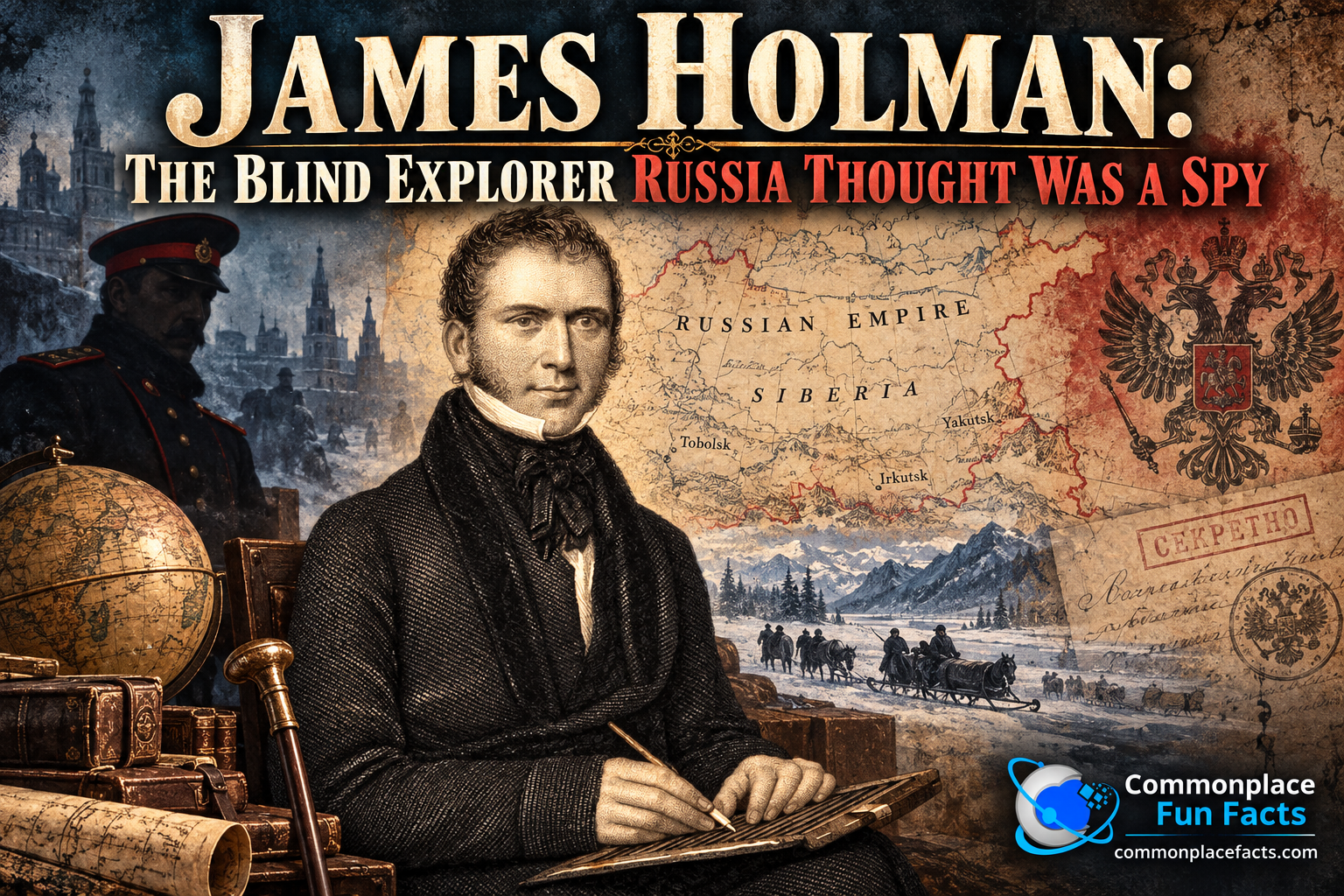

In the early nineteenth century, James Holman became one of the most widely traveled men on earth. He crossed continents, sailed oceans, ventured into Africa and Asia, published popular accounts of his journeys, earned election to the Royal Society, and produced travel writing that Charles Darwin would later cite.
He did all of this despite being completely blind.
That fact alone would have made Holman remarkable. Britain in the 1820s was not exactly overflowing with encouragement for blind men who announced that they intended to spend the next several decades wandering around the planet. Holman had been given a secure position at Windsor Castle that could have provided him with a comfortable life requiring very little travel at all.
Naturally, he found this intolerable.
Instead, the former Royal Navy lieutenant began traveling farther and farther from home, usually without a permanent guide, often through countries whose languages he did not speak, and with an apparent tendency to regard phrases such as “remote,” “dangerous,” and “perhaps you shouldn’t go there” as useful additions to an itinerary.
His first attempt to travel around the world carried him thousands of miles across the Russian Empire and deep into Siberia. He made it almost to the Chinese frontier before officials in St. Petersburg suddenly developed an intense interest in the solitary Englishman who kept asking questions and taking notes.
The Russian government said it was worried about his safety.
Holman suspected they were worried about something else.
Whatever Russia thought James Holman was doing in Siberia, sending him home accomplished very little. He would eventually find another route, circle the globe, travel an estimated quarter-million miles over the course of his life, and become famous simply as “the Blind Traveller.”
Then, somehow, history managed to lose sight of him.
Contents
James Holman Was Not Supposed to Become an Explorer
James Holman was born in Exeter, England, on October 15, 1786. According to the Royal Society’s biographical record, he entered the Royal Navy in 1798 at the age of twelve and became a lieutenant in 1807.

Then his naval career came to an abrupt end.
An illness struck Holman while he was still in his twenties. It caused severe physical problems and eventually left him totally blind. Whatever future he had imagined for himself as a naval officer suddenly seemed to have disappeared along with his sight.
Early nineteenth-century Britain was not exactly overflowing with enlightened expectations for blind people. Disability often meant dependence, institutionalization, poverty, or some combination of the three. Holman’s naval service at least provided him with an alternative.
In 1812, he received an appointment as one of the Naval Knights of Windsor. The arrangement provided housing and financial security, with religious duties attached. In practical terms, Holman had been handed something rare for a disabled man of his era: security for life.
There was only one problem.
He hated sitting still.
For Holman, a comfortable existence at Windsor Castle apparently had roughly the same appeal as being placed permanently on a very tasteful but boring shelf.
The Blind Man Who Refused to Stay Put
Holman obtained permission to leave Windsor and study medicine and literature at Edinburgh. Then he began traveling. Between 1819 and 1821 he journeyed through France, Italy, Switzerland, parts of Germany, Belgium, and the Netherlands.
He returned home and published The Narrative of a Journey through France, &c. in 1822.
The trip established two things.
First, Holman could travel independently despite his blindness. Second, Europe was nowhere near enough.
History is full of people whose disabilities failed to prevent them from doing things that supposedly sensible observers considered impossible. Commonplace Fun Facts has previously looked at Ralph Teetor, the blind engineer who invented cruise control, as well as John of Bohemia, the blind king who rode into battle.
Holman chose a different method of alarming everyone around him.
He decided to go around the world.
A Minor Detour Through Siberia
Holman left London on July 19, 1822, aboard a schooner bound for St. Petersburg. Although he presented the trip as a visit to the Russian Empire, his much larger ambition was already taking shape: if circumstances permitted, he intended to continue traveling until he had circled the globe.
His route took him from St. Petersburg to Moscow and then eastward across Siberia.

This would have been a difficult journey for anyone. Roads were primitive, distances were enormous, winter temperatures were brutal, and Holman frequently had to depend on local postilions, carts, sledges, horses, and whatever transportation happened to be available.
He also often entered regions where he spoke little or none of the local language.
And, lest this rather important detail get buried under the logistical problems, he could not see.
Yet Holman continued east for thousands of miles.
One contemporary account based on Holman’s writings describes him traveling through Siberia with little more than the assistance of local drivers. By September 1823, he had reached Irkutsk, roughly 4,000 miles east of St. Petersburg and tantalizingly close to the Chinese frontier.
That was when the Russian government suddenly became intensely concerned about his welfare.
Russia Decides the Blind Englishman Is Getting a Little Too Curious
Holman was visiting the governor-general at Irkutsk when he received surprising news. A military officer had arrived from St. Petersburg under orders from Emperor Alexander I to escort him back toward Europe.
According to an early biographical account of Holman’s travels, the governor explained that the emperor was distressed that a blind traveler had penetrated so far into Siberia without suitable assistance or knowledge of the language. His Imperial Majesty, therefore, had kindly sent an officer to protect Holman by taking him several thousand miles in the opposite direction from where he wanted to go.
Few expressions communicate official concern quite as effectively as “For your own safety, you are leaving immediately.”
Holman was unconvinced.
During his journey, he had made detailed inquiries about the places he visited and the conditions of the people who lived there. He later concluded that his questions had attracted official attention and that reports about the unusually inquisitive English traveler had reached St. Petersburg.
Later reference works were considerably less diplomatic. The 1911 Encyclopædia Britannica states plainly that Holman was suspected of being a spy and arrested before being sent back toward Europe.
Whether Alexander I personally sat at his desk thinking, “That blind Englishman is obviously an intelligence operative,” is harder to establish. Holman’s own account records the official explanation as concern for his welfare while making clear that he believed political suspicion was the real reason.
Either way, Russian hospitality had reached its natural conclusion.
Holman was going home.
Russia Accidentally Made the Return Trip Worse
If the emperor’s objective was to protect Holman from the dangers of travel, the execution of the plan had certain conceptual weaknesses.
The Russian officer responsible for escorting him west drove hard through the Siberian winter. Horses galloped for long stretches. One collapsed from exhaustion. Their sledge nearly went over a precipice. They collided with another sledge. Temperatures plunged far below freezing, and Holman’s health deteriorated badly enough that he eventually had to insist upon stopping for medical attention.
In other words, the Russian government saved the blind traveler from the hazards of traveling through Siberia by making him travel through Siberia much faster.
Holman eventually returned to western Europe and published his experiences in Travels through Russia, Siberia, Poland, Austria, Saxony, Prussia, Hanover, &c. in 1825.
At this point, a less persistent man might have concluded that attempting to travel around the world without the advantage of sight had been an interesting idea whose flaws had now been adequately demonstrated.
James Holman was not a less persistent man.
Fine. He Would Go Around the World the Other Way
In 1827, Holman tried again.
This time he did not attempt to cross Russia. His travels carried him through Africa, Asia, Australasia, and the Americas during a journey lasting until 1832. His own account survives in the four-volume A Voyage Round the World, the first volume of which is available through Project Gutenberg.

He visited places including Madeira, Sierra Leone, Fernando Po in present-day Equatorial Guinea, Ceylon, India, China, Australia, and South America. He traveled by ship, horse, cart, sledge, and foot, generally using the transportation available to ordinary people rather than moving with a lavish expedition and an entourage of servants.
Then, in 1832, James Holman returned to Britain.
He had done it.
The blind traveler whom Russia had turned around in Siberia had circumnavigated the globe anyway.
Later estimates placed Holman’s lifetime travels at roughly 250,000 miles. The precise mileage is difficult to reconstruct, so the figure is best treated as an estimate rather than as the result of a nineteenth-century odometer reading. Still, contemporary and modern accounts agree on the larger point: Holman traveled an extraordinary distance by the standards of any age, much less one in which crossing an ocean required considerably more commitment than selecting “economy plus.”
How Did a Blind Man Navigate the World?
One of the most interesting aspects of Holman’s story is the way he gathered information about his surroundings.
He relied heavily on hearing and touch and used a metal-tipped cane while moving through unfamiliar environments. Accounts of his travels describe him detecting nearby objects and spatial features through sound in ways that bear a striking resemblance to what researchers now call human echolocation.
The term is modern. Holman did not announce that he had invented a new branch of sensory neuroscience somewhere outside Moscow.
But the underlying phenomenon is real. Modern research has shown that some blind people can use echoes produced by sounds—including clicks or cane taps—to obtain information about the location, distance, size, and even characteristics of nearby objects.
That does not mean Holman possessed some supernatural substitute for sight. He developed practical ways of extracting information from sound, touch, conversation, memory, and careful observation through his remaining senses.
It was sophisticated adaptation, not magic.
That distinction is worth making because remarkable people with disabilities have an unfortunate tendency to acquire mythology once everyone finishes underestimating them. Helen Keller’s achievements accumulated their own assortment of myths and misunderstandings. Holman deserves better than being turned into a Victorian superhero whose blindness somehow ceased to matter.
It mattered enormously.
He simply learned how to work around it with astonishing effectiveness.
The Royal Society Took James Holman Seriously
Holman was not merely collecting travel stories to impress people at dinner parties.

His observations attracted scientific attention. On February 2, 1826, he was elected a Fellow of the Royal Society. His certificate of election described him as strongly attached to science and likely to become a useful and valuable member.
There is an even better endorsement.
Charles Darwin cited him.
In the 1845 edition of Journal of Researches, better known today as The Voyage of the Beagle, Darwin discussed the vegetation of the Cocos (Keeling) Islands and the remarkable distances seeds could travel across oceans. He specifically cited “Holman’s Travels” for an account of seeds, plants, and timber washing ashore, while noting that Holman had recorded the information on the authority of A. S. Keating, who had lived on the islands for twelve months.
This is an especially satisfying detail.
One of the objections eventually raised against Holman’s work was that a blind man could not possibly make worthwhile observations about distant places. Meanwhile, Charles Darwin was quietly using material from Holman’s published travels in one of the nineteenth century’s most famous scientific travel books.
Apparently nobody remembered to tell Darwin that Holman wasn’t supposed to be useful.
From Famous Explorer to Historical Footnote
Holman was famous during his lifetime. He published successful travel accounts and became widely known as “the Blind Traveller.” His journeys were sufficiently celebrated that later writers compared the geographical scope of his travels favorably with some of history’s most famous explorers.
Then his reputation faded.

Part of the problem may have been the changing nature of travel writing. Part of it was undoubtedly the persistent assumption that blindness made genuine observation impossible. A sighted explorer could describe a country and be treated as an authority. Holman could visit the same country, record detailed observations, and still face the question, “Yes, but how could he really know?”
It was an objection that confused eyesight with perception.
Holman continued traveling into later life, visiting parts of Europe, the Middle East, and North Africa. He died in London in July 1857 at the age of seventy.
By then, the man once famous simply as the Blind Traveller was already slipping from popular memory.
The Blind Explorer Russia Couldn’t Stop
James Holman’s life contains the sort of sequence that sounds suspiciously like historical embellishment.
He joined the Royal Navy as a boy. He became an officer. An illness left him completely blind. He received a secure position at Windsor Castle and promptly discovered that security bored him senseless. He studied at Edinburgh, toured Europe, wrote a travel book, and decided his next reasonable objective was crossing Siberia on the way around the planet.
Russian authorities apparently became suspicious of his motives and ordered him out.
So he tried again by another route and circled the globe.
He traveled widely enough for later writers to estimate his journeys at roughly a quarter-million miles. He became a Fellow of the Royal Society. Charles Darwin cited his published travels. And after spending much of his life demonstrating how badly other people had underestimated him, he somehow managed to be underestimated by history as well.
Imperial Russia may never have been entirely certain what James Holman was doing in Siberia.
One thing, however, should have been obvious.
Telling him to go home was not the same thing as making him stop.
You may also enjoy…

Meet Ralph Teetor: The Amazing Blind Inventor Who Revolutionized the Way We Drive
Discover the inspiring story of Ralph Teetor, the blind inventor who created cruise control and transformed modern driving. Learn how his remarkable touch, vision, and ingenuity revolutionized the way we move.

The Surprising Truth About How Much of Helen Keller’s Writing Was Really Her Own
How much of Helen Keller’s writing and success was really her own? Explore Anne Sullivan’s role, Keller’s talent, and the truth behind the legend.

Seaman the Dog: Lewis and Clark’s Four-Legged Explorer
Meet the Newfoundland dog who joined Lewis and Clark, hunted, guarded camp, survived a beaver bite, and nearly got dognapped. It’s the story of Seaman the dog, the four-footed member of a famous exploration team.



Leave a Reply