
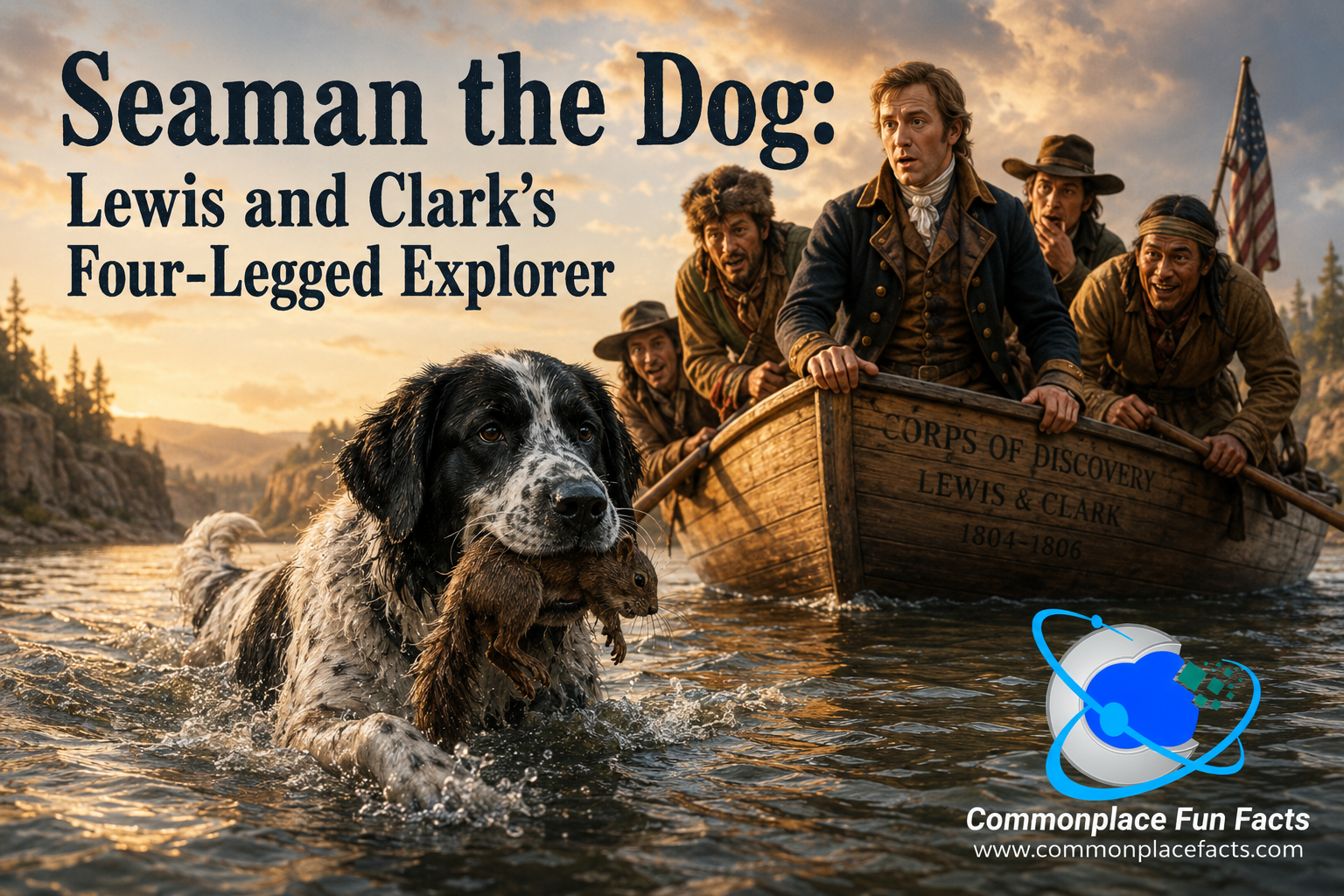

When people talk about the Lewis and Clark Expedition, they usually mention Meriwether Lewis, William Clark, Sacagawea, York, Toussaint Charbonneau, and the Corps of Discovery. This is understandable. They were the humans, and humans are very good at writing themselves into the main cast.
But there was another member of the expedition who crossed rivers, guarded camp, hunted game, impressed Native communities, survived a serious injury, and never once insisted on naming a creek after himself.
Meet Seaman the dog.
Seaman was Meriwether Lewis’s Newfoundland, and he was not there as a mascot, emotional support animal, or early nineteenth-century content creator. He was a working dog. A very large, very enthusiastic, very useful working dog.
And in the grand story of the Corps of Discovery, Seaman may be the most underrated member of the whole expedition. He did not keep a journal, which is unfortunate, because the dog’s version of events would probably have been shorter, more honest, and heavily focused on squirrels and zoomies.
Contents
Lewis Buys a Dog for the Unknown West
Meriwether Lewis bought Seaman in 1803, as he was preparing for the journey west. The dog cost him $20 (nearly $600 in 2026 currency). In other words, this was not an impulse purchase made because the puppy flashed him sad eyes from a pet shop window.
Lewis was buying equipment.

That may sound cold, especially to those of us who have looked into a dog’s eyes and immediately surrendered all claims to household authority. But in 1803, a strong working dog was an asset. The expedition would depend on rivers. It would involve boats, portages, hunting, strange terrain, dangerous animals, tense encounters, freezing weather, and the constant problem of getting enough food into exhausted men who were centuries away from a convenience store.
A Newfoundland made sense. These dogs were powerful swimmers, sturdy workers, and famously useful around water. Lewis was not buying a parlor ornament. He was buying a shaggy amphibious assistant with teeth.
Put another way, Seaman was not there to sit in the canoe and look adorable. Although, to be fair, he probably did some of that too. He was a dog, after all, and being adorable is pretty much in all of their job descriptions.
Seaman is usually pictured today as a solid black Newfoundland, looking every inch like the official dog of heroic wilderness dampness. The problem is that the journals do not actually tell us what color he was. A survey by an art historian suggests that Newfoundlands during Seaman’s era, in the early nineteenth century, were generally not painted as solid black. Instead, they were often shown as mostly white dogs with black or dark patches and freckling. So while Seaman’s true coat color remains uncertain, he was probably not the all-black dog familiar from many modern illustrations.
Seaman’s First Job: Squirrel Retrieval, Because History Is Weird and Dogs Are Predictable
Seaman enters the written record on September 11, 1803, in one of those historical details that makes you simultaneously appreciate that history was being made and dogs have always behaved like dogs.
Lewis was traveling along the Ohio River when he noticed squirrels swimming across the water. Seaman, built for water and for chasing squirrels, must have thought he had entered the Promised Land. He dove into the water, caught as many as he could, and brought them back to the boat.
Dinner was served.
Had Yelp been a thing, Lewis would have left a positive review. His journal records that the squirrels were fat and pleasant when fried. This is a sentence that belongs to a time before drive-through windows, refrigeration, and the luxury of pretending food comes from nowhere more traumatic than aisle seven.
The important point is that Seaman’s first appearance in the journals was not sentimental. He did not bound into history under a rainbow while violins played. He arrived as a practical food-gathering machine with fur.
That tells us something important about the expedition. The Lewis and Clark journey was not just maps, diplomacy, and noble silhouettes against sunset skies. It was also wet socks, improvised meals, biting insects, injuries, digestive catastrophe, and a large dog bringing squirrels to the boat like an employee who understood the assignment.
And if you are at all interested in the digestive catastrophe aspect of the expedition, be sure to read Lewis and Clark’s Laxative: How Mercury Pills Became Archaeological Evidence for more than you probably will ever want to know.
How Much for That Doggie in the Window?
By November 1803, Seaman had already attracted attention beyond the members of the Corps of Discovery. While Lewis was near the confluence of the Ohio and Mississippi Rivers, a Shawnee man offered him three beaver skins for the dog.
Lewis refused.
In his journal entry for November 16, 1803, Lewis explained that the dog was of the Newfoundland breed and that he prized him for his “docility and qualifications” for the journey. He also noted that he had paid $20 for him. Lewis’s conclusion, in his own spelling, was wonderfully direct: “there was no bargan.”
That is one of the most relatable moments in the entire expedition. A man looked at Lewis’s dog and said, in effect, “I would like to buy that excellent animal.” Lewis responded with the early American equivalent of, “Absolutely not. This dog is management.”
It also shows that Seaman was valuable in more than one way. He was useful to Lewis, interesting to others, and impressive enough that people noticed him. A Newfoundland would have been an unusual sight along much of the route, especially in places where local dogs were generally smaller. Seaman was not just another animal in camp. He was a walking conversation piece with paws the size of saucers.

Seaman the Working Dog of the Corps of Discovery
Seaman’s usefulness did not end with Ohio River squirrel procurement, though frankly that would already be enough to earn him a commemorative plaque in our book.
He hunted. He retrieved. He helped bring back game. He moved easily in water. He warned the men of danger. He gave the party another set of ears, another nose, and another body willing to hurl itself into situations where bravery was more important than deliberate contemplation.
There are accounts of Seaman alerting the party to bears and helping protect expedition members from bison. This was no small thing. Bears along the route were not quaint woodland neighbors waiting to appear on a national park sticker. They were enormous, dangerous, and inconveniently confident. Bison were not much better. A bison is basically a sofa with hooves, horns, and anger management concerns.
The expedition needed all the help it could get. Food was a daily issue. So was security. So was morale. There were long stretches when the men were exhausted, hungry, wet, cold, or being eaten alive by insects with the work ethic of tax collectors.
A dog in camp mattered.
Not in the sentimental greeting-card sense, although surely that mattered too. Seaman was a working animal in a world where work meant survival. He could retrieve meat from water. He could detect animals or strangers before humans did. He could help turn a hunt into a meal. He could keep watch while men slept.
And, because he was a dog, he could also provide companionship without launching into a speech about his own aches, pains, and hardships.
That alone may have made him invaluable.
The Beaver Strikes Back
For all his strength, Seaman was not invincible. In May 1805, he learned this the hard way from a beaver.
One of the men had wounded a beaver, and Seaman swam in after it. This was exactly the kind of task he had performed before. Retrieve the animal. Bring it back. Receive approval. Possibly eat something later. The usual employment package.
The beaver disagreed with this workflow.
It bit Seaman through the hind leg and cut an artery. Lewis struggled to stop the bleeding and feared the injury might be fatal. Clark also recorded that Lewis’s dog was badly bitten and nearly bled to death.
This was a serious moment. There was no veterinarian waiting at the next bend in the river. There was no emergency clinic, no antibiotics, no friendly person behind a counter asking whether Seaman had been there before. There was only a wounded dog, a bleeding artery, and Lewis trying to save him with whatever frontier medicine and calm panic he could assemble.
Seaman survived.
He survived rivers, wilderness, hunger, weather, bears, bison, mosquitoes, and a beaver that apparently had no interest in becoming a hat. If there were expedition merit badges, Seaman’s sash would have required structural support.
The beaver, for its part, should not be dismissed. Wounded, pursued, and cornered by a large dog, it responded with the energy of a litigant filing a counterclaim. Respect where due.
Seaman Gets Dognapped
In April 1806, during the return trip, Seaman was stolen.
That sentence sounds like either the beginning of a children’s adventure book or the start of a 19th-century John Wick story, but the actual episode was tense. The Corps was near the Columbia River when someone lured Seaman away from camp. Once the men learned what had happened, Lewis sent three armed men after him.
They caught up with the people who had taken the dog. Seaman was released and returned to the expedition.
This is one of those stories that needs a little care. The journals give us the perspective of Lewis and Clark, and that perspective was shaped by fear, hunger, fatigue, cultural misunderstanding, and the expedition’s own assumptions. Relations with Native communities along the route were often complex. The Corps depended on Native knowledge, food, trade, and diplomacy, even as the expedition represented a young American government already imagining a future in which it would claim more and more control over western lands.
So the point is not simply “someone stole the dog, cue the chase music.”
The point is that Seaman mattered enough for Lewis to react immediately and forcefully. This was not treated as the loss of a camp curiosity. It was the loss of a valuable member of the party.
For a brief moment, the Corps of Discovery became an armed search-and-rescue operation for a Newfoundland.
Which sounds excessive only if you have never had a dog. The rest of us understand completely and would like to know why Lewis sent only three men.
The Dog Nearly Lost His Name to Bad Handwriting
For years, many people thought Lewis’s dog was named Scannon.
This was not because the dog had a secret identity. There is no evidence that he also answered to “Mr. Bitey,” “Admiral Squirrelmouth,” or “The Damp Menace,” though all three are plausible.
The confusion came from handwriting.
The Lewis and Clark journals were handwritten, and handwritten manuscripts are where certainty goes to develop a nervous twitch. Letters blur. Names get misread. Editors make choices. Later writers repeat them. Before long, the mistake has put on a hat and moved into the textbook.
Some early readers interpreted the dog’s name as Scannon. That name circulated for decades. Eventually, researchers went back to the manuscript evidence and concluded that the dog’s name was Seaman. Clark and Ordway sometimes wrote it as “Seamon,” but the evidence supports Seaman, especially since Lewis named a Montana stream “Seaman’s Creek.” That is a fairly strong hint.
Imagine surviving the entire expedition only to be nearly defeated by penmanship.
Seaman battled water, weather, wildlife, hunger, theft, and insects. Then historians came along and almost renamed him because cursive had a bad day.
Even the Dog Got a Creek
The Corps of Discovery left names scattered across the map like frontier breadcrumbs. Lewis and Clark named rivers, creeks, islands, points, and other features after presidents, patrons, friends, expedition members, and occasionally whatever had just happened there, because “Hungry Creek” is what happens when cartography meets low blood sugar.

The rank-and-file men were not left out. Geographic features were named for members of the expedition, including Windsor’s Creek for Richard Windsor, Potts Creek for John Potts, Pryor’s Creek for Sergeant Nathaniel Pryor, Whitehouse Creek for Joseph Whitehouse, Howard’s Creek for Thomas Howard, Field’s Creek for Reuben Field, and Frazier Creek for Robert Frazier.
And then there was Seaman. On July 5, 1806, while traveling through present-day Montana, Lewis named a tributary of the Blackfoot River after his Newfoundland. Seaman’s Creek is now known as Monture Creek, but the original name matters. It helped confirm that the dog’s name really was Seaman and not “Scannon,” the mistaken reading that wandered through history for years like a dog that slipped its collar.
So yes, Seaman did not merely cross the continent. He made the map. That seems fair. He certainly earned it sometime between the squirrel retrievals, the beaver bite, and keeping his fellow travelers well fed. At minimum, the dog deserved a creek. Probably a pension.
Seaman Reaches the Pacific
In November 1805, after more than two years of rivers, mountains, mud, hunger, diplomacy, guesswork, and weather that seemed personally opposed to them, the Corps of Discovery finally reached the Pacific Ocean.
That moment gets remembered, naturally enough, as a triumph for Lewis, Clark, and the human members of the expedition. They had crossed from the Mississippi River system to the Pacific drainage, proved there was no easy all-water highway across the continent, and gathered enough information to keep mapmakers, politicians, scientists, and later textbook writers busy for generations.
But standing—or more likely dripping—somewhere in that same historic moment was Seaman.
This needs one careful qualification before we start handing out dog-sized medals. Seaman was not the first dog in the American West. Native peoples had dogs throughout North America long before Lewis and Clark showed up with notebooks, rifles, trade goods, and the federal government’s early habit of calling occupied places “new.” Dogs had crossed, lived, worked, hunted, hauled, guarded, and slept beside human beings on this continent for thousands of years.
What made Seaman unusual was that he became one of the first well-documented dogs associated with a Euro-American expedition to travel overland from the eastern United States to the Pacific Coast and back. That is a narrower claim, but it has the advantage of being true, which is always helpful when history is in the room checking your pockets.
By the time the Corps reached the Pacific, Seaman had already earned his place in the story. He had swum after game, brought food back to the boats, guarded camp, survived wild animals, attracted trade offers, and generally behaved like the expedition’s wettest and least argumentative employee. The men could write the journals, take the measurements, and report to President Jefferson. Seaman could not do any of that. His contribution was more direct: stay alive, stay useful, and keep coming back when called.
So when the expedition finally looked out over the Pacific, Seaman was not merely along for the ride. He had crossed a continent under his own power, one paw at a time. No speeches. No commission. No self-important declaration about destiny. Just a large Newfoundland standing at the edge of the continent, probably wet, probably hungry, and probably wondering whether anyone intended to rub his belly.
The Last Clear Mention of Seaman the Dog
The last clear journal reference to Seaman comes on July 15, 1806, during the return journey. It is not grand. It is not ceremonial. There is no stirring farewell, no patriotic tableau, no sweeping mountain vista.
It is about mosquitoes.
Lewis wrote that the mosquitoes were so terrible that they could scarcely exist. He said his dog even howled from the torture. This is one of those details that collapses the distance between the past and present. You may not have crossed the Rockies in buckskins, but you probably understand being personally attacked by insects with a strategic plan.
After that, Seaman disappears from the known expedition journals.
That silence has bothered historians and dog lovers ever since, because historians like evidence and dog lovers like closure. The journals give us neither, which is rude.
What Happened to Seaman?
We do not know for certain what happened to Seaman after the expedition.
That is the honest answer, and also the annoying one. The journals do not record his death. They do not clearly state that he returned triumphantly. They do not give us a final scene of Seaman trotting into St. Louis while everyone applauded and someone handed him a squirrel-shaped medal.

Because no death or loss is recorded, many historians think Seaman probably survived the journey. That is a reasonable inference. The men noted plenty of other injuries, deaths, losses, and difficulties. If Lewis’s prized Newfoundland had died or vanished during the expedition, it seems likely someone would have mentioned it.
But “likely” is not the same as “proved,” and that is where the story becomes murkier.
There is also a famous collar story. In 1814, Rev. Timothy Alden published a collection that included an inscription said to have appeared on a dog collar in the Alexandria Museum. The inscription identified the dog as the one who accompanied Lewis across the continent to the Pacific and back. The same tradition suggested that Seaman remained attached to Lewis and died grieving after Lewis’s death.
That is a powerful story. It is also exactly the kind of story historians approach while carrying a flashlight, a clipboard, and emotional restraint.
The collar has not survived. The museum record does not settle everything. The story may preserve a real memory of Seaman’s later life. It may also reflect the nineteenth century’s fondness for sentimental animal tales, a genre that could wring tears from a boot if given enough time.
So the safest conclusion is this: Seaman probably made it home, but we cannot say with certainty what became of him afterward.
Annoying? Yes. Honest? Also yes.
Why Seaman Matters
Seaman matters because he pulls the Lewis and Clark Expedition out of the schoolbook haze.
It is easy to talk about the expedition in big polished phrases: Jefferson’s vision, the Louisiana Purchase, the Corps of Discovery, the search for a route to the Pacific, the mapping of the West. Those phrases are true enough, but they can make the journey sound cleaner than it was. They smooth out the mud.
Seaman puts the mud back.
He reminds us that the expedition was not just a national project. It was a daily survival problem. Men needed food. Boats needed hauling. Camps needed guarding. Animals had to be hunted, retrieved, or avoided, depending on whether they looked more like dinner or death. Rivers had to be crossed. Weather had to be endured. Mosquitoes had to be suffered, because apparently some things were written into the creation order as a test of character.
He also reminds us that the Corps traveled through lands already occupied, named, used, and understood by Native nations. Lewis and Clark were not entering an empty world. They were entering a world full of people, politics, trade networks, languages, customs, warnings, hospitality, suspicion, and consequences. Seaman’s story brushes against that world repeatedly, whether in trade, curiosity, or the tense episode of his theft and recovery.
And then there is the simple fact of companionship.
That should not be underrated. A dog is not a map. A dog is not a treaty. A dog is not a scientific specimen. A dog will not calculate latitude, negotiate passage, or produce a tidy report for President Jefferson.
But a dog will stay near you when the night is cold. He will warn you when something moves in the dark. He will swim when you need him. He will bring back what he can. He will make camp feel slightly less like the end of civilization and more like a place where someone is glad you are there.
That counts.
The Good Boy of the Corps of Discovery
Lewis and Clark left behind journals, maps, observations, and a story America has been arguing over, polishing, correcting, and complicating ever since.
Sacagawea’s role became famous, then mythologized, then slowly restored to something more human and more interesting than the old classroom version. York’s presence forces uncomfortable questions about slavery, freedom, and who gets remembered as an explorer. Native nations along the route shaped the expedition at nearly every stage, though later retellings often treated them as scenery with dialogue.
And through it all padded Seaman: huge, loyal, useful, damp, and apparently irresistible to anyone in the market for an excellent dog.
He caught squirrels. He retrieved game. He guarded camp. He survived a beaver bite that nearly killed him. He was offered for, refused, stolen, recovered, misread, renamed, and finally lost in the silence of incomplete records.
He was not the most important member of the Corps of Discovery. But he may have been the least self-important, which is not nothing.
Seaman crossed the continent without writing a self-congratulatory account, demanding a statue, or claiming to have discovered places where people already lived. He simply did his job, stayed with his people, and occasionally brought dinner back in his mouth.
We all could use more of that.
You may also enjoy…

Juliana: the Heroic Great Dane With a Great Bladder
Learn about Juliana, the heroic Great Dane of World War II who defused a bomb with her bladder.

Meet Pickles — the Dog Who Saved the World Cup
Discover the remarkable true story of Pickles, the dog who saved the FIFA World Cup.

Lewis and Clark’s Laxative: How Mercury Pills Became Archaeological Evidence
Lewis and Clark carried Dr. Rush’s mercury-laced Bilious Pills, a frontier laxative that later helped archaeologists confirm Travelers’ Rest.






Leave a Reply