
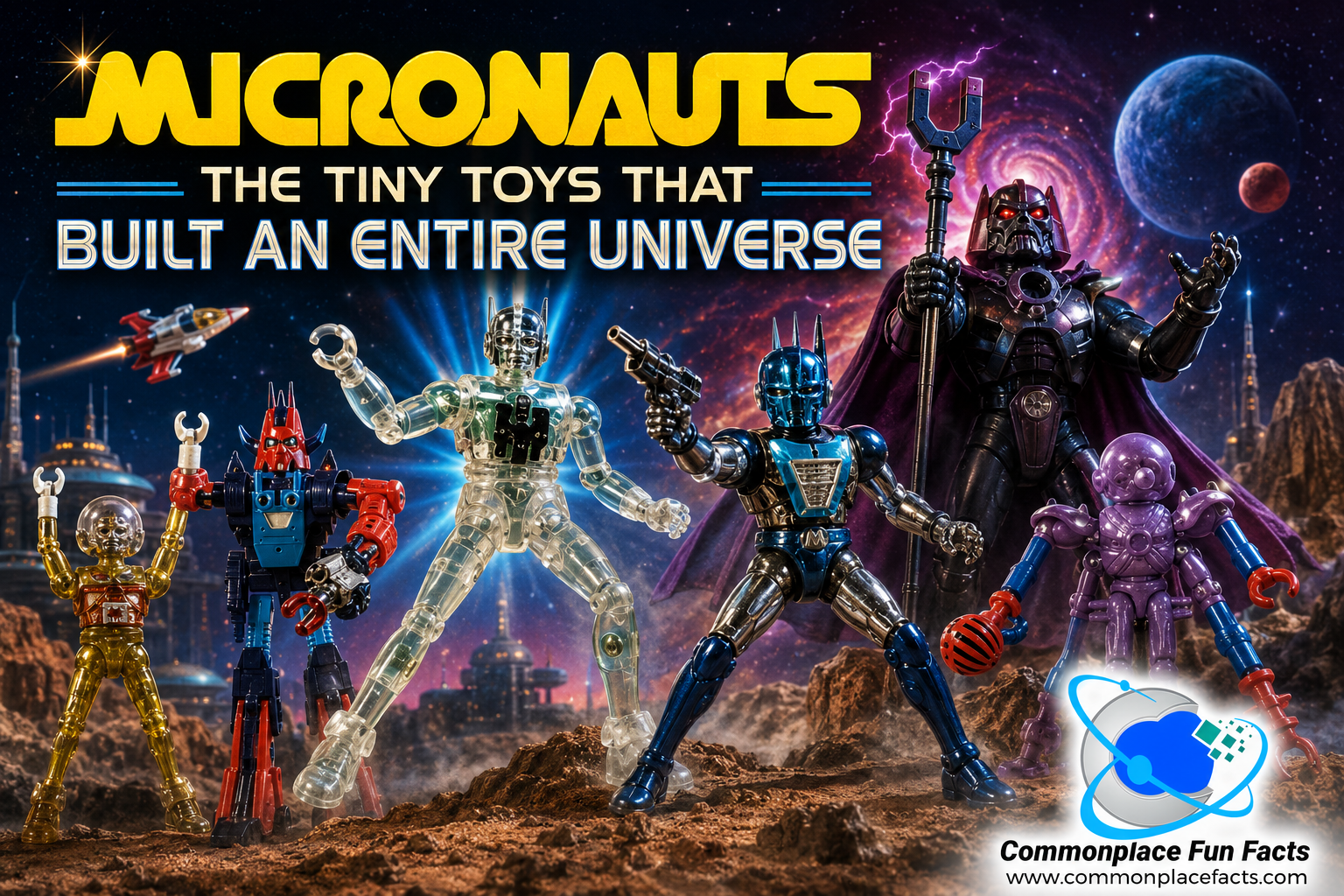

Some toys arrive with a television show, a movie, a breakfast cereal, and a licensing department powerful enough to place the hero’s face on everything from bedsheets to vitamin bottles. Micronauts arrived with chrome heads, transparent torsos, modular spacecraft, mysterious names, and very little interest in explaining themselves.
If you encountered Micronauts in the late 1970s or early 1980s, you might have found a translucent Time Traveler, an armored Acroyear, a motorized Biotron, or Baron Karza—a black magnetic tyrant who could combine with a robotic horse and become a centaur. Nobody explained why a futuristic dictator needed an evil space horse. The magnets worked. The matter was settled.
What tied the line together was not one universal gimmick. Some Micronauts had removable or interchangeable equipment. Many vehicles, robots, accessories, and playsets used a common 5-millimeter peg-and-port system. A smaller group of larger figures used magnetic joints. Still others relied primarily on articulation, unusual materials, motorized features, or designs that simply looked as though they had been smuggled backward through time from a civilization with better toys.
Not every Micronaut could be dismantled and rebuilt into something else, and most of them were not held together by magnets. But enough of the line could connect, combine, reconfigure, or share parts that Mego had good reason to advertise it as “The Interchangeable World of the Micronauts.” The interchangeability belonged as much to the world as to the individual figures.
Then Marvel Comics took these strange little toys and gave them political revolutions, genocidal dictators, body-harvesting banks, doomed civilizations, cosmic theology, and one of the most ambitious licensed comic books ever published.
Micronauts were never merely action figures. They were an entire universe sold in small pieces.
Contents
Before Micronauts, There Was Microman
The story began in Japan, where Takara introduced the Microman toy line in 1974. Takara Tomy’s corporate history still lists Microman among the company’s major products of that year. Microman grew out of Takara’s earlier Henshin Cyborg figures, themselves part of the long international family tree that began with Hasbro’s 12-inch G.I. Joe. Takara took the cyborg idea, reduced it to roughly 3¾ inches, and built a science-fiction toy system around the smaller scale.

This was not simply a matter of shrinking a standard action figure and calling it a day. Takara treated size as an opportunity. Microman figures offered an unusual degree of articulation for the era, while the broader line included translucent plastic, chrome, die-cast metal, robots, vehicles, bases, accessories, and a variety of connecting systems. A child did not necessarily own a toy that could do everything. He owned something that belonged to an increasingly elaborate domestic aerospace program.
One of the most important ideas running through Microman was the use of standardized 5-millimeter pegs and ports. These appeared throughout substantial portions of the line, particularly on equipment, vehicles, robots, and playsets, allowing many components to be moved, combined, or attached in new configurations. “Many” is the important word. The system was widespread, not universal. Takara was building a family of compatible toys, not requiring every action figure to submit to immediate orthopedic reconstruction.
Mego Brings the Micronauts to America
In the mid-1970s, American toy company Mego licensed selections from Takara’s Microman range and brought them to North America as Micronauts. Mego was already famous for its 8-inch heroes from Marvel, DC Comics, Star Trek, and Planet of the Apes. Those cloth-costumed figures often shared standardized bodies, occasionally suggesting that Batman, Mr. Spock, and Cornelius the ape all used the same tailor and orthopedic surgeon.
Micronauts were different. Some had clear bodies or gleaming metal surfaces. Others had wings, claws, drills, missiles, removable equipment, or inexplicable mechanical appendages whose purpose was not immediately obvious but clearly involved space. The Mego Museum’s history of the line shows just how broad the assortment became: figures, robots, vehicles, building sets, aliens, and enough attachments to ensure that vacuum cleaners would remain well supplied for decades.

The line became one of Mego’s major successes. Former Mego executive Neal Kublan recalled peak Micronauts business of roughly $32 million when the company itself was doing about $110 million in sales—a remarkable share for tiny plastic people whose biographies could initially have been written on the back of a postage stamp. Mego’s 1978 dealer catalog devoted roughly its first third to Micronauts.
What “Interchangeable” Actually Meant
Mego advertised “The Interchangeable World of the Micronauts,” and that slogan captured something real. It just should not be read as a technical specification applying identically to every toy in the box.

There were several different kinds of interchangeability. The 5-millimeter peg-and-port system let many accessories, vehicle components, weapons, and structural pieces connect across portions of the line. Some figures had removable hands, chestplates, weapons, backpacks, or other equipment. Certain later creatures incorporated removable parts of their own. The Micronauts Aliens, for example, carried the concept into distinctly biological territory with removable brains and arm-mounted accessories. Apparently ordinary detachable equipment was no longer sufficiently unsettling.
But there were also Micronauts whose principal appeal was articulation, appearance, motorized action, or some other specialized feature rather than wholesale reconstruction. A Time Traveler’s chestplate could be changed; that did not mean his arms were magnetically detachable. Biotron could lumber around under battery power; he was not simply a box of universal connectors that happened to have a face.
And then there were the magnets.
Magnetic construction belonged primarily to a distinct group derived from Takara’s Magnemo toys. Baron Karza and Force Commander were the stars of that particular engineering experiment. Their magnetic ball-and-socket connections allowed major body parts to be removed, exchanged, and combined with compatible components. As Inner Space Online’s history of Mego’s second Micronauts series notes, the arrival of these “Magno” figures added a new form of interchangeability to a line that already had other connecting systems.
So yes, Micronauts were famously interchangeable. No, this does not mean every Micronaut was a magnetic Mr. Potato Head from outer space. Toy history is complicated enough without giving everyone detachable legs.
Why Micronauts Felt Like Technology
Put many of the early Micronauts beside contemporary action figures, and the difference is immediate. Figures such as Time Traveler, Space Glider, and Galactic Warrior offered unusually sophisticated articulation for their size. Knees bent. Elbows moved. Waists turned. Suddenly an action figure could assume poses other than “standing at attention” and “lying face down after falling from a shelf.”
Some figures also combined plastic with die-cast metal. Galactic Warrior, for example, carried enough metal to produce a satisfying weight that suggested quality, machinery, and the possibility that dropping it on a bare foot might count as an industrial accident.
The clear plastic was especially striking. Time Traveler came in translucent colors with a chrome head and removable chestplate. The figure looked like a human body redesigned by someone who understood anatomy entirely from automobile dashboards. Light passed through it. Internal shapes showed through the torso. It appeared both futuristic and vaguely medical, as if it had escaped from a laboratory and immediately applied for work in space exploration.
Acroyear offered another kind of appeal. With metallic armor, weapons, and a design that seemed to occupy the disputed border between medieval warrior and aerospace equipment, he looked like a knight whose family had invested wisely in technology. The toy did not need a detailed biography. The name “Acroyear” and the chrome weaponry did most of the work.
Baron Karza: A Villain Held Together by Magnets
Baron Karza was the visual center of the Micronauts line. Standing about 6½ inches tall, dressed in black armor, and equipped with magnetic joints, he looked like a villain who had already conquered several planets and was now reviewing the paperwork.

His heroic counterpart was the white-armored Force Commander. Both were derived from Takara Magnemo toys and used magnetic ball-and-socket connections in their major joints. Arms and legs could be removed and rearranged, while adapters let other Micronauts components enter the proceedings. This made combat damage easy to simulate and post-battle medical ethics somewhat flexible.
That feature should not be projected onto the entire toy line. Karza and Force Commander were unusual even among Micronauts. Their magnetic construction was precisely what made them memorable.
Karza could be paired with the black mechanical horse Andromeda, while Force Commander rode the white Oberon. The compatible connection systems allowed rider and mount to be combined into centaur-like forms. It is difficult to overstate how impressive this seemed in the late 1970s. A child could begin with an armored man and a robot horse, perform several medically questionable procedures, and finish with a heavily armed mythological war machine.
The horses could be equipped with wheels because even futuristic robotic horses sometimes prefer not to walk.
Marvel would later turn Baron Karza into a dictator of almost Shakespearean persistence, but the toy had already established the essentials. Black armor. Red accents. Magnetic limbs. Evil horse. No further questions.
Robots, Pharaohs, Aliens, and Things With Glowing Brains
Biotron was another standout, for entirely different reasons. A large motorized robot with room for a Micronaut pilot, Biotron could move under battery power while its arms operated. Its appeal was not magnetic dismemberment but machinery. It was less a sidekick than a walking appliance from a household where all appliances had recently become self-aware.
Pharoid arrived with an Egyptian-inspired design and a sarcophagus-like chamber. No one was entirely sure why a pharaoh had entered the same product line as translucent time travelers and magnetic cyborgs. The correct answer was that he looked terrific, and the 1970s toy aisle was not burdened by excessive continuity supervision.
As Mego expanded the line, it developed original creatures known as the Micronauts Aliens. Antron, Repto, Membros, Lobros, Kronos, and Centaurus abandoned much of the sleek mechanical elegance of the earlier toys in favor of claws, tentacles, reptilian heads, exposed organs, and glow-in-the-dark rubber brains. Some continued the modular concept through removable brains and 5-millimeter weapon ports, but again, each toy used the idea differently. They looked like the results of a committee meeting where someone asked, “What if we just throw all of the parts together and see what comes out?”
The Vehicles Were Construction Sets Disguised as Spacecraft
If interchangeability was not universal among the figures, it became much more obvious once you wandered into the vehicles and playsets. Many Micronauts vehicles were not merely molded shells with wheels attached. They came with numerous separate components, and some required enough assembly to make opening the box feel suspiciously like the first day of an engineering apprenticeship.

The Battle Cruiser contained roughly 70 pieces and could be configured in multiple ways. The Astro Station, Mobile Exploration Lab, Galactic Cruiser, Star Searcher, and other toys made extensive use of compatible components and connectors. The Micropolis building sets went further, using geometric panels, flexible hinges, beams, domes, cranes, elevators, and control stations to let children construct their own futuristic settlements.
This was where Mego’s description of an “Interchangeable World” made the most sense. The company was not promising that every figure could exchange every body part with every other figure. It was selling an ecosystem in which figures, accessories, vehicles, robots, and playsets could interact to varying degrees. The toy box was not merely a collection. It was infrastructure.
Rocket Tubes: Public Transportation for the Microverse
And then there were Rocket Tubes, introduced in 1979 and advertised by Mego as “The Transportation System of the Future.” This was not merely another vehicle. It was an entire pneumatic transit network for Micronauts, consisting of transparent tubes, curved and straight sections, supports, transfer chambers, capsules, and a powered terminal that used forced air to propel passengers through the system.
In other words, Mego looked at an action-figure line and concluded that what it really needed was public transportation.
The Power Terminal used a blower to push or pull air through the tubes, and a control lever could reverse the airflow and therefore the direction of travel. A Time Traveler could ride inside one of the orange capsule cars, while the set also included a special rigid Micronaut designed to travel vertically through the tubes themselves. The Sears version went even further, adding a launching station that could fire small Styrofoam spacecraft when the ascending figure reached the top. Somewhere at Mego, an engineer had apparently been left unsupervised with a toy catalog and access to a wind tunnel.
The concept was magnificent. The practical requirement that all those tubes remain sufficiently airtight was somewhat less magnificent. Poorly fitted joints could reduce the air pressure and leave the Transportation System of the Future behaving more like an elaborate transparent plumbing problem. Collectors and former owners have remembered Rocket Tubes as visually spectacular but temperamental, while contemporary advertising shows just how seriously Mego took the idea.
Rocket Tubes may be the purest expression of what made Micronauts unusual. A conventional action-figure line sold cars and spaceships. Micronauts briefly attempted to provide its citizens with a mass-transit system.
That same philosophy gave Micronauts a different kind of play value. A Star Wars figure arrived with an established identity. Luke Skywalker was Luke Skywalker, even after reassignment to the backyard. A Time Traveler was much more open-ended. Hero, android, alien, prisoner, king, or merely the only person qualified to operate the Hydro Copter—the toy suggested possibilities and left most of the rest to the child.
That places Micronauts in the same broad tradition as other open-ended toys. The enduring appeal of the Radio Flyer wagon, for example, comes partly from the fact that it supplies equipment rather than a plot. Even sand managed to enter the National Toy Hall of Fame largely by letting children decide what it was supposed to become. Micronauts were considerably more expensive than sand, but the principle was much the same: provide possibilities and get out of the way.
Micronauts did not initially hand American children a finished mythology. They handed them tools, machines, figures, strange names, and—quite often—parts.
Bill Mantlo Finds a Universe Under the Christmas Tree
On Christmas morning in 1977, Marvel writer Bill Mantlo watched his son Adam open Micronauts toys. Mantlo immediately saw story potential. He later described the moment in a 1978 article for The Comics Journal, explaining that the toys’ names and appearances prompted him to begin imagining their origins almost immediately. A reproduction of that contemporary account can be read at Inner Space Online.

Mantlo developed a proposal and persuaded Marvel editor Jim Shooter to pursue the license from Mego. The resulting Micronauts #1 appeared with a January 1979 cover date. Mantlo wrote the interior story, with Michael Golden providing breakdowns and Joe Rubinstein providing finished art and inks.
This could easily have become a 22-page advertisement in which the heroes repeatedly announced the names and features of their vehicles. Licensed comics were not always expected to wrestle with tyranny, mortality, class exploitation, and the moral cost of revolution. They were expected to remind children that the Battle Cruiser was sold separately.
Working initially with Golden, Mantlo instead transformed the toy line into a sweeping space opera. Golden’s detailed machinery, alien environments, expressive characters, and dynamic layouts gave the series an identity related to the toys but never confined by them. The comic looked fast, intricate, and unfamiliar. It seemed to have more moving parts than Biotron.
The Lore of the Microverse
The story begins in the Microverse, a subatomic realm containing planets and civilizations beyond ordinary human perception. Its central world, Homeworld, consists of linked spherical habitats arranged like a molecular model. This is a clever visual idea and also the sort of place where directions probably require an advanced physics degree.
Commander Arcturus Rann returns from a 1,000-year voyage aboard the Endeavor. He has spent the journey in suspended animation, accompanied by the faithful robot Biotron, only to discover that warp-drive technology has made his thousand-year mission obsolete. It is the science-fiction equivalent of returning from a heroic expedition and learning that everyone else downloaded the map.
Homeworld has also fallen under the control of Rann’s former mentor, Baron Karza. Karza is no longer merely a magnetic toy with a horse. He is an armored tyrant who maintains power through the Body Banks, institutions that provide replacement organs and life-extending procedures for the wealthy while treating the poor as a supply of usable parts.
That is an unexpectedly grim concept for a comic inspired by toys that included removable hands and interchangeable chestplates.
Rann joins Princess Mari—better known as Marionette—along with the armored warrior Acroyear, the insectoid thief and adventurer Bug, Biotron, Microtron, and the mysterious Time Travelers. Their mission is to overthrow Karza, free Homeworld, and survive the sort of betrayals, sacrifices, resurrections, invasions, and cosmic revelations that were apparently unavoidable once Bill Mantlo got started.
The Enigma Force, represented by the Time Travelers, gave the story a mystical dimension and eventually connected with the Uni-Power that creates Captain Universe. The licensed comic did not merely borrow pieces of the Marvel Universe. It added new pieces to it.
Yes, It Looked a Little Like Star Wars
The original comic debuted less than two years after Star Wars, and some similarities were hard to miss. A group of rebels battled a black-armored dictator. There was a princess, a roguish alien, loyal robots, a cosmic force, desperate escapes, and enough spacecraft to keep the merchandising department emotionally invested.

Baron Karza looked so much like Darth Vader’s ambitious cousin that one expects him to begin family conversations with heavy breathing.
There is an important wrinkle, however: the Microman toys that became Micronauts predated Star Wars, and Mego’s first Micronauts were already underway when George Lucas’s film transformed the toy business. The resemblance became much more pronounced when Marvel built a space-opera narrative around them.
Star Wars would, of course, become one of the great merchandising phenomena in entertainment history. It also generated the sort of mythology in which even alleged production jokes acquire lives of their own, as demonstrated by the persistent story of the shoe and potato asteroids in The Empire Strikes Back.
Yet Micronauts quickly became its own thing. The Microverse was stranger, more political, and often more disturbing. The Body Banks introduced class horror. Acroyear’s loyalty to his people collided with his loyalty to the team. Rann’s heroic return was complicated by the fact that history had moved on without him. Karza was not merely conquering territory; he manipulated bodies, identities, institutions, and the fear of death itself.
Mantlo also had the freedom of the larger Marvel Universe. The Micronauts crossed into ordinary-sized reality and encountered the Fantastic Four, Doctor Strange, Man-Thing, S.H.I.E.L.D., the X-Men, Doctor Doom, Arcade, and other established characters. The size difference produced obvious adventure possibilities. A tiny spaceship crossing a Florida lawn could become an epic voyage. A child’s bedroom could become a battlefield. A normal household object could qualify as geography.
The Comic Outlived the Toys
Mego’s original Micronauts line faded around 1980 as the company faced financial trouble, an increasingly crowded science-fiction market, and the enormous success of Kenner’s Star Wars toys. Mego’s 1980 catalog was effectively the end of the original American line. The company itself entered bankruptcy soon afterward.
The comic kept going.
The original Marvel series ran for 59 issues from 1979 to 1984, plus two annuals. Artists after Michael Golden included Howard Chaykin, Pat Broderick, Steve Ditko, Keith Giffen, Butch Guice, Kelley Jones, and others. The book changed styles over time, but it continued expanding the Microverse long after the toys had disappeared from ordinary store shelves.
Marvel then launched Micronauts: The New Voyages, written by Peter B. Gillis with artwork initially by Kelley Jones. That series ran for 20 issues from 1984 to 1986 and sent the surviving characters into a more exploratory and philosophical phase. By then, Micronauts had traveled an impressive distance from the toy aisle. A product line involving detachable accessories had acquired theology.
The Licensing Maze Swallows the Microverse
That success produced a problem familiar to anyone who has spent too much time examining intellectual-property history: eventually somebody has to determine who actually owns all of this.
The toy rights covered the Micronauts brand and characters derived from the toys, while Marvel retained rights in characters and concepts it had created independently for the comics. That is why characters such as Bug, Arcturus Rann, and Marionette could later appear in Marvel stories without Marvel necessarily having the right to publish a comic called Micronauts.
Comic-book history has produced more than its share of these ownership puzzles. The decades-long confusion over why both Marvel and DC ended up with characters associated with the name “Captain Marvel” demonstrates that superheroes are perfectly capable of fighting for decades without throwing a single punch, provided enough trademark lawyers are available.
Other publishers later produced new Micronauts comics. Devil’s Due acquired the comic-book rights and launched a new series through Image Comics in 2002, with later material appearing under Devil’s Due itself. IDW Publishing introduced another version in 2016 and incorporated Micronauts into a larger Hasbro comic-book universe alongside properties such as Transformers and G.I. Joe. Nothing says coherent world-building like placing several decades of unrelated toy licensing agreements in the same room and turning off the lights.
The rights complications also kept Marvel from comprehensively reprinting its original series for decades. Fans could collect the old issues, pay collector prices, or stare longingly at incomplete runs while pretending issue #37 was probably not essential.
That finally changed when Marvel regained the ability to publish the material. Beginning in 2024, Marvel released Micronauts: The Original Marvel Years omnibus editions. The three-volume set ultimately collected the original 59-issue series, the annuals, and all 20 issues of The New Voyages. Paperback Epic Collections followed. The comic once regarded as nearly impossible to reprint had returned in books large enough to injure a reader more efficiently than a die-cast Galactic Warrior.
Why Complete Vintage Micronauts Are So Difficult to Find
Not every Micronaut was built to come apart, but the line as a whole had an impressive talent for generating loose components. Figures came with weapons, chestplates, missiles, hands, backpacks, wings, adapters, and other accessories. Vehicles and playsets could contain dozens of pieces. Some toys were deliberately modular. Others merely possessed the traditional childhood feature known as “something small enough to disappear.”
Small accessories vanished. Chrome wore away. Clear plastic scratched or yellowed. Rubber deteriorated. O-rings and joints loosened. Missiles, adapters, chestplates, and weapons entered the same extradimensional realm that contains single socks, spare keys, and every pen purchased for the office.
A loose Time Traveler may survive, but locating the correct chestplate and accessories can become a separate archaeological project. A Baron Karza may be missing hands, missiles, adapters, or backpack components. Vehicles can be even more challenging because their modular construction created large numbers of pieces that looked perfectly reasonable in a child’s pocket and completely anonymous forty years later.
This helps explain why complete examples, original packaging, unusual color variations, European releases, and rare late-series toys attract serious collectors. Other toy crazes have taught collectors equally painful lessons about completeness and perceived value—the history of Cabbage Patch Kids and Beanie Babies demonstrates what happens when otherwise sensible adults discover that childhood objects can acquire price guides.
Micronauts did not need a speculative bubble to become incomplete. Actual children had already handled that part.
The Micronauts Keep Returning
Several companies have attempted to revive the toys. Palisades released Retro Micronauts beginning in 2002, recreating classic figures after learning that it would not have access to the original tooling; collectors supplied vintage examples to help the company develop the reproductions. Manufacturing problems plagued portions of the line, demonstrating that the Micronauts tradition of detachable body parts had practical limits.

The brand has nevertheless continued to resurface. Super7 began releasing Micronauts in its ReAction+ line in 2025, revisiting characters including Baron Karza, Force Commander, Biotron, Microtron, Emperor, and several translucent Time Travelers. The company has continued expanding the range; its later releases include Phobos and another translucent Time Traveler.
The modern toys provide another useful reminder that “interchangeable” can mean different things even within Micronauts. Super7’s Time Travelers have removable chest panels, while its Force Commander uses an articulated O-ring construction rather than recreating the old Magnemo magnetic system. The visual language survives even when the engineering changes.
Chrome heads, clear bodies, and ominous names have aged better than many carefully focus-tested concepts.
Why Micronauts Still Matter
Micronauts arrived during a transitional moment in toy history. They carried the influence of G.I. Joe through Takara’s Henshin Cyborg and Microman lines, introduced American children to sophisticated Japanese toy engineering, and demonstrated how figures, vehicles, robots, and playsets could be designed as parts of a broader system rather than as isolated products.

That did not require every figure to use the same construction method. In fact, part of the line’s appeal was the opposite. A Time Traveler, Biotron, Baron Karza, Pharoid, and Antron barely seemed to belong to the same species, much less the same engineering department. One offered translucent plastic and interchangeable chestplates. Another was motorized. Another had magnetic limbs. Another slept in a sarcophagus. Another displayed its brain.
That was all the brand consistency that was needed in 1979.
The Micronauts also offered something that modern licensed toys often struggle to provide: uncertainty. Most contemporary action figures arrive with decades of established continuity. The child knows the hero’s name, powers, allies, enemies, origin, preferred vehicle, cinematic release schedule, and position on several streaming-service menus.
Micronauts often arrived as beautiful mysteries. A child could look at Time Traveler and invent the explanation. Marvel later supplied an elaborate mythology, but the toys themselves still invited improvisation. Where modular features existed, creativity could become physical: rearrange a vehicle, move an accessory, combine compatible pieces, or transform Baron Karza and Andromeda into something that would create difficult questions for both veterinarians and orthopedic surgeons.
The important point was not that every Micronaut could be rebuilt. It was that the line encouraged children to treat the toy box as a system rather than a collection of sealed-off objects.
A Small Toy Line With an Oversized Legacy
Micronauts lasted only a few years in their original Mego form, but they left a remarkably complicated legacy. They were Japanese toys adapted for an American market, a mixture of action figures, robots, construction systems, vehicles, and playsets, and products that became fictional characters long after the products themselves disappeared.
Baron Karza began as a magnetic black robot derived from a Japanese Magnemo toy and became one of Marvel’s most memorable cosmic dictators. Time Traveler began as a translucent figure with a chrome head and removable chestplate and became a visible manifestation of the mysterious Enigma Force. Bug began with inspiration from the toy line and eventually found his way into Marvel’s Guardians of the Galaxy.
Not bad for toys whose accessories spent most of the 1980s under refrigerators.
The Micronauts never conquered popular culture in the way that Star Wars, G.I. Joe, or Transformers did. They did something stranger. They became a secret handshake among children who had owned them, posed them, connected them, dismantled the ones that were supposed to be dismantled, attempted to dismantle several that probably were not, and wondered why so many other action figures suddenly seemed stiff and unimaginative.
Some were modular. Some were magnetic. Some were motorized. Some were translucent, die-cast, grotesque, Egyptian, robotic, or simply impossible to explain without pointing at a photograph.
Together, however, they really did form an interchangeable world.
And somewhere beneath a couch, one crucial connector is presumably still waiting to prove it.
You may also enjoy…

The Rise and Fall of Saturday Morning Cartoons: When Cereal, Toys, and Regulation Collided
Discover the rise and fall of Saturday morning cartoons—from cereal-fueled rituals and toy-driven plots to the regulations that pulled the plug. Relive the nostalgia and uncover the surprising history behind your favorite childhood shows.

Cabbage Patch Kids and Beanie Babies: the Great Toy Crazes of the 80s and 90s
Discover the wild history of Cabbage Patch Kids and Beanie Babies—two toy crazes that sparked riots, fueled speculation, and turned plush toys into prized investments in the 1980s and 1990s.

How Thousands of Rubber Bath Toys Helped Unlock the Ocean’s Secrets
The container ship Ever Laurel was en route from Hong Kong to Tacoma, Washington. On January 10, 1992, it was only halfway to its destination when it encountered a violent storm. The ship survived, but twelve of its shipping containers were washed overboard. While the owners of those lost containers presumably wrote off their losses,…



Leave a Reply