
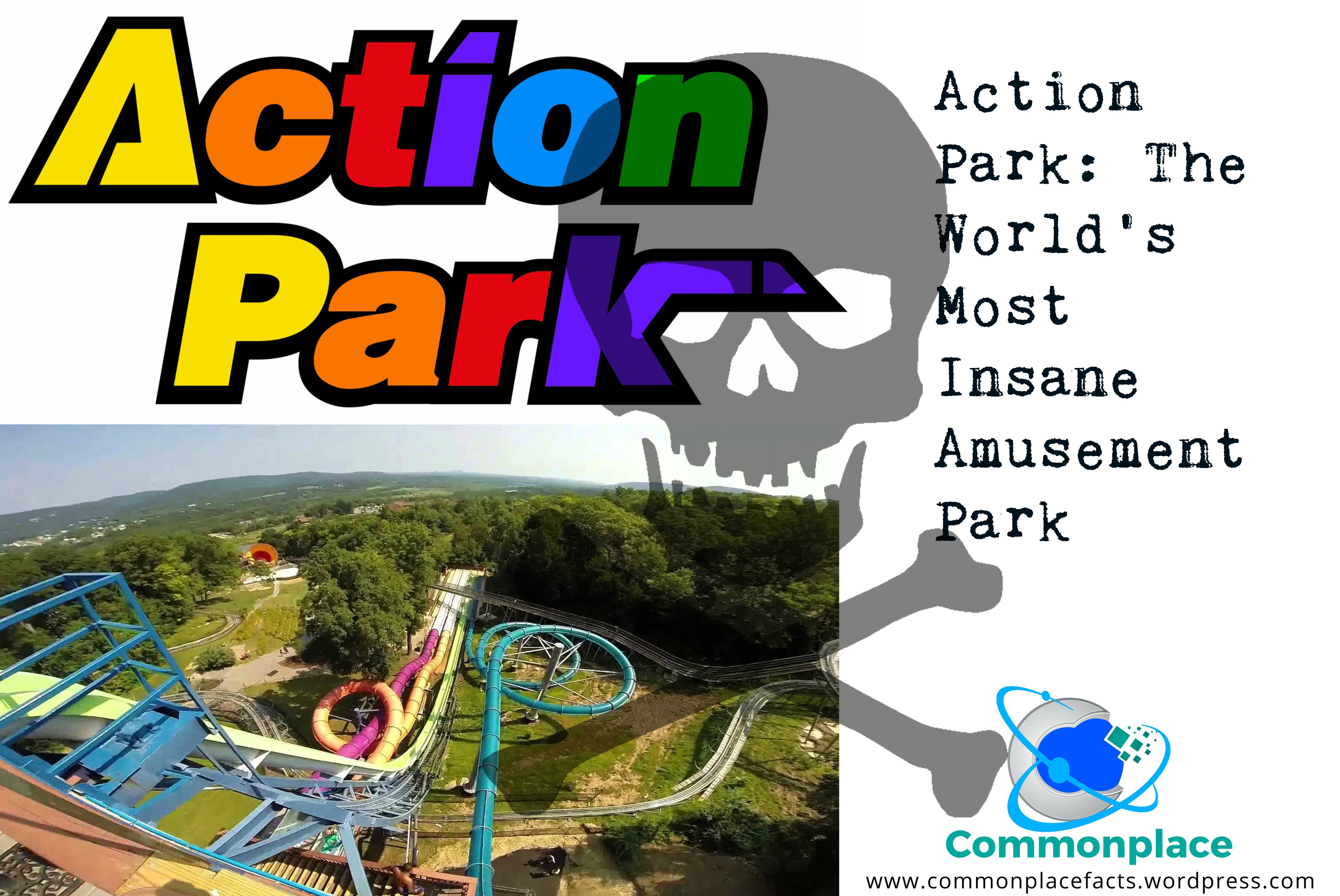

People go to amusement parks for thrill rides and to get an adrenaline fix. The excitement comes from the sensation of danger, accompanied by the assurance of safety. Patrons of New Jersey’s Action Park got adrenaline — and more — from the sensation of danger, accompanied by the real thing.
Action Park’s safety record was so abysmal that it quickly earned the nicknames “Class Action Park” and “Traction Park.” Here is a brief history of America’s most infamous amusement park.
Labor Day, 1976: Eugene Mulvihill, developer of the Vernon Valley–Great Gorge ski area in northern New Jersey, opens a pair of 2,700-foot “Alpine Slides” to keep the resort going in the off-season. Patrons head down on sledlike carts, with skids and small wheels, controlled by a joystick.
May 26, 1978: The resort area expands: Action Park opens at the base of the mountain. The Alpine Slide is soon joined by the Wave Pool, where 20-minute cycles of white water alternate with short periods of calm. Lifeguards constantly have to haul floundering patrons out of the water.
1980: A 19-year-old is killed on the Alpine Slide when his car jumps the track. It’s the first of four confirmed deaths at the park, among uncountable injuries. “They had an on-site infirmary,” says filmmaker Seth Porges. “Unless you had a broken bone, you wouldn’t go to the hospital, and your injuries wouldn’t be reported.”
1982: The park has more than 50 rides, and its ads are ubiquitous on local New York TV. Around the time Mulvihill tells a Jersey paper that his park is “gonna be better than Disney World,” a 15-year-old drowns in the Wave Pool. A week later, a 27-year-old is electrocuted on a ride called the Kayak Experience.
November 1984: Mulvihill pleads guilty to setting up a fake company in the Cayman Islands to “insure” the park. He cops a plea, gets three years’ probation, and he and the company pay almost $300,000 in fines. He’s supposed to sell the resort but manages to hang on to it.
Summer 1985: The Cannonball Loop, reputedly designed by Mulvihill on a napkin, opens. The notorious slide is about 100 feet high, and Mulvihill’s son Andy is the first to ride it, wearing hockey pads. Andy Fiori, a regular park visitor, recalls a rumor that “they sent a dummy down to test it, and it came out with no arm.” Riders tend to get stuck at the bottom of the loop, and there’s no escape hatch. According to some reports, New Jersey’s regulators ordered it closed after just a month. The summer’s tally: 110 reported injured, including 10 fractures and 45 head injuries.
1986: Mulvihill not only hangs on to the resort but expands, buying a mountain from the State of New Jersey. In a Times interview, he calls his business practices “legal, but aggressive.”
Summer 1986: Evan Schuman, the courts-and-investigations reporter for the New Jersey Herald, finds that workers as young as 14, hired to do lawn care and the like, have been informally and illegally promoted and are running the rides.
1987: Another death: An 18-year-old drowns in the Wave Pool. By this time, the top of the Alpine Slide has graphic injury photos posted, to warn kids to play it safe. The place is acquiring a grim nickname: “Class Action Park.”
Ca. 1990: A bungee jump is built. “It wasn’t very high,” recalls Fiori, adding: “I think they had an ambulance on standby.”
1995: After years of bad press, lawsuits, and citations for safety violations, the park goes bankrupt and closes. A resort company, Intrawest, buys it three years later.
1998: Intrawest reopens the resort under the name Mountain Creek Waterpark.
2010: Intrawest sells the park to Crystal Golf Resort — which is owned by the Mulvihills.
2012: Gene Mulvihill dies. He’s eulogized as one of the great economic forces of North Jersey.
There were so many injuries that Action Park purchased ambulances from the city. One local doctor estimated that five to seven people came into his emergency room daily from Action Park. Between 1984 and 1985 the park’s rides were responsible for fourteen fractures and twenty-six head injuries. Most injuries came from people slipping when drunk or from smashing into concrete walls. Several deaths were caused by drowning or trauma. (Anthony, Dave, and Gareth Reynolds. The United States of absurdity: untold stories from American history. California, Ten Speed Press, 2017.)
See a video documentary of Action Park here.




Leave a Reply