
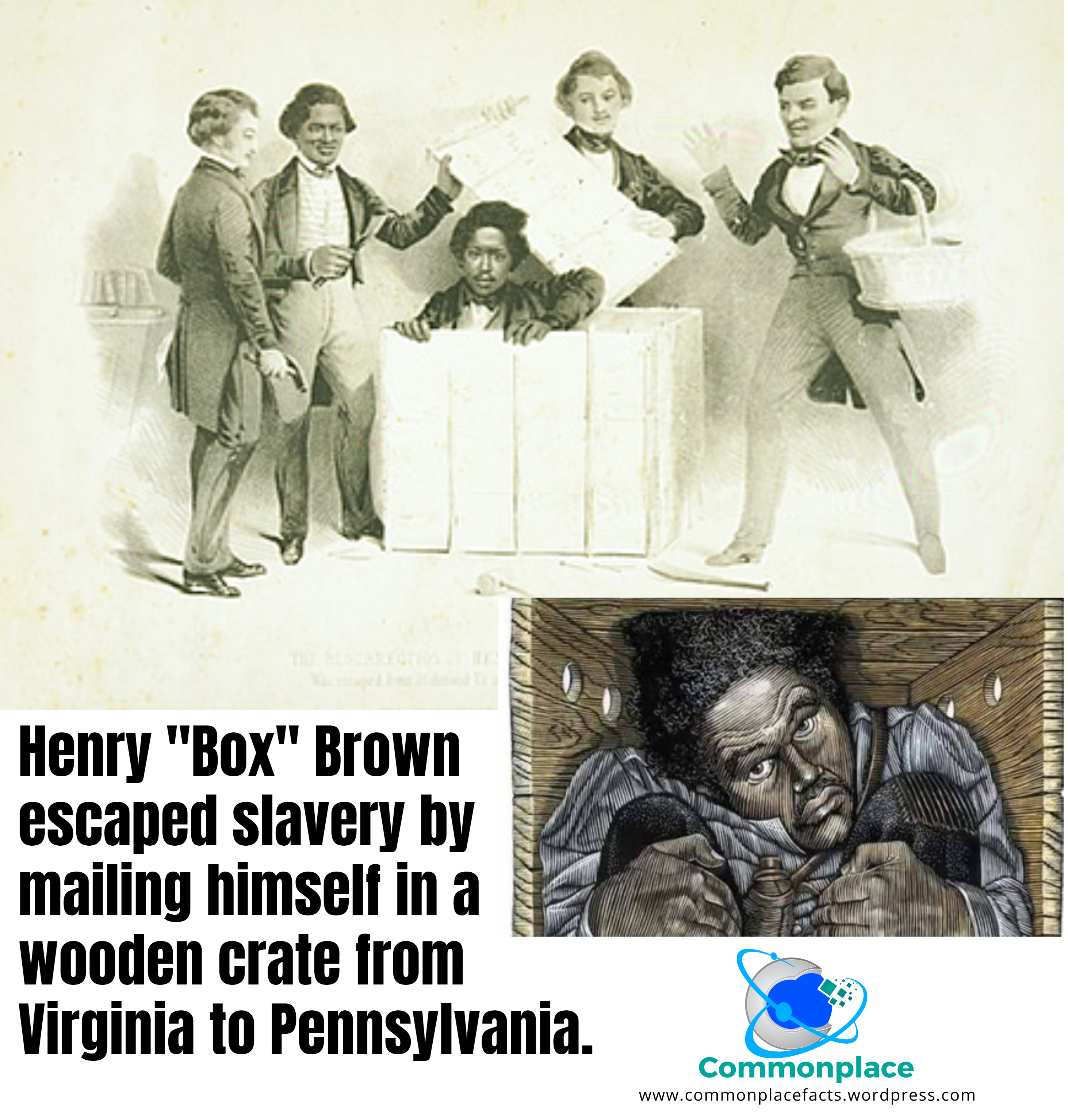

If $86 seems like a lot to pay for postage — especially in 1849 — you might think differently if you realized that was how much it cost to buy one man his freedom.
Henry “Box” Brown (c. 1815 – June 15, 1897) was born into slavery in Virginia. He worked on a tobacco farm with his wife and three children. When his wife and children were sold to another slaveholder, Brown decided he needed to escape such an oppressive situation.
Brown hatched a plan to ship himself to free territory. He enlisted the assistance of James C. A. Smith, a free black man, Samuel A. Smith, and a sympathetic white shoemaker. Together, they built a crate large enough to hold Brown and prepared him for the perilous — and highly uncomfortable — journey ahead.
The box was 3 feet long by 2 feet 8 inches deep by 2 feet wide. It displayed the words “dry goods.” Lined with a coarse woolen cloth and containing a small portion of water and a few biscuits, the crate bore a single hole cut for air.
All that remained was for Brown to be enclosed in the crate and delivered for shipment. The men selected the Adams Express Company because of its reputation for confidentiality and efficiency. When the crate was weighed, the postage came to $86, which Brown paid out of his savings of $166.
Brown later wrote that his uncertain method of travel was worth the risk. “If you have never been deprived of your liberty, as I was, you cannot realize the power of that hope of freedom, which was to me indeed, an anchor to the soul both sure and steadfast.”
Brown’s journey began on March 29, 1849. His crate journeyed by wagon, railroad, steamboat, another wagon, another railroad, ferry, a third railroad, and a delivery wagon. All told, it was 27 hours from point to point. Despite the instructions on the box of “handle with care” and “this side up,” several times carriers placed the box upside-down or handled it roughly. Through all of this, Brown remained still and avoided detection.






Leave a Reply