
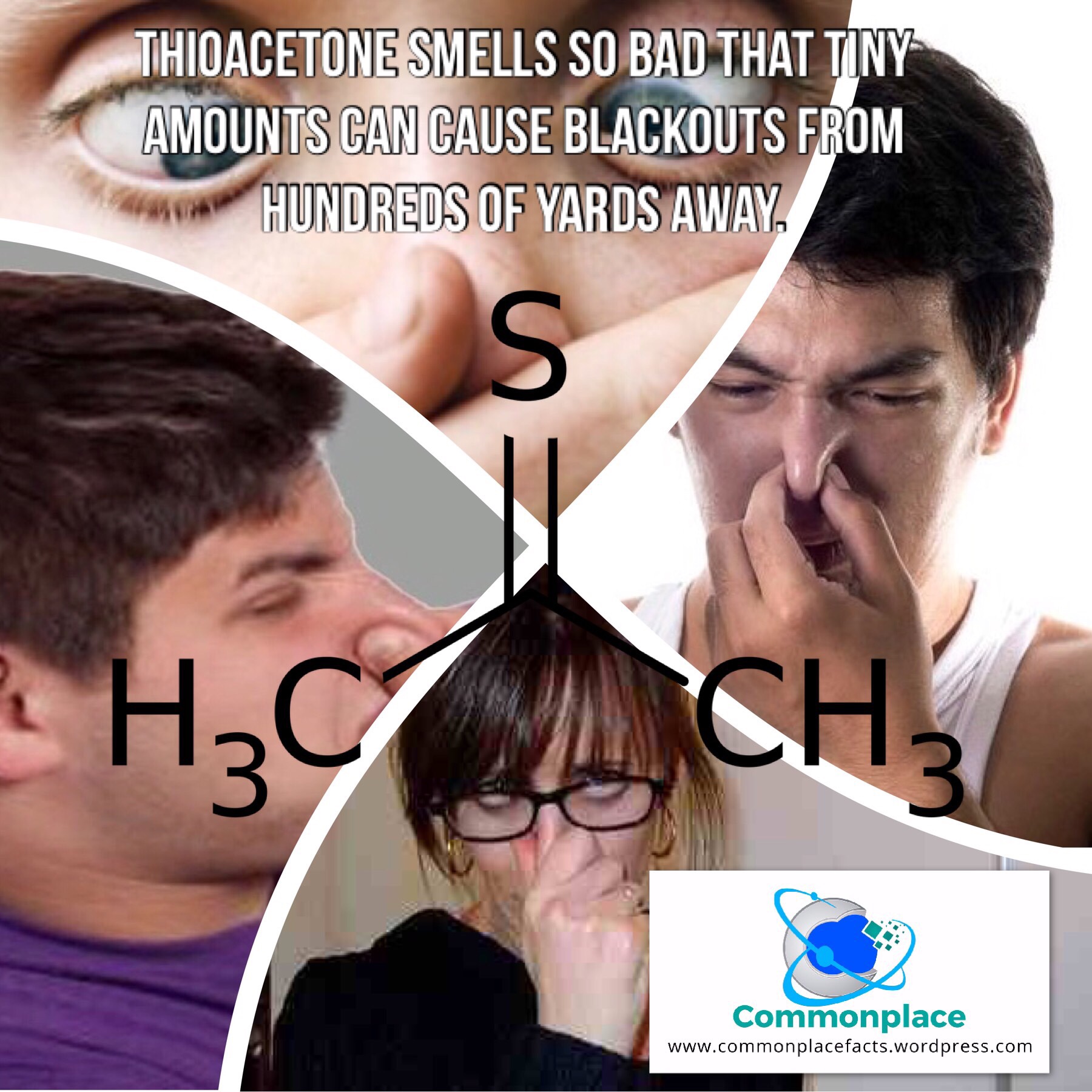

Thioacetone: In a Smelly League of Its Own
Everyone has a personal “absolutely not” smell. For some, it is a pair of week-old running socks that have achieved sentience. For others, it is rotten eggs, gym lockers, or the sort of diaper situation that makes you briefly reconsider your life choices. These are the odors that make you recoil, question your surroundings, and possibly your friendships.
And then there’s thioacetone.
Contents
When Chemistry Decides to Become a Supervillain
Thioacetone is not merely unpleasant. It does not politely offend. It does not linger awkwardly in the air like burnt popcorn or overcooked broccoli or evoke feelings of nostalgia, as do the 20 most-recognizable aromas. Thioacetone commits to the bit. Its odor is so aggressively vile that it has achieved something rare in science: a near-universal consensus that it is, without exaggeration, horrifying.
The Day Freiburg Briefly Considered Moving
In 1889, German researchers in Freiburg were working with a class of compounds known as thioketones. At some point—likely a moment they regretted immediately—they succeeded in isolating thioacetone from a neutralizing compound.
When Even a Soap Factory Says “Absolutely Not”
If you want to establish that something smells bad, it helps to find witnesses with a high tolerance for unpleasant odors. Enter the Whitehall Soap Works in Leeds, which in 1890 described the smell of thioacetone as “fearful.”
The Experiment That Followed Them to Dinner
Fast forward to the mid-20th century, when scientists, demonstrating the optimism that defines their profession, decided to take another look at thioketones. At the Esso Research Station in Abingdon, researchers Victor Burnop and Kenneth Latham conducted experiments that confirmed what Freiburg had already learned the hard way: thioacetone does not believe in personal boundaries.
“Recently we found ourselves with an odour problem beyond our worst expectations. During early experiments, a stopper jumped from a bottle of residues, and, although replaced at once, resulted in an immediate complaint of nausea and sickness from colleagues working in a building two hundred yards away. Two of our chemists who had done no more than investigate the cracking of minute amounts of trithioacetone found themselves the object of hostile stares in a restaurant and suffered the humiliation of having a waitress spray the area around them with a deodorant. The odours defied the expected effects of dilution since workers in the laboratory did not find the odours intolerable … and genuinely denied responsibility since they were working in closed systems. To convince them otherwise, they were dispersed with other observers around the laboratory, at distances up to a quarter of a mile, and one drop of either acetone gem-dithiol or the mother liquors from crude trithioacetone crystallisations were placed on a watch glass in a fume cupboard. The odour was detected downwind in seconds.”
The Smell That Refuses to Stay Local
What makes thioacetone particularly impressive—if that is the word we are going with—is its refusal to behave like a normal smell. Most odors become less noticeable as they disperse. Thioacetone treats dilution as a helpful suggestion rather than a rule.
A New Appreciation for Literally Anything Else
After encountering thioacetone—whether directly or through the misfortune of being downwind—people tend to develop a newfound appreciation for the entire spectrum of ordinary smells. Suddenly, those previously offensive odors seem almost comforting. Familiar. Possibly even pleasant.
You may also enjoy…

Little Baby’s Ice Cream Commercials: The Creepiest Ads You’ll Ever See
Discover the bizarre Little Baby’s Ice Cream commercials that shocked viewers with surreal, creepy imagery—and why they’re still unforgettable today.

Space Smells Like Raspberries: The Sweet Chemistry of the Cosmos
Scientists have discovered that a massive dust cloud in our galaxy, Sagittarius B2, contains ethyl formate, which gives raspberries their flavor. In other words, space smells like raspberries! This finding implies that space is richer in molecules essential for life than previously thought. These discoveries may help answer questions about the origins of life on…

The Nose Knows an Astonishing 1 Trillion Smells
Just how sensitive is your nose? We know that animal noses tend to be much more nuanced to different aromas than their human counterparts. Even so, how many different scents do you think your sniffer could identify? A study by Andreas Keller and associates in 2014 tells us that we shouldn’t be too quick to…





Leave a Reply