
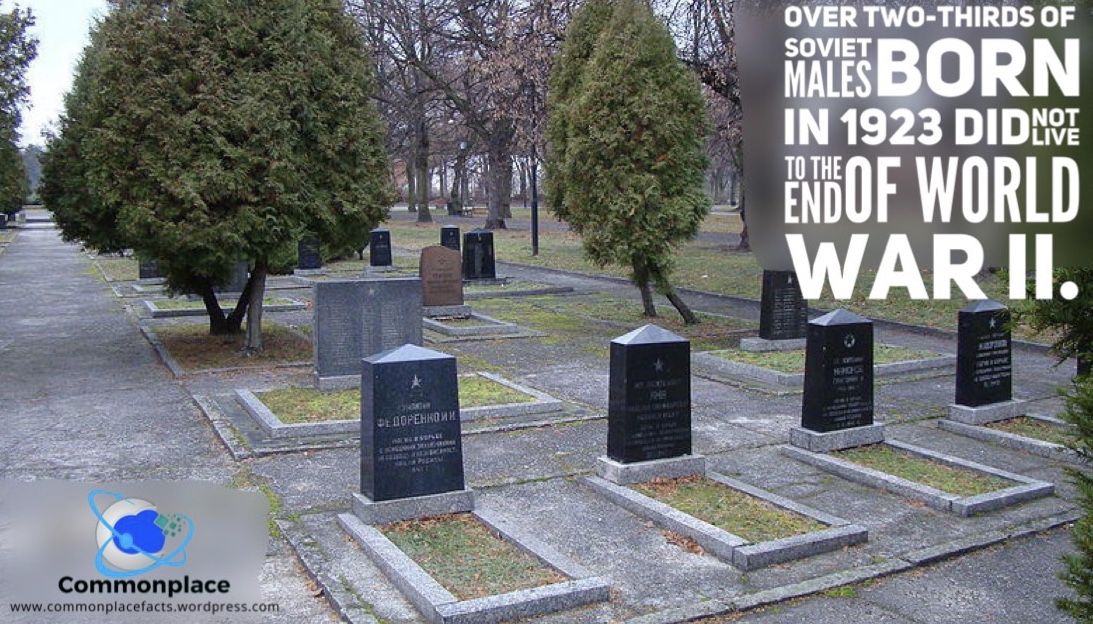

Soviet Male Mortality: Digging Into the Numbers
A fun fact on another site recently proclaimed that 80% of the males born in the 1923 generation in the Soviet Union did not survive World War II. This seemed like a good fact to share for Commonplace Fun Facts, but before we could do that, this information needed to be independently verified. As it turns out, the snippet of information did not stand up to scrutiny, but it wasn’t that far off.
The Census Data for the 1923 Generation
Census data shows the following with regard to baby boys born in 1923:
- Males born in the Soviet Union in 1923: 3,400,000
- Infant (0-1) mortality: 800,000
- Childhood (1-18) mortality, famine, and terror: 800,000
- Surviving to 1941: 1,800,000
- Wartime mortality: 700,000
- Surviving to 1946: 1,100,000
As you can see, only 32% of the boys born in 1923 were still alive at the beginning of 1946. A 68% mortality rate is still ghastly, even if it falls short of the 80% figure that is circulating through the internet. Interestingly, though, the primary cause of death for that generation was not World War II. One out of five died due to the violence of the Second World War. Twenty-three percent died in infancy, and an equal number died from the horrific conditions of life in the Soviet Union between 1923 and 1941.
That generation had it particularly bad. Not only did they face a major famine in 1932, but they also lived through Stalin’s Great Terror in 1937. They became adults in the year their country went to war with Germany.
World War II packed a wallop to the Soviet population. In the first six months of the war, three million Soviet troops were killed or taken prisoner. Most prisoners did not survive. In all, the Soviet Union suffered around 25 million war deaths, plus or minus a million. This, out of a total population in 1939 of just under 171 million.
To get a better idea of what these numbers actually mean, look at this powerful video that helps visualize the sheer number of deaths in World War II:
You may also enjoy…

The Great Lunik Heist: That Time the CIA Kidnapped a Soviet Spacecraft
Learn about the time the CIA kidnapped a Soviet spacecraft! The outrageous Lunik Heist of the Cold War!

How a U.S. President Enabled a Soviet General’s Coke Addiction
Georgy Zhukov was a hero of the Soviet Union, but he had an embarrassing secret. He was an addict. What made it worse was that his addiction, if known, would be especially shameful. Addiction to something as ordinary as alcohol would scarcely have raised an eyebrow. For Zhukov, it wasn’t vodka that preoccupied his waking…

The Crazy Story of Aimo Koivunen, the Soldier Who O.D.’d on Speed, Stepped On a Mine, Skied 250 Miles, and Outmaneuvered the Soviet Army
Discover the extraordinary survival story of Aimo Koivunen, the Finnish soldier who skied 250 miles under the influence of amphetamines during WWII.
You may also enjoy…

Operation Dirty Trick: The Time U.S. Planners Considered Blaming Cuba If John Glenn Didn’t Come Home
On February 20, 1962, John Glenn climbed into a tiny spacecraft called Friendship 7, was launched into orbit atop a converted missile, circled the Earth three times, and returned home as an American hero. This is the version of the story we quite properly remember: brave astronaut, nervous nation, roaring rocket, dramatic reentry, splashdown, ticker-tape…

Why Are Old Dolls So Creepy? The Psychology Behind Their Unsettling Stare
Why are old dolls so creepy? Explore the psychology, history, and uncanny valley effect behind antique dolls’ unsettling stare and lifelike features.

Hands Across America: The Day the 1980s Tried to Solve Hunger by Holding Hands Really Hard
Hands Across America united millions in 1986 to fight hunger and homelessness. Explore its history, impact, celebrity roots, surprising gaps, and the legacy of one of the most ambitious charity events ever staged.
You may also enjoy…


The Plainfield Teachers College and Johnny Chung: The Fake Football Sensation of 1941
Discover the Plainfield Teachers College hoax—how a fake football team and fictional star Johnny Chung fooled newspapers in 1941 in one of history’s strangest sports scams.

Stooky Bill: The Creepy Puppet Head That Helped Invent Television
Meet Stooky Bill, the creepy puppet head that helped John Logie Baird invent early television, survive blazing studio lights, and launch one of history’s strangest technological breakthroughs.







Leave a Reply