

Soviet Male Mortality: Digging Into the Numbers
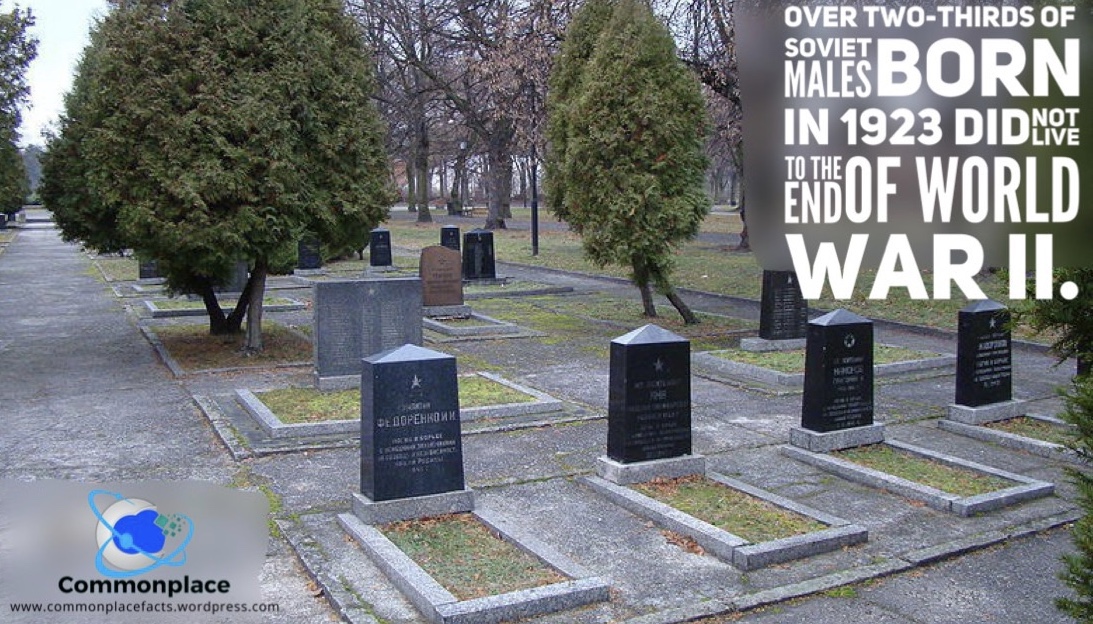
A fun fact on another site recently proclaimed that 80% of the males born in the 1923 generation in the Soviet Union did not survive World War II. This seemed like a good fact to share for Commonplace Fun Facts, but before we could do that, this information needed to be independently verified. As it turns out, the snippet of information did not stand up to scrutiny, but it wasn’t that far off.
The Census Data for the 1923 Generation
Census data shows the following with regard to baby boys born in 1923:
- Males born in the Soviet Union in 1923: 3,400,000
- Infant (0-1) mortality: 800,000
- Childhood (1-18) mortality, famine, and terror: 800,000
- Surviving to 1941: 1,800,000
- Wartime mortality: 700,000
- Surviving to 1946: 1,100,000
As you can see, only 32% of the boys born in 1923 were still alive at the beginning of 1946. A 68% mortality rate is still ghastly, even if it falls short of the 80% figure that is circulating through the internet. Interestingly, though, the primary cause of death for that generation was not World War II. One out of five died due to the violence of the Second World War. Twenty-three percent died in infancy, and an equal number died from the horrific conditions of life in the Soviet Union between 1923 and 1941.
That generation had it particularly bad. Not only did they face a major famine in 1932, but they also lived through Stalin’s Great Terror in 1937. They became adults in the year their country went to war with Germany.
World War II packed a wallop to the Soviet population. In the first six months of the war, three million Soviet troops were killed or taken prisoner. Most prisoners did not survive. In all, the Soviet Union suffered around 25 million war deaths, plus or minus a million. This, out of a total population in 1939 of just under 171 million.
To get a better idea of what these numbers actually mean, look at this powerful video that helps visualize the sheer number of deaths in World War II:
You may also enjoy…

The Great Lunik Heist: That Time the CIA Kidnapped a Soviet Spacecraft
Learn about the time the CIA kidnapped a Soviet spacecraft! The outrageous Lunik Heist of the Cold War!

How a U.S. President Enabled a Soviet General’s Coke Addiction
Georgy Zhukov was a hero of the Soviet Union, but he had an embarrassing secret. He was an addict. What made it worse was that his addiction, if known, would be especially shameful. Addiction to something as ordinary as alcohol would scarcely have raised an eyebrow. For Zhukov, it wasn’t vodka that preoccupied his waking…

The Crazy Story of Aimo Koivunen, the Soldier Who O.D.’d on Speed, Stepped On a Mine, Skied 250 Miles, and Outmaneuvered the Soviet Army
Discover the extraordinary survival story of Aimo Koivunen, the Finnish soldier who skied 250 miles under the influence of amphetamines during WWII.
You may also enjoy…

The Great Horse Flu of 1872: When America’s Transportation System Called in Sick
In 1872, America’s transportation system came to a screeching halt—not because of a fuel shortage or mechanical failure, but because the horses caught the flu. Streetcars stopped, deliveries stalled, and even firefighters struggled to reach emergencies. Discover how the Great Horse Flu epidemic brought an industrial nation to its knees and exposed the surprising weakness…

Grumbletonian: The Centuries-Old Word for Someone Who Complains About Everything
Long before cable news and social media, the English had a wonderfully descriptive word for people who complained endlessly about politics: grumbletonian. Meet the original political malcontents.

In 1897, the Post Office Sent a Live Cat Through a Tube—Because Progress
In 1897, New York postal officials celebrated their revolutionary underground mail system by sending a live cat through a pneumatic tube. The experiment was declared a success, although nobody thought to ask the cat. Discover the bizarre history of pneumatic mail, the engineering marvel beneath New York City, and why this once-futuristic technology ultimately lost…
You may also enjoy…

Gardyloo! The Scottish Word That Meant You Were About to Have a Very Bad Day
In eighteenth-century Edinburgh, hearing someone shout “Gardyloo!” meant you had seconds to get out of the way. Discover the forgotten Scottish word that warned pedestrians of an unpleasant delivery from the windows above—and why modern plumbing deserves considerably more appreciation.

The Hinterkaifeck Murders: Six Dead, One Missing Killer, and Some Very Well-Fed Cows
In 1922, six people were murdered on an isolated Bavarian farm after reports of mysterious footprints, strange noises in the attic, and other unsettling discoveries. The killer was never identified—and may have remained behind to feed the livestock. Welcome to the Hinterkaifeck murders, where even the cows seem to have known more than the detectives.

World War II Gave Rod Serling Nightmares—He Gave America The Twilight Zone
Long before Rod Serling introduced America to *The Twilight Zone*, he experienced horrors that no television writer could have invented. From deadly combat in the Philippines to the bizarre death of a fellow paratrooper, World War II left Serling with physical wounds, recurring nightmares, and a firsthand appreciation for life’s cruel unpredictability. Discover how those…





Leave a Reply