
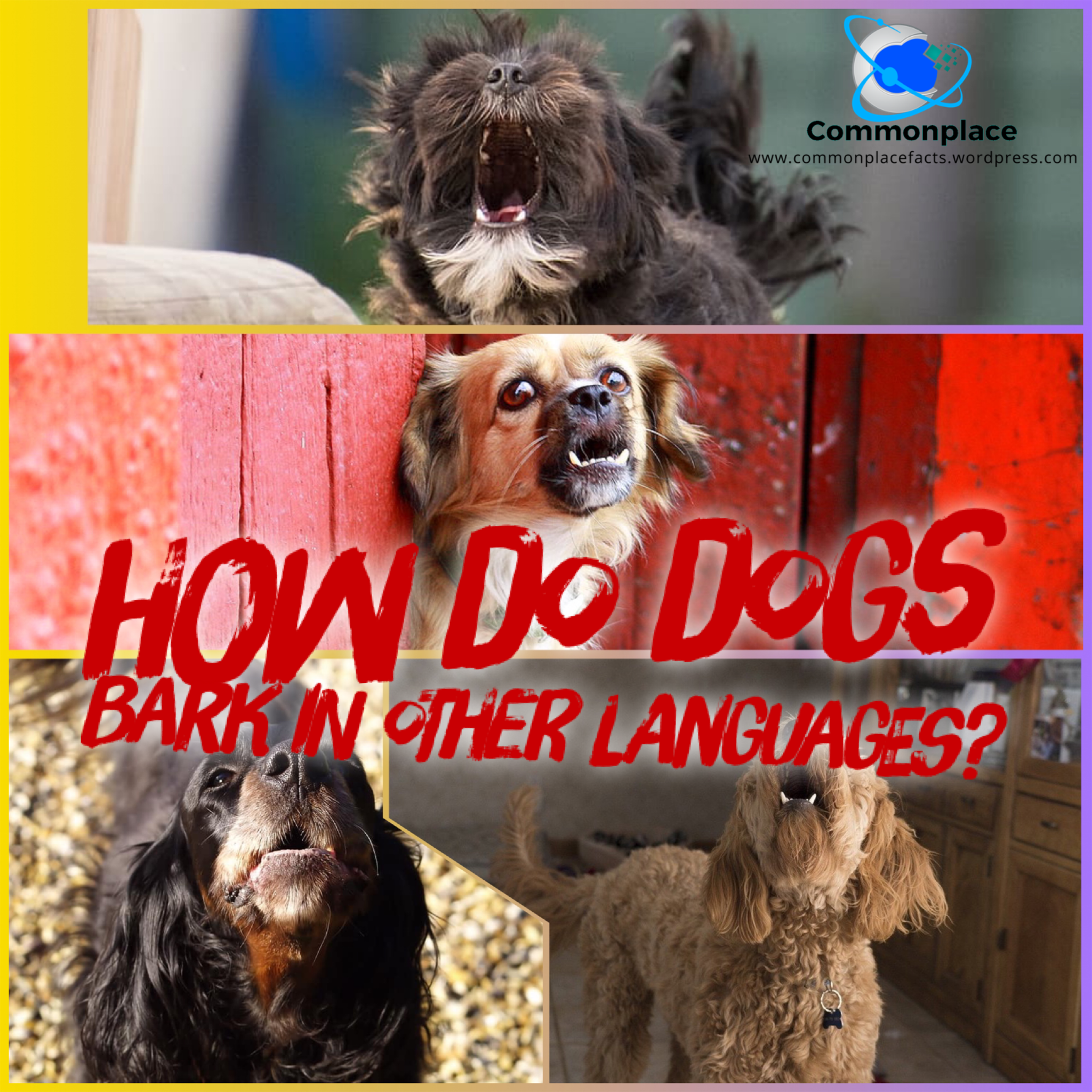

Who knew that animals are like people in having to learn other languages to be understood in different cultures? It may seem that the basic sound made by dogs, “woof,” would be universally understood. Curiously, an English-speaking (English-barking?) dog might be hopelessly confused in another country. Consider Russia, where dogs say, “gav gav,” or France, where, “ouaf ouaf,” is used. Our monolinguistic canine would be utterly befuddled in Sweden, when he hears his yappy counterparts utter, “bjäbb bjäbb,” or in Spain, where they say, “guau guau.”
How do dogs bark in different languages, and why do they make different sounds?
When a word that describes a sound is an approximation of the sound itself, it is known as an onomatopoeia. Examples of onomatopoeia include such words as “buzz,” “bang,” “toot,” and “tweet.” Since the sound is the same in every part of the world, it makes sense that the onomatopoeia would be the same in each language. As anyone who tries to learn a new language quickly learns, however, languages rarely conform to logic. In English, a cannon goes, “Boom!” In Mandarin Chinese, however, it makes a “ping 乒” sound.
Many theories abound as to why these sounds do not get expressed the same way in different languages. No one is entirely certain of the answer. Since all languages are, in essence, expressions of culture, the words certainly are a some mixture of not only the way the ear processes the sound but also the associations the brain connects to it.
When it comes to the seemingly-simple concept of the sound a dog makes, you can see in the following video how different cultures attempt to communicate the root language of canines.
Bow Wow Meow – Animal Sounds in Different Languages from Ke Nguyen on Vimeo.
Following is a quick-reference list of how dogs bark in different languages. Keep it handy in case you find yourself needing to effectively communicate with man’s best friend.
- English – woof, woof; ruff, ruff; arf, arf (large dogs and also the sound of sea lions); yap, yap; yip, yip (small dogs), bow wow
- Afrikaans – blaf, blaf; woef, woef; keff, keff (small dogs)
- Albanian – ham, ham
- Arabic – hau, hau; how how (هو ,هو)
- Armenian -haf, haf
- Basque – au, au; txau, txau (small dogs); zaunk, zaunk (large dogs); jau, jau (old dogs)
- Balinese – kong, kong
- Bengali – gheu, gheu; bhao, bhao
- Bulgarian – bau-bau (бау-бау); jaff, jaff (джаф-джаф)
- Brazilian Portuguese – au au
- Burmese – woke, woke
- Catalan – bau, bau; bub, bub
- Chinese, Cantonese – wow, wow (汪汪)
- Chinese, Mandarin – wang, wang
- Croatian – vau, vau
- Czech – haf, haf; štěk (the bark itself)
- Danish – vov, vuf
- Dutch – waf, waf; woef, woef
- Esperanto – boj, boj
- Estonian – auh, auh
- Finnish – hau, hau; vuh, vuh; rauf, rauf
- French – waouh, waouh; ouahn, ouahn; vaf, vaf; wouf, wouf; wouaf, wouaf; jappe jappe
- German – wuff, wuff; wau, wau; rawrau, rawrau
- Greek – ghav, ghav (γαβ, γαβ)
- Hebrew – hav, hav; hau, hau
- Hindi – bow, bow
- Hungarian – vau, vau
- Icelandic – voff, voff
- Indonesian – guk, guk
- Irish – amh, amh
- Italian – bau, bau
- Japanese – wan-wan (ワンワン); kyan-kyan (キャンキャン)
- Korean – meong, meong (멍멍, pronounced mong-mong)
- Latvian – vau, vau
- Lithuanian – au, au
- Macedonian – av, av
- Malay – gong, gong (“menggonggong” means barking)
- Marathi – bhu, bhu; bho, bho
- Norwegian – voff, voff or boff
- Persian – vogh, vogh
- Polish – hau, hau
- Portuguese – au, au; ão-ão (nasal diphthong); béu-béu (toddler language); cain-cain (whining)
- Romanian – ham, ham; hau, hau
- Russian – gav, gav (гав-гав); tyav, tyav (тяв-тяв, small dogs)
- Scots Gaelic — comhartaich (pronounced kor-tchee)
- Serbian – av, av
- Sinhala – සිංහල – buh, buh
- Slovak – haf, haf; hau, hau
- Slovene – hov, hov
- Spanish – guau-guau; gua, gua; jau, jau
- Swedish – voff, voff; vov, vov; bjäbb, bjäbb
- Tagalog – aw, aw; baw, baw
- Tamil – wal wal
- Thai – โฮ่ง โฮ่ง (pronounced hôŋhôŋ); บ๊อก บ๊อก (pronounced bɔ́kbɔ́k)
- Turkish – hev hev; hav, hav
- Ukrainian – гав, гав (hau, hau); дзяв, дзяв (dzyau, dzyau)
- Urdu – bow bow
- Vietnamese – gâu gâu; ẳng ẳng
- Welsh – wff, wff
Read more fun facts about languages.
Read more fun facts about animals.




Leave a Reply