

There are certain legal concepts so fundamental to civilization that even people who think “Blackstone” is either a guitar amp or a villain in a Marvel movie have heard of them. One of the crown jewels of these principles is habeas corpus. Latin for “to have the body,” it’s the judicial equivalent of asking, “All right, you arrested them, but where exactly are you keeping them, and is this all as lawful as you claim?” It’s the mechanism that forces the government to show its work, which, history reveals, is not always its strongest subject.
The idea predates 1215, and Article 39 of the Magna Carta immortalized it in writing with the kind of clarity you only get when a bunch of cranky barons force the king to negotiate at metaphorical sword-point. It promised that “no freeman shall be taken or imprisoned or disseised” (a medieval way of saying “keep your hands off my stuff”), unless it was done through lawful judgment. In other words, the King could no longer wake up cranky, throw someone in a dungeon before lunch, and feel good about it. Progress.
Over the centuries, Parliament revisited the subject of habeas corpus with the persistence of someone trying to get a vending machine to drop a candy bar that’s stuck on the coil. One of its most consequential efforts became the Habeas Corpus Act of 1679, passed during the reign of Charles II. The merry monarch, best known for reopening theaters, indulging every possible court entertainment, and raising the national average of royal mistresses to statistically improbable levels, presided over a government that still managed to do something profoundly important: enshrining a prisoner’s right to challenge their detention. The Act remains part of United Kingdom law today, making it significantly more durable than most royal romances of the era.
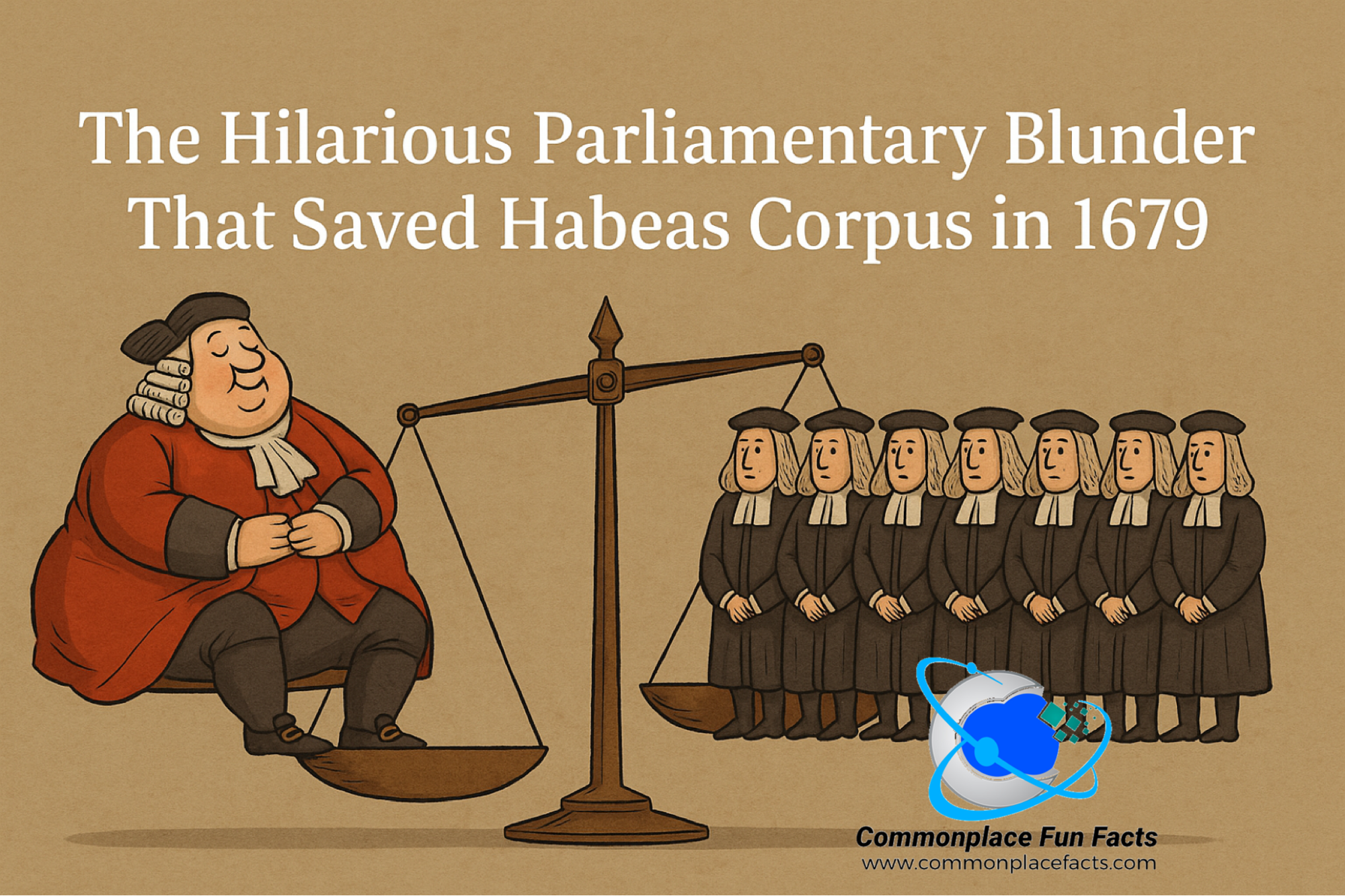
The Bill’s passage, however, did not float gently through Parliament on a cloud of enlightened goodwill. It fought its way through enough opposition to make you suspect some members of the Lords were looking for any excuse to avoid paperwork. Opponents lobbed amendments like medieval legal dodgeballs, using every procedural trick short of faking a plague outbreak to stall the process. When the decisive vote finally arrived, each side appointed tellers to count members as they walked through the division lobbies. This required attention, diligence, accuracy, and at the very least the awareness that counting one person as ten was not actually allowed.
Gilbert Burney recounted how the vote tally took place:
“Lord Grey and Lord Norris were named to be the tellers. Lord Norris, being a man subject to vapours, was not at all times attentive to what he was doing: so, a very fat lord coming in, Lord Grey counted him as ten, as a jest at first: but seeing Lord Norris had not observed it, he went on with this misreckoning of ten: so it was reported that they that were for the Bill were in the majority, though indeed it went for the other side: and by this means the Bill passed.”
To modern eyes, the tale sounds suspiciously like the kind of thing that should end with the words “and that’s why we can’t trust group projects.” Yet the clerk dutifully recorded that the “ayes” had fifty-seven and the “nays” had fifty-five. The only problem? Only 107 Lords were present that day. Parliamentary math, it seems, occasionally took liberties large enough to require their own coat of arms.
Remarkably, no one overturned the vote after realizing that one gentleman had been credited with the gravitational pull of a small planetary body. The Act took effect, lawyers everywhere rejoiced, and habeas corpus achieved a status normally reserved for national treasures and exceptionally charming corgis.
It’s far from the only time Parliament’s vote-counting methods have wandered into the realm of creative interpretive dance. During the 18th century, one MP famously attempted to pair his vote with a colleague’s—standard practice—only for the colleague to die before the vote, leaving everyone scrambling to determine whether he still “counted.” Another time, an absent member was tallied because his hat was spotted inside the chamber. For all the jokes made about American electoral chaos, the British system has earned more than a few participation trophies of its own.
And yet, through the wobbly arithmetic, the logistical hiccups, and the occasional overgenerous estimate of a peer’s corporeal footprint, habeas corpus emerged intact. It kept governments honest (or at least honest-adjacent) and protected citizens from being locked up merely because someone important woke up cranky.
You may also enjoy…

TONA: Did a Missing Constitutional Amendment Take Away the Citizenship of All Lawyers?
“The first thing we do, let’s kill all the lawyers!” (Henry VI, Part 2, Act IV, Scene 2). When William Shakespeare wrote those infamous words about lawyers in 1591, he parodied the anti-attorney sentiment that has been part of popular culture for centuries. The Bard, of course, wrote those words in jest. No one has…

The London Great Stink of 1858: When the Thames Made Parliament Hold Its Nose
The London Great Stink of 1858 turned the Thames into a sewer so foul it stopped Parliament. Discover how it sparked Joseph Bazalgette’s sewer revolution in London.

It Is Illegal to Wear a Suit of Armor in Parliament
Find out why it is illegal to wear a suit of armor in Parliament.


Leave a Reply