
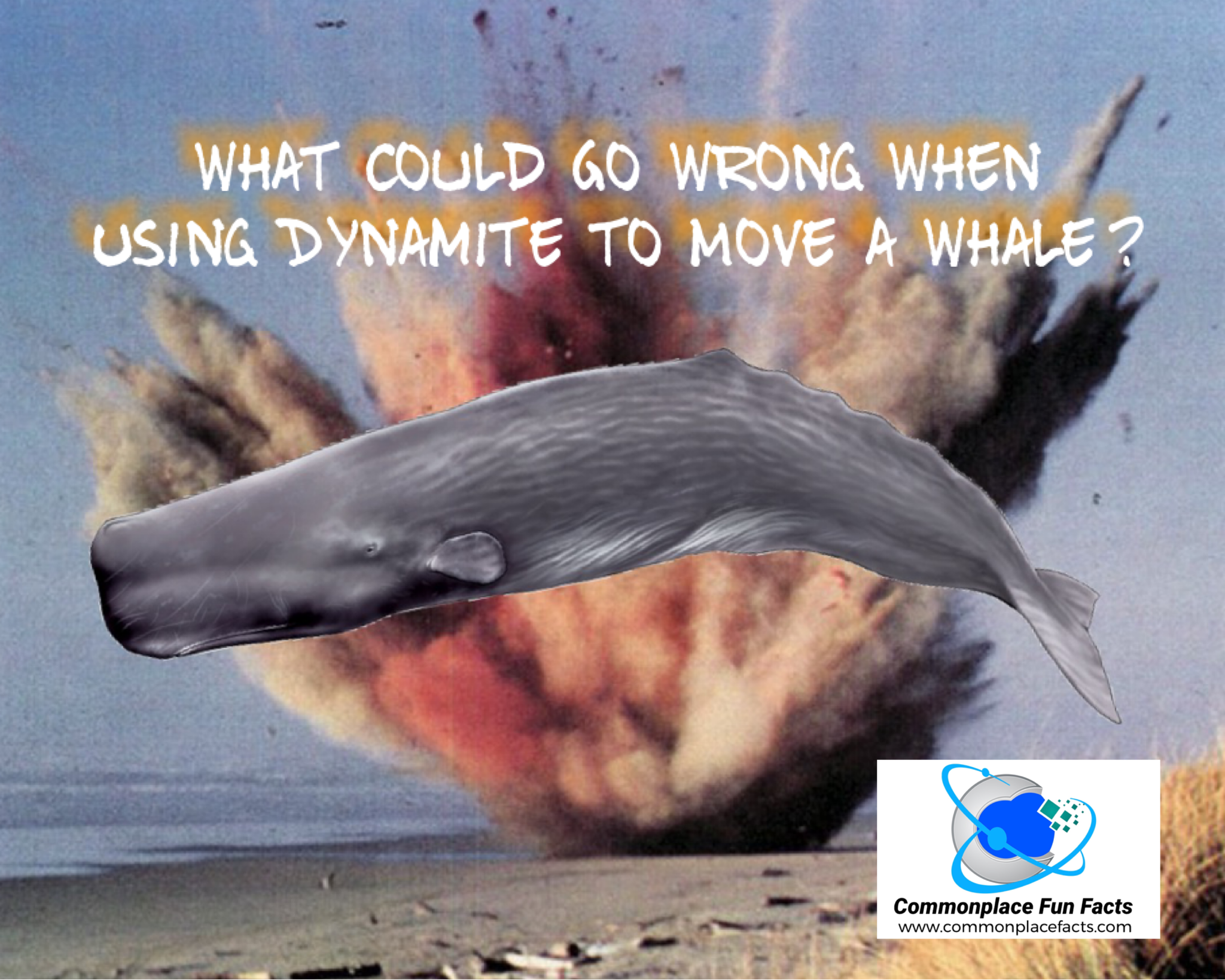

The Exploding Whale of Florence, Oregon
November 12, 1970, was a whale of a day in Florence, Oregon.
We would like to apologize for that sentence, but honesty prevents us from doing so. When history hands you a dead whale, a sunny beach, and a government agency with dynamite, the puns are not merely available. They are legally unavoidable.
The morning began pleasantly enough. The sun was bright. The skies were clear. The Pacific Ocean was doing its usual picturesque thing. The only blemish on this otherwise lovely coastal scene was the 45-foot, 16,000-pound whale carcass decomposing on the beach like nature had abandoned a blubbery sofa and refused to come back for it.
Three days earlier, the whale had washed ashore. This was not the sort of event that came with a helpful instruction manual. Local officials quickly discovered that “dead whale disposal” had somehow failed to appear in the standard civic emergency playbook, probably because most communities spend their planning time on fires, floods, and potholes instead of eight tons of marine mammal rapidly converting itself into a biological weapon.
Contents
A Large, Smelly Problem
Under Oregon law at the time, the beaches were the responsibility of the Oregon Highway Department. This made a certain amount of sense when the job involved keeping public areas clear and accessible. It made slightly less sense when the obstruction in question was a rotting whale.

Highway engineers knew roads. They knew bridges. They knew culverts, drainage, grading, asphalt, and the mysterious bureaucratic art of making traffic cones appear in places where no work has been done for seventeen months. What they did not know was how to remove a dead whale from a beach before it became the unofficial fragrance of coastal Oregon.
The warm weather made the matter worse. The whale’s dark skin absorbed the sunlight, the body bloated, and gases built up inside it. The resulting odor spread through the area, giving the residents of Florence the memorable opportunity to experience the seaside without all that distracting “fresh air” nonsense.
The Options Were Bad, Worse, and Government
Several possible solutions were discussed.
One idea was to bury the whale in the sand. This had the advantage of being simple and the disadvantage of being horrifying. Winter storms could easily shift the sand and bring the whale back to the surface months later, when it would be even less suitable for polite company. There was also the charming possibility that, if the whale remained buried, it might decompose into a sort of subterranean pocket of liquefied whale. An unsuspecting beachgoer could step onto the wrong patch of sand and sink into a nightmare casserole of marine biology.
That was generally considered undesirable.
Still, history has repeatedly shown that when humans face an animal-related problem, someone will eventually suggest a solution that sounds bold, creative, and deeply in need of adult supervision. For another fine example, see the American plan to raise hippos for food, because apparently beef was too predictable.
Burying the whale might have worked if it had been done immediately and farther inland, where the sand was more stable. After three days of decomposition, however, moving the whale risked turning one large problem into several hundred smaller, smellier problems. Nobody wanted to discover what happened when a fragile whale corpse came apart during transport. Some questions do not need field testing.
Enter the Dynamite
At last, someone proposed the sort of solution that sounds reasonable only if you say it very quickly and do not let any adults in the room ask follow-up questions.
The basic reasoning went something like this: When highway workers needed to remove a large rock, they blasted it away. Therefore, when faced with a large whale, they could blast that away, too.
This is technically an argument. It is not a good argument, but it does contain nouns and verbs, which is sometimes enough to get government projects moving.
There is, of course, a meaningful difference between a rock and a whale. A rock is hard, dense, and resistant. Dynamite fractures it. A whale is soft, flexible, greasy, and already undergoing internal chemical processes best described as “hostile.” Dynamite does not necessarily fracture such a thing. Dynamite may instead launch it.
This distinction would soon become important.
How Much Dynamite Does One Whale Require?
The man in charge was project manager George Thornton. Shortly before the blast, he told a reporter, “I’m confident that it’ll work.”
This would have been more reassuring if he had stopped there.
He continued, “The only thing is, we’re not sure just exactly how much explosives it’ll take to disintegrate this thing so the scavengers, seagulls and crabs and what-not, can clean it up.”
There are moments in human history when a single sentence should cause everyone nearby to stop, sit quietly, and reconsider the direction of civilization. This was one of those moments.
When the man supervising the detonation of an eight-ton whale publicly admits he does not know how much dynamite is required, that seems like the sort of statement that should trigger a review committee, a prayer meeting, or at least someone saying, “George, let’s not turn the beach into chowder just yet.”
Nevertheless, the whale continued to rot. The smell continued to worsen. The pressure to do something increased. And nothing says “decisive public administration” quite like packing explosives around a dead animal and hoping the seagulls will understand the assignment.
The Plan, Such As It Was
The ideal outcome was simple enough. The explosion would either blast the whale back into the ocean, where the waves could carry it away, or break it into small enough pieces for scavengers to clean up. In theory, nature would take care of the rest.

This plan depended on several assumptions, including the assumption that seagulls would view an artillery barrage of rotten whale meat as an invitation to lunch rather than a compelling reason to leave the county.
Since no one knew how much dynamite to use, Thornton decided to err on the side of “more.” His crew dug into the sand around and under the whale and packed case after case of DuPont dynamite around the carcass. In all, they used 20 cases.
That is a lot of dynamite. It is especially a lot of dynamite when the target is already dead and not expected to resist arrest.
The One Guy Who Knew Better
One person on the scene actually had some useful experience with explosives. Unfortunately, he was not part of the project.
Walter Uemenhoefer, an executive with the Kingsford Charcoal Company, happened to be in town on business. During his military service, he had received training in the use of explosives. When he saw the amount of dynamite being prepared, he understood immediately that the plan occupied that uncomfortable middle ground between “not enough to vaporize the whale” and “more than enough to distribute it across the neighborhood.”
Uemenhoefer approached Thornton and suggested using a much smaller charge — about 20 sticks — to push the whale off the beach. Alternatively, if the goal was to truly vaporize the carcass, they would need far more explosives than they had. The 20 cases they were using, he warned, would not solve the problem. It would simply relocate the problem into new and exciting places.
Thornton listened to this advice and proceeded with the original plan, because history must have content.
Thar She Blows
Spectators were moved at least a quarter-mile away from the blast site. This seemed like a safe distance, which only proves that people in 1970 had not yet developed a proper appreciation for the aerodynamic potential of decomposing blubber.
Thornton gave the all-clear. Everyone waited.
Then the dynamite detonated.
What followed was one of those rare moments when comedy, horror, engineering, and seafood all arrived at the same party wearing the same bad suit.
The blast shook the beach. Sand filled the air. Pieces of whale flew skyward. Television reporter Paul Linnman later described the sight as looking “like a mighty burst of tomato juice.” Spectators initially cheered, because human beings are simple creatures and explosions tend to produce applause before consequences arrive.
Then the consequences arrived.
Chunks of whale began raining down on the crowd. Some pieces were tiny. Others were not. Shards of flesh and bone fell over the beach, the dunes, the spectators, and the vehicles parked nearby. The whale had not been vaporized. It had been converted into weather.
The scene was strangely prophetic of the infamous “Turkey Drop” scene from WKRP in Cincinnati, except this involved fewer fictional radio executives and considerably more marine mammal.
As the television camera recorded the aftermath, a woman’s voice could be heard saying, “All right, Fred, you can take your hands out of your ears now … here come pieces of … oh my G—…”
That is not a quote. That is a historical document.
The Whale of a Deal That Wasn’t
Walter Uemenhoefer had moved as far away as he could, believing he had safely removed himself from the unfolding catastrophe. He was mistaken.
A piece of whale carcass the size of a coffee table landed directly on the roof of his car, crushing the top and blowing out the windows. The car was new.
Because the universe occasionally hires comedy writers, Uemenhoefer had purchased the vehicle during a promotional sale at a Eugene, Oregon dealership. The slogan was: “Get a Whale of a Deal on a New Oldsmobile.”
Rarely has advertising aged so violently.
Miraculously, no one was seriously injured. This is the part of the story where we pause to acknowledge that history could have taken a much darker turn. Being pelted with decomposing whale is unpleasant. Being flattened by it is worse. Civilization sets its standards where it can.
The Seagulls Decline the Invitation
In his newscast, Linnman summed up the aftermath with admirable restraint: “Fortunately, no human was hurt as badly as the car. However, everyone on the scene was covered with small particles of dead whale.”
That sentence deserves to be carved into a monument somewhere.
As for the actual goal of removing the whale, the plan was not a success. Most of the carcass remained on the beach. The explosion did not eliminate the smell. It expanded the jurisdiction of the smell. The blast scattered whale debris over a wide area and made the cleanup considerably worse than it had been before.
The hoped-for army of helpful scavengers also failed to materialize. The explosion had frightened away the seagulls and other wildlife. Apparently, even creatures willing to eat beach carrion have professional standards.
“What Do You Mean, ‘What Went Wrong?’”
Thornton, for his part, maintained that the operation had gone about as expected. “It went just exactly right,” he told the Eugene Register-Guard, “except the blast funneled a hole in the sand under the whale.”
When asked what went wrong, he reportedly replied, “What do you mean, ‘what went wrong?’”
This is either the confidence of a man who refuses to be rattled by criticism or the final defense mechanism of a public official standing on a beach covered in exploded whale.
Either way, the Florence exploding whale became a legend. It survived first as local lore, then as a beloved oddity of television journalism, and eventually as one of the internet’s favorite historical disasters. It is the kind of story that feels too absurd to be true, which is precisely why it could only have happened in real life.
There are lessons here, of course. Listen to the person who understands explosives. Do not assume seagulls will assist with disaster recovery. Never confuse a whale with a rock. And if someone proposes solving a smelly problem by adding dynamite, perhaps take a moment to ask whether the plan is “cleanup” or merely “distribution.”
History is full of grand achievements, solemn sacrifices, and noble moments of human courage.
It also includes the time Oregon tried to blow up a whale and accidentally invented blubber rain.
You may also enjoy…

Moby-Dick: The Whale of a Flop That Became a Classic
Discover how Herman Melville’s Moby-Dick went from a commercial failure in 1851 to one of the greatest American novels of all time, influencing literature, art, and pop culture for generations.

Why is Whale Poop So Stinking Valuable?
What is yellowish-gray, comes after a whale, and is worth more than $1,000 per ounce? No, this isn’t the start of a corny joke; it is a legitimate question. The answer is whale poop. To find out why people are so eager to find and pay for something whales are so eager to get rid…

Looking for Gas Leak with Open Flame… Anyone Else See a Problem with This?
The largest cylindrical gas container in the world in 1927 was in the heart of the industrial center of Pittsburgh, Pennsylvania. On the morning of November 14, 1927, it developed a leak, so repairmen set out to look for it…. ….with an open-flame lamp. At 8:43 a.m., either they found the leak, or the leak found…






Leave a Reply