
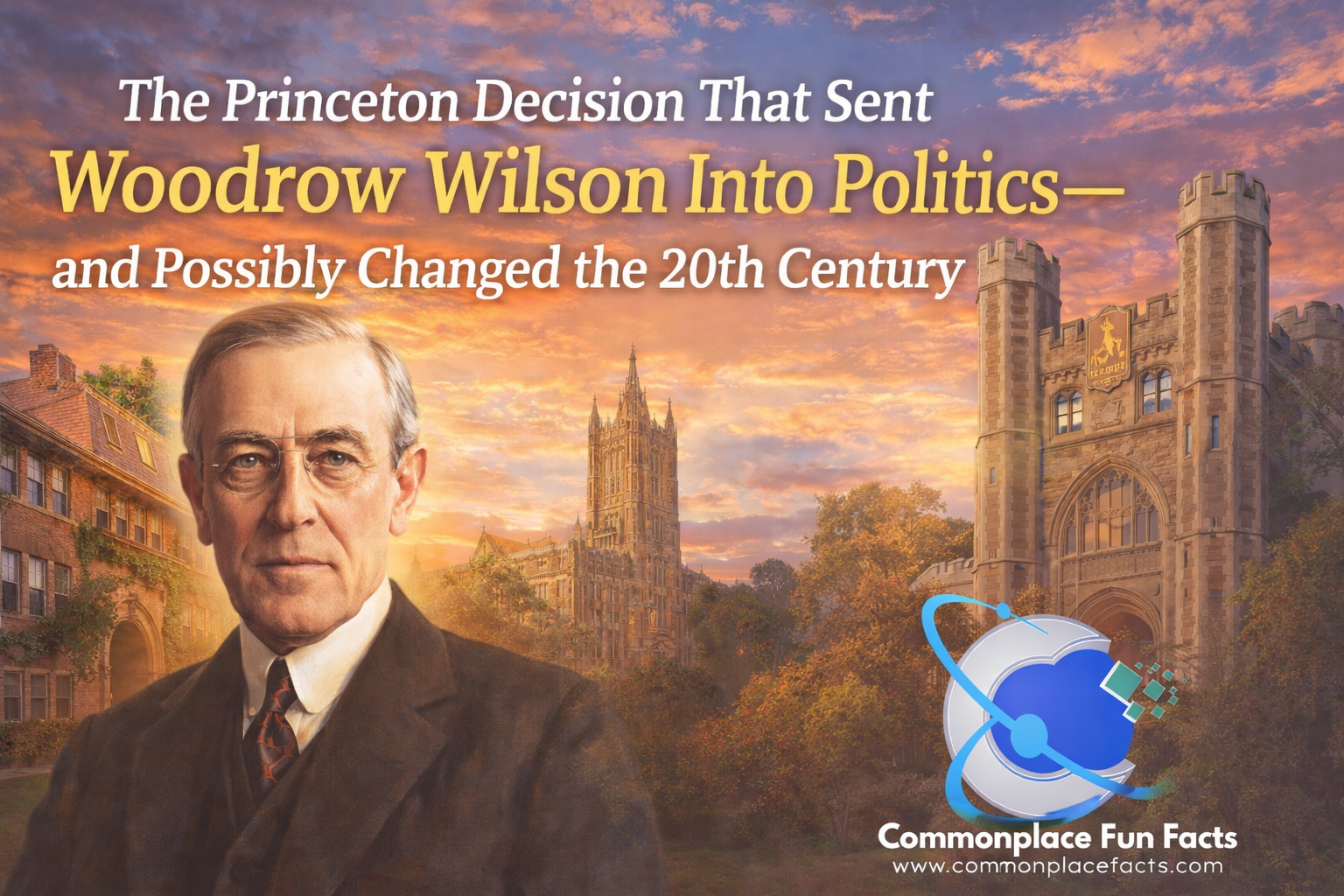

Most of the time, decisions made by university trustees do not change world history.
They determine where to put a building, what to name a lecture hall, or whether the cafeteria should experiment with something ambitious like edible food.
But in 1910, the trustees of Princeton University made a decision about where to build a graduate school that—depending on whom you ask—may have altered the course of the entire twentieth century.
The decision drove Princeton’s president out of academia and into politics.
That president’s name was Woodrow Wilson.
Contents
The Princeton Graduate College Controversy
Princeton’s graduate program already had a well-established reputation, beginning with its first graduate student, James Madison. By the late nineteenth century, Princeton University was expanding rapidly. Graduate education was becoming an increasingly important part of American universities, and Princeton wanted a proper home for its growing graduate program.
Plans for a permanent Graduate College began circulating as early as 1896. Graduate students were scattered across temporary facilities, and administrators agreed that the university needed a dedicated building where advanced scholarship could flourish.
The problem was not whether Princeton should build the Graduate College.
The problem was where it should go.
And on that question, two powerful figures had very different ideas.
Andrew West’s Vision of Scholarly Isolation
Andrew Fleming West, the dean of Princeton’s Graduate School, believed that graduate students needed something approaching a monastery.
Not literally monks with robes and candles, but something close.
West argued that serious scholarship required distance from the noise and chaos of undergraduate life. His ideal Graduate College would be located away from the main campus—close enough to walk, but far enough to create an atmosphere of quiet intellectual seriousness.
The proposed site sat on elevated land overlooking the rest of Princeton, offering what West believed would be a perfect environment for contemplation, study, and scholarly community.
Graduate students, in West’s view, were not simply older undergraduates. They were researchers engaged in the serious business of advancing knowledge, and their surroundings should reflect that reality.
To West, a secluded Graduate College was not a luxury. It was essential.
Woodrow Wilson’s Very Different Plan

Princeton’s president, Woodrow Wilson, had an entirely different philosophy about how a university should function.
Wilson believed graduate students should be fully integrated into the life of the university rather than isolated from it. Separating them geographically, he argued, would create a subtle but damaging divide within the academic community.
In Wilson’s view, the Graduate College belonged at the very center of Princeton’s intellectual life.
The site he favored sat between Prospect House—his official residence—and Class of 1879 Hall, where his office was located. Placing the Graduate College there would embed advanced scholarship directly within the heart of campus.
Wilson warned that distance would produce an unintended consequence. Graduate students might develop their own separate identity, drifting away from the rest of the university.
He wrote that geographic separation had already created “a sense of administrative as well as social seclusion… noticeable, and of course undesirable.”
This was not a minor disagreement over landscaping.
Wilson believed the decision would determine Princeton’s future.
In a passionate letter written in May 1907, he declared that his hopes for transforming the university depended heavily on the Graduate College’s location. If it were placed too far from the campus center, he warned, his plans for Princeton’s intellectual and social development would be “injured and deranged at their very heart.”
Wilson envisioned the Graduate College as a model community—one that would inspire sweeping reforms across the university.
West envisioned a quiet scholarly retreat.
The two men were not merely disagreeing.
They were describing two completely different visions of what Princeton should become.
The Trustees Make Their Decision

After years of debate, the issue landed before Princeton’s Board of Trustees.
The trustees understood the stakes. They knew the decision would shape the future character of the university.
What they could not possibly know was that their vote might also shape the future of the United States—and perhaps the world.
In 1910, the trustees made their decision.
They sided with Andrew West.
The Graduate College would be built away from the center of campus.
For Wilson, the decision was a devastating defeat.
The battle had been bitter and personal. Losing it left him deeply disillusioned with university politics and with Princeton itself.
Later that year, Woodrow Wilson resigned as president of Princeton.
From Princeton to the Presidency
Once free from academic life, Wilson made a dramatic career shift.
He entered politics.
In 1910—the same year he left Princeton—Wilson ran for governor of New Jersey and won.
Two years later, in 1912, he ran for president of the United States.
The election was unusual because former president Theodore Roosevelt ran as a third-party candidate against incumbent president William Howard Taft. The Republican vote split between the two men, clearing a path for Wilson.
Wilson won the election and became the twenty-eighth president of the United States.
His presidency would shape some of the most consequential events of the twentieth century, including America’s entry into World War I and the creation of the League of Nations.
George Will’s Famous Observation
Many decades later, political commentator George Will offered a memorable—and slightly mischievous—interpretation of the Princeton dispute.
According to Will, the decision about where to place the Graduate College may have been one of the most consequential choices of the entire century.
He once remarked:
“I firmly believe that the most important decision taken anywhere in the twentieth century was where to locate the Princeton Graduate College. When Wilson lost, he had one of his characteristic tantrums, went into politics, and ruined the twentieth century.”
Will’s remark was partly tongue-in-cheek, but it captures an intriguing historical truth.
Small decisions sometimes produce enormous consequences.
A dispute about campus planning drove Woodrow Wilson away from academic life.
That departure launched a political career.
And that political career eventually placed Wilson in the Oval Office during one of the most turbulent periods in modern history.
All because Princeton needed to decide where to put a building.
University trustees rarely expect their votes to reshape global events.
But in this case, they might have done exactly that.

How Did the Hindenburg Disaster Nearly Destroy Marvel Comics?
What was the unlikely connection between the Hindenburg disaster and Marvel Comics? Find out in this amazing tale.

Did a Missing Key Sink the Titanic?
When the RMS Titanic went down in the icy North Atlantic in April 1912, the world wanted answers. How could the “unsinkable” ship not only sink, but do so in less time than it takes to binge-watch a season of your favorite show? Over the last century, historians, engineers, and armchair captains have pointed fingers at the too-small rudder, the paper-thin flood compartment design, and, of course, the glaring lack of lifeboats (because why prepare for everyone when you can just prepare for some?). But tucked among these theories is one of the strangest of all: the idea that it…

Robert Todd Lincoln: The Unlucky Witness to 3 Presidential Assassinations
Robert Todd Lincoln, son of Abraham Lincoln, witnessed the assassinations of three U.S. presidents—Lincoln, Garfield, and McKinley. Explore his eerie reputation as America’s unluckiest VIP guest.


Leave a Reply