
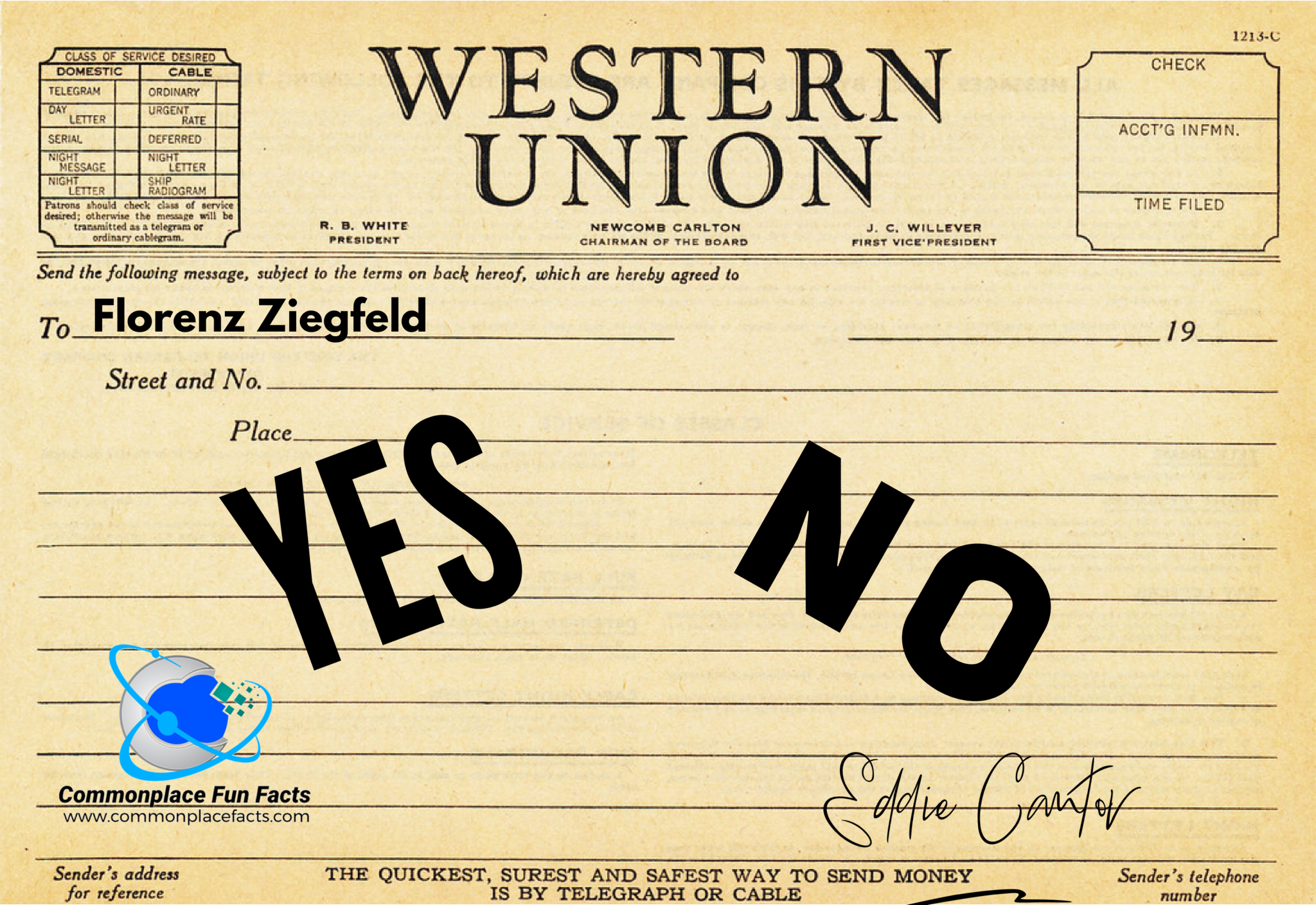

The legendary showman Florenz Ziegfeld was well known for his constant and frantic use of the telephone and telegram. He would often send his performers telegrams after watching their work from the back of the theater, offering criticisms or suggestions.
Once, when Eddie Cantor was playing Kid Boots in Chicago, he received a twelve-page telegram from Ziegfeld with a variety of suggestions, from line changes to the removal of an entire song, and remarks about the other performers, certain scenes that needed attention, and so forth.
The entire telegram was such a jumble of questions, Cantor knew that to address each question would result in the longest telegraphed interchange ever conducted. So he simply wired back: “Yes.”
This did nothing to deter Ziegfeld, who promptly fired off another telegram, twice as long as the previous missive, which ended: “What do you mean, Yes? Do you mean yes you will take out the song, or yes you will put in the lines, or yes you will fix that scene? Or yes you have talked to the other actors?”
Cantor wired back:
“No.”

Wordiness Is a Defense Against Popularity
Sir Winston Churchill was a master of the English language and greatly appreciated the effectiveness of a carefully-edited work. He was famous for emphasizing the need for brevity in all of his official documents. He had little patience for anyone who could not exercise similar discipline. Once, when evaluating a lengthy report, he remarked, “This…

Calvin Coolidge Makes Short Work of Long Sermon
Preachers and politicians often share the quality of loquaciousness. That doesn’t mean they necessarily appreciate or tolerate that quality in each other. President Calvin Coolidge earned his nickname “Silent Cal” by saying no more than necessary. He often wished others would strive toward the same objective. One Sunday morning, his wife, Grace, was ill and…

Pardon Me, Mr. President
President Abraham Lincoln personally reviewed over 1,600 cases of military convictions during his 1,503 days in office and issued many pardons and commutations to soldiers who were convicted of desertion. Lincoln referred to these cases as “Leg Cases.” He said, “If Almighty God gives a man a cowardly pair of legs, how can he help…





Leave a Reply