
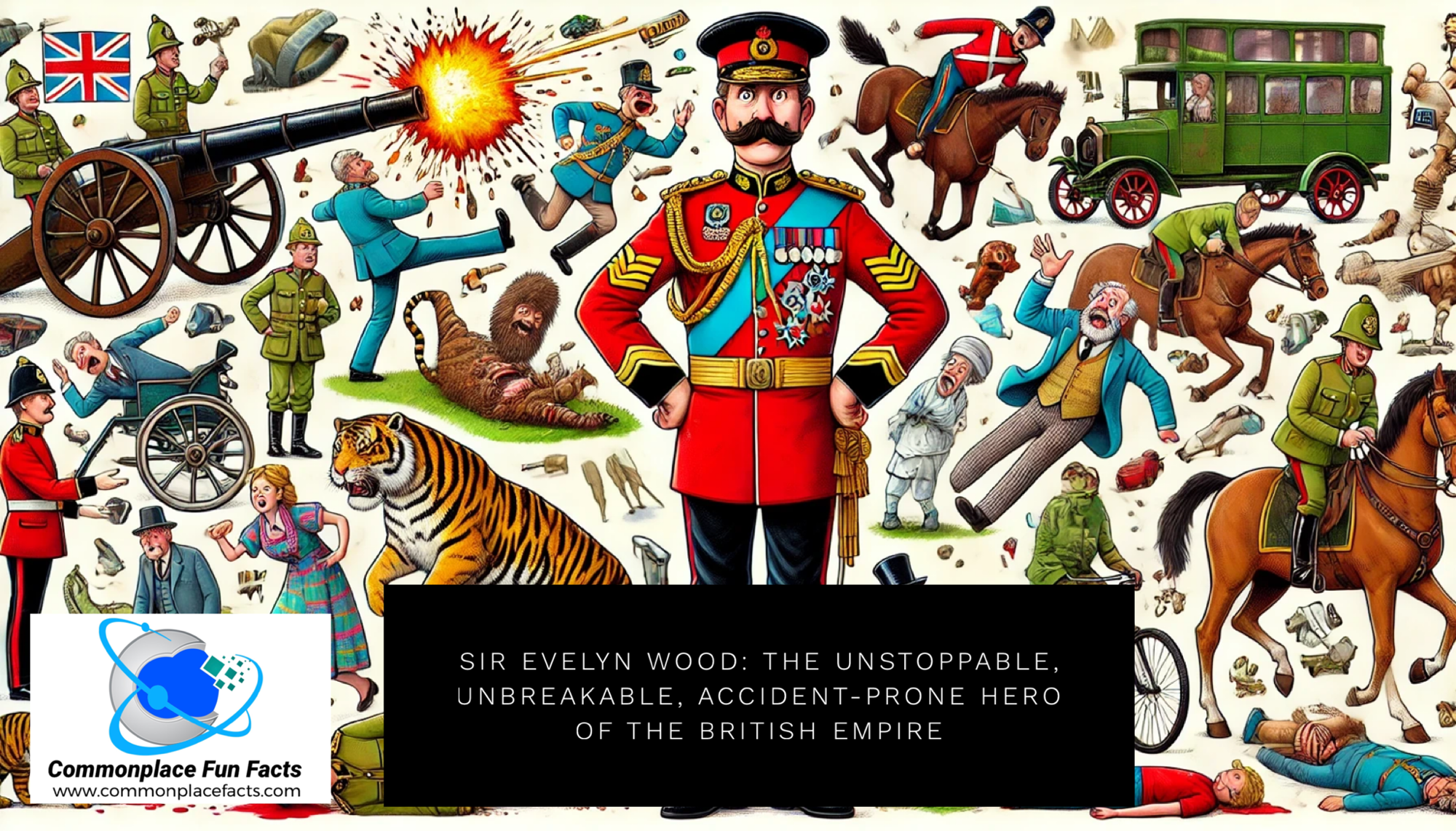

Do you like adventure stories? If so, this has the makings of being your lucky day. Who needs fictional figures such as Indiana Jones, Crocodile Dundee, or Allan Quartermaine, when we have a real-life hero whose exploits leave those fictional guys in the dust? Gather ’round and join us on a wild ride through the life of Field Marshal Sir Evelyn Wood, a man whose bravery was matched only by his sheer determination to collect injuries like a Pokémon trainer.
Our Hero’s Origin Story

Born on February 9, 1838, in a quaint vicarage near Braintree, Essex, Evelyn Wood came from a family with a pedigree more impressive than a Westminster Kennel Club winner. His paternal grandpa was the mayor of London, one uncle was the lord high chancellor, and another a Royal Navy admiral. His maternal side boasted an admiral in the Portuguese navy. Despite all this, his father, Sir John Page Wood, struggled to support his large brood on a vicar’s salary, turning young Evelyn into a poster child for financial struggle and resilience.
Evelyn did not warm to formal education. That may have had something to do with Marlboro College’s approach to discipline which was heavily centered around harsh beatings. Evelyn ditched school and joined the Royal Navy at the tender age of 15. Thanks to some family connections, he secured a midshipman appointment on the HMS Queen, a 110-gun first-rate ship of the line. Just in time for the Crimean War, Evelyn was about to embark on his first major adventure—and injury.
The Crimean Capers: Boom, Bang, and Ouch
At 16, Evelyn Wood was thrown into the thick of the Crimean War, demonstrating a level of bravery that could be described as bordering on lunacy. Assigned to the naval contingent operating big guns, young Wood got his first taste of battle and lifelong hearing problems from all that cannon fire. Nothing as trivial as partial deafness was going to stop him, though. In true action-hero style, he repaired battlements under fire and put out fires on powder magazines as casually as if he were merely stamping out a campfire.
The summer of 1855 saw him participating in the near-suicidal assault known as the Battle of the Great Redan. Armed with a scaling ladder, our plucky 17-year-old reached the fortification alone, only to be blasted by grapeshot, shattering his left arm and knocking him out. He was rescued by a corporal who, in a move straight out of a slapstick comedy, shook his shattered arm to wake him up. The fun didn’t stop there. A surgeon insisted on amputating his arm, and Wood had to stage a daring escape from the clutches of his doctor. This harrowing series of events earned him recommendations for the newly created Victoria Cross and other honors. Also, quite importantly, it marked the beginning of his lifelong collection of injuries.
The Pattern Emerges: Persistence In the Face of Illness and Injury
After the Crimean War, Evelyn hopped from one ailment to another like a hypochondriac bunny on a pogo stick. He contracted typhoid, pneumonia, malaria, dysentery, and sunstroke. If there was a disease to catch, Wood caught it. He also endured periods of deafness, eye problems, and toothaches that would debilitate ordinary men.
Wood was no ordinary man, however. Despite these ailments, he transferred to the 17th Lancers so he could head off to India for the Sepoy Rebellion. His time there was marked by sunstroke, facial neuralgia, and chronic indigestion. Wood brushed these maladies off as if they were nothing more than the common cold. In true action-movie fashion, he single-handedly fought off mutineers, broke his collarbone riding into a tree, got bitten by a tiger, and, in a move worthy of YouTube stardom, fell off a giraffe. Yes, you read that right—he fell off a giraffe, which then stepped on his face, crushing his nose and cheekbones. Clearly, Evel Knievel had nothing on Evelyn Wood.
Adventures in Africa
In 1873, Wood joined the campaign against the Ashanti Empire on Africa’s Gold Coast. Here, he was shot in the chest by a nail from an Ashanti gun, a souvenir he carried near his heart for the rest of his life. He wouldn’t let something as small as a near-fatal wound slow him down, though. He continued to lead his troops until the fighting was finished.
The Anglo-Zulu War was another chapter in Wood’s epic saga of bravery and bodily harm. He led his men in the Battle of Kambula, where he reportedly killed a Zulu chief from 250 yards away. His hearing had deteriorated so badly that he required an aide to accompany him at night to avoid being shot by his own sentries.
And the Injuries Keep Coming
During the First Anglo-Boer War, Wood negotiated an unpopular treaty, but any bad memories of that experience were overshadowed by yet another bizarre accident. While traveling in an artillery wagon, the horses were spooked by a snake and bolted, running the wagon into a termite mound. Wood was thrown out of the wagon, landing with his spine across the back of one of the horses. This caused his feet to swell to clownish proportions.
In his later years, Wood became an army reformer, pushing for better conditions for soldiers. Queen Victoria herself thought he was a swell guy, describing him as a remarkable man with imperial views. Promoted to Field Marshal in 1903, he continued his tradition of spectacular injuries. At 59, he took up bicycling, only to be bitten by a horse he ran into. The bite left a mark lasting for the rest of his life—because why break tradition now?
In 1900, a hunting fall drove a crucifix into his rib cage, a relic from his late wife. Wood again proved his resilience by surviving an injury that would have taken out an immortal vampire.
Grand Tally of Injuries
In case you haven’t caught on yet, Wood was an accident waiting to happen. Much like the unkillable General Adrion Carton de Wiart, he never gave up. All told, the list of injuries and maladies he experienced over nearly fifty years includes:
- Lifelong hearing problems from cannon fire and battles, leading to deafness.
- Shattered left arm by grapeshot during the Battle of the Great Redan, with subsequent bone splinters.
- Reopened arm wound while hunting and falling down barrack stairs.
- Contracted typhoid fever and pneumonia in the Crimea.
- Chronic neuralgia, including facial neuralgia causing “face ache.”
- Chronic digestive issues, including frequent bouts of indigestion.
- Bouts of malaria and dysentery from travels to tropical regions.
- Sunstroke during military campaigns in India.
- Periods of complete deafness from exposure to loud sounds.
- Eye problems throughout his military career.
- Toothaches requiring medical attention.
- Broken collarbone from riding into a tree while hunting.
- Bitten on the hand by a wounded tiger.
- Crushed nose and cheekbones from falling off a giraffe.
- Shot in the chest by a nail from an Ashanti gun, which remained lodged near his heart.
- Swollen feet from a fall off an artillery wagon spooked by a snake, causing a spinal injury.
- Nearly died from a morphine overdose.
- Cut and crushed fingertip during the Nile Expedition.
- Bicycle accident resulting in a severe bite from a horse pulling a cab.
- Crucifix driven into his rib cage from a hunting fall.
Retirement: The Final Chapter
Wood retired from active service in 1904, wrote several books and took on honorary roles. In 1911, he became Constable of the Tower of London. Field Marshal Sir Evelyn Wood passed away peacefully in his bed in 1919 at the age of 81. His life was a testament to bravery, resilience, and a remarkable ability to survive injuries that would have felled lesser mortals.
Evelyn Wood’s story is a rollercoaster of valor, misfortune, and sheer tenacity. His ability to bounce back from countless injuries, illnesses, and bizarre accidents is nothing short of legendary. So next time you’re having a bad day, just remember Sir Henry Evelyn Wood—a man who survived being shot, stepped on by a giraffe, bitten by a horse, and nailed in the chest, all while maintaining the kind of courage and fortitude that made him a legendary figure to be reckoned with.

Adolphe Sax: The Hated Inventor and the Dreaded Thing He Created
Adolphe Sax must have been the most unfortunate boy ever. He was certainly the most accident-prone. His mother concluded that he was “condemned to misfortune” and concluded that “he won’t live.” It seemed as if nature knew that this seemingly innocent boy would grow up to invent something so utterly horrifying and threatening that mobs…

Don’t Spend Christmas in the Emergency Room
Christmas is a time to spend in church, shopping in stores, and visiting the homes of family and friends. For too many people, it is also a time to spend in the hospital, recovering from Christmas decoration-related injuries. According to a report from the U.S. Consumer Product Safety Commission (CPSC), holiday decorations do more than…

The Foul Story of Baseball’s Unluckiest Fan
The baseball game between the Philadelphia Phillies and the New York Giants on August 17, 1957, is one for the history books. What made the game so memorable wasn’t anything like a no-hitter, extra innings, or even an impressive final score. This was a game that would go into the books because of two foul…



Leave a Reply