

The Bible is filled with references to animals. “Swarms of living things” are mentioned in the 20th verse of the first chapter, and dogs make an appearance in the 15th verse of the final chapter. Throughout the 1,187 chapters in between, we see a veritable zoo of critters working their way through the sacred texts. Some animals are clearly favorites. Sheep, generally, are mentioned 200 times, and lambs earn an additional 188 appearances. Lions show up 176 times, and horses get 164 appearances. Even creatures that no longer stalk the earth, such as leviathan and behemoth, make their appearances, generating plenty of debate in the process.
There is one animal that is curiously absent from the biblical pages. The common house cat is the only domesticated animal that cannot be found in the Bible.
Cats have been beloved pets for centuries, captivating us with their elegance, independence, and, let’s face it, their undeniable knack for causing mayhem. Yet, despite their long-standing presence in human society, there is a peculiar absence of our feline friends in history’s most significant book. This omission has puzzled many a cat lover and scholar, sparking theories and debates on why the Bible is cat-less.
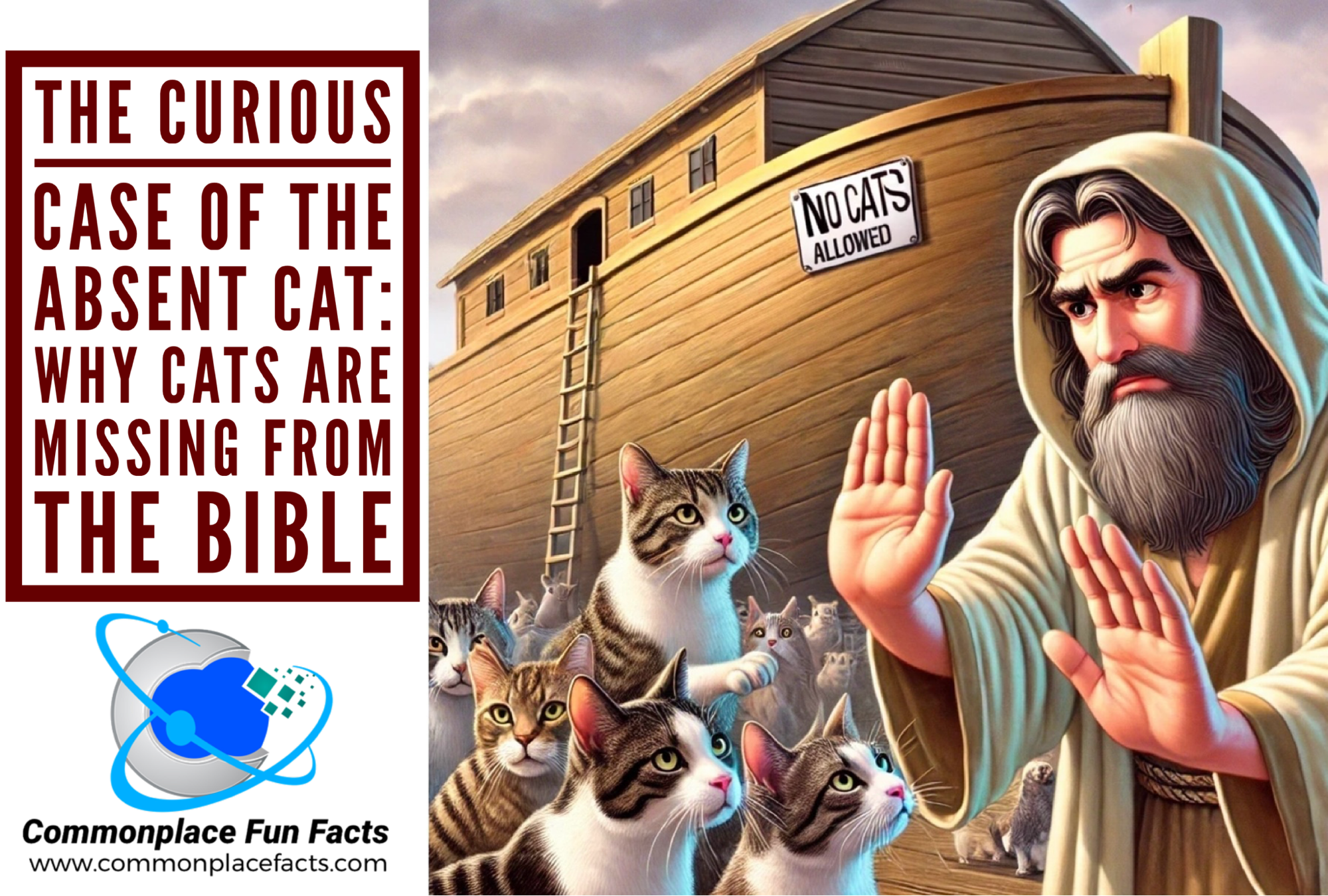
What’s the deal? Did Noah have a “No Cats Allowed” policy on the Ark? Maybe Mrs. Noah had a cat allergy? Let’s dive into this feline mystery and explore this cat-ostrophic omission.
Theories Behind the Cat Conundrum
Cats Weren’t Worthy of Mention

In ancient times, cats didn’t enjoy the same revered status they often hold today. While dogs were lauded for their roles in hunting and guarding, cats were frequently seen as pests or, even worse, as symbols of evil. This negative association could easily explain why the sacred texts chose to leave out our furry companions. It wasn’t that cats weren’t around—they just weren’t considered important enough to be included.
Cats Weren’t Native to the Region
The domestic cat we know today has its origins in the Near East, but it wasn’t common in ancient Israel, where much of the Bible was written. Cats simply didn’t have the geographical clout to make it into the Bible’s pages. Without a significant presence in the region, they weren’t familiar or noteworthy enough to warrant a mention.
Dogs, Dogs Everywhere
One noticeable trend is the prevalence of dogs in the Bible, mentioned over 40 times. Dogs were indispensable in ancient times for their hunting and guarding capabilities, making them more prominent and useful animals to include in sacred texts. Cats, on the other hand, didn’t serve such practical purposes, which could explain their biblical exclusion.
Cats and Paganism
Cats were closely associated with pagan beliefs and practices, especially in ancient Egypt, where they were revered as sacred animals linked to the goddess Bastet. This connection to paganism might have made cats a taboo subject in the monotheistic religions of Judaism and Christianity, leading to their deliberate exclusion from the Bible.
A Collection of Critters
As we have mentioned, the Bible is a veritable zoological dictionary in terms of the variety of creatures that make their appearance. Here are 48 animals that show up in its pages:
- Addax – A desert antelope (Deuteronomy 14:5).
- Ant – Known for its wisdom and industrious nature (Proverbs 6:6; 30:25).
- Antelope – Clean animal fit for consumption (Deuteronomy 14:5; Isaiah 51:20).
- Ape – Imported by Solomon’s ships (1 Kings 10:22).
- Bald Locust – Permitted for eating (Leviticus 11:22).
- Barn Owl – Considered unclean (Leviticus 11:18).
- Bat – Listed among unclean animals (Leviticus 11:19; Isaiah 2:20).
- Bear – Symbol of strength and ferocity (1 Samuel 17:34-37; 2 Kings 2:24).
- Bee – Samson found honey in the carcass of a lion (Judges 14:8).
- Behemoth – A mighty land animal, possibly mythical (Job 40:15).
- Buzzard – Mentioned in prophecies (Isaiah 34:15).
- Camel – Commonly used for transportation (Genesis 24:10; Matthew 3:4).
- Chameleon – An unclean animal (Leviticus 11:30).
- Cobra – Represents danger (Isaiah 11:8).
- Cormorant – A water bird, considered unclean (Leviticus 11:17).
- Cow – Symbol of prosperity and blessing (Isaiah 11:7; Luke 14:5).
- Crane – A migratory bird (Isaiah 38:14).
- Cricket – Permitted for eating (Leviticus 11:22).
- Deer – Clean animal, suitable for food (Deuteronomy 12:15; 14:5).
- Dog – Often mentioned in negative contexts (Judges 7:5; Revelation 22:15).
- Donkey – Used for labor and transportation (Numbers 22:21–41).
- Dove – Symbol of peace and the Holy Spirit (Genesis 8:8; Matthew 3:16).
- Dragon – Symbolic creature, representing chaos (Isaiah 30:7).
- Eagle – Represents swiftness and vision (Exodus 19:4; Revelation 12:14).
- Eagle Owl – An unclean bird (Leviticus 11:16).
- Egyptian Vulture – Considered unclean (Leviticus 11:18).
- Falcon – A bird of prey (Leviticus 11:14).
- Fish – Miraculously multiplied by Jesus (Matthew 14:17).
- Fox – Known for being cunning (Luke 13:32).
- Frog – One of the plagues of Egypt (Exodus 8:2-14).
- Gazelle – Clean animal, suitable for food (Deuteronomy 12:15).
- Goat – Used for sacrifices (Leviticus 16:7-10).
- Grasshopper – Permitted for eating (Leviticus 11:22).
- Hare – Considered unclean (Leviticus 11:6).
- Hawk – A bird of prey (Leviticus 11:16).
- Horse – Used in warfare (Exodus 14:9; Revelation 6:2-8).
- Hyena – Rarely seen though fairly abundant, powerful but cowardly, a feeder on carrion and addicted to grave-robbing (Isaiah 34:14).
- Ibex – A wild goat (Deuteronomy 14:5).
- Jackal – Often associated with desolation (Isaiah 34:13).
- Kite – A bird of prey (Leviticus 11:14).
- Lamb – Symbol of Jesus Christ, the sacrificial Lamb of God (John 1:29).
- Leopard – Represents stealth and beauty (Isaiah 11:6).
- Lion – Symbol of strength and the tribe of Judah (Revelation 5:5).
- Lizard – Considered unclean (Leviticus 11:30).
- Locust – Permitted for eating; also a plague in Egypt (Exodus 10:12-15).
- Mole – An unclean animal (Leviticus 11:30).
- Monkey – Imported by Solomon’s ships (1 Kings 10:22).
- Moth – Represents decay (Isaiah 50:9).
Conclusion
The absence of cats in the Bible remains a captivating mystery that continues to fascinate and provoke debate. While we may never definitively know why our feline friends were left out, the various theories and trends related to this topic offer valuable insights into the cultural, historical, and religious contexts in which the sacred texts were written. Whether viewed as a curious omission or a deliberate choice, the absence of cats in the Bible invites further exploration and contemplation. So, next time your cat curls up on your lap, remember that their mysterious biblical absence only adds to their enigmatic charm.
Thanks to Courageous Christian Father for the list of animals.

Scientists Create Glow in the Dark Cat — Because Normal Cats Apparently Aren’t Already Sufficiently Weird or Freaky
Why would anyone want a glow in the dark cat? Find out why scientists have created such a thing.

Is a Cat a Liquid or a Solid? The Science Behind This Fascinating Debate
Discover the surprising physics behind the question: Is a cat a liquid or a solid? Learn about the science of rheology, the Deborah number, and how cats defy expectations!

The Great Bonsai Kitten Hoax
Bonsaikitten.com, launched in 2000 as a parody by MIT students, featured fictitious “bonsai kittens” living in glass containers, sparking public outrage over perceived animal cruelty. Despite the site’s intention as a joke, animal rights groups criticized it fiercely. The FBI investigated and found no real harm. Subsequently, the site was removed from servers.




Leave a Reply