

Gather ‘round as we give you the Commonplace Fun Facts basic course on particle accelerators. Here’s what you need to know:
- They are massive.
- They are expensive.
- They do sciencey things that involve all kinds of complicated sums with mathematical symbols that appear to have been designed by ancient Egyptians or E.T.’s algebra professor.
- They are difficult and costly to repair.
That about sums it up — except for that last bullet point. Yes, they are generally difficult and costly to repair, unless, of course, you happen to have access to a talented $35 ferret named Felicia. Yes, you read that right. Join us for a story so quirky that you’d be forgiven for thinking it’s straight out of a sci-fi comedy. Trust us, this one’s for the history books (or at least for a blog post).
A Big Machine With Big Stakes
Come with us to Batavia, Illinois. The year is 1971. The National Accelerator Laboratory (NAL), which we now know as Fermilab, is in the middle of testing what was then the biggest machine on the planet—a proton synchrotron particle accelerator, capable of zipping protons around a four-mile ring at a whopping 200 billion electron volts. We’ll pause to let that number sink in and to make you suspect that we have even the foggiest notion of what any of that means.
The stakes were as high as the energy levels they were playing with. Bob Wilson, the lab’s director, had confidently told the U.S. Department of Energy that he could get this beast of a machine up and running within five years, and for a cool $250 million. The time had come to put the government’s money where Wilson’s mouth was.
Like any good high-stakes drama, things weren’t going smoothly. The problem was the magnets, specifically, the 774 dipole magnets, which were supposed to steer the proton beam, and the 240 quadrupole magnets, which focused the beam. These weren’t your run-of-the-mill fridge magnets. Each of these bad boys was 20 feet long, weighed nearly 13 tons, and was absolutely essential to the whole operation. Problems arose when the magnets started failing. First, it was just two magnets. Then it became two a day. By the time the team managed to send a beam of particles all the way around the ring on June 30, 1971, they’d already replaced 350 magnets. When they tried to crank things up, the failures escalated.
A Ferret Becomes Science’s Best Friend

Enter Ryuji Yamada, a physicist and the mastermind behind the dipole magnet. After much head-scratching, Yamada had a Eureka moment. (Actually, that’s probably a bad description when talking about a physicist. The original “Eureka moment,” of course, was when Archimedes had a bright idea while bathing and went on a naked run through the streets of Athens, yelling, “Eureka!” As quirky as brainiacs tend to be, there’s nothing in the record that suggests Yamada copied Archimedes’ streaking sensation. Anyway, back to our story…)
Yamada realized the problem with the magnets were tiny metal slivers left behind when engineers cut into the vacuum tubes. When the magnets were powered up, these slivers were pulled into the magnet gap and wreaked havoc by blocking the beam. They had to get those slivers out, and fast.
We’re talking about a $250 million thingamawoojit, so obviously, any kind of repairs are going to be pretty expensive, right? That’s probably the route they would have had to go, had it not been for Robert Sheldon. Sheldon was a British engineer known for his out-of-the-box ideas. He suggested a ferret. His logic was simple: in his native Yorkshire, hunters used ferrets to flush rabbits out of their warrens, so why not use one to clean out the vacuum tubes?
Training a Ferret for Science: The Rise of Felicia

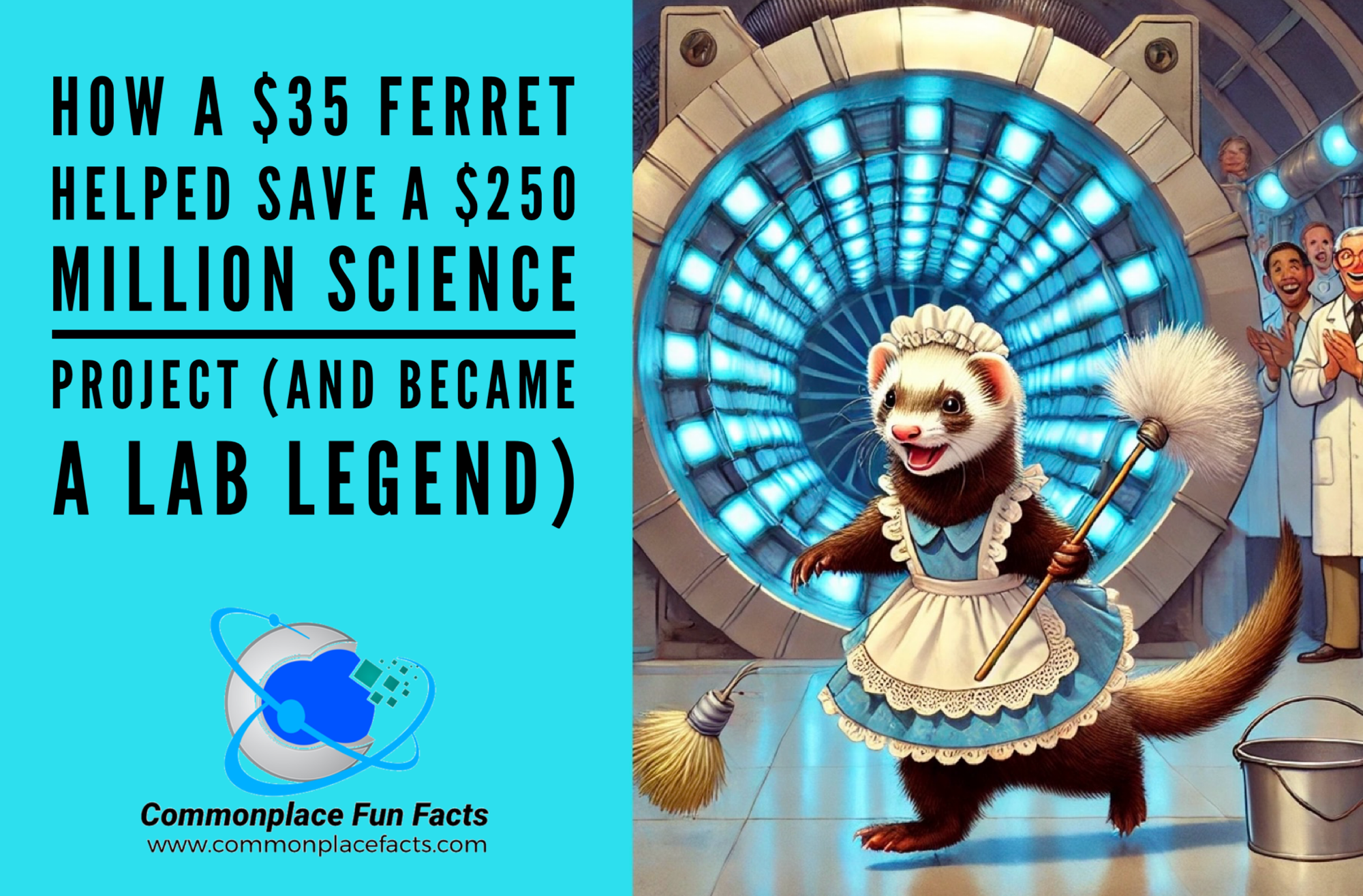
Enter Felicia, a ferret from the Wild Game and Fur Farm in Gaylord, Minnesota. At 15 inches long and sporting a fetching coat of brown and black fur with white patches on her face, Felicia was the smallest ferret the farm had ever produced. And at $35, she was quite the bargain for a scientific hero in the making.
Felicia was no ordinary lab animal. The scientists at NAL didn’t just toss her into the vacuum tubes and hope for the best. They fitted her with a custom collar, attached a string to it, and even put a diaper on her—because, as it turns out, ferret poop in a tube is just as problematic as metal slivers when you’re trying to accelerate protons.
The plan was simple: Felicia would scamper through the vacuum tubes, pulling the string along behind her. Once she reached the other end, the scientists would attach a cleanser-dipped swab to the string and pull it back through the tube, collecting all the metal slivers in the process.
A Reluctant Hero: Felicia’s Trials and Triumphs
Felicia didn’t immediately warm to the whole “scamper around a dark, narrow, four-mile-long tube” thing. Who can blame her? Instead, the scientists reassigned her to a smaller task: the Meson Lab, a testing facility that was still under construction and had more manageable 12-inch-wide tubes.
With a bit of training, Felicia was soon scampering through progressively longer tunnels like a pro. After her first successful run through a 300-foot section, she emerged looking “a little tired and bemused but otherwise quite healthy,” as Frank Beck, a former head of research services at Fermilab, put it. The swab pulled through behind her came out covered in specks of dust and steel. Mission accomplished.
Felicia’s escapades quickly made her a media darling. Time magazine even suggested she should be rewarded with a mate, to which one unnamed official quipped, “If Felicia became pregnant, she might not fit through the tubes.” It’s always a challenge when scientists become celebrities.
A Short But Heroic Career: Felicia’s Legacy
Despite the media attention, Felicia’s role in the project was relatively short-lived. She made seven successful runs before being retired to a mink farm, where she spent most of her days as a beloved pet. The scientists still had a four-mile ring to clean out, and Felicia wasn’t quite up to that task. Enter Hans Kautzky, an engineer who developed a “magnetic ferret.” This device, a stainless steel rod equipped with Mylar disks, a flexible 700-meter cable, and a permanent magnet, was shot through the main ring with compressed air, pulling the metal slivers along with it. While it wasn’t perfect, it worked well enough to allow the accelerator to reach its target energy level on March 1, 1972.
As for Felicia, her retirement was tragically short. In the spring of 1972, while staying at the home of a NAL employee named Charles Crose, she fell ill and died from a ruptured abscess in her intestinal tract. Plans were made to stuff and mount her as a permanent symbol of NAL’s early days, but no one knows if that actually happened. Fermilab’s archivist, Valerie Higgins, has scoured the storage spaces, but Felicia’s final resting place remains a mystery.
The Legacy of Felicia: Science Marches On
Today, Fermilab is one of 17 national labs in the U.S. and boasts multiple particle accelerators. Of the 13 known subatomic particles in the Standard Model, three were discovered there: the bottom quark in 1977, the top quark in 1995, and the tau neutrino in 2000. The accelerator complex operates 24/7, with occasional maintenance shutdowns, during which the tubes are cleaned using—you guessed it—a method Felicia made famous: a string and a swab.

The First Telephone Book Had 50 Names, No Numbers, and Some Very Strange Rules
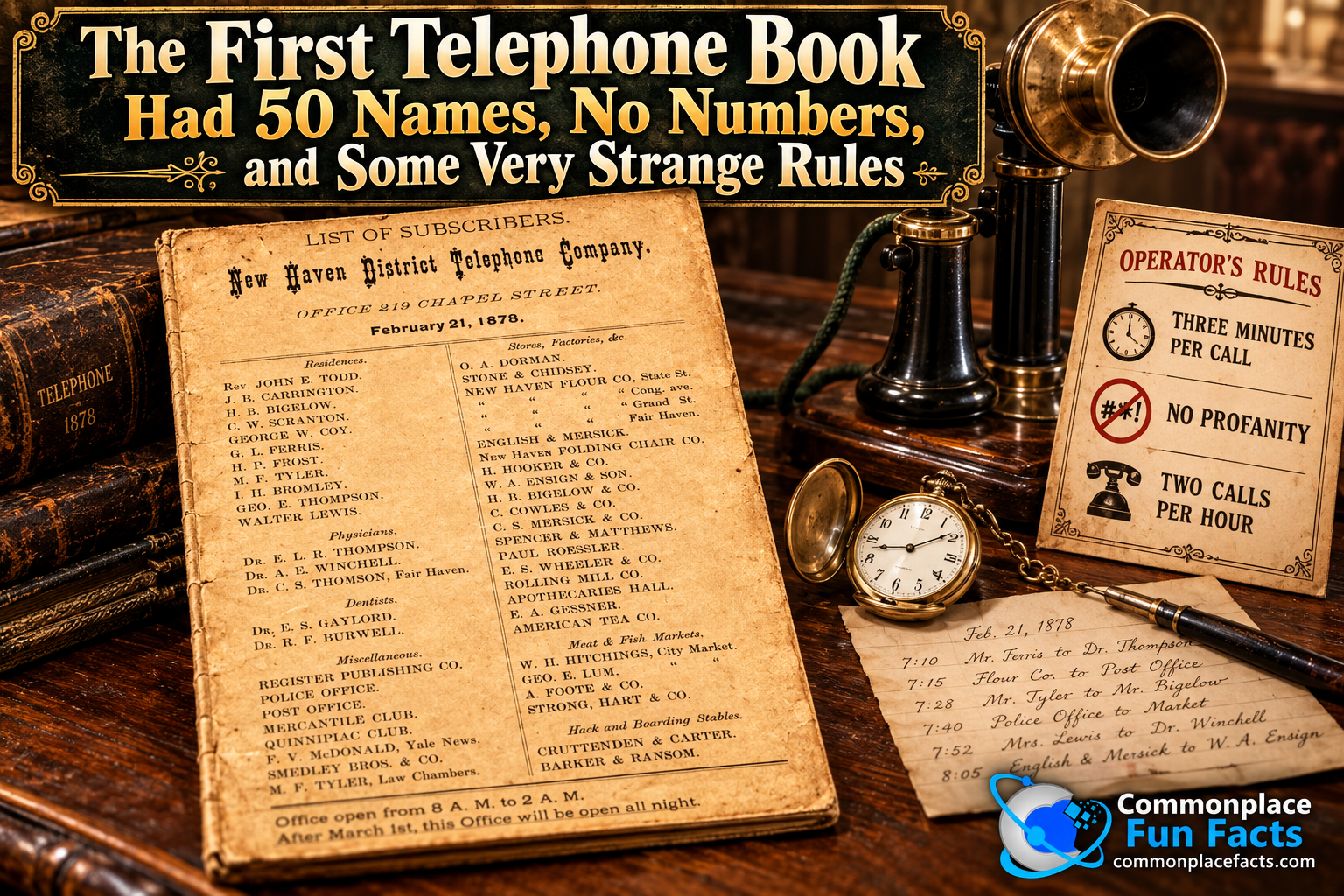
The world’s first telephone book had 50 names and no phone numbers. Nine months later, subscribers faced three-minute call limits, rules against swearing, and instructions on how to say hello. Welcome to telecommunications in 1878. #History #Technology

The Great Lafayette: The Magician Whose Greatest Trick Came After Death
In 1911, the Great Lafayette died in a devastating Edinburgh theater fire. Authorities identified his body, cremated it, and considered the matter settled. Then another corpse appeared wearing his distinctive rings. With a body double, a beloved dog, a real lion, and one extraordinarily unfortunate case of mistaken identity, the famous magician managed his strangest…

The Times Square Ball Drop Started With Sailors. Naturally, Things Got Out of Hand
Every New Year’s Eve, millions watch the Times Square ball drop. But the tradition’s origins have nothing to do with celebrating the new year. Discover how a nineteenth-century invention designed to help sailors navigate the oceans became one of the world’s most famous celebrations.



Leave a Reply