
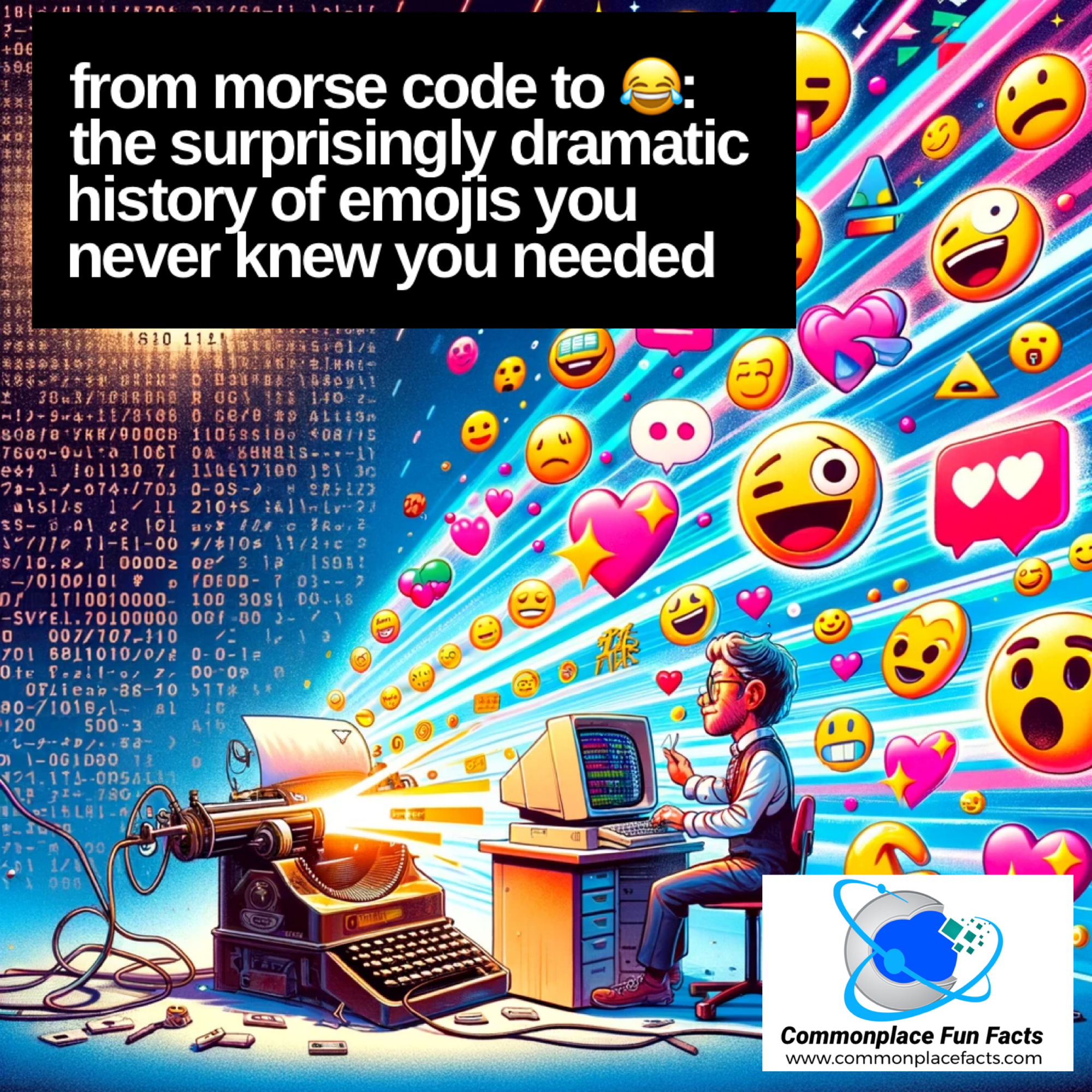

😊📱👉🌍✉️📝➡️😄🎉. 🌟📅, 🤔💭 “🤷♂️❓” 🔄📧➡️📲🖥️, 👨💻💡✨1980s 💭, 🗣️📡📧➡️💬. 🇯🇵📱➡️🎨🖍️🔠🖥️, 🥳🙌. 🕰️➡️, 🌍👨💻📱➡️🎉😜. 😱🚨📚🔎, 🕵️♀️📝, 👨⚖️⚖️❗🚫❌❗
They say one picture is worth 1,000 words. We weren’t able to hit that ratio, but we did use 61 pictures to say 81 words. For those who can’t read fluent emoji, the above paragraph translates as follows: Emojis have taken over the world of digital communication, making our messages more expressive and fun. But have you ever wondered where they came from? It all started in the 1980s, when a computer scientist had a brilliant idea: use symbols to show emotion in text. Later, Japanese mobile phones added colorful characters, and the rest is history. Now, they’re everywhere, from our screens to legal battles, proving that these tiny icons are more powerful than they seem.
That was easy, wasn’t it?
It Begins With Poetry and Morse Code
If you aren’t fluent in the language of smiley faces, perhaps you would benefit from a brief dive into the history of the phenomenon. The picturesque communication tools are so much a part of our lives, that it’s hard to imagine a time without them. To do so, we’d have to look at a time well before the birth of computers.
The father of emojis might possibly be the 17th century poet Robert Herrick. In 1648, he wrote “To Fortune.” The second line of the poem has some interesting punctuation:
Tumble me down, and I will sit
Upon my ruins, (smiling yet:)
Did he intend to create a smiley face? We’re not sure, but it sure looks like one.
That historical anomaly aside, the development of our colorful characters draws its main roots from Morse code. You remember those days, don’t you? Neither do we. Even so, our beloved 🙂 and 😦 have roots in the days when the height of technology was a series of dots and dashes. Morse code operators had special abbreviations to use for brightening an otherwise boring day. Although their dots and dashes did not visually look like a smiley face, they showed the necessity to convey emotions through a communication system that was, let’s face it, as expressive as a rock.
We can’t talk about smiley faces, of course, without making a hat tip to the guy who created the iconic smiley face, in the first place. Read this article to learn about Harvey Ball, the guy responsible for more smiles than you can count.
Back to the topic at hand, let’s fast forward to 1982. Enter Scott Fahlman, a computer scientist at Carnegie Mellon University, who probably had no idea he was about to change the world. Fahlman noticed that jokes and serious posts on online bulletin boards were being hopelessly misunderstood. Humor is tricky business, after all. In what can only be described as a stroke of genius—or perhaps the result of one too many misunderstood posts—he suggested that 🙂 be used to indicate a joke, and 🙁 to indicate something more serious. This was the birth of the digital emoticon.
The idea spread like wildfire among the early internet crowd, and soon, you couldn’t visit a message board without seeing smileys and frownies peppered throughout. We’ve got Scott to thank for those late-night AIM sessions where every sentence ended in a 😉 because, well, we were all just trying to be cool.
Japan Takes It to the Next Level: Enter Emoji
Now, let’s hop across the Pacific to the land of innovation: Japan. The late 1990s saw the rise of mobile phones—those clunky, antennaed gadgets that now seem more prehistoric than the dinosaurs. It wasn’t the phones themselves that were the real game-changer. It was something much smaller—176 tiny things, to be exact.
Enter Shigetaka Kurita, a Japanese interface designer at NTT DoCoMo, a major telecom company. Kurita noticed that people were increasingly using symbols and pictures to express themselves in text messages. Realizing the potential to make communication more expressive, he and his team created the first set of emojis—176 little icons that could convey everything from weather conditions to love and anger. These weren’t just happy faces, folks. This was the full range of human emotion, encapsulated in a few pixels.

The first emojis were a hit in Japan, but it wasn’t long before they took the world by storm. Major tech companies like Apple, Google, and Microsoft got in on the action, and soon, emojis were everywhere. Remember when you had to download a special app just to get a smiley face on your phone? Those days are long gone. Now, our phones come pre-loaded with hundreds of emojis, just waiting to be unleashed in the next group chat.
The Great Emoji Standardization: When Google Met Unicode
But here’s where things get interesting—if you consider standardization interesting, that is. In 2007, a team at Google had a brilliant idea: what if emojis were standardized so they could be used across different platforms? Up until then, each mobile carrier in Japan had its own set of emojis, meaning that what looked like a smiley face on one phone might look like… well, who knows what, on another. It was emoji chaos!
The solution? Unicode. Now, before you glaze over at the mention of tech jargon, stick with us here. Unicode is basically the reason your texts don’t look like gobbledygook when sent from an iPhone to an Android. It’s a universal character encoding standard that ensures every letter, number, and—yep—emoji, appears the same across all devices.
In 2010, Unicode officially recognized emojis, adding 114 of them to their standard. This was just the beginning, though. Apple, ever the trendsetter, released an emoji keyboard in Japan with iOS 2.2 in 2008. A year later, they proposed adding 608 new emojis to Unicode, bringing the total to a whopping 722. Emojis had officially gone global, and there was no turning back.
Emojis in the Wild: From Cute to Criminal

Now, we could end the story here with everyone living happily ever after in emoji-land, but that wouldn’t be very 21st century, now would it? As it turns out, those tiny icons we love to sprinkle into our messages can get you into some serious trouble.
Case in point: France, 2015. A 22-year-old man was sentenced to three months in prison for texting his ex-girlfriend a pistol emoji. The court decided it constituted a “real threat,” and that’s when things got serious. The United States hasn’t been immune to the phenomenon either. In a Massachusetts murder case, prosecutors successfully argued that the defendant’s use of an emoji with Xs for eyes, paired with the victim’s nickname, suggested premeditated homicide. The emoji was evidence of criminal intent, and it played a role in the conviction.
It gets even more complicated. Because different platforms can display the same emoji in slightly different ways, the meaning of a message can change depending on the device. Imagine sending a friend the sequence🚑 👉👊, intending to convey that an ambulance is on its way to help with an injured hand. But on the recipient’s phone, the emoji flips: 👊 👉 🚑, and it looks more like you are threatening to punch your friend hard enough to send him to the hospital. Lest you think this example is too on the nose, that was the exact message sent by two men taken into custody for stalking charges in South Carolina.
This emoji miscommunication isn’t just theoretical. It’s happened in real life, and it’s landed people in court. The issue boils down to how different platforms—like Apple, Google, and Microsoft—choose to display emojis. While Unicode provides the basic framework, it doesn’t dictate exactly how each emoji should look. This leaves room for interpretation, which can be a real problem when emojis end up as evidence in legal cases.
The Future of Emoji: Where Do We Go From Here?
Where does this leave us? Emojis have come a long way from their humble beginnings as emoticons in the world of Morse code. They’ve gone from being a quirky addition to text messages to a global phenomenon, complete with their own movie (which we won’t discuss further, for everyone’s sake). And as we’ve seen, they’re not just cute—they can have real-world consequences.
As technology continues to evolve, so too will our beloved emojis. We’ve already seen the rise of animated emojis, custom emoji creators, and who knows what’s next? Maybe we’ll be able to send holographic emojis one day. But one thing’s for sure: the emoji isn’t going anywhere. It’s become an essential part of how we communicate, adding a layer of emotion and nuance that text alone can’t always convey.
Meanwhile, let’s not forget the cautionary tales. As fun as they are, emojis can also be misunderstood—or worse, used against us. So next time you’re about to send that innocuous smiley face or that playful wink, take a moment to consider how it might be interpreted. Because in the world of digital communication, a picture may be worth a thousand words—but sometimes, those words aren’t the ones you intended.

The First Computer Bug Was a Moth. Yes, Really.
Discover the surprising origin of the first computer bug, from Thomas Edison’s inventions to Grace Hopper’s infamous moth. A humorous look at how one insect made tech history.

How Do QR Codes Work? Because Typing URLs is So Early 21st Century
How do QR codes work? Discover the mystery behind those pixelated boxes.

How Hundreds of Mazda Infotainment Systems Got Nuked by One Radio Station
In 2022, a KUOW 94.9 HD Radio signal bricked Mazda infotainment systems across Seattle. Learn how a simple data error caused chaos for drivers.



Leave a Reply