
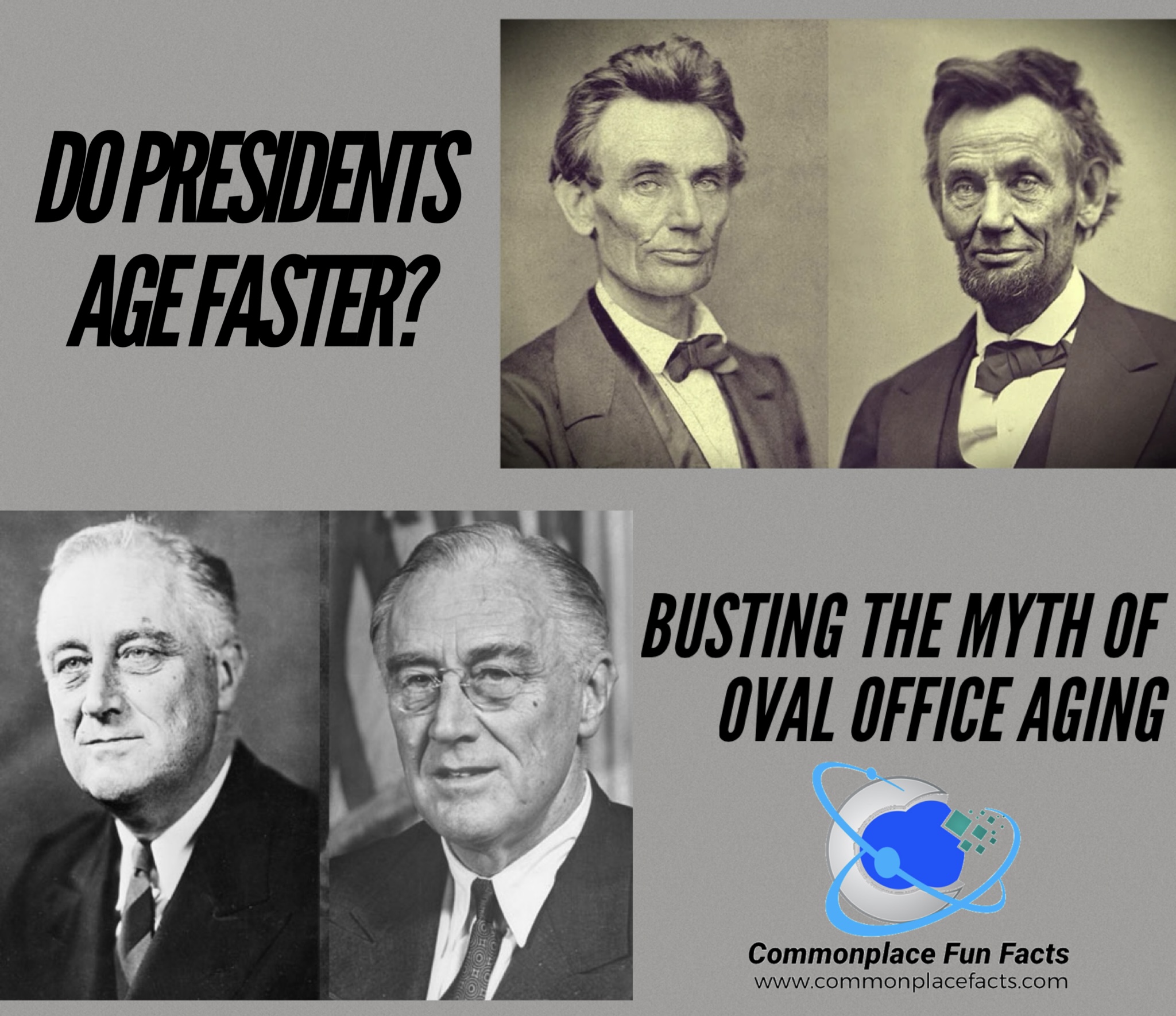

Being president of the United States is the most difficult job on earth. The nonstop stress is so great that we all expect the president to end the job looking much older than when he started. How much of that is reality? Do presidents age faster than ordinary mortals?
It has to be true, doesn’t it? Presidential aging must work a lot like dog years — one human year in office equals two, or something like that. The proof? Look no further than those before-and-after photos that capture presidents with grayer hair and more lines than an interstate highway. But does the highest office in the land actually accelerate aging? Or is this just another myth that looks great in a headline? Let’s dive into this historical rabbit hole and see if the science backs up the claim.
The Origin of the Double-Aging Myth


It would seem that we need no more evidence about the peculiar phenomenon of presidential aging than the before and after pictures of two presidents. Just look at Abraham Lincoln and Franklin D. Roosevelt at the time they were elected to the office. Then take a look at the last photographs that were taken in their administrations. Do presidents age faster? It seems that this puts that question to rest.
Experts such as Dr. Michael Roizen claimed that presidents “age two years for every year they are in office.” Roizen’s theory, supported by presidential medical records dating back to the 1920s, caught fire, and suddenly, everyone was diagnosing the presidency as the world’s fastest ticket to the golden years.
Putting the Theory to the Test
Dr. S. Jay Olshansky wasn’t convinced. He is a professor of public health and a human longevity expert. He heard the two-years-for-one theory and thought, “Hold on a minute, can we actually prove that?” He did what any self-respecting academic would do—he ran a study. Olshansky analyzed data on presidential aging, dating back to the days of George Washington, to see if Roizen’s theory held any water.
His findings, “Aging of US Presidents”, published in the Journal of the American Medical Association in 2011, threw a big bucket of cold water on the idea. Olshansky’s methodology was simple: He compared how long presidents were expected to live at the time of their inauguration with how long they actually lived. Using life expectancy data for U.S. men, he also brought in French statistics for the really old-timers, as reliable American stats only stretch back to 1900. He crunched the numbers under the assumption that presidents age twice as fast and — brace yourselves — it didn’t quite add up.
So, Are Presidents Really Living Longer?
If anything, Olshansky’s research suggested that presidents don’t just age at a normal rate—they might actually live longer than the average guy. Out of 34 presidents who passed from natural causes, 23 outlived the average lifespan expected of them at inauguration. To put it in perspective, the first eight presidents lived an average of 79.8 years, nearly double the average lifespan for men in their day, which was just shy of 40. As for recent presidents? Let’s just say that Gerald Ford, Ronald Reagan, and George H.W. Bush lived into their 90s. As of this writing, Jimmy Carter is 100 years old. In a world where the average lifespan for U.S. men is about 75, that’s impressive.
Why are we convinced that the presidency fast-tracks you to the grave? How could we be mistaken about the effects of the presidency on health? Maybe it’s the daily deluge of photos documenting every gray hair and forehead wrinkle. Most of us get to hide the signs of advancing age from all but our closest friends and family. If you are the president, you don’t have that luxury.
Longevity experts like Olshansky also point out that presidents are typically educated and wealthy—two key ingredients in the recipe for a long life.
All Those Presidential Ailments? Not as Unique as You’d Think
If you dive into the health records of U.S. presidents, you’ll find complaints about back pain, hearing loss, sinusitis—the usual suspects in the aging game. But are these ailments unique to those wielding executive power? Hardly. In Olshansky’s words, “It happens to everyone when they grow older.”
When it comes to the presidency, we hear about every ache and sniffle. We even hear about the embarrassing bits. All of that health-related news reinforces the myth about the effects of the presidency on health.
Let’s be honest, if every one of us had a dedicated press team chronicling our yearly physicals and medical misadventures, our health stories might sound pretty presidential, too.
The Real Reason for Those Gray Hairs
But what about the hair? Presidents are known to go gray as fast as a trendy Manhattan restaurant fills up at lunchtime. Olshansky argues that this isn’t exactly an anomaly. If you take any 40- or 50-something-year-old man and follow him for eight years, odds are he’ll show more grays and wrinkles, regardless of his job title. In other words, it’s not so much the presidency that’s aging these guys—it’s a little thing called life.
Final Verdict: Do Presidents Age Faster? Not So Much
In the end, the theory that presidents age twice as fast might make for a fun party fact, but science says otherwise. If anything, presidents are blessed with longevity, perhaps thanks to their access to top-notch healthcare and, yes, the occasional vacation. So, while the hair dye and wrinkle creams might fly off the shelves a little faster in Washington, D.C., there’s no evidence to suggest the Oval Office is a supercharged presidential aging machine.
The next time you see those before-and-after photos, just remember: gray hair doesn’t equal a shortened lifespan. In the end, presidents age just like the rest of us—they just happen to do it in the spotlight, under the unyielding gaze of cameras, voters, and history itself. But hey, if they end up outliving us all, we might have to reconsider who’s really living the good life.
You may also enjoy…

Does France Always Surrender? Exposing the Surprising Truth Hidden Behind Musket Smoke
Think France always surrenders? Think again. This deep dive into French military history debunks the surrender myth with facts, battles, and a whole lot of musket smoke.

Busting the Myth: Can You Teach An Old Dog New Tricks?
Discover whether you can teach an old dog new tricks and find out why the old saying is all bark and no bite. Backed by science and served with humor, this myth-busting article proves age is just a number—even for dogs!

Cow Tipping 101: Myth-Busting the Moo
Discover the truth behind the myth of cow tipping! This humorous and fact-filled article explores the science, folklore, and pop culture behind one of rural America’s most enduring (and impossible) legends.




Leave a Reply