
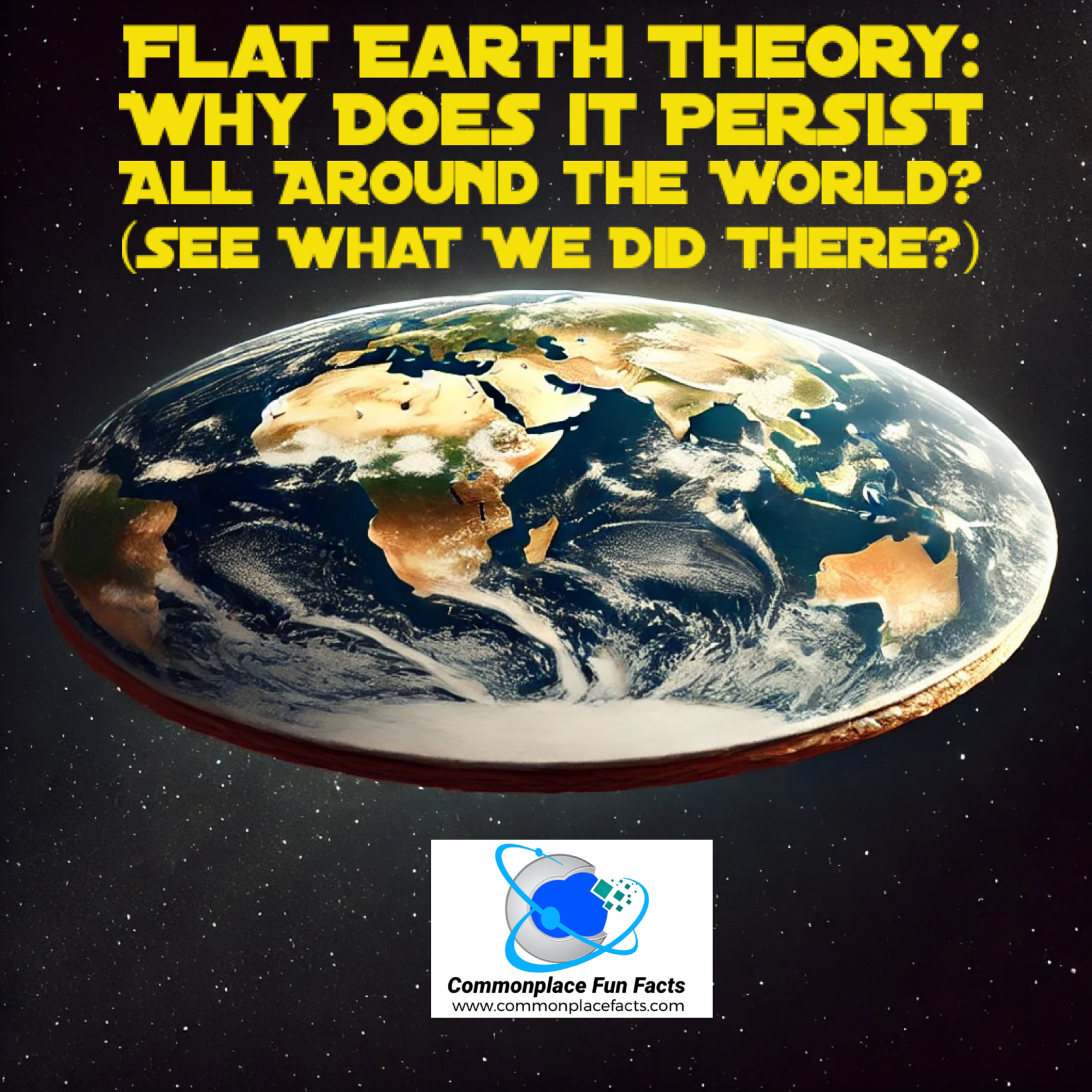

Why Do People Believe The Earth is Flat?
Do you know any flat earthers? These are folks who subscribe to one of the craziest of conspiracies. They think that those of us who believe that the earth is round have bought into some strange multi-national scam to keep us from acknowledging that the earth is as flat as a pancake.
Yes, we know it sounds crazy, but we live in a world where some people seem to think that pineapple belongs on pizza. Clearly, nothing is beyond the capacity for some folks to believe. When it comes to the Flat Earth Theory, there’s more adherents out there than you might believe.
Let’s embark on a historical (and occasionally head-scratching) journey through the winding path of Earth’s roundness and the bold souls who, despite mountains of evidence, are still convinced Earth is as flat as a board.
A Spherical Revelation: Pythagoras, Aristotle, and a Well-Placed Well
Our journey begins around the 6th century BC, when Pythagoras—the triangles guy (and the fellow who had a deadly phobia about beans) first suggested that the Earth might not be a flat plane after all. Naturally, the idea didn’t exactly go viral. A couple of centuries later, along came Aristotle (4th century BC) with some actual evidence, pointing out how the southern constellations change position when you travel south. He also observed that during a lunar eclipse, the Earth’s shadow on the Moon was round. A certain pattern seemed to be emerging.
It was Eratosthenes, the 3rd century BC genius librarian of the Library of Alexandria, who truly made waves. Using a stick, a shadow, and a well, he calculated the Earth’s circumference. At noon on the summer solstice in Syene, the Sun shone directly down a well. Meanwhile, in Alexandria, Eratosthenes measured a shadow that was at a 7-degree angle. From this angle and the known distance between the two cities, he calculated Earth’s circumference with stunning accuracy. Not bad for a guy with no calculator.
The Dark Ages Myth and Medieval Round Earth Advocates
Fast-forward to the so-called “Dark Ages,” when it’s popularly believed that religious zealots squashed round-Earth beliefs underfoot. In reality, Christianity didn’t just entertain the idea of a spherical Earth; it embraced it. The 7th-century monk Bede discussed Earth’s spherical shape in his work, The Reckoning of Time. By the time Dante’s Divine Comedy came along in the 1300s, the notion of a round Earth was as settled as medieval science could get.
Historians like Jeffrey Burton Russell put it plainly: “With extraordinarily few exceptions, no educated person in the history of Western Civilization from the third century B.C. onward believed that the Earth was flat.” Every sailor could see the Earth’s curve as ships vanished bottom-first over the horizon. You don’t need a PhD to figure out that things disappear over a curve, not a flat plane.
The Rise of the Modern Flat Earth Society: Rowbotham’s Big Ideas
So, if humans have known about Earth’s roundness for over two millennia, why on Earth is there a Flat Earth movement? Allow us to introduce you to Samuel Rowbotham, a 19th-century dropout from London, who would become the reluctant father of the modern Flat Earth movement. Not only did Rowbotham argue that the Earth was flat, but he also claimed that all heavenly bodies were just a few thousand miles above us. Rowbotham was charming, persuasive, and a master debater. That doesn’t mean that he knew what he was talking about; he was simply good at convincing laypeople that he was.
He eventually established the Zetetic Society, which thrived on the philosophy of only accepting truths that one can prove firsthand. This “see it to believe it” approach would form the cornerstone of Flat Earth ideology for generations to come.
Sputnik and Satellites: A Minor Inconvenience for Flat Earthers
In 1956, Samuel Shenton revived the Flat Earth movement with the International Flat Earth Research Society, just in time to witness Sputnik orbit the Earth. Naturally, Shenton dismissed the obvious implications, suggesting that satellites merely circled above the flat disc of Earth. When NASA started sending back photos of our little blue sphere, Shenton calmly explained that they were meant to “fool the untrained eye.” And when astronauts returned with firsthand accounts? “Public deception,” he proclaimed.
By the 1970s, however, membership dwindled to around 100 as the inconvenient truth of a round Earth became harder and harder to ignore.
Enter the Internet: Flat Earth 2.0
The modern era brought new life to the Flat Earth movement in the form of a discussion forum established in 2004 by Daniel Shenton (no relation to Samuel). With the launch of social media, Flat Earth theories found fresh soil to grow. Today, the society has an online presence with countless pages and groups dedicated to spreading “the truth.” Their model? Earth is a disc surrounded by an ice wall, conveniently guarded by NASA, who apparently has nothing better to do than keep us from falling off the edge.
The Science (or Lack Thereof) Behind Flat Earth Beliefs
The Flat Earth Society, ever skeptical of things like “evidence” and “physics,” explains phenomena like gravity with a delightful theory: the Earth is constantly accelerating upward at 9.8 meters per second squared, giving us the illusion of gravity. When asked how the Earth could keep accelerating without reaching the speed of light, the society pulls out some impressive-sounding physics jargon to assure us that special relativity has their back.
As for day and night, the society posits that the Sun moves in circles around the North Pole, like a celestial spotlight. Eclipses? Phases of the Moon? Atmospheric optics? They shrug these off, confident in the knowledge that it’s all part of a vast conspiracy.
You can read for yourself how they explain away all these things through the Flat Earth Wiki.
Belief Perseverance and the Lure of Conspiracy
So why do Flat Earth theories persist despite overwhelming evidence? if we could answer that question, we’d know why the Sovereign Citizen movement hasn’t been cast into the burn pile of discredited conspiracy theories. Humans, as it turns out, are hardwired to seek patterns and meaning, often creating them where none exist. Belief perseverance, cognitive dissonance, and the comfort of a community all play a role. Ironically, while Flat Earthers advocate “trusting your senses,” they often ignore any evidence that contradicts their worldview, dismissing it as manipulated or unreliable.
And as for us Round Earthers? We’ll keep our telescopes aimed at the sky, our sextants at the ready, and our eyes peeled for that mythical NASA ice wall tour package.
You may also enjoy…

The Tartarian Empire: The Internet’s Favorite Lost Civilization That Wasn’t
Explore the Tartarian Empire theory, from old maps and real Tatar history to mud floods, grand architecture, and internet pseudohistory.

Albert K. Bender: The UFO Investigator Who Helped Create the Men in Black Legend
Albert K. Bender founded one of the first UFO investigation groups, tried to contact aliens by telepathy, and helped launch the Men in Black legend.

“Louie Louie”: Why the FBI Investigated Rock-and-Roll’s Most Mumbled Song”
In 1964, the FBI investigated “Louie Louie” for obscenity, only to conclude that The Kingsmen’s garbled lyrics were officially unintelligible.



Leave a Reply