
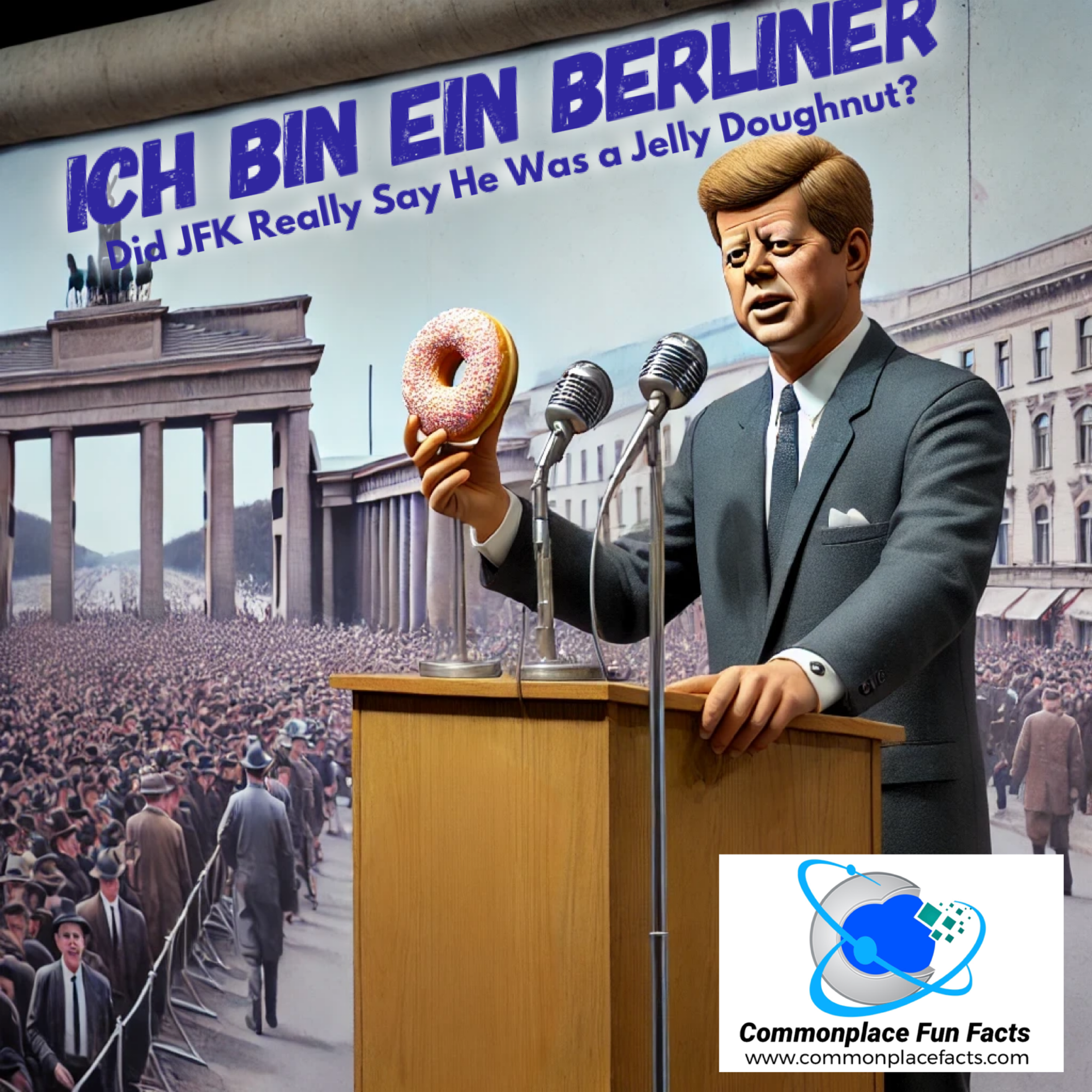

Ich Bin Ein Berliner — a Great Moment of Solidarity or an Embarassing Misstatement?
It was one of the defining moments of the 20th century. On June 26, 1963, President John F. Kennedy stood on the steps of the Rathaus Schöneberg in West Berlin, face beaming, speech ready. A crowd of 450,000 Berliners waited in anticipation. The Cold War was in full freeze, and Kennedy was there to rally West Berlin with a call to democracy that would echo through history. At least, that was the plan. Depending on who you ask, what followed was one of the most iconic moments of his presidency or it was an embarrassing gaffe.
“Ich bin ein Berliner!” Did he claim solidarity with the citizens of Berlin, or did he confess that he chose to identify as a jelly doughnut?
We sent the Commonplace Fun Facts Fact Check Department on an all-expense-paid trip to Berlin to find the truth. OK, technically, we told our volunteer intern not to come out of his room until he appropriately scoured the internet to separate the wheat from the chaff, but either way, we’re pretty confident we finally figured this one out.
Contents
The Berlin Wall: The Front Line of the Cold War
To set the scene, let’s rewind a couple of decades. After World War II, Germany was divvied up by the Allies with more gusto than hungry college students parceling out the last piece of pizza. The United States, Great Britain, France, and the Soviet Union each took a slice. The capital, Berlin, was smack in the middle of Soviet-occupied East Germany. It, too, was split up between the Allies. The divided city became the ultimate Cold War hotspot, a stew of espionage, tension, and some good old-fashioned defiance.
Fast-forward to 1961, and East Germany’s leader Walter Ulbricht, fed up with East Germans hopping the border to the West, ordered a wall to keep the East Berliners from becoming West Berliners. One morning, the people of Berlin woke up to find the city cleaved in two by concrete, barbed wire, and guard towers. East Germany dubbed this architectural masterpiece the “Anti-Fascist Protection Wall,” while the rest of the world calls it, with less flourish, the Berlin Wall. It was more than just a wall; it was a grim reminder of division, isolation, and ever-growing animosity between the Soviet Union and its former allies.
Kennedy’s Moment on the Stage
This is the background for the Kennedy’s Berlin speech. Amid mounting criticism that America wasn’t doing enough to resist Soviet aggression, he arrived in Berlin with a speech designed to hit all the right notes: he applauded West Berlin’s resilience, assured the city of unwavering U.S. support, and called out the divide between East and West. Then, in a final flourish, he uttered the immortal words, “Ich bin ein Berliner,” (“I am a Berliner,”) declaring his solidarity with the city’s residents. For the Berliners listening, the message is crystal clear: freedom-loving people stick together.
Back in the English-speaking world, the gossip took those words detour—right to the nearest bakery.
The Great Doughnut Myth: A Case of Sweet Misinterpretation
Not long after Kennedy’s speech, a rumor popped up that he didn’t actually call himself a Berlin resident; he called himself a jelly-filled pastry. Yes, the jelly doughnut in question—a Berliner, to be exact—sparked what would become a culinary Cold War myth. Legend has it, instead of cheers, Kennedy’s audience broke out into laughter at his choice of words, as they heard the most powerful man in the world proclaim himself to be a delicious pastry.
As embarrassing as such a gaffe would be, he wouldn’t be the only occupant of the White House to have some cringeworthy moments thanks to mistranslations. Just ask Jimmy Carter, for example. Or consider the possibility that the bombing of Hiroshima was a result of a mistranslation. Even so, that’s a pretty big deal for a speech this monumental.
We called in the international branch of the grammar police. Here’s the scoop: in German, saying “Ich bin Berliner” (without the “ein”) is the typical way of declaring, “I am from Berlin.” Kennedy wanted to express something broader — a kinship with Berliners. By adding “ein,” he signaled that he meant this figuratively. Instead of merely saying that he was a resident of Berlin (which he obviously was not), he was saying, “I am one with you, Berlin.”
It would appear that the Germans listening to the speech understood this. If you watch the video (above) you won’t see or hear giggles or expressions of amusement. No snickers, no snarky barbs. Just a crowd moved by solidarity and gratitude. So where did this whole “jelly doughnut” debacle come from?
Lies, Journalism, and Jelly Doughnuts
Enter Len Deighton, author of the 1983 spy novel Berlin Game. In his fictional tale, Deighton’s protagonist quips that “Ich bin ein Berliner” would have sounded like “I am a doughnut,” fueling a now decades-old myth. Journalists picked up the line, further spreading the idea, because hey—never let the truth get in the way of a good story, right? And just like that, the myth settled in.
Laughing at a President? Not This Time
There are a few additional facts that cast doubt on the jelly doughnut story. For one thing, Berliners don’t actually call their jelly doughnuts “Berliners.” Just as people in China don’t call their meals “Chinese food,” in Berlin, those particular pastries go by the term Pfannkuchen, meaning “pancake.” Even if Kennedy had mistakenly declared himself a doughnut, it would still have taken a Berlin-native mind-bender to get there.
What about the laughter that is described in Berlin Game? As it turns out, there was laughter during Kennedy’s speech, but not because he “doughnut-ed” his way through Berlin. JFK frequently used humor in his public remarks. At one point, he joked about his limited German, saying, “I appreciate my interpreter translating my German.” That line got a good-natured laugh, showing that the Berliners were in on the joke and rooting for the president. Far from being a language flub, the crowd’s reaction was Kennedy’s win.
What actually concerned the president’s advisors that day wasn’t a doughnut misinterpretation, but the aggressive tone of the speech itself. Kennedy took a strong stance against communism, surprising even his own advisors. It certainly got the attention of Soviet leaders, including Nikita Khrushchev. The Berlin speech made waves beyond the checkpoint, cementing Kennedy’s status as a champion of freedom.
A “Fun Fact” That Refuses to Die
The legend of “Ich bin ein Berliner” as a doughnut declaration has persisted, despite mountains of evidence to the contrary. It turns out, it’s not the only mistranslated or misunderstood phrase from the Cold War. Khrushchev, Kennedy’s counterpart on the Soviet side, once famously said, “We will bury you.” Americans took that as an ominous threat, but the phrase, a Russian idiom, actually means something closer to, “We will outlast you.”
In the end, Kennedy’s “Ich bin ein Berliner” is as misunderstood as it is famous. Perhaps it’s a testament to our collective love of good-natured misinterpretation—or our desire for a sweet story, even if it’s a bit far-fetched. While Kennedy may not have called himself a pastry, his words still serve up plenty of food for thought on freedom, loyalty, and the enduring power of a well-phrased speech.
Now, if you’ll excuse us, we’ve got a date with a real jelly doughnut, and no misunderstandings attached.
You may also enjoy…

How a 22-Year-Old George Washington Accidentally Started the Seven Years’ War
Before George Washington led a revolution, he accidentally started a global war. Discover how a 22-year-old militia officer triggered the Seven Years’ War—and the chain reaction that led to American independence.

Makt Myrkranna: Iceland’s Powers of Darkness That Rewrote Dracula With Nordic Weirdness
Discover the bizarre tale of Makt Myrkranna, Iceland’s mysterious “translation” of Dracula that rewrites the classic with political intrigue, erotic tension, and a whole lot of vampire weirdness.

Lost in Translation: The Hilarious Tale of Pedro Carolino’s Unintentional Comedy Masterpiece, “English as She Is Spoke”
There are books that are good and books that are bad. Then you have the delightfully atrocious English As She Is Spoke — a book that is so bad that it is good. English As She Is Spoke is the work of author Pedro Carolino. He aspired to become famous, and he achieved that goal.…



Leave a Reply