
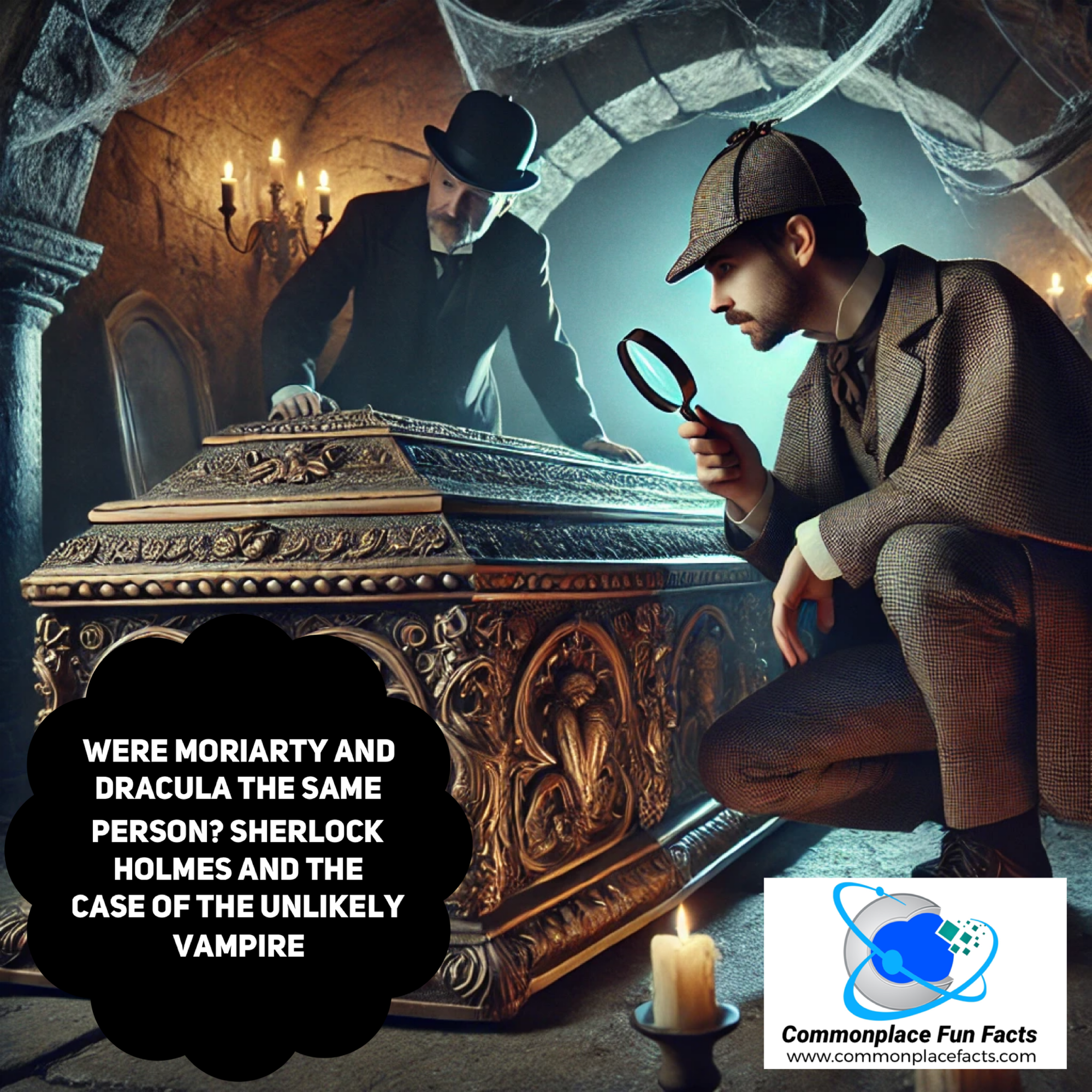

Here at Commonplace Fun Facts, we pride ourselves on illuminating the obscure and occasionally outrageous corners of history, literature, and whatever else happens to grab our attention. Today, we tackle an interesting theory that combines two giants of Victorian fiction: Sherlock Holmes vs Dracula. This Sherlock Holmes crossover comes together in a theory so wild, even Watson might raise an eyebrow over his trusty typewriter.
Could it be that Professor Moriarty, the infamous arch-nemesis of Sherlock Holmes, was none other than the vampire lord himself, Count Dracula?
Sit back, grab your deerstalker and garlic, and let’s investigate this Holmesian hypothesis. The game is afoot!
Contents
In A Sherlock Holmes Compendium, edited by Peter Haining, we find a fascinating essay by William Leonard. In “Re: Vampires“, he reveals some startling connections.
The Case of the Missing Months: Where Was Sherlock?
First, let’s set the stage. According to Bram Stoker’s Dracula, the Count made his way to London in the summer and early autumn of 1890, no doubt enticed by its reputation as “the great cesspool into which all loungers and idlers are irresistibly drained.” Meanwhile, Sherlock Holmes, according to his chronicler Dr. John Watson, was uncharacteristically quiet during this very same period.
Watson admits that 1890 was a sparse year for recorded adventures. The Canon mentions only three cases, and only one—“The Red-Headed League”—took place during Dracula’s London escapade. Coincidence? Perhaps. But if you believe in coincidences, you probably also believe Holmes never knew Sigmund Freud. In that case, you’ll miss out on our favorite Sherlock Holmes crossover: The Seven Percent Solution.
Could Holmes have been otherwise occupied, playing chess with the king of vampires while Watson was blissfully unaware? It’s a tantalizing notion, particularly given the abruptness of the opening of “The Red-Headed League.” No time for pipe smoking and parlor tricks here. Holmes is straight to business. Perhaps he was distracted by something a bit more… fangy.
The Curious Case of Dr. Van Helsing: A Disguise Too Perfect?
Here’s where the theory takes a dramatic turn: what if Holmes himself entered the fray against Dracula—not as Sherlock Holmes, but as Dr. Abraham Van Helsing?
The physical resemblance is uncanny. Stoker describes Van Helsing as possessing a poised head, a hard square chin, a long, straight nose, and deeply knit brows when pondering a problem. If you slapped a deerstalker on that description, you’d have Holmes in his natural habitat.
Learn about Arthur Conan Doyle’s secret obsession that changed the world?
What about Van Helsing’s age? Stoker’s characters describe him as older, but that’s hardly a problem for a master of disguise. Remember Holmes’s convincing turn as an aged bookseller? A little makeup, a stooped posture, and voilà: Van Helsing emerges.
Van Helsing’s methods, too, bear the hallmark of Holmesian logic. He breaks into houses with the flair of a seasoned detective, keeps his plans close to his chest, and occasionally lets his “broken English” slip into the eloquent clarity we’d expect from a Baker Street denizen.
If Holmes was indeed Van Helsing, he must have relished the chance to trade deductive reasoning for wooden stakes and garlic flowers. We can almost picture him savoring the challenge, muttering, “Elementary, my dear Dracula,” while driving a stake through the Count’s heart.
Moriarty and Dracula: Two Sides of the Same Coffin?
Now, let’s not ignore the more scandalous suggestion: that Professor James Moriarty and Count Dracula were, in fact, one and the same.

Consider this: Moriarty is described as the “Napoleon of crime,” a man with vast networks and almost supernatural influence. Dracula, meanwhile, is an immortal predator with an uncanny ability to bend others to his will. If you ask us, they sound suspiciously like two sides of the same coffin.
Could Moriarty’s criminal empire have been a front for Dracula’s vampiric schemes? After all, what better way to dominate London than to infect its underworld with the Un-Dead? And what better cover for a vampire’s nocturnal activities than the shadowy dealings of organized crime?
Sherlock Holmes vs Dracula: A Case of Deduction or Delusion?
Of course, this is all speculation, and Holmes himself would be the first to remind us of the dangers of theorizing without sufficient data. That said, the parallels between the Holmesian Canon and Stoker’s Dracula are too delicious to ignore.
Did Holmes secretly battle Dracula in the summer of 1890? Was Van Helsing merely another of his brilliant disguises? Could Moriarty have been the Count all along, hiding behind a thin veneer of academic respectability?
We may never know the truth. But as fans of both Holmes and Dracula, we can’t help but admire the symmetry of this theory. After all, what’s better than one Victorian legend? Two of them locked in mortal (and immortal) combat.
Coincidence? Consider the Unlikely Friendship of Literary Giants
As it turns out, the creators of Sherlock Holmes and Count Dracula weren’t just literary icons—they were also acquaintances. Arthur Conan Doyle and Bram Stoker first crossed paths in the early 1890s, thanks to their shared interest in the world of theater. Who would have thought that the creator of the world’s most logical detective and the mastermind behind a bloodthirsty vampire would bond over stage productions?
In March 1891, Arthur Conan Doyle published a short story, A Straggler of ‘15’, which told the tale of a veteran from the Battle of Waterloo. Doyle later adapted the story into a one-act play and sent it to Sir Henry Irving, the most famous actor of the day and manager of London’s Lyceum Theatre.
“I think it is the very best story of diablerie which I have read for many years,”
Letter from Arthur Conan Doyle to Bram Stoker re: Dracula
Enter Bram Stoker, who at the time was Irving’s secretary and stage manager. (Yes, before Dracula, he had a day job wrangling theater schedules and actors’ egos.) Stoker recalled that Irving was immediately captivated by the play’s lead character, the aging Corporal Henry Brewster, and dove into studying the role.
In his autobiography, Memories and Adventures, Doyle remembered the thrill of receiving a note from Stoker himself, offering £100 for the copyright to the play. The title was shortened from A Story of Waterloo to simply Waterloo, and Stoker even convinced Doyle to trim down the opening scenes for better pacing. The play was eventually performed at the Lyceum, giving Doyle his first theatrical success—though it didn’t exactly spark a lifelong career in playwriting.
A few years later, Doyle tried to recreate Stoker’s success by bringing Sherlock Holmes to the stage. He turned a melodramatic Holmes story into a script, which eventually made its way to famed actor-manager Herbert Beerbohm Tree. Alas, nothing came of it. Doyle even mentioned that Sir Henry Irving had shown interest in the play, but that was insufficient to bring Holmes to the stage under Irving’s direction. One can only imagine how Irving might have portrayed the great detective—perhaps with a touch of melodrama and a lot of cape-flourishing.
Doyle Reviews Dracula and a Friendship Beyond Fiction
Fast forward to 1897, when Bram Stoker unleashed his gothic masterpiece Dracula upon the world. Arthur Conan Doyle, ever the literary gentleman, wrote to Bram Stoker with glowing praise. “I think it is the very best story of diablerie which I have read for many years,” Doyle gushed, adding that the novel was “painfully vivid” and “engrossing.” He wrapped up his congratulations by calling it “a fine book.”
The friendship between Doyle and Stoker extended beyond mutual admiration for each other’s works. Stoker attended Doyle’s second wedding in 1907, when Doyle married Jean Leckie. Before the nuptials, Stoker interviewed Doyle at his home in Surrey for an article that covered everything from Doyle’s childhood to his lecture tours in America. The article, originally published in The World (New York) under the extravagantly long title Sir Arthur Conan Doyle Tells of His Career and Work. His Sentiments Towards America. And His Approaching Marriage, later appeared in the UK with a more concise heading.
Lasting Legacies
Today, the characters created by these two men—Sherlock Holmes and Count Dracula—are more iconic than ever. Whether it’s a detective solving crimes with cold logic or a vampire stalking his prey under moonlight, their legacies continue to captivate audiences.
While Holmes and Dracula never officially faced off in their creators’ lifetimes, their worlds share a fascinating connection through Doyle and Stoker’s friendship, theatrical collaborations, and mutual admiration. And who knows? Perhaps somewhere in the mists of literary history, the connection between these two great authors did inspire an epic showdown between the Sage of Baker Street and the Prince of the Undead.
Final Thoughts: A Study in Vampirism
Whether you find this theory plausible or preposterous, it serves as a delightful reminder of the enduring appeal of both Sherlock Holmes and Count Dracula. Both have captivated audiences for generations, and both are ripe for endless speculation, reinterpretation, and—dare we say—fanfiction.
As for us, we’ll be keeping a wary eye on the shadows of Baker Street, just in case. After all, when it comes to vampires and consulting detectives, it’s better to be overprepared. Pass the garlic, would you?
You may also enjoy…

How Sherlock Holmes’ Author Was Tricked Into Believing in Fairies
Humanity has been looking for proof of the paranormal for a long time. Many people insist there is more to the world than the things most of us see. Skeptics need evidence, however. If only there were reliable photographs to support the claims about the paranormal, that would put a lot of doubts to rest.…

How Arthur’s Secret Obsession Changed the World
If it was little known and uncommon, there was a good chance that Arthur would be drawn to it. His curious mind naturally gravitated toward things that polite society shunned. It was for that reason that his latest fling with the uncommon had to be done under the cover of darkness. You can’t blame him…

Porphyria: The Creepy Dracula Disease That Creates Real Vampires
Porphyria is a group of genetic disorders marked by symptoms resembling vampire traits, including sunlight sensitivity, painful skin reactions, and gastric distress from garlic. This condition results from disrupted heme production, leading to porphyrin accumulation. While incurable, Porphyria can be managed through regular blood transfusions.



Leave a Reply