
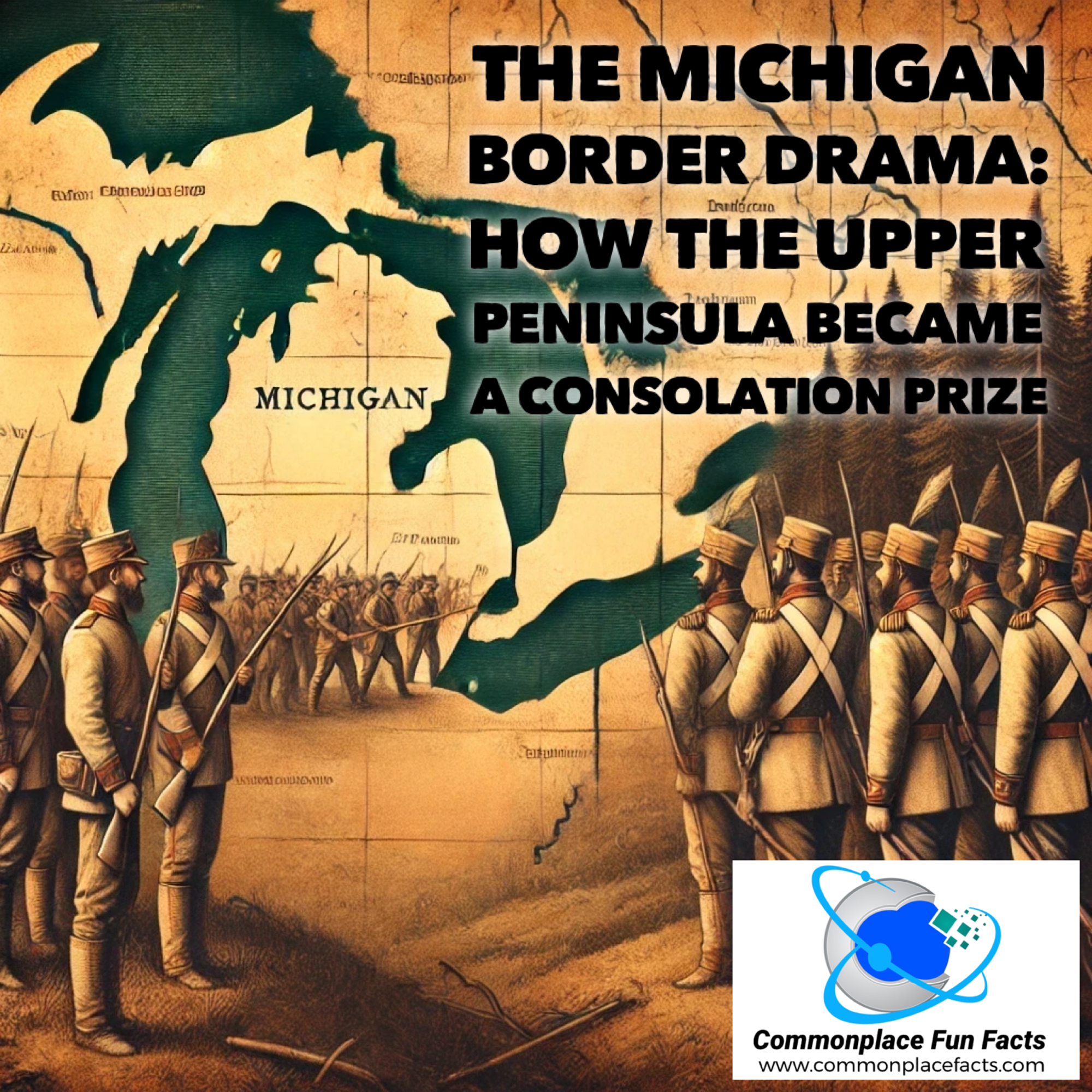

Michigan. It’s known as the Great Lakes State, the Wolverine State, and The State That Looks Like a Mitten. It has a proud history for its role in revolutionizing and monopolizing the automotive industry during most of the 20th century. It boasts some of history’s most influential people among its citizens, such as Henry Ford, Gerald Ford (no relation), Thomas Edison, Tim Allen, and Tom Sellek, just to name a few.
Michigan’s natural beauty is beyond comparison. From its pristine Great Lakes beaches and massive shifting sand dunes to the towering pine trees of its forests, even the most died-in-the-wool city slicker can’t help but be awestruck.
Despite all of its endearing qualities, there is something a bit odd and somewhat disturbing about the state: its southern border. Instead of a nice, straight line connecting Lake Michigan to Lake Erie, the border is jagged, resembling the hasty, unprofessional cuts in the paper when husbands are forced to wrap presents on Christmas Eve.

Why does that weird little issue mar an otherwise top-of-the-line state? What could possibly justify a cosmetic blight that transforms a beautiful mitten into a deflating latex glove?
As it turns out, it has a lot to do with the early days when Michigan was still finding itself. Let’s call it “the awkward years” that is part of everyone’s growing up experience.
Join us as we go back in time and journey with Michigan on its glorious — and awkward — path to statehood.
The Jagged Michigan Border and Journey to Statehood
To really dig into this issue, we need to talk about how Michigan became a state.
After the 1783 Treaty of Paris officially ended the American Revolutionary War, Great Britain surrendered a large chunk of land that would later go on to become Ohio, Indiana, Illinois, Wisconsin, part of Minnesota and Michigan.
In 1787, Congress passed the Northwest Ordinance, designating the surrendered land as the Northwest Territory — which was the first organized territory of the United States. At the time, the furthest western border of the country was the Mississippi river.
The Northwest Ordinance drew out borders for future states within the territory. One of these boundaries was a straight line from the southern tip of Lake Michigan to Lake Erie.
Those who are good at retaining information — or have looked at a map of Michigan at any point after 1816 — are aware that Michigan’s southern border is, in fact, not a straight line.
Nearly 200 years later, Michigan and Ohio have set the record for the longest game of Tug-of-War.
How the War of 1812 made a mess of Michigan’s clean border
In 1787, Congress (the one that existed before the ratification of the Constitution), with all the optimism of newly minted nation-builders, enacted the Northwest Ordinance. This act was supposed to bring order to the vast, uncharted territory that now makes up the upper Midwest. The plan? Divide the Northwest Territory into “not less than three nor more than five” future states. As part of this visionary map-making, they drew boundaries that included “an east and west line drawn through the southerly bend or extreme of Lake Michigan.” Simple, right?
Well, about that.
Fast forward to 1802. Congress passed the Enabling Act, greenlighting Ohio’s journey to statehood. They used language for Ohio’s northern boundary that mirrored the original Ordinance: an east-west line through the southern tip of Lake Michigan, extending eastward until it hit Lake Erie or the border with British Canada. It all seemed logical—on paper, at least.
The Problem with Maps (and Overconfident Mapmakers)
Here’s where things got murky. The map Congress relied on, the much-revered Mitchell Map, showed Lake Michigan’s southern tip farther north than the mouth of the Detroit River. Based on this, Ohio’s delegates assumed their northern boundary would include not only the Maumee River but also most—if not all—of the Lake Erie shoreline west of Pennsylvania. Michigan? Huron and Superior were nice lakes, but Ohio wasn’t about to share Erie.

Then came a curveball: whispers from fur trappers suggested that Lake Michigan stretched much farther south than the Mitchell Map claimed. If true, that pesky east-west line could shift southward, possibly cutting Ohio off from its cherished access to Lake Erie altogether. In fact, depending on Lake Michigan’s actual position, Ohio’s northern boundary might not even touch the lake at all. Cue the panic.
A Boundary with Built-In Flexibility
To hedge their bets, Ohio’s constitutional delegates included a creative contingency plan. If the trappers’ rumors were true and Lake Michigan’s southern tip sat farther south than mapped, the northern boundary would veer northeast, angling to ensure it intersected Lake Erie at Maumee Bay’s most northerly cape. This nifty clause ensured Ohio would keep access to Lake Erie, along with the Maumee River watershed—prime real estate for any aspiring state.
Congress approved the draft constitution with this sneaky proviso. But here’s the kicker: Congress wasn’t entirely convinced this boundary was set in stone. When Ohio’s constitution came up for final review in 1803, a Congressional committee noted that the boundary hinged on a geographical “fact not yet ascertained” (i.e., where Lake Michigan’s southern tip actually was). Rather than sort it out, Congress punted the issue down the road. Because not dealing with an issue until after the election has always been so effective.
Michigan Enters the Picture
Meanwhile, in 1805, Congress created the Michigan Territory, reusing the original Northwest Ordinance language to define its southern boundary. This language completely ignored Ohio’s northeastern angle clause, effectively setting up Michigan’s southern border along the same east-west line that Ohio’s constitution had tried to dodge.
At the time, nobody seemed to notice—or care. But this quiet oversight planted the seeds of a conflict that would erupt 30 years later, as Ohio and Michigan went head-to-head over a skinny strip of land that both claimed as their own.
The boundary dispute simmered for decades, fueled by ambiguous maps, territorial pride, and a lack of decisive action from Congress. By the time the dust settled, it would take militias, skirmishes, and more map redraws than a procrastinating cartographer to resolve the mess.
The Toledo Strip: A Big Deal About a Little Piece of Real Estate
In 1812, Congress approved an official survey of the disputed border, but progress stalled thanks to the War of 1812. By the time work resumed after Indiana’s statehood, the person in charge of the survey was U.S. Surveyor General Edward Tiffin, a former Ohio governor with a keen interest in giving Ohio the upper hand.
When Indiana was admitted to the Union in 1816, the Michigan Territory’s southern boundary was pushed 10 miles north to give Indiana better access to Lake Michigan—a change Michigan strongly opposed. This shift was just the beginning of the chaos.
Tiffin assigned William Harris to survey the line, but instead of following the original boundary laid out in the Northwest Ordinance, Harris aligned the survey with Ohio’s state constitution of 1802. The resulting “Harris Line” conveniently placed the mouth of the Maumee River—critical to the area’s economic future—entirely within Ohio. Michigan’s territorial governor, Lewis Cass, cried foul, accusing Tiffin of tilting the scales in Ohio’s favor.
Michigan wasn’t about to let this stand. They commissioned their own survey under John A. Fulton, who followed the original Northwest Ordinance boundary. Fulton’s survey placed the disputed border just southeast of the Maumee River, firmly within Michigan. The strip of land between the Harris and Fulton lines, now called the Toledo Strip, became a contested zone. Michigan quietly occupied it, establishing local governments, building roads, and collecting taxes while Ohio refused to give up its claim.
The Toledo Strip wasn’t just a political headache—it was a prime piece of real estate. Before the railroads dominated commerce, waterways were the highways of the Midwest. The Maumee River offered a crucial link between Lake Erie and the Ohio River, making Toledo a logical hub for trade and transportation.
Adding to the urgency was the success of the Erie Canal, completed in 1825, which transformed the Great Lakes into a bustling trade corridor. Suddenly, the western end of Lake Erie became a launching pad for settlers heading west and goods heading east. Port cities like Buffalo boomed, inspiring a flurry of canal projects, and allowing us to be able to write the article “Buffalo Buffalo Buffalo Buffalo Buffalo Buffalo Buffalo Buffalo,” although that admittedly wasn’t a high priority at the time.
A key plan for the development of this economic zone was the creation of the Miami and Erie Canal. It was designed to connect Toledo to the Ohio River, positioning the area as an economic powerhouse.

Detroit, while a stronghold in Michigan, faced logistical challenges. Its location farther up the Detroit River and its proximity to the impassable Great Black Swamp made it less viable for transportation projects like canals and railroads. Toledo, by contrast, was ideally situated for new infrastructure and had fertile farmland to boot. The region’s loamy soil produced abundant crops, making it a valuable prize for both Michigan and Ohio.
Both sides saw the Toledo Strip as a ticket to prosperity, and neither was willing to blink first. The economic stakes, combined with the strategic importance of controlling a key trade hub, ensured the fight over this narrow strip of land would escalate far beyond border surveys and maps.
The First Michigan/Ohio Rivalry Heats Up
In 1827, Michigan claimed Toledo as Port Lawrence Township. Michigan businesses and lobbyists invested heavily in Port Lawrence. The Miami-Erie Canal, connecting Lake Erie and the Ohio River, was expected to make Toledo a massive successful port city, like Detroit, Chicago and Boston.
Lobbyists pressured Michigan politicians to make sure that Toledo remained within Michigan’s borders as Michigan businesses invested in many large-scale projects — such as rail lines and hotels — that would ultimately be canceled, at great expense to Michigan investors.
In 1832, Michigan petitioned Congress for an Enabling Act to allow Michigan to call a constitutional convention. Congress denied the request, citing the unresolved border conflict between Michigan and Ohio.
Instead, Congress decided to redraw the border. For the fourth time.
The man who drew the line was Robert. E. Lee, who seemed to be just dipping his toes into civil wars to see how they felt. You may know him from having a key role in a much larger border dispute that involved all of the states.
In 1835, Ohio Gov. Robert Lucas pushed for new laws that extended the state’s borders to include Toledo. Michigan lawmakers responded that any attempted control of Toledo would be seen by Michigan as a crime and enacted the Pains and Penalties Act. That sounds like what we experienced in Fourth Grade when we were sent to the principal’s office after mouthing off to a teacher. In reality, it was a law that made it a criminal offense for Ohioans to carry out governmental actions in the Strip, under penalty of a fine up to $1,000, up to five years imprisonment, or both.

Less than a month after the Pains and Penalties Act was passed, Ohio insisted Toledo was theirs and asked to have the border drawn a fifth time — and had the Ohio Militia present during the surveying.
Michigan Territory Gov. Stevens Mason was elected to office when he was 23, and is still the youngest state governor in American history.
Mason, who was 24 at the time, was told by his father to act slow and to allow Ohio to be the aggressor. He was told that public opinion would be on Michigan’s side, since they were literally being invaded by another state’s militia.
The Drumbeat Toward The Toledo War
Mason put Joseph Brown in charge of keeping the peace in the Toledo Strip. Brown was the founder of Tecumseh and owned shipping and stagecoach lines between Detroit, Ypsilanti, Chicago and more. He also owned inns and hotels along these lines.
Mason told Brown to not engage with Ohio unless fired upon.
President Andrew Jackson went on record saying he didn’t want to pick sides or interfere. U.S. Secretary of State John Forsyth told Mason if he wasn’t willing to accept a compromise, the federal government would force one.
Both Mason and Lucas contacted Jackson about the Toledo Strip, asking for the border to be redrawn again.
Jackson appointed Benjamin C. Howard and Richard Rush to arbitrate the dispute.
On April 2, 1835, Lucas’ new line drawing team reach Toledo. The next day, Howard and Rush arrived.
On April 6, Ohio held elections for local government in Toledo.
Michigan wasn’t fond of that — and on April 8, Brown and Michigan authorities went into Toledo to arrest violators of the Pain and Penalties Act.
In the middle of the night, about 40 people — Michigan Militia, sheriff’s deputies and volunteers — went into the home of Maj. Benjamin Stickney, a known Ohio supporter and assaulted his guests and children.
They brought people to Monroe and held trials. People were arraigned for either being Ohio loyalists or interfering with arrest of loyalists.
“We are driven from our homes for acting under the authority of Ohio; our houses broken open in the dead of night; citizens taken prisoners, bound hand and foot, and tied to fiery horses, gagged that they may not alarm the rest of the citizens,” one witness recalled. “The females too in the same house are treated with violence by being held and prevented from going to alarm the neighbors; and all this for saying to an individual, he need not obey the laws of Michigan.”
Continuing to fail to allow Ohio to be the aggressor, about 300 Michigan horsemen, armed with guns and bayonets, took the Ohio state flag down and dragged it through the streets of Toledo.
The Battle of Phillips Corner
The commission team met with Jackson and told him the only way to avoid war would be to surrender Toledo to Michigan. Residents of Toledo would have to decide what state they were citizens of.
On April 25, Lucas put together 40 armed men with a new line survey party. Mason sent 30 armed men from Adrian to stand against Lucas’ men.
On April 26, the 30 Michigan men found the survey party. Most of the party fled, but a small group hid in a nearby cabin that was promptly surrounded by the Michigan men.
The Ohio men emerged from the cabin to surrender, but ultimately made a run for it.
The Michigan men fired on the Ohio men, who surrendered. All were captured.
In June, Ohio started its own Pain and Penalties Act and designated the Toledo Strip as Lucas County.
The Frostbite Convention
Jackson met with Ohio legislators and agreed that Michigan needed to surrender Toledo to Ohio. Mason argued the Toledo Strip was legally Michigan’s, due to the Ordinance of 1787.
On Aug. 17, Mason appeared before a federal counsel to defend his actions against Ohio. He would later request hundreds of men for self-defense. Jackson removed Mason from power and replaced him with John Horner.
Michigan residents would not acknowledge Horner and would still use Mason as their representative, without the legal title. When Jackson’s paperwork for Horner had gone through and been validated, Michigan voters had already re-elected Mason as governor. In return, Congress refused to seat the two Michigan representatives who had just been elected to office, only allowing them to observe.
In June, 1836, Congress proposed giving Toledo to Ohio and giving Michigan a huge peninsula to the north — now known as the Upper Peninsula as a consolation. Jackson signed it; Congress just needed Michigan to agree.
Mason asked for the border to be resurveyed. Again. Jackson declined the request.
In September, Mason invited officials from throughout the Michigan Territory to meet in Ann Arbor to discuss the deal. The deal didn’t pass, on a vote of 28 to 21.
As the conflict went on, the problem Michigan faced was the territory was going bankrupt due to high military expenses. The government was spurred to action by the realization that a $400,000 surplus in the U.S. federal coffers was to be distributed to the 25 states, but not to territorial governments.
During a particularly cold and snowy December, a second convention was held in Ann Arbor and delegates voted to approve Congress’ offer.
The Matter Was Finally Settled — Or Was It?
The legitimacy of the vote was far from being universally accepted.
The legislation did not approve a call to convention. Congress and Michigan residents questioned the legality of the vote and petitioned for Jackson to not allow statehood to go through.
Jackson, who had been dealing with this nonsense for years, accepted Michigan as the 26th state on Jan. 26, 1837. Its southern border was jagged because it was missing the Toledo Strip. As a consolation prize, however, it had the massive Upper Peninsula.
The Twentieth Century, and the Conflict Continues
The Toledo Strip ultimately became a permanent part of Ohio, but Michigan’s consolation prize—the Upper Peninsula—turned out to be a hidden gem. Initially dismissed as a desolate wilderness valuable only for timber and fur trapping, the Upper Peninsula proved its worth in the 1840s with the discovery of copper in the Keweenaw Peninsula and iron in the central region. These discoveries sparked a mining boom that stretched well into the 20th century, transforming Michigan’s supposed loss into a long-term economic win. While Michigan surrendered 1,100 square miles of fertile agricultural land and the bustling port of Toledo, it gained 9,000 square miles of timber- and ore-rich land, a trade-off that paid dividends for generations.
The border dispute didn’t vanish entirely with Michigan’s statehood. Differences over the exact location of the boundary lingered until 1915, when a definitive re-survey resolved the matter. While re-survey protocol typically required strict adherence to the Harris Line, surveyors made some adjustments to avoid disrupting residents’ state affiliations or splitting parcels of land between Michigan and Ohio. The result was a border marked by 71 granite monuments, each 12 inches wide and 18 inches tall. The process culminated in a symbolic handshake at the border between Michigan Governor Woodbridge N. Ferris and Ohio Governor Frank B. Willis—a gesture that marked the end of nearly a century of conflict on land.
Well, almost….
While the land border was finally settled in 1915, disputes over the Lake Erie boundary persisted. In 1973, the states brought their competing claims to the U.S. Supreme Court. In Michigan v. Ohio, the Court sided with Ohio, affirming that the lake boundary followed the angled line described in Ohio’s 1802 constitution rather than the straight east-west line Michigan had hoped for. This decision also divided Turtle Island, a small piece of land near Maumee Bay, between the two states, putting an end to the last major border adjustment.
Today, the legacy of the Toledo War lives on in subtler ways. The rivalry between Michigan and Ohio persists, but it’s now largely confined to the sports arena. Whether it’s the fierce clashes on the football field between the University of Michigan and Ohio State or the spirited competition between the Detroit Tigers and Cleveland Guardians, the echoes of the old border dispute remain. For many, the Toledo War is more than a historical footnote—it’s the quirky origin story of a rivalry that endures to this day.
You may also enjoy…

The Bath School Disaster: The Deadliest Act of School Violence In US History — That No One Remembers
Discover the shocking story of the Bath School Disaster — the worst case of school violence in U.S. history.

Origin of Chicago: How a Man Without a Country Created a Quiet Place of Refuge
Would you believe that the origin of Chicago centered around one man’s plan to create a quiet place of refuge away from all the chaos?

You Can Reign in Hell (Michigan)
In Paradise Lost, John Milton paints a word picture of Satan being cast into Hell. The fallen angel, in making his choice of eternal rebellion, declares, “Better to reign in hell than serve in heav’n.” (Paradise Lost, Book One, lines 254-263). We sincerely hope none of our readers will follow his example. There is, however,…


Leave a Reply