
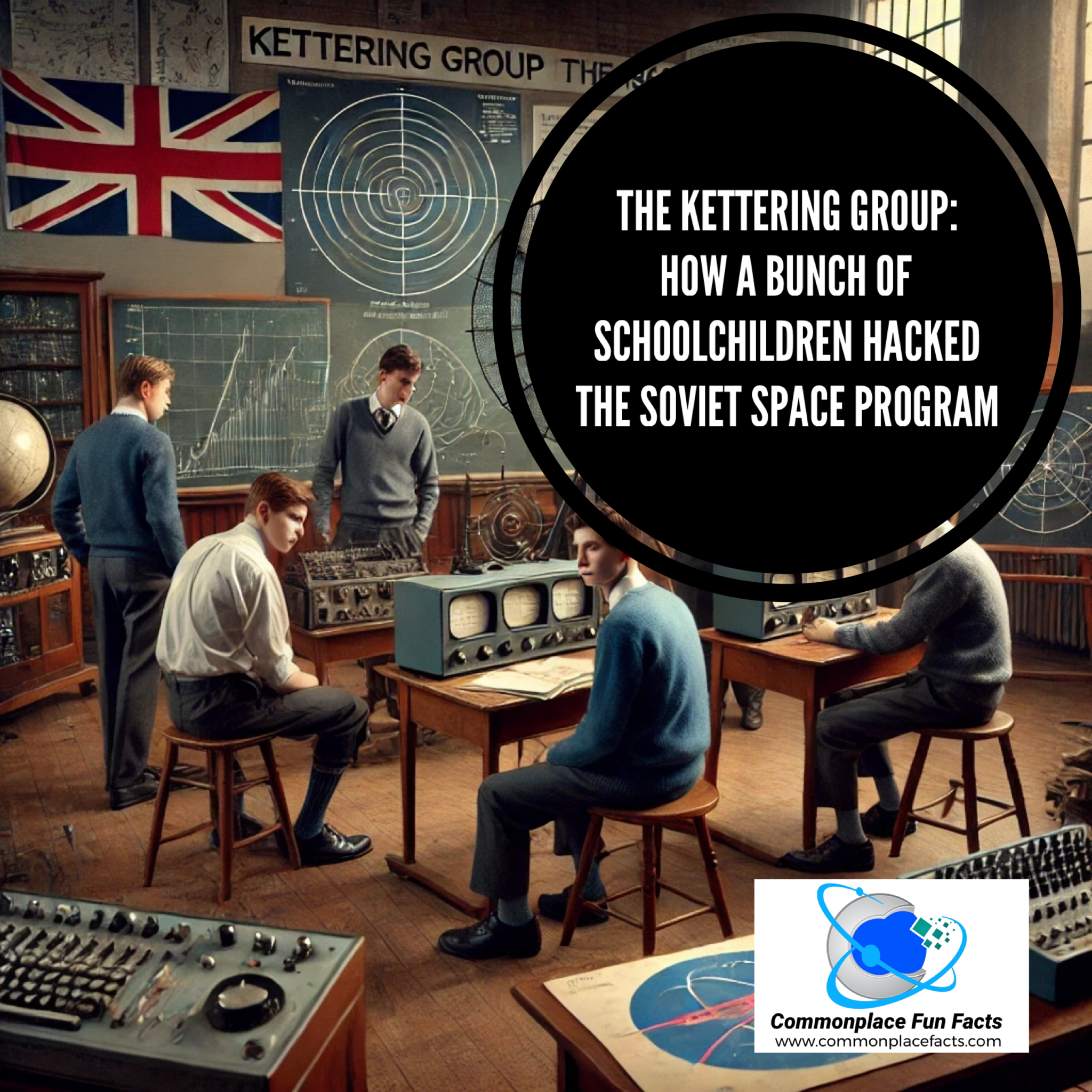

The Kettering Group: When the Cold War and Space Race Met Their Match in Schoolchildren
The Science Fair: that annual event where countless students valiantly attempt to dodge humiliation by presenting projects that straddle the fine line between “mildly interesting” and “unintentionally hilarious.” For most kids, this meant whipping up a baking soda and vinegar volcano, growing bean sprouts, or determining which toothpaste brand makes your teeth sparkle brightest. Groundbreaking? Hardly. But for one group of British schoolchildren in the early 1960s, “extracurricular science” wasn’t just about impressing the judges—it was about outsmarting the world’s top intelligence agencies.
Enter the Kettering Group: a ragtag team of teenage space enthusiasts who, armed with little more than second-hand radio equipment and a metric ton of patience, became one of the world’s leading satellite tracking organizations. Yes, you read that right. At an age when most of us were struggling to understand the difference between submarines and subatomic particles, these kids were unraveling the secrets of the Soviet space program—right in the thick of the Cold War.
Contents
How It All Began: One Teacher, A Radio, and Some Serious Doppler
Our story kicks off in October 1957 with one Geoffrey Perry, science master and head of physics at Kettering Grammar School for Boys in Northamptonshire. Born in 1927, Perry’s fascination with space had less to do with stargazing and more to do with dodging German V-2 rockets during World War II. Add a healthy dose of Arthur C. Clarke’s The Exploration of Space in 1951, and you’ve got the recipe for a physics teacher who’d rather point a radio antenna at the sky than stick to boring textbook examples.
When the Soviets launched Sputnik 1—the world’s first artificial satellite—on October 4, 1957, most people saw it as a sign of Soviet technological dominance. Perry, on the other hand, saw it as the perfect teaching tool to explain the Doppler Effect. Why bore students with car engine sounds when you could use actual space signals?
Conveniently, the new head of chemistry, Derek Slater, was a radio enthusiast with the call sign G3FOZ. Together, Perry and Slater set up a war-surplus shortwave receiver in the school’s physics lab and started eavesdropping on Soviet satellites. Their first big win came on May 16, 1960, when they picked up transmissions from Korabl-Sputnik 1, an unmanned test version of the Vostok capsule that would later carry Yuri Gagarin into orbit.
By analyzing the Doppler shift in the satellite’s signals and doing some good old-fashioned trigonometry, they plotted its orbit and—here’s the kicker—uncovered their first space mystery. Three days post-launch, the satellite’s signals started arriving late. Perry deduced that the spacecraft had increased its altitude due to a navigation error that fired its retro rockets in the wrong direction. Instead of deorbiting, it moved higher—a cosmic oops moment that eventually ended with the satellite re-entering Earth’s atmosphere in 1962. Oh, and a piece of it landed on a street corner in Manitowoc, Wisconsin, because space debris apparently has a sense of humor.
From Physics Class to International Espionage

Riding high on their success, Perry and Slater went all-in on satellite tracking. Physics lessons? Pfft. Tracking mysterious Soviet spacecraft was way more fun. The secrecy of the Soviet space program only added to the allure. The Soviets, eager to flex their technological muscles, only announced launches after the satellites were safely in orbit—if they bothered to announce them at all.
But Perry and Slater weren’t so easily fooled. On April 26, 1962, they detected the launch of Cosmos IV, the first in the Soviet Zenit series. Initially, its purpose was unclear. But soon, patterns emerged: the satellites orbited for exactly eight days, re-entered deliberately, and transmitted locator beacons upon landing. Oh, and they conveniently passed over North America during peak photography times—early morning and late evening when shadows were just right. Perry and Slater had a lightbulb moment: the Zenit satellites were Soviet spy cameras in the sky. Cue the dramatic music.
By 1964, the hobby had outgrown the two teachers. That’s where the students come in. Tracking satellites became a lunchtime activity, occasionally bleeding into weekends. According to student Robert Christie, they managed most of their tracking during school hours. Say what you will about the Soviet Union — at least they were considerate enough to launch their satellites at times that coincided with the British school day.
The Kettering Group Takes on the World

What started as a hobby for two curious teachers morphed into the Kettering Grammar School Satellite Tracking Group. Despite being named for an all-boys school, the group wasn’t all boys; girls from the nearby high school joined in, proving that espionage knows no gender boundaries.
Their setup was…let’s say…”resourceful.” They used scrounged-together radio equipment, an antenna made from copper gas tubing, and an off-the-shelf electric wall clock for timing. A globe with a circular wire served as their analog computer for calculating orbits. For complex calculations, they borrowed the computer at a local garment factory.
Despite their crude methods, they managed to become a world-renowned satellite tracking group. By 1966, they went international. Sixteen-year-old Swedish student Sven Graan contacted Perry about signals from Cosmos 104, and soon, students from around the world joined the Kettering effort. The group even beat intelligence agencies in cracking a major Soviet secret—discovering the Plesetsk Cosmodrome, a previously unknown launch site in the Arctic Circle. Their findings embarrassed the CIA, delighted journalists, and earned them headlines like School Sleuths Scoop Space Experts.
From Lunchtime Hobby to Global Impact
As the Kettering Group’s reputation grew, so did their capabilities. They received donations of advanced equipment, consulted for government agencies (including the Pentagon), and even got a congratulatory letter from Chinese leader Mao Zedong. Perry became a space consultant for Independent Television News, helping cover the Apollo 15 mission in 1971.

The group tracked historic missions, from the Apollo 11 lunar landing to the first Chinese satellite, Dongfang Hong 1. They even figured out how to unscramble Soviet voice transmissions, becoming the first Westerners to learn that the Soyuz 11 crew had tragically died during re-entry in 1971.
In 1978, they made a crucial safety contribution by discovering that the nuclear-powered Soviet satellite Cosmos 954 was out of control. The satellite eventually re-entered Earth’s atmosphere, scattering radioactive debris over northern Canada and sparking a massive cleanup operation.
The Legacy of the Kettering Group
Geoffrey Perry retired in 1985, with Derek Slater following two years later. The school itself closed in 1993 and was demolished in 2007. But the Kettering Group’s legacy lived on through its members, many of whom pursued careers in the space industry.
“By inviting them to help me with my hobby, they were being unconsciously taught the scientific method. If you say to a British schoolboy, ‘Sit down, lad, I’ll teach you the scientific method,’ he’ll say, ‘Over my dead body; I want to go play football.’ But if you say, ‘Come help me track satellites,’ they come. And over the years, they learn.”
Reflecting on the group’s achievements, Perry summed it up best: “By inviting them to help me with my hobby, they were being unconsciously taught the scientific method. If you say to a British schoolboy, ‘Sit down, lad, I’ll teach you the scientific method,’ he’ll say, ‘Over my dead body; I want to go play football.’ But if you say, ‘Come help me track satellites,’ they come. And over the years, they learn.”
So next time you roll your eyes at a school science project, just remember: with a little creativity (and maybe some second-hand radio equipment), you might just outsmart the world’s top spies. Or at least, impress your physics teacher.
You may also enjoy…

Space Smells Like Raspberries: The Sweet Chemistry of the Cosmos
Scientists have discovered that a massive dust cloud in our galaxy, Sagittarius B2, contains ethyl formate, which gives raspberries their flavor. In other words, space smells like raspberries! This finding implies that space is richer in molecules essential for life than previously thought. These discoveries may help answer questions about the origins of life on…

The Strange Story of the Salem Trade School Football Team: the Original Sports Scandal
Explore the intriguing story of the Salem Trade School football team, a fake high school squad that played throughout the 1920s before being exposed as a scam. Learn about Harold Burgess’s scheme and its place in sports history.

How a $35 Ferret Helped Save a $250 Million Science Project (And Became a Lab Legend)
The National Accelerator Laboratory faced challenges with its proton synchrotron particle accelerator, including magnet failures. The whole project was doomed until a $35 ferret named Felicia saved the day. Read how this furry friend to physicists became a hero to science.


Leave a Reply