
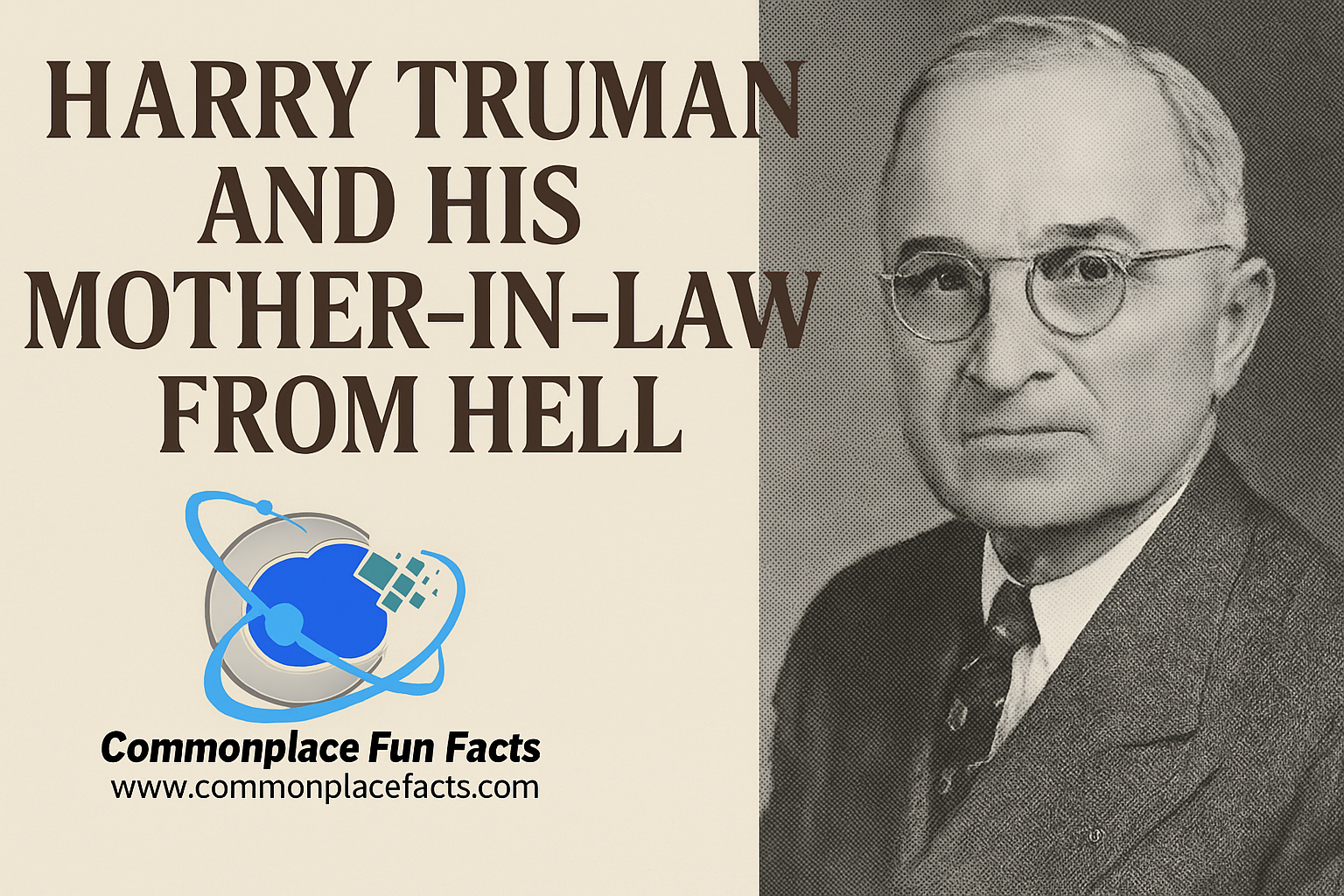

When Harry Truman said, “If you can’t stand the heat, get out of the kitchen,” he probably was talking about the White House. But it’s also possible that he was referring to heat from a special kind of inferno that followed him from Independence, Missouri, straight to the halls of power in Washington, D.C. The source of that heat? Margaret “Madge” Gates Wallace — a woman who has repeatedly been described as “the mother-in-law from hell” who lodged herself into Truman’s life like a stubborn popcorn kernel between presidential teeth.
Contents
Love at First Sight… for Bess, Not Madge
Truman fell hard for Bess Wallace when he was just six years old, reportedly proclaiming his undying love the first time he saw her. He eventually earned her reciprocal affection. As for her mother, Madge, well, she had a different reaction — and it was anything but warm. To Madge, Truman was a dirt farmer with no college education, failed business ventures (hello, failed oil well venture and haberdashery debacle), and a résumé so unimpressive that it practically came with an apology note. Bess, on the other hand, was the granddaughter of Independence’s Flour King. Madge was horrified that her daughter would marry a man whose greatest claim to fame was plowing a Missouri field.
Mr. Truman, Not “Harry”
Even after Truman became President of the United States — a title most people would find somewhat impressive — Madge refused to call him anything but “Mr. Truman.” That was actually an improvement from her former title: “Farmer Truman.” Forget terms of endearment or even a grudging “Harry.” Truman was always “Mr. Truman,” with all the formality and affection reserved for a door-to-door salesman who overstayed his welcome.
And welcome, he was not. Madge believed her daughter had committed a colossal social faux pas by marrying Truman. To her, even after he ascended to the highest office in the land, he was still that farm boy who was beneath her daughter.
Life Under Madge’s Roof

Truman couldn’t afford a house of his own until he became a senator, which meant he and Bess lived with Madge in her stately Independence home for 33 years. Let that sink in. Thirty-three years of daily scrutiny, backhanded comments, and a mother-in-law who treated him like an uninvited guest at his own dinner table.
Even when Truman was elected to the U.S. Senate, Madge packed her bags and moved to Washington with them. And when Truman became President? You guessed it — Madge claimed her own bedroom in the White House. She didn’t just live with the President and First Lady; she died in her White House bedroom at the ripe age of 90, just a few days before the end of Truman’s presidency. Talk about leaving a lasting impression.
A Constant Critic in Residence
Madge wasn’t content to merely reside with the Trumans — she made sure Truman knew exactly how little she thought of him. She openly questioned his political ambitions, doubted his qualifications, and told him he would never make it as a politician. A lifelong anti-Semite, Madge did nothing to hide her disgust when when Truman made the decision to recognize the newly formed State of Israel in 1948. Madge gave “Give Him Hell Harry” hell for it.
When Truman faced off against Thomas Dewey in the 1948 election, Madge declared that Dewey was the better man and predicted Truman’s defeat. As history would have it, she was spectacularly wrong, but that didn’t stop her from criticizing his every move.
“A Captain from the National Guard”
One of Madge’s most infamous gripes was Truman’s firing of General Douglas MacArthur. Truman’s decision to relieve MacArthur of command during the Korean War was met with public outrage, but Madge took it to another level. She lamented that she couldn’t “imagine a captain from the National Guard telling off a West Point general.” Never mind that “the captain” was the Commander-in-Chief.
The Scandal That Shaped Her
To be fair, Madge’s life wasn’t without tragedy. Her husband, David Wallace, died by suicide — an event that left her a prisoner of shame. From that moment forward, she leaned heavily on Bess for emotional support, and by extension, Truman was roped into the caretaking. Despite her withering criticism and open disdain, Truman dutifully cared for her until the end. He resolutely spoke respectfully to her and about her throughout her long life.
Key West: A Truman Escape Plan
To cope with the stress of running the country — and perhaps to escape his mother-in-law’s shadow — Truman retreated to Key West for a total of 175 days over 11 separate trips during his presidency. Not once did Madge join him. Truman might not have been able to get her out of his house, but he could at least keep her out of Key West.
Why Did Truman Endure It?
Why did Truman put up with Madge’s antics for so long? Historians suggest that his devotion to Bess was so great that he was willing to tolerate Madge’s abuse for the sake of his marriage. His loyalty and love for Bess outweighed any indignity he suffered at Madge’s hands. As his daughter, Margaret, said, “So Dad must have loved Mother very much.”
That, or he was simply the most patient man ever to occupy the Oval Office.
Conclusion: A Saint in the White House
Harry Truman may be remembered as the man who made tough decisions, but his most heroic act might have been surviving 33 years under the relentless gaze of Madge Wallace. While Truman’s legacy is one of strength and integrity, let’s not forget the unrecognized battle he fought daily — the one where he endured the scorn of the “mother-in-law from hell.”
And perhaps, as he soaked up the sun in Key West, he wasn’t just thinking about world affairs. Maybe, just maybe, he was thinking, “At least Madge isn’t here.”
Learn more about President Harry S. Truman at the Harry S. Truman Library and Museum.
You may also enjoy…

The Creepy Boy Who Hated Mothers And Became a Beloved Hero
Explore the dark origins of Peter Pan, the boy who hated mothers, as J.M. Barrie’s character transforms from the villainous Demon Boy into a beloved hero. Discover the psychological roots behind the famous tale.

Anna Jarvis and Her War Against Mother’s Day
Anna Jarvis, despite her support for motherhood, despised the commercialism of Mother’s Day. She strived to focus on honoring mothers, not profiting from the holiday. Her efforts to abolish the day failed, despite her initial success in establishing it. Surprisingly, the creator of Mother’s Day spent her later years fighting against her own creation.

A Schoolboy Crush, a Teacher’s Kiss, and a Quest for Greatness
They certainly weren’t the first students in history to develop a schoolboy crush on their teacher. Who could blame them for their innocent preoccupation over Miss Brown? Matilda “Tillie” Brown was young, pretty, and she had that special gift of teaching and encouragement that caused her students to want to do their best. Miss Brown…



Leave a Reply