

Filed under: Creatures That Want to Kill You (But Only in Spirit)
Australia: the only place where even the tourism brochures seem to come with a footnote that says, “Try not to die.” Between venomous snakes, sharks, and spiders so large they qualify for voting rights, it’s easy to believe everything there wants to kill you. It only makes sense, then, that Australians would want to imagine something even more dangerous than what may be looking at them through the bedroom window when they wake up in the morning. In other words, the fearsome and legendary Drop Bear.
If you’ve never heard of the Drop Bear, don’t worry. That just means you’ve never been set up by a grinning Aussie while hiking under suspiciously leafy trees. Welcome to your orientation session, mate.
Contents
What Exactly Is a Drop Bear?
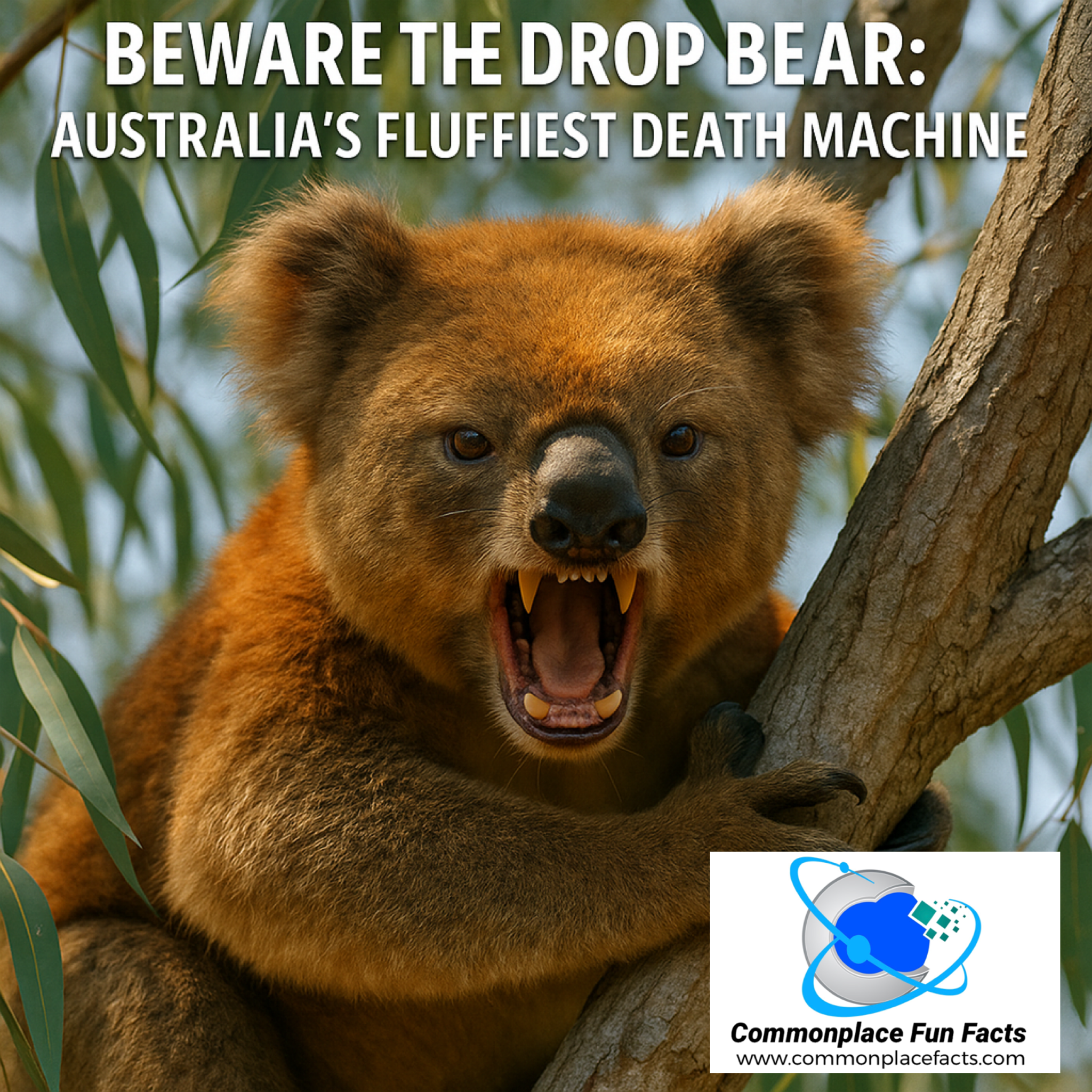
Imagine a regular koala. Now make it bigger. Add carnivorous tendencies, a bad attitude, and a penchant for plummeting from trees onto your skull. Congratulations: you’ve just met the Drop Bear, Australia’s most lovingly crafted hoax animal.
According to the Australian Museum (who are in on the joke, mind you), the Drop Bear’s Latin name is Thylarctos plummetus. It’s described as weighing about 120 kilograms (265 pounds), covered in coarse orange fur, and armed with fangs that would make a vampire jealous.
Of course, none of that is true, but then again, it’s entirely possible that the whole continent of Australia is an elaborate hoax to begin with. Assuming Australia is really a place, then its Drop Bear is an elaborate prank—a national pastime designed to terrify tourists and confuse visiting scientists. (You’re welcome, National Geographic.)
How to “Survive” a Drop Bear Encounter

Over the years, locals have refined the art of Drop Bear misinformation to a high science. If you ever ask how to avoid being turned into a Drop Bear snack, you might hear such helpful advice as:
- Smear Vegemite behind your ears (extra points for strategic peanut butter application).
- Wear forks in your hair to scare them off.
- Speak in a convincing Australian accent (good luck with that, ya drongo).
- Only walk under trees while making loud noises to startle them (though this mostly startles everyone else around you).
- Keep yourself armed at all times with the Ultimate Drop Bear Defense Hammer.
Seasoned pranksters might even suggest that certain brands of deodorant repel Drop Bears. The nice thing about the claim is that it’s awfully hard to disprove it. After all, have you seen a Drop Bear attack anyone who had a thick layer of Degree covering both armpits? An added bonus is that it keeps a healthy limit on stinky tourists.
Origins of the Drop Bear Myth
The Drop Bear legend didn’t spring fully formed from the forehead of Crocodile Dundee. It’s a mishmash of Australian humor, traditional campfire tales, and an intense national love of messing with people. References to Drop Bears began circulating more widely in the 1980s, although the notion of dangerous creatures lurking in the trees goes back much further.
Some credit the modern version to the sketch comedy show The Paul Hogan Show, where killer koalas made their comedic debut. Others trace it to the military, where new recruits would be warned to watch out for tree-dwelling death machines during training exercises. Either way, it’s a uniquely Aussie way of welcoming people while simultaneously making them question their life choices.
How Serious Is the Joke?
Let’s just say: very. The Australian Museum actually published a full entry on the Drop Bear, complete with mock-serious habitat descriptions, physical characteristics, and behavioral traits. The Australian Army has even been known to include Drop Bear warnings in unofficial guides for new soldiers. At this point, the Drop Bear is less an animal and more a rite of passage.
Drop Bears vs. Other Hoax Creatures
Australia doesn’t have a monopoly on fictional fauna designed to terrorize the gullible. Around the world, pranksters have been inventing mythical monsters for centuries. A few illustrious cousins of the Drop Bear include:
- Jackalopes – North America’s horned rabbits, created when someone decided rabbits just weren’t weird enough.
- Hoop Snakes – Also American, these snakes allegedly bite their own tails and roll like wheels to chase prey. (Physics, meet myth.)
- Sidehill Gougers – Creatures from American tall tales said to have legs shorter on one side so they could walk along hillsides without tipping over. Evolution clearly had a field day with that one.
- Wild Haggis – In Scotland, tourists are often told about the “wild haggis,” a critter whose legs are longer on one side to better navigate the Highlands.
- Honest Politicians — Legendary beings who have been rumored to put their hands in their own pockets when it gets cold. (Editor’s Note: This is a bit snarky, even for our standards… Be sure to delete this paragraph before the article is published.)
Clearly, humans everywhere love two things: making stuff up, and laughing at the people who believe it.
How to Spot a Drop Bear “Attack” in the Wild

If you ever hear a sudden rustle in the trees while on a guided walkabout, brace yourself. Not for an actual attack—but for the Aussie guide to put on the most serious face they can manage and solemnly point to claw marks on a tree, murmuring, “Drop Bear territory.”
Warning signs, caution tape, and even fake news articles have been created to keep the myth alive. There are entire tours where the highlight is staging an elaborate, totally fake Drop Bear encounter. It’s less about deception and more about inducting you into the greatest club of all: People Who Got Drop Bear’d and Lived to Tell the Tale.
Modern Day Memes and Merchandising
As with any good hoax, the Drop Bear has evolved with the times. Today, you can buy Drop Bear warning signs, t-shirts, plush toys, and stickers. Memes abound. Instagram photos proudly showcase “bite marks” after a “close encounter” with one of these cuddly assassins.
And, of course, every April Fool’s Day brings a fresh crop of news stories about “newly discovered” Drop Bear subspecies, complete with CGI images and fake expert quotes. It’s an art form, really.
Final Thoughts: Why We Love the Drop Bear
In a world of real dangers—violent crime, global pandemics, pineapple on pizza—the Drop Bear offers a much-needed laugh. It’s a harmless way to poke fun, to bring people into the fold of Australian culture, and to remind everyone that not everything needs to be deadly serious. Sometimes, it can just be deadly hilarious.
So next time you’re walking through the eucalyptus forests of Australia and someone warns you to check the trees for Drop Bears, do what any self-respecting traveler would do:
- Smear that Vegemite.
- Stick a fork in your hair.
- And, most importantly, enjoy the joke. You’re officially part of the club now.
You may also enjoy…

Linnaeus: The Father of Taxonomy and the Obviously-Fake Pelican
Carl Linnaeus (1707-1778), the father of modern taxonomy, created a global system to classify living organisms by genus and species, detailed in his seminal work, Systema Naturae. His classifications included thousands of species, but he also debunked mythical creatures, exemplifying the blend of rigorous science and the era’s fantastical beliefs.

Perplexing Platypus Promotes Plentiful Pondering
The general scientific consensus was that someone was trying to pull off a hoax. The newly-discovered animal could not possibly be real. It was an admirable effort, to be sure. It appeared that a skillful taxidermist had somehow attached a duck’s bill to a beaver’s body. Nice try, but it was too ridiculous to fool…

The Great Moon Hoax of 1835: Two-Legged Beavers, Winged Moon Men, and One Seriously Salty Edgar Allan Poe
Explore the bizarre 1835 Great Moon Hoax that captivated readers with tales of lunar beavers and bat-men—and discover why Edgar Allan Poe thought it was all a rip-off of his own sci-fi satire.






Leave a Reply to Herald StaffCancel reply