
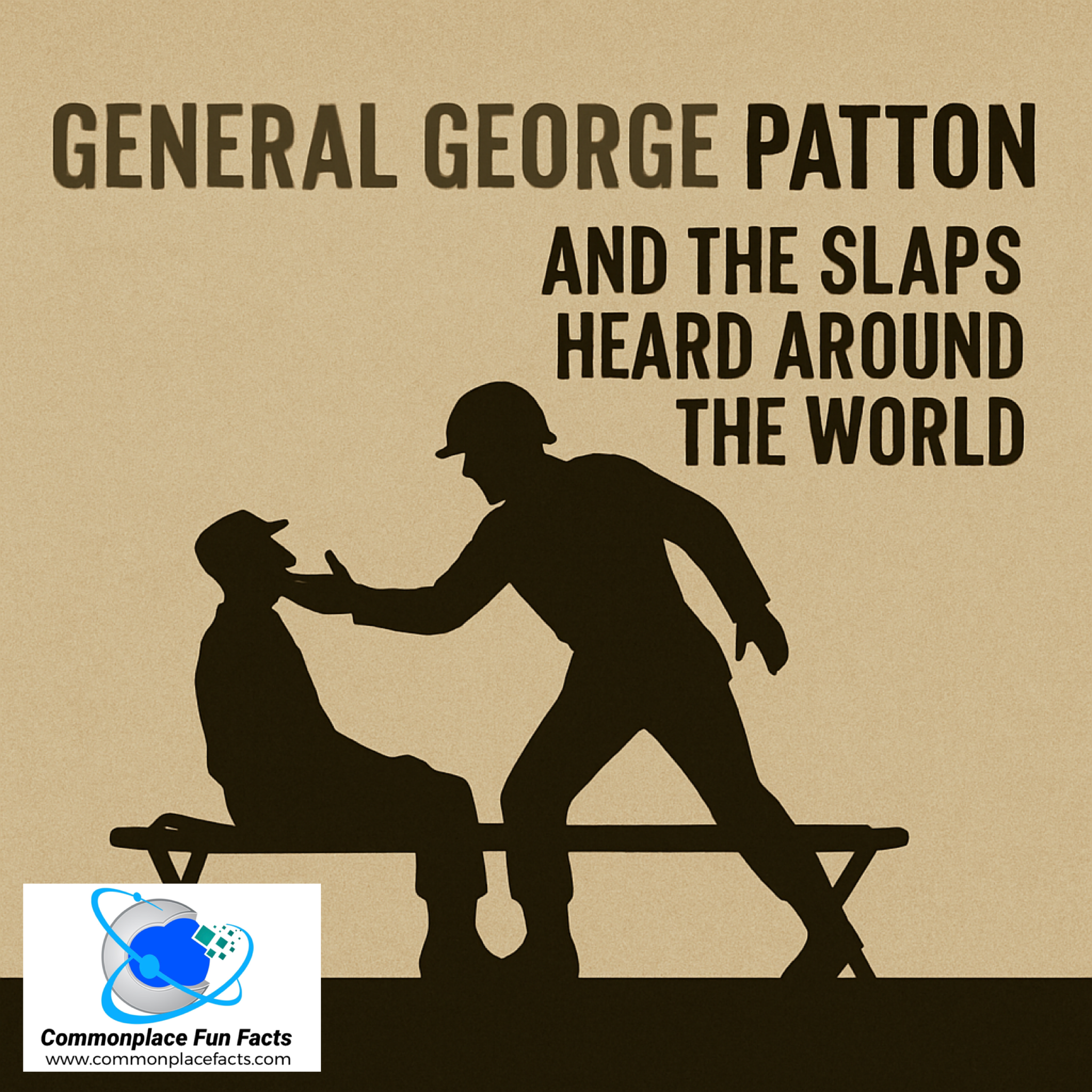

Few figures in military history have ever managed to blend tactical brilliance, aristocratic flair, and unapologetic controversy quite like General George Patton. Known affectionately—or not so affectionately—as “Old Blood and Guts,” Patton was the kind of commander who could quote Latin, ride a tank into battle, and still find time to deliver a motivational speech peppered with more expletives than a Tarantino film festival. But even the greats have their gaffes, and in August 1943, Patton’s temper managed to do what a battalion of Nazis couldn’t: put his career in real danger.
Contents
The Setting: Sicily, Sweat, and Shell Shock
It’s the summer of 1943, and the U.S. Seventh Army is battling its way across the sweltering, sun-baked terrain of Sicily. The air smells of dust, diesel, and desperation. Amid the chaos, thousands of wounded soldiers pour into field hospitals—some with visible wounds, others carrying the invisible weight of combat stress.
Back then, this psychological trauma was known as “battle fatigue.” Today, we call it PTSD. But in 1943, the understanding of mental health was about as sophisticated as a field latrine. (Speaking of which, you might want to read this article and learn why one of General Patton’s latrines was honored as a war hero.) Soldiers suffering from emotional breakdowns were often branded as cowards or malingerers. Which brings us to the star of our story: General Patton, the man who would turn battlefield visits into Broadway-level performances of ego and discipline.
The First Incident: August 3, 1943 – “What Are You, Yellow?”
Patton was not in the best of spirits when he arrived at the 15th Evacuation Hospital near Nicosia. He had just come from a meeting with 1st Infantry Division Commander General Clarence R. Huebner. When asked how things were going, Huebner replied, “The front lines seem to be thinning out. There seems to be a very large number of ‘malingerers’ at the hospitals, feigning illness in order to avoid combat duty.”
Patton came across Private Charles H. Kuhl. Kuhl wasn’t sporting any dramatic wounds—no bandages, no crutches—just a haunted look. When asked what was wrong, Kuhl shrugged and said he was nervous and added, “I guess I just can’t take it.”
Those were not the words General Patton wanted to hear. He slapped Kuhl across the face and called him a coward.
Turning his attention to the hospital staff, Patton yelled, “Don’t admit this son-of-a-bitch!” He demanded that Kuhl be sent back to the front at once, adding “You hear me, you gutless bastard? You’re going back to the front.”
Although medical science did not have a good understanding of PTSD at this point, we’re now pretty confident that recovery from psychological trauma is rarely enhanced by inflicting a fresh dose of the same through slapping and verbal artillery fire.
Patton Orders PTSD Out of the Army
As far as Patton was concerned, there was no such thing as “battle fatigue,” “shell shock,” or “PTSD.” In his mind, it was all cowardice and could be chased away with appropriate motivation. Two days after the slapping incident — August 5 — he issued a directive to all of his commanders:
It has come to my attention that a very small number of soldiers are going to the hospital on the pretext that they are nervously incapable of combat. Such men are cowards and bring discredit on the army and disgrace to their comrades, whom they heartlessly leave to endure the dangers of battle while they, themselves, use the hospital as a means of escape. You will take measures to see that such cases are not sent to the hospital but dealt with in their units. Those who are not willing to fight will be tried by court-martial for cowardice in the face of the enemy.
As far as he was concerned, the the problem had been addressed, and he expected to encounter no further soldiers who “just can’t take it.”
The Sequel: August 10, 1943 – “The Return of the Slap”

Just one week later, General Patton was at another hospital—this time the 93rd Evacuation Hospital near San Stefano. There, he encountered Private Paul G. Bennett, another shell-shocked soldier. And just like that, history repeated itself.
Patton asked the soldier what was wrong with him. Bennett replied, “It’s my nerves. I can’t stand the shelling anymore.”
The general was livid. He slapped the soldier across the face and retorted, “Your nerves? Hell, you are just a … coward. Shut up that … crying. I won’t have these brave men who have been shot at seeing this yellow bastard sitting here crying.”
“You’re going back to the front lines, and you may get shot and killed, but you’re going to fight. If you don’t, I’ll stand you up against a wall and have a firing squad kill you on purpose. In fact, I ought to shoot you myself, you … whimpering coward.”
He followed up his verbal barrage with another slap knocking his helmet liner off. The general then ordered the receiving officer not to admit Bennett as a patient. Turning back to the stunned G.I., Patton said, “You’re going back to the front lines, and you may get shot and killed, but you’re going to fight. If you don’t, I’ll stand you up against a wall and have a firing squad kill you on purpose. In fact, I ought to shoot you myself, you … whimpering coward.”
Just to show that he meant what he said, Patton pulled out his pistol. That’s when the hospital’s commander wisely stepped in to separate the men. As Patton left the tent he repeated his orders, yelling to medical officers to send Bennett back to the front lines.
Just How Cowardly Were They?
Patton reacted to what he saw. Unfortunately, there were some things he didn’t see that might have changed his opinion of the two soldiers.
As it turned out, Private Kuhl had good reason to be in the hospital. Later, upon examination, he was found to be running a temperature of 102.2 °F (39.0 °C) and was suffering from malaria.

As for his part, Kuhl was quite magnanimous. He wrote his parents about the incident, but asked them to “just forget about it.” His parents later stated that they had avoided mention of the matter because they “did not wish to make trouble for General Patton.”
As for Private Bennett, he too was running a fever. He showed symptoms of dehydration, fatigue, confusion, and listlessness. Despite this, he did not want to be in the hospital. Instead, he asked repeatedly to be returned to his unit on the front. His requests were turned down by medical officers.
One medical officer said, “The shells going over him bothered him. The next day he was worried about his buddy and became more nervous. He was sent down to the rear echelon by a battery aid man and there the medical aid man gave him some tranquilizers that made him sleep, but still he was nervous and disturbed. On the next day the medical officer ordered him to be evacuated, although the boy begged not to be evacuated because he did not want to leave his unit.”
None of this was known to Patton, but it was too late to change what had already taken place. What was done was done.
Or was it?
Damage Control: The War Within the War
You might be wondering how Patton’s antics went over with his superiors? At the risk of spoiling the ending, we should tell you that they did not go over well at all. Word of the incidents trickled up the chain of command and eventually landed on the desk of General Dwight D. Eisenhower.
Ike had a full-time job managing the Allied forces in Europe and Patton’s volcanic ego. Despite his long friendship with Patton, Eisenhower was furious when he heard the reports.
Privately, Eisenhower was torn. He knew Patton was one of the best battlefield commanders in the game, but he also understood that slapping soldiers wasn’t exactly a great look for morale—or headlines. He said, “If this thing ever gets out, they’ll be howling for Patton’s scalp, and that will be the end of Georgie’s service in this war. I simply cannot let that happen. Patton is indispensable to the war effort – one of the guarantors of our victory.”
Eisenhower wrote to Patton:
In the two cases cited in the attached report, it is not my present intention to institute any formal investigation. Moreover, it is acutely distressing to me to have such charges as these made against you at the very moment when an American Army under your leadership has attained a success of which I am extremely proud. I feel that the personal services you have rendered the United States and the Allied cause during the past weeks are of incalculable value; but nevertheless, if there is a very considerable element of truth in the allegations accompanying this letter, I must so seriously question your good judgement and your self discipline as to raise serious doubts in my mind as to your future usefulness. I am assuming, for the moment, that the facts in the case are far less serious than appears in this report, and that whatever truth is contained in these allegations reports an act of yours when under the stress and strain of winning a victory, you were thoughtless rather than harsh. Your leadership of the past few weeks has, in my opinion, fully vindicated to the War Department and to all your associates in arms my own persistence in upholding your pre-eminent qualifications for the difficult task to which you were assigned. Nevertheless, you must give to this matter of personal deportment your instant and serious consideration to the end that no incident of this character can be reported to me in the future, and I may continue to count upon your assistance in military tasks.
In Allied Headquarters there is no record of the attached report or of my letter to you, except in my own secret files. I will expect your answer to be sent to me personally and secretly. Moreover, I strongly advise that, provided that there is any semblance of truth in the allegations in the accompanying report, you make in the form of an apology or other such personal amends to the individuals concerned as may be within your power, and that you do this before submitting your letter to me.
To his credit, Patton received the rebuke and responded in a quintessentially Patton style. He went on an apology tour that could rival any modern celebrity caught saying something stupid on a hot mic.
Private Kuhl said that when Patton personally apologized to him, “He said he didn’t know that I was as sick as I was. I think at the time it happened, he was pretty well worn out himself.”
Ike hoped the situation had been satisfactorily addressed and that the unfortunate incidents would stay under wraps. The military’s press officers were told to keep a lid on the whole affair. That plan worked. That is, until it didn’t.
The Public Backlash: Blood, Guts, and Bad Press
On November 21, 1943, journalist Drew Pearson broke the story during a radio broadcast. Pearson was known for gossip mongering and muckraking. The facts were bad enough, but Pearson sensationalized them even further. Suddenly, the American public was buzzing with outrage. Newspapers ran headlines that made Patton sound less like a war hero and more like a schoolyard bully in a general’s uniform. Veterans’ groups were appalled. Politicians called for his dismissal. Patton’s approval rating was dropping faster than a Sherman tank falling over the white cliffs of Dover. (See this article in Time from December 1943, as an example.)
There was talk of sending Old Blood and Guts home in disgrace, court-martialing him, or at the very least, making him sit in the military’s version of a timeout.

Eisenhower mulled over the options and slapped (probably not the best choice of words under the circumstances) a gag order on Patton designed to keep his colorful commentary far away from reporters’ notebooks. “It would be far easier to keep him for a significant role in the war if he could shut off his public utterances,” Ike later wrote in his memoirs, probably while rubbing his temples at the memory.
But the consequences didn’t end there. As punishment for his hospital dramatics, Patton was yanked from field command and benched for months—exiled from the front lines like a misbehaving schoolboy told to sit in the corner and think about what he’d done. Of course, this is Patton we’re talking about, so even his time in the penalty box came with a twist.
Eisenhower, ever the strategist, turned Patton’s punishment into a brilliant bit of wartime misdirection. Knowing the Germans feared and respected Patton more than a surprise tank offensive at brunch, Ike made sure they saw Patton right where he wanted them looking: the English coast near Dover. There, Patton was placed in charge of the First United States Army Group—an entirely imaginary army made of ghosts, rumors, and more inflatable decoys than a parade float factory.
The goal? Operation Fortitude: the elaborate deception campaign that convinced the Germans the D-Day invasion would come at Pas de Calais, not Normandy. And thanks to Patton’s reputation and the Germans’ belief that there was no way he’d miss the biggest show of the war, they bought it—hook, line, and Panzer division.
When the dust settled and the Allies needed someone to charge across France and make the Germans weep, guess who got the call? That’s right—Patton was back, baby, leading the Third Army with a vengeance. And with just a teensy bit more restraint around army hospitals.
Legacy of the Slaps
The slapping incidents remain one of the most controversial chapters in Patton’s otherwise storied career. To some, they highlight the darker side of a man who demanded the impossible and couldn’t comprehend weakness. To others, they’re a regrettable blemish on a brilliant record—a sign of the times and the mental health ignorance that came with them.
Today, those slaps serve as a cautionary tale about leadership, empathy, and the importance of understanding what a soldier carries—not just on his back, but in his mind. And while Patton remains a towering figure in military lore, we remember that even giants have feet—and sometimes hands—of clay.
You may also enjoy…

How General Patton’s Latrine Became a National Hero
Discover the fascinating story of how a misunderstood latrine during WWI became a revered ‘heroic site’ in France, showcasing cultural differences and General Patton’s legacy.

Patton’s Pugnacious Party Pummeling
The greatest battlefield commander of the modern age was, by most accounts, General George S. Patton. His understanding of military history, instinctive grasp of technological innovation, and dogged determination rightly cemented his place among the greatest military leaders of all time. He also had a bit of a temper that got him into trouble on…

This Royal Custom Was a Real Slap in the Face
Who hasn’t heard of some unpopular government action and entertained a stray thought about slapping the person who was responsible? In ancient Babylon, that stray thought was actually encouraged to be acted upon. The Babylonian New Year was celebrated each year with elaborate rituals. The ceremonies lasted for several days, with a special program prepared…





Leave a Reply