
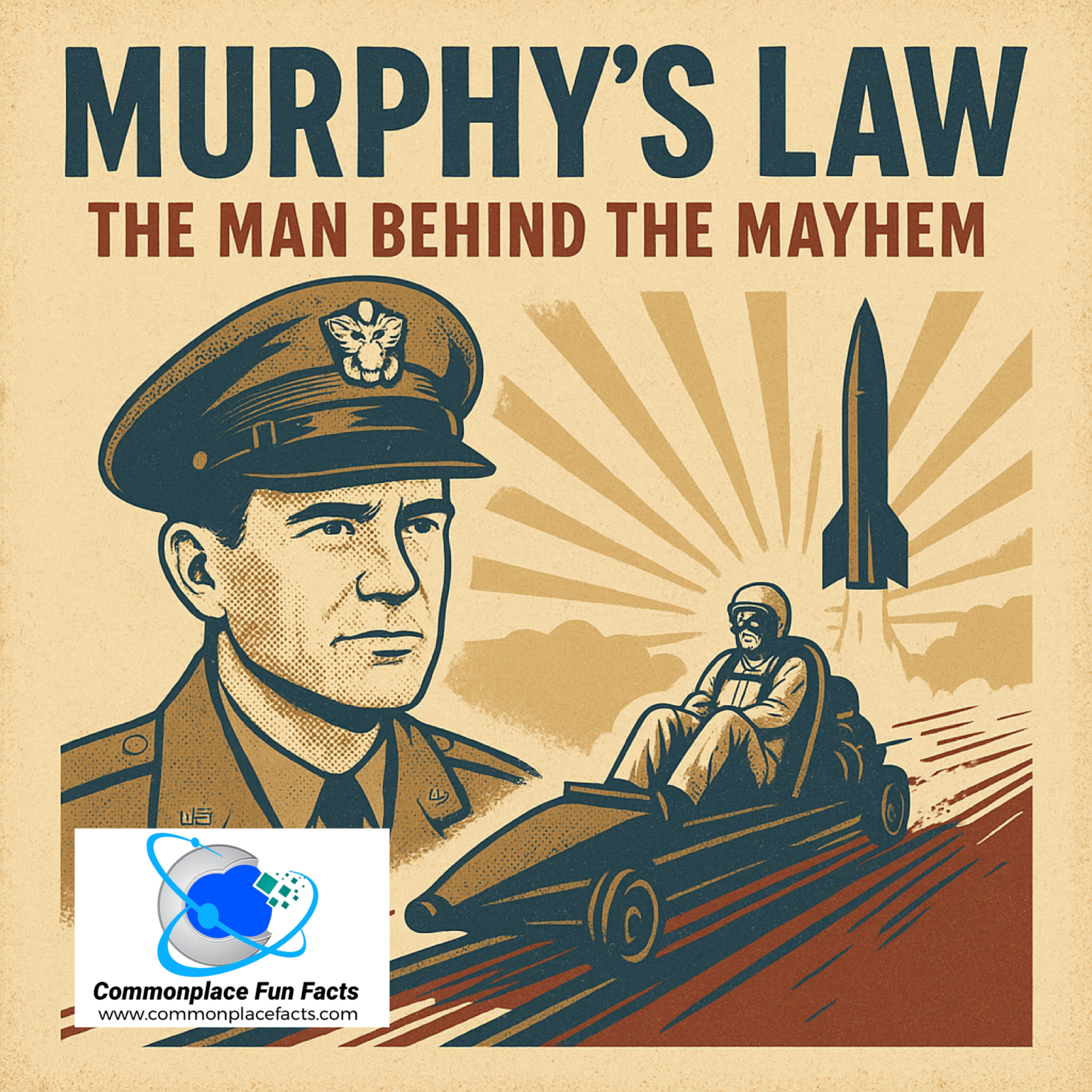

“Anything that can go wrong, will go wrong.” We know it as Murphy’s Law. It’s the rallying cry of pessimists, over-planners, and people who own an off-brand inkjet printer. But behind that famous doom-and-gloom decree is a man named Murphy — an actual, real person. He was an Air Force engineer with a low tolerance for human error and a front-row seat to the birth of one of the world’s most beloved cynical axioms.
Contents
Meet Captain Edward A. Murphy, Jr.: The Man, the Myth, the Lawmaker
Edward Aloysius Murphy Jr. (1918-1990) wasn’t trying to become a cultural icon. He didn’t wake up one day and say, “Today I shall create a universal law of failure!” Murphy was an aerospace engineer, which means he was more likely to say things like, “These transducers are toast,” or “Why are we strapping a human to a rocket sled again?”

In 1949, Murphy was working on Project MX981 at Edwards Air Force Base — a delightful little endeavor involving high-speed rocket sleds and the reckless use of human test subjects. The goal was to understand the effects of rapid deceleration on the human body.
The star of the show was Colonel John Paul Stapp. Providing further explanation about the reasons women tend to live longer than men, Stapp voluntarily strapped himself to rocket sleds going 632 mph and endured up to 46.2 Gs of force. This is basically like getting hit in the chest by a cement truck made of physics.
The Moment Everything (Predictably) Went Wrong
During one particular test, sensors were supposed to measure the G-forces on Stapp’s body. The technician responsible for wiring them somehow managed to install all the sensors incorrectly. Not just one. Not just most. All of them. If he had been aiming for a perfect failure, he stuck the landing.
Murphy was reportedly not amused. He is said to have muttered something along the lines of: “If there’s any way to do it wrong, he’ll find it.”
This offhand grumble — uttered in frustration, not prophecy — got paraphrased and passed around the project team like gossip at a middle school lunch table. Eventually, the pithy, pessimistic nugget we now know as Murphy’s Law was born.
Colonel Stapp: From Human Crash Dummy to PR Machine
Colonel Stapp, the man whose spine had recently been introduced to the concept of “instantaneous stop,” ended up doing a press conference about the project. When asked why their team had such a high safety record, he replied that they always took into account Murphy’s Law. That was it. The phrase exploded faster than a poorly wired G-sensor.

Interestingly, Murphy himself wasn’t exactly thrilled that his name had become synonymous with failure. He insisted the law was meant to promote rigorous testing and caution — a reminder to engineers to think through every possible way something could go sideways. But once the phrase escaped into the wild, it took on a life of its own. And like a lawnmower halfway through a bad haircut, it was too late to undo the damage.
In the 1970s, Arthur Bloch published Murphy’s Law and Other Reasons Why Things Go WRONG, and that only enhanced its fame and usage in popular culture.
Murphy May Have Named It, But He Didn’t Invent the Mayhem
As much as we love giving Captain Edward A. Murphy Jr. the credit (and the blame) for one of history’s most quotable downers, he didn’t exactly pull it out of a vacuum tube. The idea that the universe has a grudge against human intentions has been lurking in engineering manuals, math lectures, ship logs, and magician’s diaries long before Murphy got fed up with a botched wiring job.
In fact, the sentiment behind Murphy’s Law had been floating around for centuries, just waiting for someone to slap a name on it. Mathematician Augustus De Morgan scribbled in 1866, “Whatever can happen will happen, if we make trials enough.” Which sounds suspiciously like Murphy’s Law if you squint and add a snarky tone. Some have even suggested “Murphy” may have just been a bad memory of “De Morgan,” making this a case of mistaken pessimistic identity.
In 1877, engineer Alfred Holt warned his colleagues that “anything that can go wrong at sea generally does go wrong sooner or later.” His advice? Keep it simple, because the human factor can—and will—sabotage your shiny new maritime contraption.
Meanwhile, on dry land (and in far weirder shoes), British stage magician Nevil Maskelyne had his own take in 1908: “On any special occasion, such as the production of a magical effect for the first time in public, everything that can go wrong will go wrong.” Presto, disaster!
By the 1930s, amateur astronomers were already muttering about “Spode’s Law” — the notion that clouds will roll in exactly when you need a clear sky for stargazing. And in 1948, humorist Paul Jennings coined resistentialism — the belief that inanimate objects are actively plotting against you, which every parent who is trying to assemble a children’s toy on Christmas Eve can attest to.
Even in mountaineering circles, Murphy’s Law was considered old news. In 1952, journalist John Sack called the phrase “Anything that can possibly go wrong, does” an “ancient mountaineering adage,” which makes sense. When you’re dangling off a cliff by a nylon rope while your crampon decides to develop sentience and quit, you tend to become a bit of a philosopher.
So yes — Murphy gave the phenomenon a name, but he didn’t invent it. He just became its spokesperson.
Murphy’s Law, Version 2.0 (and 3.0, and 4.0…)
Since its unfortunate but inevitable debut, Murphy’s Law has spawned dozens of delightful variations:
- “If there’s a possibility of several things going wrong, the one that will cause the most damage will be the one to go wrong.”
- “Left to themselves, things tend to go from bad to worse.”
- “You will always find something in the last place you look.” (Well, duh.)
- “When you try to prove to someone that a machine won’t work, it will.”
Murphy’s Law has so many cousins in the family of snarky fatalism, including Sod’s Law, Finagle’s Law, and the slightly more optimistic Peter Principle (which mostly suggests your boss is not qualified and neither are you), that we have devoted two articles to cataloging these eponymous laws.
In the End, Murphy Was Right (And That’s the Problem)
Whether you’re installing a ceiling fan, launching a Mars rover, or trying to print a simple mailing label without triggering a complete ink cartridge meltdown, Murphy’s Law is there — lurking in the shadows, whispering “Not today, buddy.”

And while Edward A. Murphy may not have wanted his name to be attached to the world’s most enduring ode to pessimism, we salute him. Because without his irritable quip and a botched rocket sled test, we wouldn’t have the perfect phrase to yell when our computer freezes five minutes before a deadline.
Thanks, Captain Murphy. You didn’t invent failure — but you did give it a brand.
You may also enjoy…

Go to Law School Over These Eponymous Laws — Part I
Most people are familiar with Murphy’s Law — whatever can go wrong, will. Many more people than Mr. Murphy have posited laws, principles, and rules that bear their names. See how many of these eponymous laws you know. Aigner’s Axiom: No matter how well you perform your job, a superior will seek to modify the…

Cleveland Balloon Disaster: Spectacle or Ecological Debacle?
In 1986, the Cleveland Balloon Disaster saw an attempt to break the world record for releasing the most helium balloons. Despite initial excitement, the release led to disastrous consequences. The balloons obstructed rescue operations, caused traffic accidents, and polluted waterways, resulting in lawsuits and significant environmental impact.

Monkeys in Space: The Unlucky Adventures of Albert the Monkey — Times 6!
Six astronauts named Albert all had the distinction of becoming monkeys in space — and all had unlucky travels. Read about them here.




Leave a Reply