
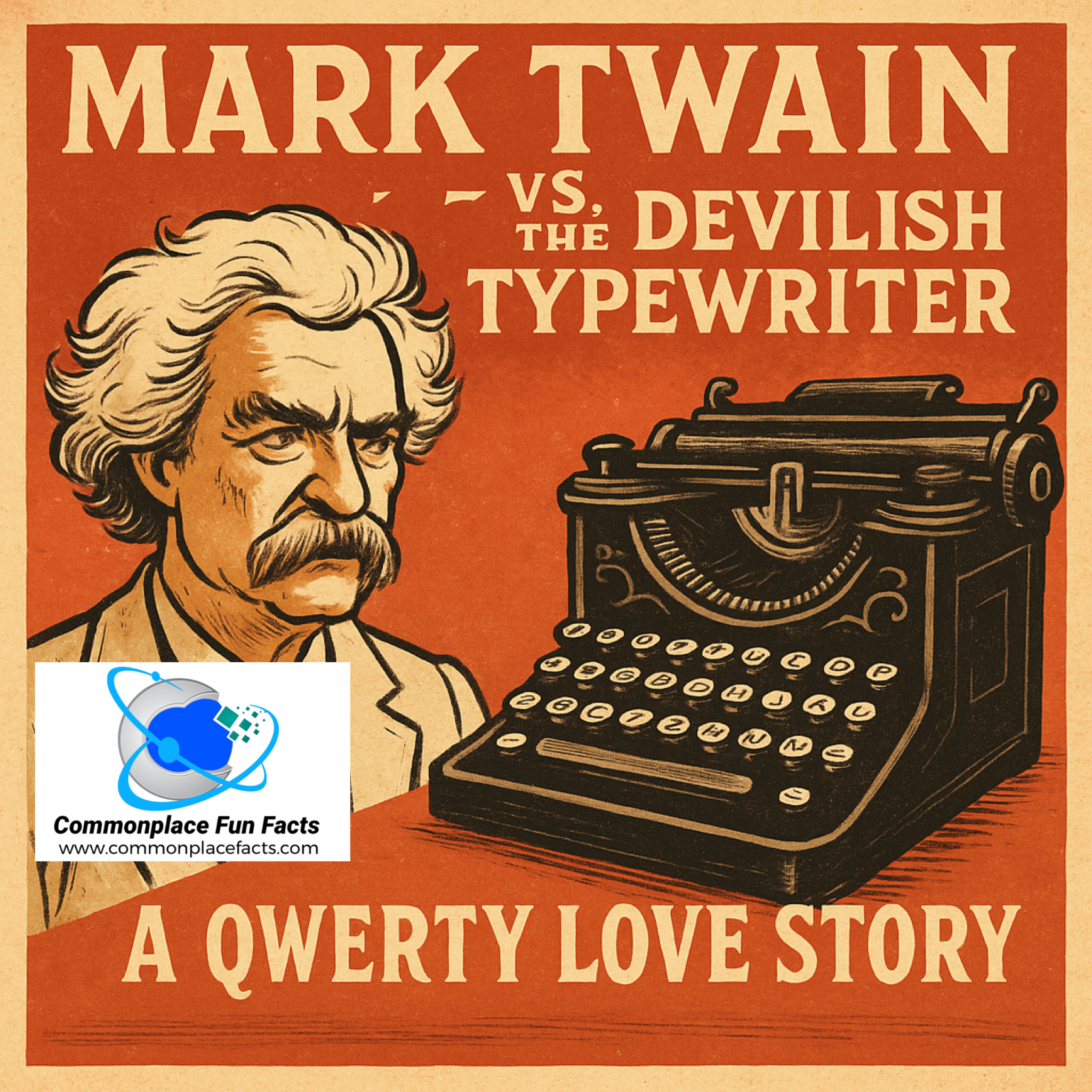

Before there was autocorrect and passive-aggressive red underlines, there was Mark Twain and his typewriter. One a beloved literary giant with a flair for sarcasm and cigar smoke, the other a clunky mechanical monster that spat out letters like it was chewing on Scrabble tiles. Together, they formed one of history’s most charmingly dysfunctional partnerships—part innovation, part irritation, and entirely too loud for polite company.
Twain, ever the tinkerer, stumbled across the typewriter in Boston in the early 1870s. He timed a professional typist at 57 words per minute and, presumably while stroking his mustache, thought, “That beats the snot out of ink blots.” The machine was new. The potential was limitless. And the frustrations? Oh, they were legion.
Contents
“It Piles an Awful Stack of Words on One Page”
In 1874, Twain purchased a Sholes & Glidden typewriter—also known as the Remington No. 1, and more affectionately known in Twain’s house as “that infernal contraption.” It was the first commercially available typewriter and proudly featured the newly-minted QWERTY keyboard layout, which would one day haunt the dreams of every texting teenager and secretarial pool. He paid $125 for the device. That’s approximately $3,375 in 2025 dollars—or, as Twain might have put it, “a princely sum to be shouted at by a mechanical demon.”

Twain initially gushed about the thing. It saved time, used less paper, and spared him from the inky chaos of fountain pens. But much like the relationship between Charles Dickens and Hans Christian Andersen, it started strong and quickly spiraled into bitterness.
He described it as “full of caprices, full of defects—devilish ones.” According to him, it had the power to degrade his moral character. Which, given the man’s ability to drink, smoke, and sass the elite, is really saying something.
In a desperate game of mechanical hot potato, he foisted the machine onto friend and editor William Dean Howells. When Howells returned it, Twain tried again—this time giving it to a clergyman, who must have seen it as penance. The machine made the rounds like a haunted doll until it finally disappeared — possibly into a lake.
“I am not making a shining success of it.”
We have the receipts—well, one very specific letter. On December 9, 1874, Twain typed a note to his brother Orion. It opened with this gem:
”BJ UYT KIOP N LKJHGFDSA: QWERTYUIOP,.-98VN6432QW R7…”
After that stunning literary opener, he continued: “I am trying to get the hang of this new fangled writing machine, but am not making a shining success of it.”
Twain believed he might be “the first person in the world to apply the type‑machine to literature.” He even claimed—incorrectly—that The Adventures of Tom Sawyer was typed. In reality, it was written by hand, and it wasn’t even the book that he had in mind.
The book in question was Life on the Mississippi, but it wasn’t Twain who did the pecking. That responsibility fell to Isabel V. Lyon, Twain’s secretary and all-around patience saint, who typed the manuscript in 1883. That book holds the distinction of being the first typewritten manuscript submitted to a publisher, but not because Twain was hammering away at the keys. He dictated; she typed. And somewhere in heaven, she’s still waiting for the thank-you card.
So, while Twain was a fierce early adopter, he was also savvy enough to let someone else do the hard part when the novelty wore off—just like how we all swore we’d use that fancy juicer every day… until cleanup happened.
The Marketing Nightmare

For Remington, the typewriter’s creator, Twain’s early enthusiasm was also their marketing goldmine. They asked the famous author to write a letter of endorsement about their product. They namedropped him like he was a 19th-century Kardashian. Twain wasn’t having it. He fired off a letter to the company demanding they stop using his name in promotions:
”GENTLEMEN: Please do not use my name in any way. Please do not even divulge the fact that I own a machine. I have entirely stopped using the Type-Writer, for the reason that I never could write a letter with it to anybody without receiving a request by return mail that I would not only describe the machine, but state what progress I had made in the use of it, etc., etc. I don’t like to write letters, and so I don’t want people to know I own this curiosity-breeding little joker. Yours truly, Saml. L. Clemens”
He may have been the world’s first tech influencer—and definitely the first to regret the endorsement.
But Then… He Bought Another One
Despite all the yelling, Twain couldn’t stay mad forever. In the early 1900s, he picked up a Williams No. 6 typewriter—a “grasshopper” model with a cool visibility feature that let users see what they were typing in real time. This shiny new toy sat on his desk from 1908 until his death in 1910. Sometimes, love means forgiving the earlier trauma inflicted by obsolete technology.
The One That Really Did Him In
If you thought the typewriter was his greatest tech regret, allow us to introduce: the Paige Compositor. It wasn’t a typewriter—it was a mechanical typesetting device. Twain invested in it like it was going to be the Tesla of its time. He poured in $300,000 (adjusted for inflation: approximately the GDP of a small island nation).
It never worked properly. The investment failed spectacularly and was a major contributor to Twain’s 1894 bankruptcy. If the typewriter tested his patience, the Paige Compositor chewed it up, set it on fire, and then billed him for the privilege. To pay off his debt, he went on a worldwide tour and wrote about his experiences. Consequently, he sailed on the SS Warrimoo, a ship that may or may not have, in one moment, existed simultaneously in two days, two months, two seasons, two years, two decades, and two centuries.
Legacy: One Wild Ride on the Typing Train
Mark Twain wasn’t just a literary genius. He was a tech enthusiast, a frustrated early adopter, and possibly the first person to shout, “This stupid machine is ruining my life!” while hurling a typewriter across the room.
He helped usher in a new age of writing and publishing, whether he liked it or not. And despite every jammed key, every broken ribbon, and every marketing faux pas, he never stopped trying to make sense of the modern world—one BJ UYT KIOP at a time.
You may also enjoy…

How Gutenberg Invented the Printing Press Because of Bad Scheduling and a Con Scheme
How did Gutenberg come up with the printing press? Read this article to find out how it was influenced by a bad schedule and a con scheme.

First Prize For Printing a Story That Can’t Be Printed
The delightful book Littlewood’s Miscellany by John Edensor Littlewood contains a snippet that will cause brain cramps if you contemplate it for very long: It notes that in a writing competition in The Spectator magazine on the subject of what you would most like to read on opening the morning paper, the following submission won…

When The World’s Great Authors Formed a Cricket Team
What do literary giants do when they aren’t writing history’s greatest books? There’s no better way to stave off a case of writer’s block than to play a rousing game of cricket. That seemed to be the motivation of a cadre of famous writers who formed the most literary-talented cricket team in history. J.M. Barrie…







Leave a Reply to cat9984Cancel reply