
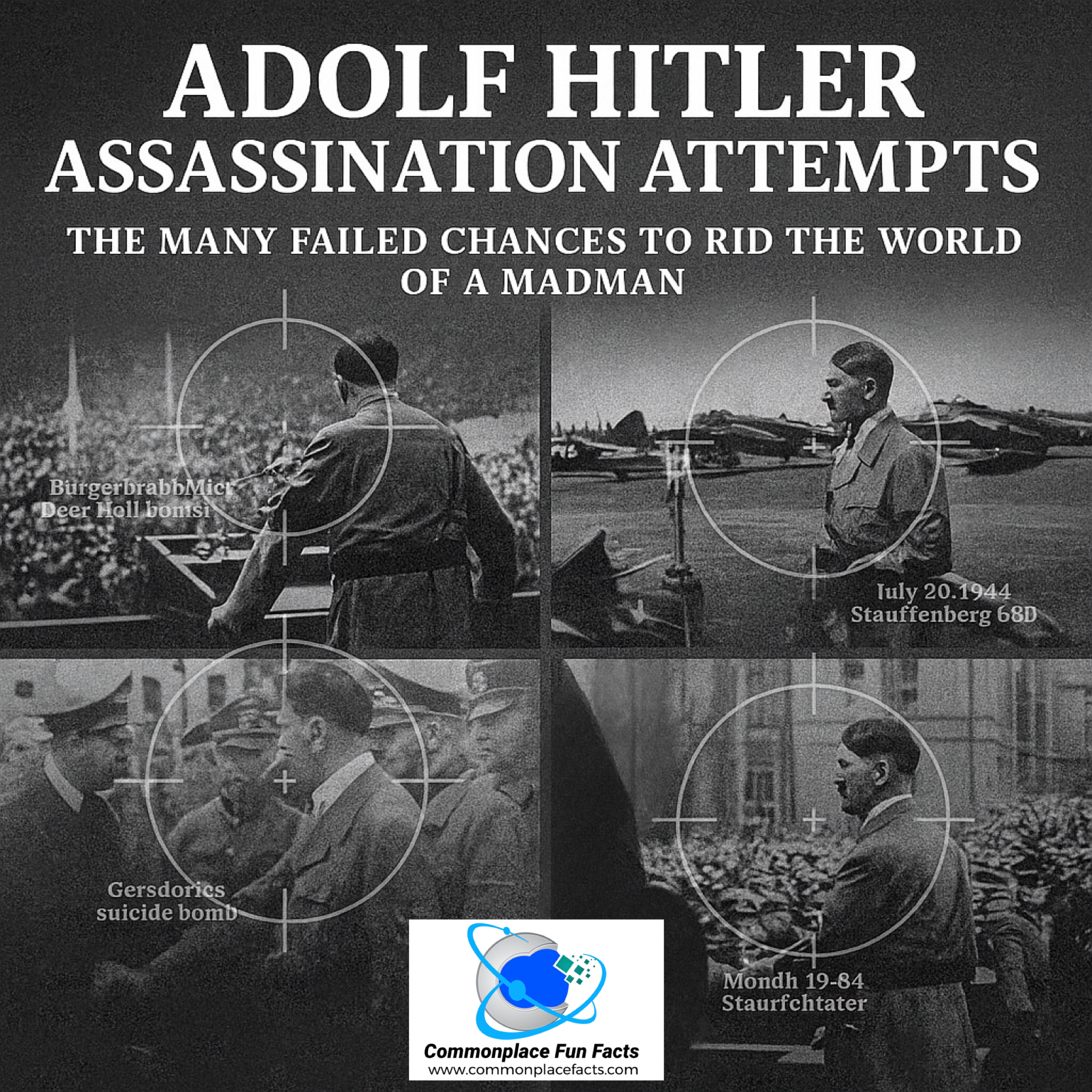

How Many Hitler Assassination Attempts Does it Take?
It’s one of history’s most frustrating rhetorical questions: Why couldn’t somebody just take out Hitler? Between 1933 and 1945, millions of people had cause to wish the Führer a swift exit from the mortal coil. And yet, through a mix of obsessive security, blind luck, bad timing, and perhaps the Devil’s own internship program, Adolf Hitler survived more attempts on his life than most action-movie heroes. Depending on which historian you ask, the number ranges from “at least 15” to “we stopped counting at 42.”
Some of these attempts are well-documented, with blueprints, eyewitness accounts, and surviving conspirators to tell the tale. Others… well, let’s just say they live in that hazy borderland between history and the sort of story you’d hear from your friend’s uncle who swears he met Elvis at a gas station. Either way, they make for an intriguing catalogue of human determination, failure, and occasional farce.
Join us as we explore some of these ambitious efforts to expedite Herr Hitler’s journey to the silly mustache gated community of the realms of hell.
Contents
1929: The Bathroom Break That Saved a Dictator? (Probably Not)
Our first stop in this deadly parade takes us to 1929, before Hitler became Chancellor. The story goes that a disgruntled SS guard planted a remote-controlled bomb under the podium at Berlin’s Sportpalast, ready to send the future Führer into the afterlife mid-speech. Unfortunately for the plot, the would-be assassin was seized by an urgent need to visit the toilet. In the process, he got locked in and missed his chance to detonate the device.
It’s a great yarn—tragic for humanity, hilarious for the ironies of fate—but here’s the catch: no reputable historical record backs it up. The earliest verifiable attempts don’t appear until years later. Still, we can all agree that if this is true, it ranks with the soldier whose full bladder caused the Second Sino-Japanese War as one of history’s most consequential restroom breaks.
1938: Generals, Czechoslovakia, and the Munich Conference
Fast forward to September 1938, when Hitler was ratcheting up tension over Czechoslovakia’s Sudetenland. Inside the German army’s upper ranks, not everyone was onboard with starting a European war over a border dispute. Some plotters were allegedly ready to move against Hitler the moment he gave the invasion order. That moment never came—not because they lost their nerve, but because British Prime Minister Neville Chamberlain pulled an unexpected “Let’s talk” move, followed by Mussolini’s diplomatic interference, culminating in the four-nation Munich Agreement.
Was there really a coup order in a general’s desk drawer, ready to go? Maybe. The evidence points to serious unease among the high command, but whether Brauchitsch was minutes away from deposing Hitler or just sighing heavily into his coffee is open to debate.
1939: The Beer Hall Bomb That Almost Worked
On 8 November 1939, Hitler returned to the Bürgerbräukeller beer hall in Munich to commemorate the anniversary of his failed 1923 coup. Enter Georg Elser, a carpenter with explosives expertise and no patience for Nazism. Elser spent weeks hollowing out a pillar behind the speaker’s platform and planted a timed bomb designed to go off at the peak of Hitler’s speech.
Normally, Hitler would speak for hours, but on this night he wrapped up early—at 9:07 p.m.—and left the building. At 9:20, the bomb exploded, killing seven and injuring over sixty. If Hitler had stuck to his usual schedule, history would have been rewritten.
There’s a fringe theory that Hitler orchestrated the explosion to eliminate inconvenient army officers in the audience. Evidence? Thin. Appeal to conspiracy buffs? Off the charts. Mainstream historians chalk this one up to bad luck for Elser, not a secret Nazi culling operation.
1940: The Paris Parade That Wasn’t

After the fall of France, so the story goes, a sniper plot targeted Hitler during his victory parade in Paris. The would-be assassin never got the chance—Hitler visited the city four days early and skipped the parade entirely.
It’s a cinematic idea—Hitler framed in a rifle scope against the Arc de Triomphe—but there’s no reliable documentation to suggest it really happened. If it did, it joins the 1929 bathroom bomb in the “probably apocryphal, but fun to imagine” category.
1943: Operation Overcoat—Fashion That Kills (Or Would Have)
According to another possibly-mythical tale, a November 1943 plot revolved around Hitler’s love of micromanaging uniform design. The plan was to present him with a new overcoat prototype loaded with grenades. The would-be assassin would trigger them during the fitting and hold on tight. Unfortunately, an Allied air raid destroyed the sample garments the day before the demonstration.
Historical record of this operation? Nowhere. But as far as improbable assassination methods go, it’s second only to “poisoned moustache comb.”
March 1943: The Frozen Bomb on the Führer’s Plane
In March 1943, a genuine and carefully planned attempt was made by Colonel Henning von Tresckow’s resistance network. They planted a bomb disguised as a liquor case on Hitler’s plane, timed to explode mid-flight. But when the plane landed safely, the conspirators discovered the detonator had failed—the acid charge that was supposed to eat through a wire and trigger the blast had frozen solid in the unheated luggage compartment.
One colorful version of the story claims the pilot, seeking smoother air for Hitler’s comfort, climbed to a higher, colder altitude at just the right moment to freeze the mechanism. Dramatic, yes—but historians generally credit plain bad weather, not an unwitting co-pilot, for this one’s failure.
March 1943: The Suicide Bomb at the War Trophies Exhibition
Just a week later, Colonel Rudolf von Gersdorff volunteered for a suicide mission. The occasion: Hitler touring a captured Soviet weapons exhibit after Berlin’s Heroes’ Memorial Day ceremony. Gersdorff carried bombs in his coat pockets, primed to detonate after ten minutes. An aide promised Hitler would linger at least thirty minutes. Instead, the Führer breezed through the exhibit in under two minutes, offering Gersdorff no opportunity.
Gersdorff managed to slip away to a restroom and defuse the bombs with seconds to spare. Some versions of the tale say Hitler then spent extra time climbing around a Soviet tank outside—plenty long enough for the plot to have worked. The tank cameo is a nice detail, but it smells like an embellishment added for tragic irony.
March 1944: The Berghof Pistol That Stayed Holstered
Another unverified account claims a cavalry captain planned to shoot Hitler during a military conference at the Berghof. Hitler suddenly decreed that junior officers wouldn’t attend, leaving the would-be assassin outside the door. No solid archival record confirms this, so it may belong more to resistance folklore than history.
July 1944: Operation Valkyrie — The Briefcase That Was Moved

The 20 July 1944 plot—Operation Valkyrie—is the best-known attempt. Colonel Claus von Stauffenberg brought a bomb in a briefcase to a conference at the Wolfsschanze (Wolf’s Lair). He set it under the map table just a few feet from Hitler. At some point, Colonel Heinz Brandt, needing a better view of the map, moved the briefcase to the far side of a thick oak table leg. When it detonated minutes later, the support absorbed much of the blast.
Hitler emerged with burst eardrums, a sprained shoulder, and a renewed commitment to paranoid security measures. The conspirators, meanwhile, paid the ultimate price.
1939: The British “Unsportsmanlike” Sniper Plan
Perhaps the oddest alleged non-attempt comes from early 1939. General Sir Noel Mason-MacFarlane, Britain’s military attaché in Berlin, supposedly suggested assassinating Hitler with a sniper shot from a nearby apartment window. The British government allegedly rejected it as “unsportsmanlike.”
It’s a great punchline, but no reliable evidence supports the anecdote. Given that Churchill later ordered targeted assassinations during the war, it’s safe to say “unsportsmanlike” wasn’t a standing policy. Also, if Churchill knew that Hitler had tried to kill him with some explosive chocolate, we’re pretty sure that all bets would have been off.
The Worst Suicide Intervention in History
We should also mention that there was one other opportunity to change history. Read this article to learn about the woman who prevented Hitler from committing suicide before he rose to power.
The Unkillable Führer?
Whether through sheer luck, bizarre coincidences, or the occasional questionable telling, Hitler survived an astonishing number of threats. The verified ones—Elser’s bomb, the frozen detonator, Gersdorff’s suicide attempt, and Stauffenberg’s briefcase—are enough to make you wonder what might have happened if just one factor had gone differently. The dubious ones? They tell us as much about how people wish history had gone as they do about how it actually unfolded.
In the end, it took the full weight of the Allied armies to bring Hitler’s story to its bloody conclusion. But history is littered with tantalizing “what if” moments—proof that while evil can be stubborn, it’s rarely invincible. In this case, it just turned out to be maddeningly, absurdly, infuriatingly lucky… or maybe just cursed with good timing.
You may also enjoy…

The Woman Who Saved Hitler’s Life—and Changed the Course of History
In 1910, Adolf Hitler nearly ended his life. One woman’s intervention changed everything—altering the 20th century and shaping history’s darkest chapter.

How a Wobbly Chair Saved FDR’s Life
On February 15, 1933, Franklin D. Roosevelt was in Miami, Florida. Having just won the presidential election three months earlier, he was still 17 days away from being inaugurated as the 32nd President of the United States. (The 20th Amendment to the Constitution, changing the date of the inauguration to January 20, would not go…

William McKinley Gave Away His Lucky Flower — and Ran Out of Luck
President William McKinley loved carnations and believed them to be lucky. Learn what happened on the day he gave away his lucky flower.



Leave a Reply