
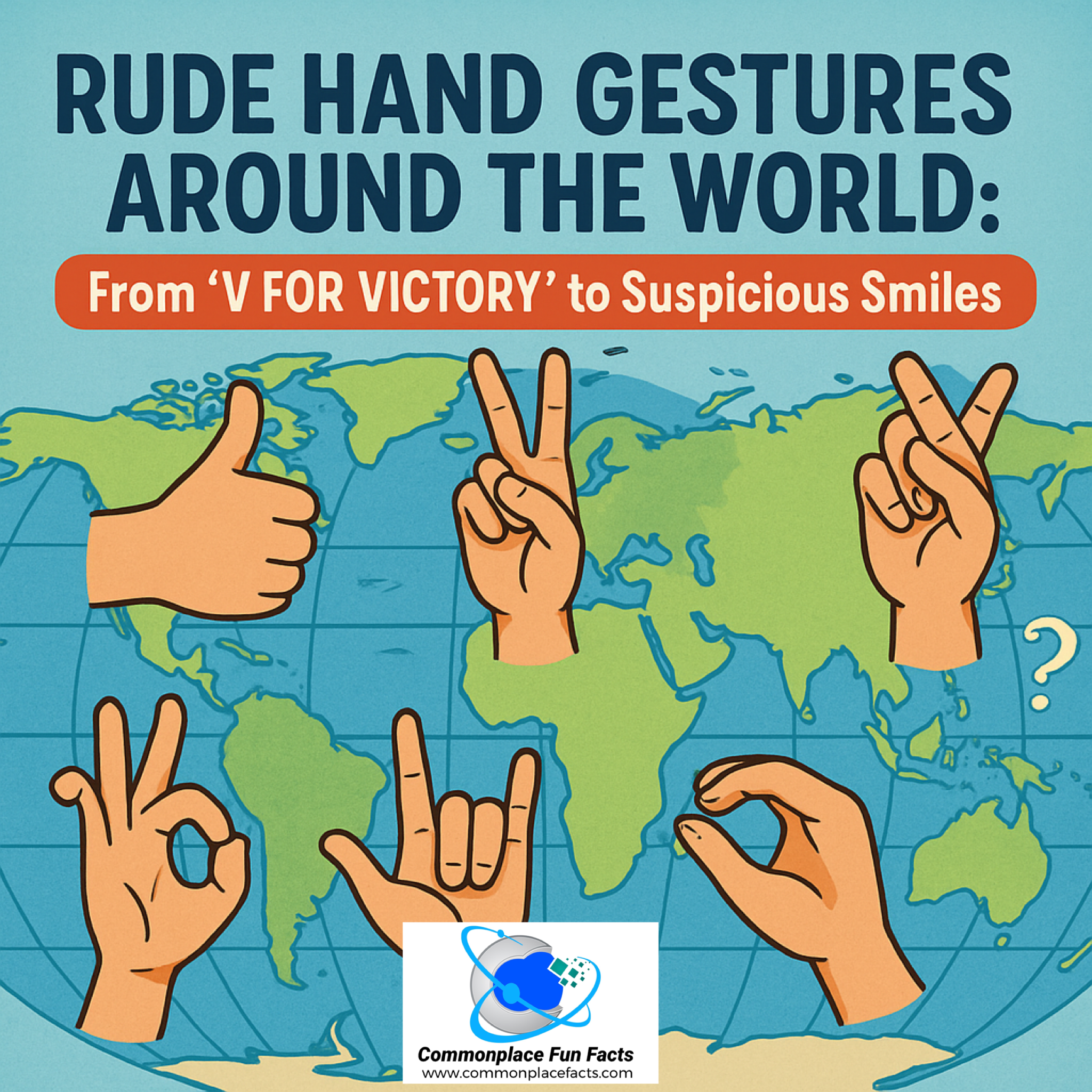

Winston Churchill had many weapons in his arsenal during World War II: booming speeches, unwavering determination, and the ability to look perpetually grumpy with a cigar clenched between his teeth. But one of his most memorable contributions wasn’t verbal at all. It was the famous “V for Victory” hand gesture.
That simple gesture of two fingers in the shape of a V — it was inspirational. It was defiant.
It was also, depending on which way those fingers were pointing, either a stirring call to freedom or the kind of thing guaranteed to get you grounded if you tried it at the dinner table. Churchill may have been rallying nations, but he also proved what every traveler eventually learns: hand gestures don’t always say what you think they do.
Contents
The Birth of “V for Victory”

The V-sign wasn’t Churchill’s brainchild. In 1941, Belgian politician Victor de Laveleye suggested on the BBC that people in Nazi-occupied Europe use the letter “V” as a unifying symbol. It stood for victoire (victory) in French and vrijheid (freedom) in Dutch. The BBC used the opening notes of Beethoven’s Fifth Symphony — da-da-da-DAH — as a coded morale booster, since the rhythm matched the Morse code for the letter V. See this article from our friends at The Hometown Herald for more insight into the V for Victory phenomenon.
Churchill, never one to pass up a solid PR opportunity, quickly adopted it. Suddenly, two fingers in the air became shorthand for Allied defiance. Simple, visual, and impossible to mishear — unlike some of Churchill’s longer sentences.
Palms Out vs. Palms In
Of course, hand signals are tricky things, and the V-sign came with a catch. In Britain, a subtle twist of the wrist completely changes the meaning:
- Palm outward: “Victory is ours!”
- Palm inward: “Up yours.”
Churchill occasionally flubbed it, throwing out the insulting version when cameras were rolling. It didn’t take long before someone explained he was essentially giving the nation the two-finger salute. He corrected himself, but the photos live on — proof that even world leaders need a cultural cheat sheet.
The Gesture Goes Global

Once Churchill nailed the wrist rotation, the V-sign spread everywhere. It was splashed across posters, adopted in films, and carried as a symbol of resistance around the globe. A generation later, the 1960s counterculture flipped it into the peace sign. Same gesture, totally different vibe. Somewhere, Churchill was probably wagging a finger of disapproval — palm outward, of course.
Rude Hand Gestures Around the World
Churchill’s early bloopers highlight a bigger truth: gestures don’t come with subtitles. What earns you cheers in one country earns you side-eye (or worse) in another. Here are a few classic examples guaranteed to get you scolded if you try them in the wrong place:
- The “OK” Sign 👌: “All good” in the U.S. In Brazil and Turkey, it’s an obscene insult. In Japan, it just means “money.”
- Thumbs-Up 👍: A casual “good job” in America. In Greece and the Middle East, it’s more like “good luck finding new friends.”
- The V-Sign ✌️: Hippie peace everywhere… unless your palm faces inward in the U.K. or Australia. Then it’s “peace off.”
- The “Rock On” Horns 🤟: Harmless enthusiasm at a concert. In Mediterranean countries, it accuses someone of marital woes. Not a great encore move.
- The “Finger Purse” 🤏: Italy: “What do you mean?” Middle East: “Let’s take this outside.”
- The Moutza ✋: A friendly wave in the U.S. In Greece, it’s an insult dating back to Byzantium. Mom definitely wouldn’t approve.
- Crossed Fingers 🤞: Good luck in the West. Obscene in Vietnam. Not exactly the charm you were hoping for.
- Beckoning Gesture 👋: “Come here” in America. In the Philippines, it’s used for animals — and if you use it on people, you’ve basically called them one.
- Shoe Soles 👞: Crossing your legs in the West? Relaxing. Showing the bottom of your shoe in the Middle East? A giant sign of disrespect. Think of it as the international version of putting your feet on Grandma’s coffee table.
The moral? Hands and feet can land you in hot water faster than your mouth. Churchill’s accidental rudeness was photographed for posterity; the rest of us usually just get scolded by our mothers or embarrassed in airports.
Even Smiles Can Backfire
If you think a smile is the one gesture that can never go wrong, think again. In Russia, there’s a proverb that goes: Смех без причины — признак дурачины — “Laughter without reason is a sign of foolishness.” In other words, if you’re walking around grinning at strangers for no apparent reason, you don’t look friendly; you look like an idiot.
To Westerners, especially Americans who are raised to believe that smiling is the international language of goodwill, this can come as a shock. But in much of Eastern Europe, smiling without cause is seen as shallow or insincere. A serious face shows respect and professionalism. A constant grin? Suspicious at best, clownish at worst.
Of course, this doesn’t mean Russians never smile. They laugh, joke, and beam just like everyone else — but only when there’s a reason. The difference is, they reserve their smiles for genuine emotions or trusted company. It’s less “customer service face” and more “I actually like you.”
So yes, even the friendliest gesture of all isn’t foolproof. In Churchill’s world, the wrong twist of the wrist could insult a nation. In Russia, a misplaced smile could make you look like you’ve escaped from the fool’s parade. Either way, it’s proof that body language can betray you just as quickly as it can inspire.
When Gestures Go Wrong
Churchill wasn’t the only one to discover how easily gestures backfire. Other famous figures have given the wrong sign at the wrong time, with predictably awkward results:
- George H.W. Bush (Australia, 1992): Flashed what he thought was a peace sign — palm inward. Australians saw it as “up yours.” Oops.
- Richard Nixon (1974): Waved goodbye with double V-signs. In the U.S., iconic. In parts of the Commonwealth, it looked more like a final insult.
- Ronald Reagan (Brazil, 1982): Gave the crowd the “OK” sign. Locals didn’t think it was OK at all.
- Prince William (2005): Playfully flipped the inward V-sign at photographers. Lesson: even royals get caught being cheeky.
- Soccer Stars Everywhere: From David Beckham to Cristiano Ronaldo, athletes have been snapped mid-match giving gestures that fans and tabloids pounced on. “I meant victory” never quite convinces the referees.
The takeaway? A misplaced finger can turn a victory lap into a PR cleanup. It’s certainly not the only time celebrities have gotten in trouble by putting their hands where they don’t belong.
Of course, there’s no guarantee that keeping your hands still will save you from embarrassment. Take a look at this article to learn about the cascading faux pas moments experienced by Jimmy Carter when his interpreter kept getting things wrong.
Conclusion: Lost in Translation
Churchill’s “V for Victory” sign was simple, powerful, and — when angled the right way — unforgettable. But his story, and countless others, show that gestures don’t come with universal subtitles. A peace sign in London is an insult in Sydney. A thumbs-up in New York is a rude dismissal in Athens. Even smiling at strangers in Moscow can make you look like you’re auditioning for the role of village fool.
The lesson? Body language is about as reliable across cultures as a Google translation of Shakespeare. What inspires in one country can enrage in another. So if you’re ever in doubt, maybe resist the urge to get creative with your fingers, thumbs, or facial expressions. A polite nod will usually do the trick — and if all else fails, just stand around in silence, awkwardly avoiding eye contact with anyone. Hey, it worked for us throughout high school and, come to think of it, most family reunions.
You may also enjoy…

Jimmy Carter’s Translation Woes
The post highlights President Jimmy Carter’s experiences with faulty interpreters, notably during his 1977 visit to Poland when Steven Seymour misinterpreted his messages, leading to embarrassing misunderstandings. Following his presidency, Carter encountered another misinterpretation at a college in Japan, reinforcing his apprehension about the reliability of interpreters.

Winston Churchill and the Fate of Marriage: A Street Sweeper or a Prime Minister?
Discover Winston Churchill’s witty exchange with his wife, Clementine, about a street sweeper with a surprising past. A short but powerful story of perspective and ambition!

The Wolves That Fought in World War I
War can bring about some uneasy alliances. In the right circumstances, opposing forces can sometimes be persuaded to stop killing each — for a little while, anyway. This happened on Christmas Day, 1914 when British and German troops paused their fighting long enough to play a few matches of soccer. It also happened a couple…





Leave a Reply