
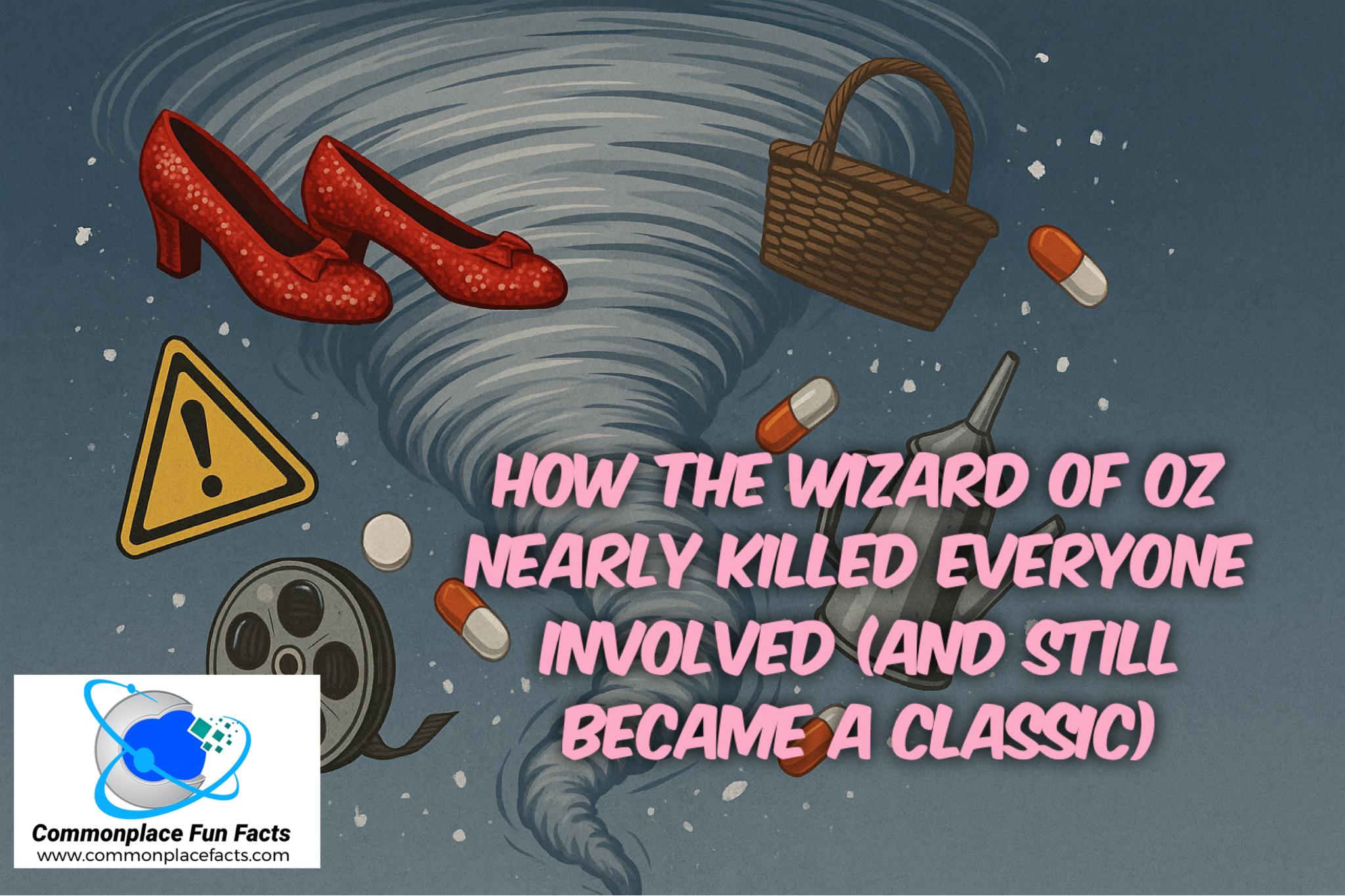

The Wizard of Oz Dark History and the Production Accidents That Plagued It
We’re all guilty of a bit of nostalgia now and then, and nothing triggers it better than a classic movie. We yearn for the days before soul-sucking reboots, CGI explosions that look like someone sneezed pixels, and dialogue so wooden it could qualify as lumber. But every once in a while, a story crawls out of Hollywood’s Golden Age so jaw-droppingly awful that you find yourself singing with Billy Joel: “You know the good ol’ days weren’t always good, and tomorrow ain’t as bad as it seems.”
Case in point: The Wizard of Oz. A beloved classic, a cinematic milestone, a cultural juggernaut. According to the Library of Congress, it might just be the most-watched movie in human history. Its songs are iconic, its visuals groundbreaking, its ruby slippers legendary. But behind that cheerful façade of a singing scarecrow and technicolor poppy fields lurks one of the most chaotic, miserable, and downright dangerous productions ever put to film. If you were involved in the production of The Wizard of Oz, you likely would not look fondly back at that time and think, “There’s no place like home.” This is the story of how making Oz was a yellow brick road was paved with asbestos, amphetamines, and very poor decisions.
Contents
Before Judy and Toto: The Many Lives of Oz
Let’s rewind to the dawn of the 20th century. In 1900, L. Frank Baum published The Wonderful Wizard of Oz, and readers went absolutely nuts for it. Hollywood, never one to let a cash cow graze unmilked, quickly turned it into not one, not two, but seven different film adaptations before Judy Garland ever clicked her heels. And speaking of cash cows, in the original stage production, instead of Toto the dog, audiences were treated to Imogen the cow.
Then came 1937, and with it, Disney’s Snow White and the Seven Dwarfs (which may have been based on a true crime story). MGM saw those box office receipts and thought, “Children’s books plus songs equals money. We can do that.” And so, they set out to make their own fairy-tale blockbuster — this time with big musical numbers, groundbreaking Technicolor, and enough ambition to power an entire film studio. What could possibly go wrong?
Casting Calamities and Character Swaps
From the start, nothing about casting this movie was straightforward. MGM’s dream Dorothy was Shirley Temple, the pint-sized superstar of the era. She was closer to the character’s age and guaranteed to sell tickets. One small problem: she belonged to 20th Century Fox, and Fox wasn’t about to loan out its golden-haired goose. So MGM settled on 16-year-old Judy Garland — older, less cutesy, and, as it turned out, destined for a truly miserable experience.
The rest of the cast wasn’t immune to chaos either. Ray Bolger was originally cast as the Tin Man, but he decided he’d rather play the Scarecrow. MGM caved, swapping him with Buddy Ebsen, who was set to wear the burlap. It was a choice Buddy would live to regret — barely.
Meanwhile, Gale Sondergaard was cast as the Wicked Witch of the West. The original plan was to make the witch glamorous — think evil queen vibes, not Halloween costume aisle. But when MGM changed course and decided she should be horrifying and green, Sondergaard exited so fast, she didn’t even have a chance to make a threat against anyone’s little dog. Enter Margaret Hamilton, a character actress who got a whopping two days to prepare for one of the most iconic villain roles in film history. It was not the last indignity she’d suffer on this job.
Then there were the Munchkins — over 100 little people hired to populate Oz. It was one of the few major roles Hollywood offered them, and they were paid well for it. Maybe a little too well, as we’ll see later. For now, let’s just say the word “rowdy” is going to come up again.
Start Shooting. Stop Shooting. Start Over.
Filming officially kicked off in October 1938 under director Richard Thorpe, who was known for efficiency and speed — two things MGM desperately needed on its most expensive production to date. Unfortunately, Thorpe’s vision of Oz wasn’t what anyone had in mind. He dressed Judy Garland in a blonde wig, caked her in heavy makeup, and told her to play Dorothy like she was performing in a high school musical. The footage was so bad that MGM panicked, fired Thorpe after just a few weeks, scrapped everything he’d shot, and brought in veteran director Victor Fleming to clean up the mess.
Fleming ditched the wig and stage makeup and told Judy to just be herself — a choice that saved the movie’s tone and probably its legacy. Unfortunately, that was about the only thing that went right from there.
The Tin Man Nearly Died for His Art

Remember Buddy Ebsen, our Scarecrow-turned-Tin Man? His new costume required a shiny metallic look, and the makeup department had just the thing: pure aluminum dust. It looked great on camera. It also nearly killed him. After a few days of inhaling the stuff, Ebsen’s lungs started failing, and he was rushed to the hospital, where he spent two weeks in an oxygen tent. His skin turned blue, he could barely stand, and MGM’s compassionate response was basically, “So… when can you get back to work?”
Answer: never. They quietly replaced him with Jack Haley and reformulated the makeup into a paste. It was slightly less lethal but still managed to give Haley a nasty eye infection. As for Ebsen, he never fully recovered. Read this article to learn how the experience destroyed his musical career.
It’s safe to say the Tin Man was the most cursed role in Oz — and that’s saying something.
The Set Was Literally an Oven
As if near-fatal makeup wasn’t bad enough, the technical requirements of Technicolor made filming physically miserable. Early color film needed enormous amounts of light, so the sets were blasted with blazing lamps that pushed temperatures above 100°F on most days. The cast was expected to work six days a week, starting makeup calls at 4 a.m. and filming until well into the evening.
No one had it worse than Bert Lahr, the Cowardly Lion. His costume weighed over 90 pounds, was made from actual lion fur, and was so complicated to put on that he wasn’t allowed to take it off during lunch. He subsisted on a liquid diet of milkshakes and soup, which eventually made him so sick he could barely finish scenes. And since he was sweating buckets into a lion pelt under studio lights all day, the smell reportedly became a biohazard. Cast and crew avoided him between takes like he was contagious.
Ironically, it turned out the guy playing the Cowardly Lion showed great courage by sticking with it. The rest of the cast were utter scaredy-cats when it came to hanging out with him.
The Wicked Witch Actually Caught Fire

Margaret Hamilton’s ordeal as the Wicked Witch was somehow worse. During a scene where she was supposed to vanish in a burst of smoke, a pyrotechnic cue went off too early, the trapdoor malfunctioned, and Hamilton was engulfed in flames. The copper-based green makeup on her skin was highly flammable, which only made things worse. She suffered second- and third-degree burns on her face and hands and was hospitalized.
And how did MGM respond? They called her the next day to ask when she’d be back on set. Hamilton eventually returned after six weeks, but she flatly refused to shoot any more scenes involving fire. MGM brought in a stunt double — who was promptly burned in a similar accident. At this point, you have to wonder if the set was designed by Al-Qaeda.
Snow Made of Cancer
There’s a famous scene where Dorothy and her friends fall asleep in a poppy field and wake up covered in gently falling snow. It’s magical. It’s cinematic. And it was also made of pure asbestos. Yes, the “snow” raining down on the cast was a carcinogenic fiber that we now know causes lung disease and cancer. In fairness, asbestos was widely used at the time because no one yet realized it was lethal. Still, there’s something grimly poetic about a movie filled with poisonous makeup and spontaneous combustion deciding, “You know what would make this scene really special? Deadly snow.”
Meanwhile, in Munchkinland: Chaos Reigns
While the main cast was suffering through toxic dust, heat exhaustion, and third-degree burns, the Munchkins were apparently having the time of their lives. Flush with steady paychecks, many of them spent their nights drinking, gambling, and partying hard at the hotel where they were staying. Judy Garland later called them “little drunks” and claimed they had to be rounded up with butterfly nets before filming each morning.
Some stories go even darker. Garland’s husband, Sid Luft, claimed in his memoir that several of the male actors harassed Judy on set, putting their hands up her dress. They were often much older than her and, he said, assumed they could get away with anything because of their size. Other historians argue the accounts were exaggerated or outright fabricated, but even if the stories were embellished, the rumors themselves reflect the circus-like atmosphere of the production. Whatever the exact truth, “peaceful and orderly workplace” was not how anyone would describe Munchkinland.
Judy Garland’s Personal Nightmare

Then there’s Judy Garland, the heart and soul of the film — and the production’s most tragic casualty. At just 16, she was already under immense pressure to perform. MGM executives were determined to make her look younger and more childlike, so they bound her chest, restricted her diet, and bombarded her with amphetamines to keep her energy up during long shooting days. When she couldn’t sleep, they gave her barbiturates. This toxic cycle of “pep pills” and “sleeping pills” — a standard industry practice for child stars at the time — would become a lifelong addiction that ultimately killed her.
The abuse wasn’t just chemical. Studio executives routinely mocked her weight, calling her a “little fat pig with pigtails.” During one shoot, she broke into hysterical laughter and couldn’t stop. Director Victor Fleming’s solution? Slap her across the face to “snap her out of it.” She nailed the next take, of course. Trauma has a funny way of focusing the mind.
Is it any wonder that Garland struggled with mental health issues and addiction for the rest of her life? Or that she died at just 47 from a barbiturate overdose? The seeds of that tragedy were planted right there on the set of a film that’s still marketed as wholesome family entertainment.
Even Toto Couldn’t Catch a Break
In a production that seemed cursed for everyone involved, even the dog wasn’t safe. Terry, the Cairn terrier who played Toto, had her foot broken when one of the actors accidentally stepped on her. She was temporarily sidelined and replaced by a double while she recovered. Because of course even the dog needed medical leave on this movie.
Terry was paid the equivalent of over $17,000 for her talent, though, so it’s not as if there wasn’t some compensation for the indignities.
The Aftermath: Scars That Didn’t Fade
Filming dragged on for six grueling months, finally wrapping in March 1939. By that time, nearly everyone involved had suffered in some way. Margaret Hamilton’s skin remained stained green for months from the copper in her makeup. Ray Bolger was left with permanent facial scars from wearing the Scarecrow mask day after day. Judy Garland was now addicted to stimulants and diet pills. The dog was recovering from a broken foot. Poor Buddy Ebsen, long forgotten by the producers, was still trying to regain his strength. If the Wicked Witch really wanted to kill Dorothy, she should have just let her linger on the sound stage for a few more days.
To add insult to injury, The Wizard of Oz wasn’t even a huge success when it premiered. It received critical praise and an Academy Award for “Somewhere Over the Rainbow,” but it was a box office disappointment and didn’t turn a profit until a 1940s re-release. It wasn’t until decades later, after countless television airings and cultural references, that Oz cemented its status as one of the most beloved films of all time.
They Don’t Make ’Em Like They Used To — and That’s a Good Thing
Today, The Wizard of Oz is celebrated as a masterpiece — and rightly so. But it’s also a cautionary tale about what lurked beneath Hollywood’s golden glow. Behind the flying monkeys and catchy songs were exhausted actors, unsafe working conditions, toxic chemicals, sexual harassment, and a teenage girl being systematically broken by a studio system that cared more about box office than basic humanity.
It’s tempting to romanticize the past, but the making of Oz reminds us that “they don’t make them like they used to” isn’t always a lament — sometimes it’s a sigh of relief. If a modern studio tried half the things MGM pulled in 1938, the lawsuits alone would cost more than the Emerald City.
So yes, The Wizard of Oz is a classic. It’s magical. It’s unforgettable. And behind that magic is a history so chaotic, so brutal, and so absurd that you’ll never watch it quite the same way again. Somewhere over the rainbow, dreams may come true — but down on that sound stage, so did nightmares.
You may also enjoy…

The Original Wizard of Oz: Toto Was a Cow
Think you know your Oz lore? Did you know that in the original Wizard of Oz, Toto was a cow?

Meet the Millionaire and the Wicked Witch who was his Schoolteacher
Many of us had a teacher whom we suspected was a witch. In the case of Jim Backus, it was very nearly true. Jim Backus (1913-1989) became an actor and was best known for his role as the eccentric millionaire Thurston Howell III in the television series Gilligan’s Island. He was also the voice of…




Leave a Reply to Monkey’s TaleCancel reply