
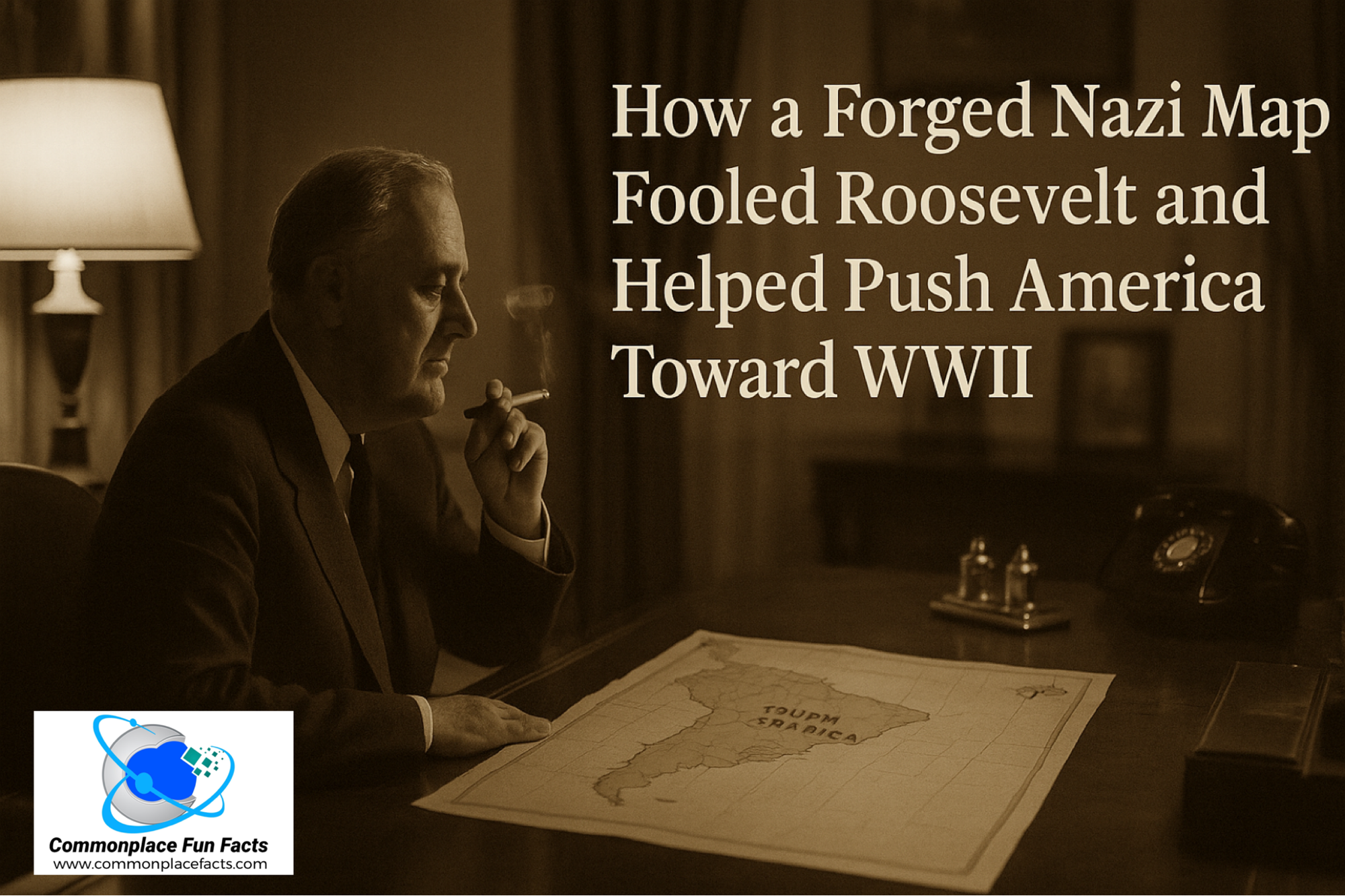

How Did a Forged Nazi Map Push the USA Toward WWII?
When the President of the United States tells the nation he’s holding a secret map of Nazi plans to conquer the Western Hemisphere, that’s the kind of news that ruins a perfectly good cup of coffee. On October 27, 1941—just six weeks before Pearl Harbor—Franklin D. Roosevelt did exactly that. He used the occasion of his Navy Day address to make a truly starlting announcement: “I have in my possession a secret map made in Germany by Hitler’s government—by the planners of the new world order.”
According to FDR, this sinister document redrew South America into four giant “mega-states,” each apparently destined to be governed under Nazi control. It even showed German bases in Central America, conveniently within bombing range of Texas and Florida. For a public still desperately clinging to neutrality and hoping that two oceans made an adequate moat, this was shocking stuff. Americans who had spent the last two years insisting the war in Europe was “over there” suddenly found “over there” looking a lot like Miami.
Contents
Britain’s Lonely Hour (and America’s Reluctant Nap)
By the autumn of 1941, Britain was still standing but wobbling. France had fallen, the Luftwaffe was relentlessly trying to bomb London into submission, and Churchill was running on little more than nicotine, caffeine, and sarcasm. Across the Atlantic, the United States clung to its Neutrality Acts like a toddler clutching a security blanket. Isolationism wasn’t just policy—it was practically religion. America sold Britain some planes and food under Lend-Lease, but public sentiment remained, “That’s Europe’s problem. Pass the baseball scores.”
For Churchill, this was intolerable. The British Empire could hold out for only so long. What he needed wasn’t sympathy; it was ships, soldiers, and American outrage. And if he couldn’t get it honestly, well, there were always other ways. Enter one of the most audacious propaganda stunts of the Second World War: a cartographic con job so convincing it made even Franklin Roosevelt lean forward in alarm.
The Gentleman Spy and His Map Factory
William Stephenson was the kind of man who makes James Bond look like he needed a nap. A Canadian industrialist and decorated World War I pilot, Stephenson was Churchill’s chosen man in the Western Hemisphere. His codename was “Intrepid,” which tells you all you need to know about subtlety. From his office high up in Rockefeller Center in New York, Stephenson ran the British Security Coordination (BSC)—a sprawling network of spies, propagandists, and professional fibbers. Their mission: pull America closer to Britain, inch by inch, headline by headline.

BSC’s methods were not what you’d call gentle. Its agents bugged isolationist politicians, leaked gossip to friendly journalists, and planted fake stories about Nazi plots from Havana to Halifax. Somewhere in that swirl of cloak-and-dagger chaos, someone decided that nothing stirred the imagination quite like a map. Maps make things real. They turn rumors into geography.
So, Stephenson’s forgers got to work. Depending on which historian you ask, the handiwork came from BSC’s Toronto outpost—possibly nicknamed “Station M”—or from a Manhattan office stocked with advertising executives, screenwriters, and even the philosopher A. J. Ayer, who traded logic for lies in the name of liberty. The result was a convincingly sinister map purporting to be a German plan for the post-war domination of South America. Thick black lines carved the continent into four Reich-approved administrative regions. German text gave it an air of authenticity. Because why forge halfway?
Psychological Warfare: Now with Stationery
In theory, the forged Nazi map was to be “found” in Cuba, in a conveniently discovered Nazi safe house. The Americans, stumbling upon this treasure, would connect the dots and realize that Hitler’s gaze extended well beyond Europe. As plots go, it was tidy, almost elegant—if you ignored the part about it being entirely fabricated.
When the plan reached Roosevelt through intelligence channels, it landed on receptive soil. FDR had long believed America couldn’t remain aloof from the war. The president was a master of rhetoric and subtle manipulation—traits that made him adored by voters and distrusted by his enemies. The British didn’t need to persuade him of much. They simply handed him the perfect prop.
The Speech That Moved a Nation (and a Few Eyebrows)
FDR had the perfect platform to use that prop. On October 27, 1941, the President’s spoke to the annual dinner of the Navy League at the Mayflower Hotel in Washington, D.C. His address was broadcast on major radio networks and world-wide by shorwave radio. Roosevelt’s radio address carried across every living room in America. Between remarks on shipbuilding and the Axis menace, he dropped his bombshell:
“Hitler has often protested that his plans for conquest do not extend across the Atlantic Ocean. His submarines and raiders prove otherwise. So does the entire design of his new world order.”
“For example, I have in my possession a secret map made in Germany by Hitler’s Government—by the planners of the new world order. It is a map of South America and a part of Central America, as Hitler proposes to reorganize it. Today in this area there are fourteen separate countries. But the geographical experts of Berlin have ruthlessly obliterated all existing boundary lines; they have divided South America into five vassal states, bringing the whole continent under their domination. And they have also so arranged it that the territory of one of these new puppet states includes the Republic of Panama and our great life line—the Panama Canal.”
“That is his plan. It will never go into effect.”
This map, my friends, makes clear the Nazi design not only against South America but against the United States as well.
Your Government has in its possession another document, made in Germany by Hitler’s Government. It is a detailed plan, which, for obvious reasons, the Nazis did not wish and do not wish to publicize just yet, but which they are ready to impose, a little later, on a dominated world—if Hitler wins. It is a plan ‘to abolish all existing religions- Catholic, Protestant, Mohammedan, Hindu, Buddhist, and Jewish alike. The property of all churches will be seized by the Reich and its puppets. The cross and all other symbols of religion are to be forbidden. The clergy are to be forever liquidated, silenced under penalty of the concentration camps, where even now so many fearless men are being tortured because they have placed God above Hitler.
In the place of the churches of our civilization, there is to be set up an International Nazi Church- a church which will be served by orators sent out by the Nazi Government. And in the place of the Bible, the words of Mein Kampf will be imposed and enforced as Holy Writ. And in the place of the cross of Christ will be put two symbols—the swastika and the naked sword.
The god of Blood and Iron will take the place of the God of Love and Mercy. Let us well ponder that statement which I have made tonight.
You can read FDR’s entire Navy Day Address here.
He might as well have set off an air raid siren. Newspapers erupted. Isolationists howled that the president was warmongering; interventionists cheered that he was finally speaking truth. The German government denied everything, calling it “a clumsy forgery.” (They were half right.) For many Americans, it was the first time the Nazi threat felt personal. South America wasn’t “somewhere else”—it was the next-door neighbor.
Here’s where it gets deliciously murky. Drafts of Roosevelt’s speech show that he initially wrote the phrase “a map of undoubted authenticity.” But at some point before delivery, he crossed it out. Whether that was caution, conscience, or just political instinct, no one knows. But it suggests that FDR, ever the cunning chess player, may have suspected the map’s pedigree was less than pure. Even so, he used it. Because a good story beats an inconvenient truth every time.
Public Opinion: Cartography as a Contact Sport

The reaction was swift. Columnists filled inches of print debating whether Hitler really planned to rename Brazil “Gauleiterland.” Radio hosts frothed, senators fulminated, and ordinary citizens finally began to grasp that neutrality might not save them. While it’s an exaggeration to say the fake map alone flipped Congress, it certainly greased the wheels. Within weeks, isolationist voices were softer, and Roosevelt had greater freedom to order U.S. destroyers to hunt German submarines in the Atlantic.
Propaganda, when done well, doesn’t scream. It whispers, “What if?” And the American public, freshly haunted by the thought of swastikas flying over São Paulo, started asking exactly that.
The Art of the Noble Lie
Churchill once said that in wartime, truth is so precious that it should always be attended by a “bodyguard of lies.” The British took that literally. To them, the map was simply another weapon—a psychological airstrike across the Atlantic. After all, wasn’t Hitler spreading his own lies daily? If the good guys fibbed to wake up the good guys, surely that balanced the scales. That’s spy math for you.
But it does raise the pesky moral question: can you defend democracy with deceit? If Roosevelt knew the map was fake—and historians like Nicholas John Cull think he might have—then the president’s radio show wasn’t just about foreign policy. It was a master class in stagecraft. He used a forgery to fight fascism and, in the process, nudged a reluctant nation toward war. The British had built the stage set, but Roosevelt delivered the performance.
The Nazi Map’s Disappearance (and Reappearance)
Forty days after Roosevelt’s broadcast, the Japanese attacked Pearl Harbor. The map—once the headline act—was instantly forgotten. America now had a real reason for war. The prop was shoved into a drawer, its value spent. For two decades it lingered in obscurity, occasionally surfacing in conspiracy theories about how Roosevelt “tricked” the nation. Only in the 1960s did declassified documents confirm what the Germans had claimed all along: the map was indeed a British forgery, cooked up in North America as part of a broader psychological campaign.
By then, nobody much cared. History had moved on to more modern lies, and the idea of a fake map shaping world events seemed almost quaint. After all, by the 1960s, everyone was busy forging something.
Spies, Ad-Men, and Philosophers Walk Into a War
Among the more charming details of this escapade is the cast list. Stephenson’s network included advertising executives who knew how to sell anything, screenwriters who could spin narrative from nonsense, and A. J. Ayer—yes, the logical positivist—who was recruited to write propaganda. One imagines him insisting that statements are only meaningful if verifiable, then nodding cheerfully as someone slid the forged map across his desk. Wartime logic was flexible that way.
These unlikely collaborators became experts in “black propaganda”—rumors and forgeries designed to look like enemy output. They faked Nazi broadcasts, counterfeit documents, and, evidently, atlases. It was a curious alliance of philosophy and Photoshop, 1940s-style.
Did It Work?

That depends on your metric. Did the map directly drag America into war? No—Pearl Harbor did that. But did it soften the ground? Absolutely. Roosevelt’s speech helped reframe the conflict as not just Europe’s fight but a defense of the entire Western Hemisphere. When Americans finally marched off to war, they did so with the idea that they were preventing fascism from landing on their own shores—an idea that map had sketched in vivid ink.
By the fall of 1941, American “neutrality” was hanging by a thread and pretending not to notice. When the destroyer Reuben James was sunk while chasing U-boats on October 31 — less than a week after Roosevelt’s Navy Day speech — the illusion of neutrality sank with it. Two weeks later, Congress repealed key provisions of the Neutrality Acts, allowing merchant ships to arm themselves and carry goods straight to belligerent nations. America hadn’t officially entered the war yet—but the paperwork was catching up fast.
In that sense, the map was propaganda gold. It didn’t have to be real to be effective. It just had to be believable long enough to serve its purpose. The British didn’t forge a map; they forged consensus.
The Cartographic Con as Precedent
Looking back, it’s hard not to marvel at how much faith people once placed in paper. A map, properly stamped and labeled, could override skepticism. Today we drown in “information warfare”—deepfakes, bots, and viral nonsense—but the principle hasn’t changed. A believable lie travels faster than the truth, and it’s usually prettier to look at.
The 1941 forgery reminds us that disinformation didn’t begin with social media; it began with ink. The tools were humbler, but the intentions were the same: manipulate perception, justify action, and make the implausible feel inevitable. Somewhere, a wartime cartographer is probably laughing that his doodle helped alter history.
The Ethical Hangover
After the war, when journalists and historians unearthed the truth, there was remarkably little outrage. The public response hovered between “Huh, clever” and “Well, it worked.” Moral clarity is a luxury of peacetime. In 1941, survival came first. Britain was cornered; Roosevelt was playing for time; and the Nazis were quite genuinely plotting world domination—just not in the specific coordinates the forged map suggested.
Still, it’s worth a shiver. Democracies thrive on trust, and the idea that leaders might quietly deploy a fake to steer public opinion is the kind of thing that gives conspiracy theorists their gym memberships. Yet history tends to shrug and move on, perhaps because, unlike most propaganda, this particular lie came with a happy ending. The Allies won. The liars, inconveniently, were the good guys.
The Real Legacy
Today the “Nazi map” survives mostly in obscure archives and the occasional late-night documentary. But its legacy lingers every time a government brandishes satellite imagery or “declassified documents” to justify action. The moral, if there is one, is simple: before believing the map, ask who drew it.
As for the British, they never quite apologized. Their forgery had done its job, and by the time anyone realized it, the world was on fire for entirely legitimate reasons. One imagines Churchill chuckling into his whisky, muttering, “Bodyguard of lies, indeed.”
Fun Facts to Unfold the Plot
- The British Security Coordination operated out of Suite 3603 in Rockefeller Center and employed more than 2,000 people by 1941. That’s a lot of typists for a secret operation.
- William Stephenson was a friend of Ian Fleming and may have inspired the creation of James Bond. Evidently, the tuxedo wasn’t optional.
- Station M in Toronto allegedly specialized in forgeries, invisible ink, and exploding chocolate. If true, that’s the most Canadian thing ever: sabotage with a snack.
- FDR’s speech also accused Germany of plotting to abolish all religions but Nazism. It was a potent mix of theology, geography, and drama—Roosevelt knew how to fill airtime.
- The map itself is believed to have been based loosely on pre-war trade maps, doctored with Nazi iconography. So even the fake had traces of truth.
The Punchline History Deserved
In the end, the forged Nazi map is a perfect wartime parable: everyone lied, everyone pretended to believe, and the only real casualty was geography. The British got their American ally; Roosevelt got his moral high ground; and cartographers everywhere learned that lines on a page can start a fire.
So next time you see a colorful diagram on the evening news explaining how some nation or another plans to dominate the world, remember 1941. Remember that a group of Canadian-based ad-men and philosophers once saved civilization armed only with pens, tracing paper, and an unholy sense of imagination. And remember that behind every “secret map,” there’s usually someone with a fountain pen, a mission, and a very flexible relationship with the truth.
History loves its heroes, but it also has a soft spot for the tricksters who get results. And if we’re honest, so do we.
You may also enjoy…

Was the Hiroshima Bombing the Disastrous Result of a Mistranslation?
A mistranslation during the Potsdam meetings in 1945 significantly impacted Japan’s response to Allied demands for surrender. Japanese Prime Minister Kantarō Suzuki’s ambiguous statement, using the word “mokusatsu,” was interpreted as contempt, leading the Allies to believe Japan rejected diplomacy. This misunderstanding contributed to the decision to drop the atomic bomb on Hiroshima.

The Lost Legends of WWII: Glenn Miller, Carole Lombard, and Their Fellow Casualties
Discover the stories of Glenn Miller, Carole Lombard, and other famous figures lost during World War II. Explore their lives, tragic deaths, and the impact these celebrity casualties had on history and culture.

Geoffrey Pyke: The Man Who Tried to Win WWII with an Iceberg Aircraft Carrier, Snowmobiles, and a Vacuum Tube
Meet Geoffrey Pyke, the eccentric genius behind WWII’s wildest ideas—including an aircraft carrier made of ice and a plan to launch soldiers through giant pneumatic tubes.



Leave a Reply