

Every war has its generals, its heroes, its villains, and its certified mad scientists. World War II had Geoffrey Pyke, a man whose brain was permanently set to “brilliant, bizarre, and possibly combustible.” Pyke didn’t command battalions or storm beaches. No, he fought the Axis powers the only way he knew how: with wild, improbable, and occasionally frozen ideas.
A journalist, inventor, economist, and part-time chaos machine, Pyke was one of those rare individuals who made people say, “That’s absolutely bonkers,” and mean it as a compliment.
Let’s dive into the life and legacy of the man who tried to win WWII with sawdust, snowmobiles, and personnel-sized pneumatic tubes.
Contents
Meet the Man Who Tried to Fight Nazis with Ice Cubes

Geoffrey Pyke was born in 1893 in England. From a young age, it was clear that he didn’t fit in conventional boxes. For that matter, he didn’t seem to acknowledge their existence. He studied at Cambridge, dropped out, sneaked into Germany during WWI as a journalist, and promptly got arrested as a British spy. He spent several months in a German internment camp and then escaped, which is honestly the least surprising thing you’ll read in this entire article.
He later founded a progressive school for children based on radical education theories. By “progressive,” we mean he believed children should direct their own education and that things like clocks and timetables were optional suggestions. His approach was quite practical. If a student happened to get badly burned during a chemical experiment, Pyke might use the opportunity to teach an impromptu lesson on the subject of why caustic chemicals and high temperatures tend to ruin any hope for a pristine facial complexion.
The school didn’t last long, by the way.
The Iceberg Aircraft Carrier: Project Habakkuk
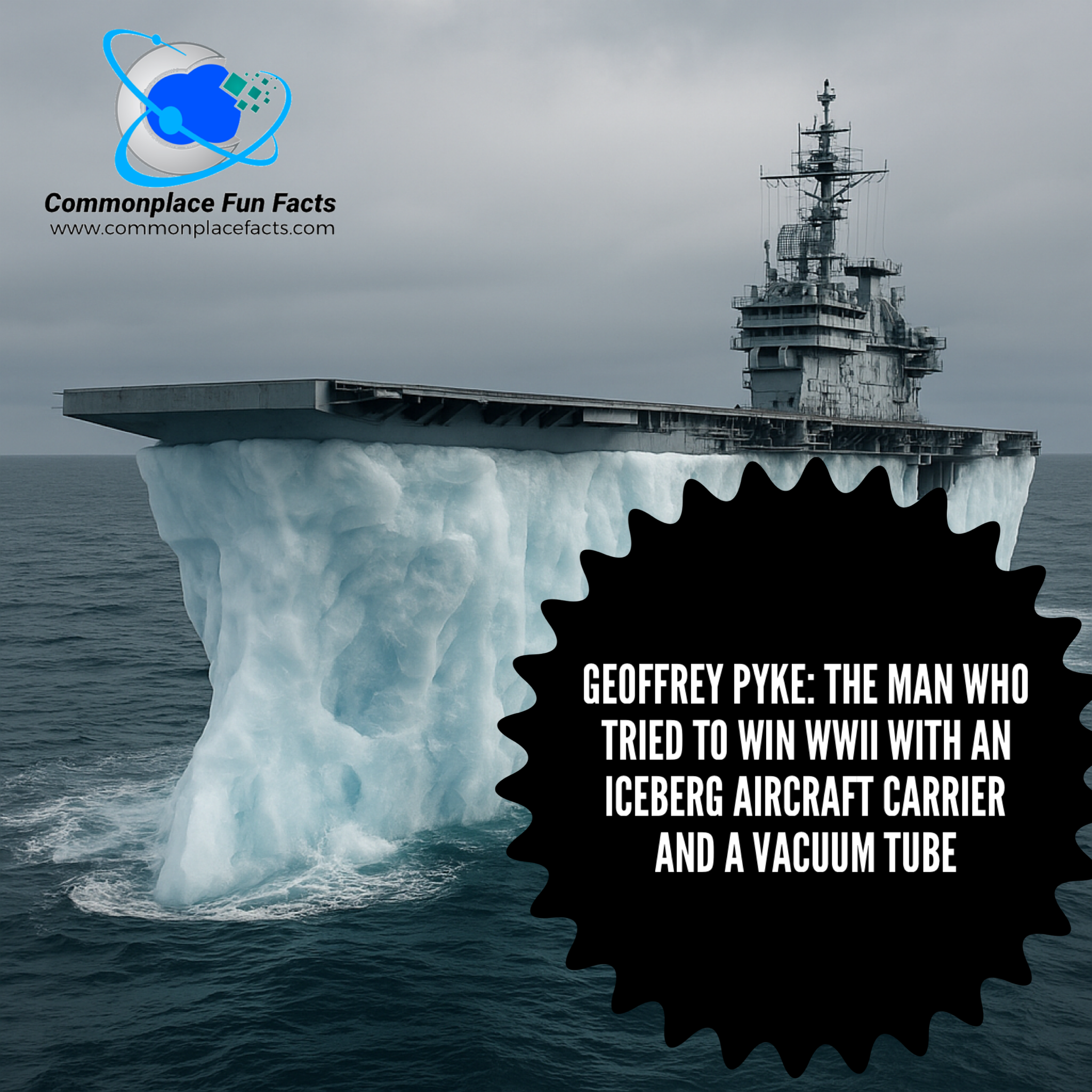
Pyke’s pièce de résistance—his frozen magnum opus—came during WWII with the delightfully insane Project Habakkuk. The plan? Build a half-mile-long aircraft carrier out of a mix of ice and sawdust. Admittedly, it’s not any weirder than one of his contemporary’s plan to create bat bombs, but it’s still pretty strange.
The idea stemmed from a real military problem: Allied convoys in the Atlantic were getting picked off by German U-boats, and land-based planes couldn’t reach far enough out to protect them. Pyke proposed a solution: build floating islands of runway that wouldn’t sink, could be repaired with a bucket of water, and—bonus—wouldn’t show up well on enemy radar.
Enter pykrete—named after Pyke himself. This miracle material was made of 14% wood pulp and 86% water. When frozen, it was much tougher than ice. Just how much tougher?
The answer to this question was answered by Lord Mountbatten, one of Pyke’s rare and powerful supporters. During the 1943 Quebec Conference, he set up an impromptu science fair project for Winston Churchill and the other bigwigs: two blocks—one plain ice, one good ol’ pykrete.
To demonstrate the resilience of pykrete, Mountbatten pulled out a pistol, shot the regular ice block, and watched it shatter like your hopes after asking the Homecoming queen to go on a date. Next, he fired at the pykrete block. The bullet seemingly took one look at the stuff and decided, “Nope.” It ricocheted off the pykrete, zipped across the room, and nearly took out Admiral Ernest King before embedding itself in a wall. Fortunately, the bullet stayed clear of Churchill, apparently realizing he was yet one more immovable object. Even so, Geoffrey Pyke’s bulletproof ice almost assassinated an Allied admiral. But hey—point made.
How to Build an Iceberg Aircraft Carrier in Ten Easy Steps (Without Telling Anyone What It Is)
Churchill was intrigued. As soon as the military realized pykrete was more than just a novelty dessert topping with delusions of grandeur, they decided it was time to go big. Like, 2-million-tons-of-frozen-insanity big. Plans were drawn up to construct a large-scale prototype of the iceberg aircraft carrier at Lake Patricia in Canada’s Jasper National Park. To test insulation, durability, and whether bullets, bombs, or physics itself would politely step aside, they built a floating hunk of frosty engineering 60 feet long, 30 feet wide, and weighing 1,000 tons. A single one-horsepower motor powered a cooling system to keep it frozen.

The build crew? It was a group of Canadian conscientious objectors doing alternative service. Crucially, they were never told what they were actually building. Imagine spending weeks stacking icy blocks in the wilderness, thinking you’re making a particularly avant-garde YMCA ice sculpture, only to later learn it was meant to be a mobile fortress bristling with bomber planes. Surprise! You were part of a top-secret plan to militarize a glacier.
Things escalated faster than you can say “structural reinforcement.” The initial estimate for the ship came in at a very reasonable-sounding £700,000. But then someone asked, “What if it has to survive torpedoes, bombs, waves the size of apartment buildings, and also house 150 planes?” Suddenly, the ice dream required 300,000 tons of wood pulp, 10,000 tons of steel, and a hull thick enough to double as a ski resort. Oh, and it needed a 2,000-foot flight deck, 40 dual-barreled turrets, and enough power to run 26 electric motors—because internal engines would melt the ship. You know a project’s in trouble when the engine becomes an existential threat.
By spring of 1943, the budget ballooned to £2.5 million. It turned out that pykrete has a tendency to sag over time, so the carrier would need steel reinforcements. Its enormous size limited its speed to about 6 knots (11 mph). There was also the troubling issue of how to steer the thing. It needed a rudder about 100 feet high, but engineers could never figure out how to mount such a contraption effectively to the hull.
Before long, the project’s chances started melting faster than its hull—which lasted through three Canadian summers before it finally liquified, by the way. Pyke, due to earlier friction with American collaborators, was quietly pushed out of the project in a diplomatic frostbite maneuver. The final design, Habakkuk II, was supposed to be a 2.2-million-ton floating fortress that could laugh at bombs and surf the Atlantic. What it became was a magnificent example of how Allied victory was often powered by a mix of wild optimism, scientific curiosity, and just enough red tape to freeze an entire continent.
Project Habakkuk was scrapped when conventional carriers and longer-range planes rendered it unnecessary. But still—an aircraft carrier made of ice. You’ve got to hand it to the guy for taking innovative thinking to a new level.
The Human Bullet: Pneumatic Tube Warfare

If you thought the iceberg carrier was Pyke at peak Pyke, buckle up. He also proposed using giant pneumatic tubes to launch soldiers from ships onto beaches, like human-sized cash canisters at a bank drive-thru. It would be faster than landing crafts, he argued. Technically true. Also: deeply alarming.
Just imagine your average GI Joe flying through a metal tube and being ejected, mid-air, onto Normandy like a meat torpedo. The physics might have checked out, but the stomachs of the British High Command decidedly did not.
Given the resources the government was willing to sink into Project Habakkuk, it’s a bit surprising that this idea didn’t make it to field testing. We assume it is because even the most daring commandos balked at the phrase “please insert soldier into vacuum tube.”
Snowmobiles for Saboteurs: Operation Plough
One of Pyke’s more plausible—and eventually useful—contributions was Operation Plough, which aimed to create a lightweight snow vehicle for Allied troops fighting in snowy terrain.
Enter the M29 Weasel, a motorized sled built for gliding over snowbanks and causing mayhem behind enemy lines. It was used by American and Canadian forces in Europe and proved to be quite useful. So, yes, Geoffrey Pyke did help win WWII with a snowmobile. Technically.
Ideas That Never Made It (and Probably for the Best)
Pyke’s brain was a constant Vesuvius of ideas. Here are just a few that didn’t quite get off the ground—literally or figuratively:
- A plan to melt Arctic sea ice with geothermal heat. (To open new shipping lanes? Possibly to spite penguins?)
- A machine to harvest solar energy in space and beam it to Earth. (Decades ahead of his time, or decades ahead of his meds?)
- A floating “road” of interlinked steel pontoons stretching across the ocean, forming a kind of watery Autobahn for tanks and trucks.
These weren’t your run-of-the-mill crackpot ideas—they were backed by solid science and deeply researched. It wasn’t that Pyke didn’t understand practicality. It’s just that practicality never stood in the way of a good brainstorm.
The Pyke Problem: Too Brilliant for His Own Good
Pyke wasn’t easy to work with. He could be erratic, obsessive, and famously difficult to manage. He once locked himself in a hotel room and refused to eat or sleep for days while brainstorming military strategy. Honestly, that’s just a Tuesday for your average startup founder, but in wartime Britain, it was cause for concern.
Pyke’s post-war years were marked by declining mental health, financial hardship, and increasing frustration at a world that no longer wanted his ideas. He died by suicide in 1948 at the age of 54.
It’s a heartbreaking ending for a man who wanted to change the world, not with weapons, but with brainpower, snow, and possibly a pneumatic tube or two.
Legacy: The Man Who Couldn’t Turn His Brain Off
Today, Geoffrey Pyke is remembered—if at all—as a quirky footnote in military history. But maybe he deserves better.
Sure, he never built a working iceberg base or launched troops like t-shirt cannons at a hockey game. But he dreamed big, thought weird, and refused to accept the idea that war—and the world—had to be business as usual.
Could we use a few more Pykes in our lives— people who ask “what if” even when the rest of us are still trying to figure out how to reset the WiFi router? Maybe he was simply ahead of his time. What do you think? Would you go on a cruise on a pykrete cruise ship or give up your car so you can commute by pneumatic tube? Let us know what you think in the comments below.
You may also enjoy…

Bat Bombs: The Wild WWII Weapon That Almost Changed History
Discover the bizarre WWII bat bombs project, led by dentist Lytle Adams, where bats were equipped with incendiary bombs to burn enemy cities. Learn how this wild war experiment unfolded.

The Great Panjamdrum — the Hilarious and Horrible Failed Weapon of WWII
The Great Panjamdrum was an ambitious yet chaotic World War II weapon intended to clear beaches for D-Day. Despite initial design optimism, extensive trials revealed major flaws, including uncontrollable trajectories and dangerous explosions. Ultimately, the project was abandoned after its disastrous final demonstration, leading to no effective military application.

USS William D Porter: The Navy’s Unluckiest Ship
Discover the strange story of the USS William D Porter — the unluckiest ship in the US Navy.



Leave a Reply