
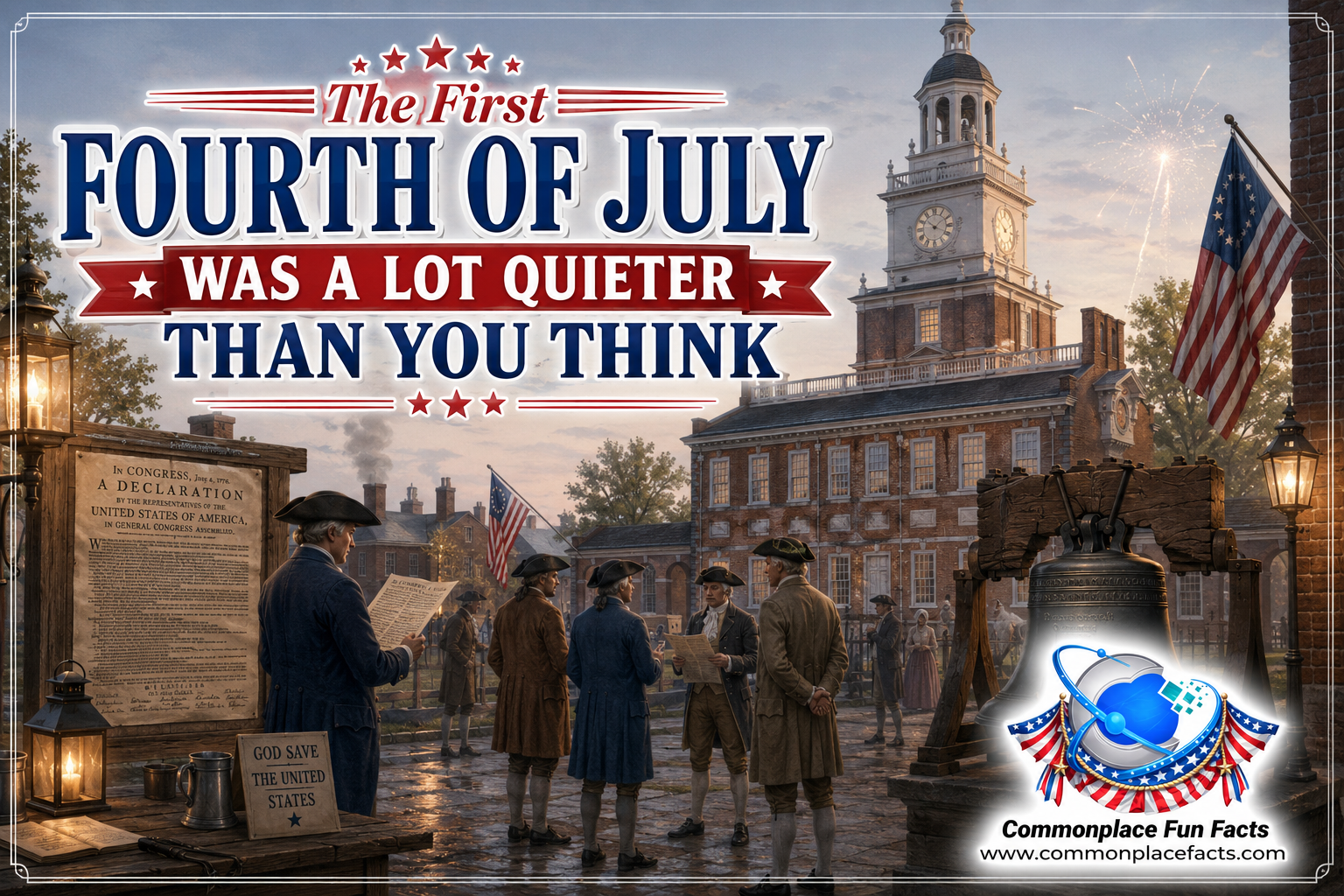

What Happened on the First Fourth of July?
Every year, Americans celebrate the Fourth of July with fireworks, parades, cookouts, patriotic music, and enough grilled meat to send cardiologists’ children through college. It is the great national festival of freedom, pyrotechnics, potato salad, and children being told, “Stop chasing your sister with that Roman candle!”
That is exactly the sort of celebration John Adams had in mind when he wrote to his wife, Abigail, in July 1776. He predicted that American independence would be celebrated with “pomp and parade,” with “guns, bells, bonfires and illuminations,” from one end of the continent to the other.
There was just one small problem.
Adams was talking about July 2.
As we have discussed before in John Adams, July 2, and the Fourth of July Mistake That Became Tradition, July 2, 1776, was the day the Continental Congress actually voted to approve Richard Henry Lee’s resolution declaring the colonies independent from Great Britain. That was the real political break. That was the day Congress said, in effect, “Dear George III: It’s not us. It’s definitely you.”
Adams thought July 2 would be remembered forever as America’s great anniversary. He imagined future generations celebrating that date with speeches, games, cannon fire, bells, bonfires, and illuminations. And he was right about almost everything except the part involving the calendar, which is unfortunate when your prediction is specifically about a date.
Two days later, on July 4, Congress approved the final wording of the Declaration of Independence. The document was dated July 4. Printed copies circulated with July 4 at the top. Eventually, July 4 became the date everyone remembered. Adams, being Adams, apparently took this about as well as one would expect from a man who had strong opinions about nearly everything and the emotional resting temperature of a teakettle.
So what actually happened on the first Fourth of July? Not the anniversary. The actual day itself. Were there fireworks? Bells? Parades? A bald eagle descending from the heavens with a sparkler in each talon?
Not exactly.
Contents
July 4, 1776: Paperwork, Printing, and Probably No Fireworks
The Fourth of July in 1776 was not celebrated the way we celebrate it today because, at the time, nobody knew it was “the Fourth of July” in that sense. It was not yet a holiday. It was not yet a tradition. It was not yet an excuse for grocery stores to build red-white-and-blue displays out of soda cartons.
To the members of the Continental Congress, July 4, 1776, was a workday. A historically gigantic workday, certainly, but still a workday. Congress spent the day reviewing, editing, and approving the final text of the Declaration of Independence. The big vote for independence had already happened on July 2. July 4 was about approving the explanation.

That explanation mattered. The Declaration was not simply a dramatic breakup letter written on fancy paper. It was a public argument to the world. Congress needed to explain why thirteen colonies were taking the rather drastic step of separating from the most powerful empire on earth. This was not the sort of thing one did casually, like changing barbers or switching from coffee to tea. Actually, come to think of it, tea was part of the problem.
The Declaration of Independence did not emerge fully formed on July 4, 1776, as if Thomas Jefferson dramatically slapped it onto the table while thunder crashed and an eagle nodded approvingly from a nearby windowsill. The process took several days. Jefferson drafted it, the Committee of Five reviewed it, and Congress then took its collective red pen to the text, because even revolutions need editorial meetings. As we discussed in our article about Thomas Jefferson’s writing desk, Jefferson composed the original draft and then gritted his teeth while others attempted to improve upon it, proving once again that one of the primary rules of government is, “There has to be a way to make this longer.”
Once Congress approved the final text, the Declaration had to be printed and distributed. That job went to Philadelphia printer John Dunlap, who produced the famous Dunlap broadsides. These printed copies were sent to the states, to military commanders, and to others who needed to know that the colonies had officially changed their relationship status with Great Britain from “In a relationship, but it’s complicated” to “Single.”
There does not appear to have been a grand public celebration in Philadelphia on July 4, 1776. No fireworks display. No national parade. No synchronized cannon salute. No children waving tiny flags while an uncle in questionable shorts tried to light a fuse.
The public celebration came a few days later. On July 8, 1776, the Declaration was read aloud in Philadelphia. Bells rang. Crowds gathered. The king’s arms were taken down. That was the moment when ordinary people in Philadelphia publicly heard the words that Congress had approved. In that sense, the first public celebration of independence was less “Fourth of July” and more “Eighth of July,” which would have been terrible for songwriters, mattress sales, and municipal parade committees.
Still, July 4 had the magic ingredient: it was printed on the document. That was enough. History loves a good headline, and “In Congress, July 4, 1776” had one.
July 4, 1777: Now This Looks Familiar
By July 4, 1777, the United States had survived its first year as a declared independent nation, which was no small thing. This was not guaranteed. Declaring independence from Great Britain in 1776 was bold, principled, and inspiring. It was also the geopolitical equivalent of poking a lion with a salad fork.

The war was still raging. British forces had not gone home. George Washington had not yet become the marble statue version of himself. The Continental Army had endured defeats, retreats, shortages, uncertainty, and all the usual inconveniences associated with trying to defeat an empire while also inventing a country.
Nevertheless, the first anniversary of the Declaration was celebrated in a way that would look surprisingly familiar to modern Americans. Philadelphia, then the capital and the emotional nerve center of the revolutionary cause, marked July 4, 1777, with a full patriotic display.
Congress adjourned for the day, because even the Founders understood that a national birthday requires at least some interruption of committee work. Ships in the Delaware River were decorated with flags and streamers. Armed vessels fired thirteen-gun salutes, one for each state. There were bells, military displays, music, public dinners, toasts, bonfires, and fireworks.
In the evening, Philadelphia was illuminated. Fireworks lit the sky. The display reportedly began and ended with thirteen rockets, because if there was one thing Revolutionary Americans enjoyed, it was making absolutely certain you remembered how many states there were. Thirteen colonies. Thirteen states. Thirteen guns. Thirteen rockets. Had there been cupcakes, one suspects there would have been thirteen sprinkles on each, and someone would have checked.
There were also dinners and toasts, which became a major feature of early Independence Day celebrations. Toasts were not merely casual “cheers” moments. They were political statements, patriotic rituals, and sometimes endurance events. Early Americans could produce toasts the way modern Americans produce passwords: too many, too long, and somehow involving special characters.
Boston also celebrated in 1777 with fireworks over Boston Common. Other cities and towns developed their own forms of celebration. Charleston marked the anniversary with cannon fire. Throughout the states, the emerging pattern was clear: July 4 was becoming a day of noise, light, ceremony, and public patriotism.
In other words, by the very first anniversary, Americans had already figured out the basic formula: set things on fire, make things explode, ring bells, give speeches, eat together, and insist that all of this was very solemn and meaningful. Which, to be fair, it definitely was.
John Adams had predicted “pomp and parade,” “guns, bells, bonfires and illuminations.” He got the date wrong, but he understood the American soul with alarming precision. Give Americans a founding document and within one year they will celebrate it with explosives.
The War Was Still Very Much a Thing
It is easy to look back at July 4, 1777, as the charming beginning of a national tradition. And it was. But it is worth remembering that these celebrations took place under the shadow of war.
In 1777, independence was still more of a claim than a settled fact. The Declaration announced that the United States was free and independent. Great Britain, demonstrating the sort of customer-service responsiveness for which empires are famous, disagreed.
Celebrating Independence Day during the Revolution was therefore not merely festive. It was defiant. Every cannon fired was a political statement. Every bell rung was an act of public confidence. Every rocket launched into the night sky said, “We are still here.”
That gives the early celebrations a very different flavor from the modern backyard cookout. Today, we celebrate independence with hamburgers, sparklers, and heroic measures to preserve the dogs’ sanity for 24 hours. In 1777, Americans celebrated while enemy armies remained in the field and the survival of the country was uncertain.
It was a birthday party for a nation that might not live to see kindergarten.
Yorktown Changes the Mood
Then came Yorktown.
On October 19, 1781, British General Lord Cornwallis surrendered to American and French forces at Yorktown, Virginia. This did not formally end the Revolutionary War, but it effectively broke Britain’s ability to continue major offensive operations in North America. It was the moment when the American cause shifted from “unlikely rebellion” to “probable success,” which is a fairly dramatic upgrade.

The news of Yorktown produced celebrations across the country. There were illuminations, bells, public rejoicing, and the sort of civic enthusiasm that tends to happen when people realize they may not be hanged for treason after all. That last part is always good for morale.
Still, the war was not officially over. That is important. The Treaty of Paris would not be signed until September 3, 1783. British troops still occupied New York City. Charleston remained under British control until late 1782. Savannah would not be evacuated until 1782. The shooting had greatly diminished, but the future was not yet wrapped up with a bow and placed gently under the Liberty Tree.
So the first Fourth of July after Yorktown — July 4, 1782 — was a different sort of celebration. It was not the anxious defiance of 1777. It was not yet the full victory lap of 1783. It was something in between: joyful, relieved, hopeful, and still just a little nervous.
July 4, 1782: Independence Day With a Deep Exhale
By July 4, 1782, Americans had reason to believe independence might actually stick. That changed everything.
George Washington, then headquartered with the army at Newburgh, New York, ordered that the anniversary of independence be commemorated with a feu de joie — a ceremonial firing of muskets or cannon in succession. The army was also issued an extra gill of rum per man for the occasion, because Washington understood both symbolism and troop morale. One may admire the Declaration of Independence in the abstract, but the average soldier probably found it easier to appreciate with a little rum added to the philosophical framework.
The Continental Army’s celebration mattered. These were the men who had spent years freezing, marching, starving, fighting, and occasionally wondering whether Congress had remembered that armies require food, clothing, and pay. For them, the Fourth of July after Yorktown must have felt different. The cause for which they had suffered no longer seemed like a noble long shot. It seemed within reach.
In civilian communities, the familiar signs of Independence Day continued: cannon fire, bells, dinners, toasts, and illuminations. The celebrations were still local and varied. There was no single national script. No federal holiday machinery. No televised concert from Washington, D.C. No one arguing over whether the fireworks soundtrack should include Tchaikovsky, who had not yet been born and, frankly, had enough problems coming.
But the mood had changed. The Fourth of July was becoming not just a commemoration of a declaration, but a celebration of endurance. The United States had declared independence in 1776. It had celebrated that declaration under threat in 1777. By 1782, after Yorktown, Americans could celebrate with the growing confidence that the gamble might pay off.
That is the emotional difference between the first anniversary and the first post-Yorktown Fourth. In 1777, the celebration said, “We mean it.” In 1782, it said, “We may actually pull this off.”
The Holiday Finds Its Shape
The early Fourth of July celebrations helped establish the patterns that would define the holiday for generations. Bells. Cannon. Fireworks. Public readings. Orations. Toasts. Parades. Military displays. Communal meals. Patriotic music. The occasional questionable decision involving flammable material.
These traditions did not emerge from nowhere. They came from older habits of public celebration, including royal birthdays, military victories, religious observances, and civic festivals. Americans repurposed the tools of public celebration and aimed them at a new object: the nation itself.
That is one of the fascinating things about Independence Day. The Revolution did not simply create a new political system. It created new rituals. People needed ways to express allegiance to something that had not existed before. There was no ancient American monarchy, no centuries-old national church, no royal birthday to observe. So Americans built a civic calendar around the Declaration of Independence.
The Declaration became more than a document. It became an event. Then it became an anniversary. Then it became a holiday. Then it became a season of retail discounts, patriotic bunting, and the annual rediscovery that fireworks laws vary wildly by jurisdiction.
History moves in mysterious ways.
John Adams Was Wrong in the Most Correct Way Possible
John Adams never got his July 2 holiday. The date he believed would be celebrated forever was quickly overshadowed by July 4, the date attached to the approved text of the Declaration. This reportedly irritated him, which is understandable, and it was by no means the only thing that got under his notoriously thin skin. Nobody likes being wrong, especially when one has gone to the trouble of being spectacularly right about everything else.

Adams foresaw the tone, scale, and spirit of American Independence Day. He predicted public celebration. He predicted bells. He predicted bonfires. He predicted guns and illuminations. He predicted national memory expressed through noise, light, ceremony, and communal festivity. He foresaw celebrations that would happen a century and two centuries in the future.
He just missed the date by two days.
That is not really failure. That is historical horseshoes. Close enough to count, especially when the whole country eventually celebrated exactly as he imagined, only on the day printed at the top of the document.
July 4, 1776, was not a fireworks-and-parade holiday. It was the day Congress approved the Declaration’s final wording. July 4, 1777, was when Americans began celebrating the anniversary in a way that looks recognizably like Independence Day. July 4, 1782, after Yorktown, carried a new tone of hope and vindication, even though peace had not yet officially arrived.
The holiday grew from paperwork to defiance to confidence. It began with congressional editing, became a wartime celebration, and eventually turned into the national birthday party we know today.
So the next time you watch fireworks on the Fourth of July, spare a thought for John Adams. He called the celebration almost perfectly. He imagined the noise, the spectacle, the patriotic fervor, and the continental scale of the thing.
Then, like every person who has ever confidently scheduled something using the wrong date, he had to live with the consequences.
You may also enjoy…

The 1876 Centennial Exposition: The Weird Ways America Celebrated Its 100th Birthday
Step back in time and discover the weird, fascinating, and surprisingly modern ways America celebrated its 100th birthday at the 1876 Centennial Exposition—from telephones to towering machines.

The 1976 Bicentennial: Tall Ships, Freedom Trains, Beards, and Patriotic Weirdness
Explore America’s 1976 Bicentennial celebrations, from tall ships and Freedom Trains to painted fire hydrants, patriotic beards, coins, Disney parades, and small-town weirdness.

John Adams, July 2, and the Fourth of July Mistake That Became Tradition
John Adams predicted American independence would be celebrated with fireworks, parades, bells, bonfires, and public celebrations. He was right about everything—except the date: July 2.


Leave a Reply