

If you could hop in a time machine and aim for early December 1941, you might think the best way to save Pearl Harbor would be something cinematic—sneak into Tokyo with a silenced pistol, or maybe drop an aircraft carrier through a wormhole like in that movie where history meets physics and physics waves a white flag of surrender. But honestly? You wouldn’t need sci-fi or sabotage. You’d just need to grab a few very real people by the shoulders, shake them awake, and yell, “Look! The clues are right there!” Because the tragedy of Pearl Harbor isn’t that there were no warnings. It’s that there were so many, and we managed to miss every single one in dazzling, bureaucratic fashion.
Join us as we revisit that fateful day that lives in infamy and stroll through the fumbling, the foibles, and the almost-alerts that composed the tragic overture to the attack on Pearl Harbor.
Contents
The “Oh Look, a Radar Blip” Moment
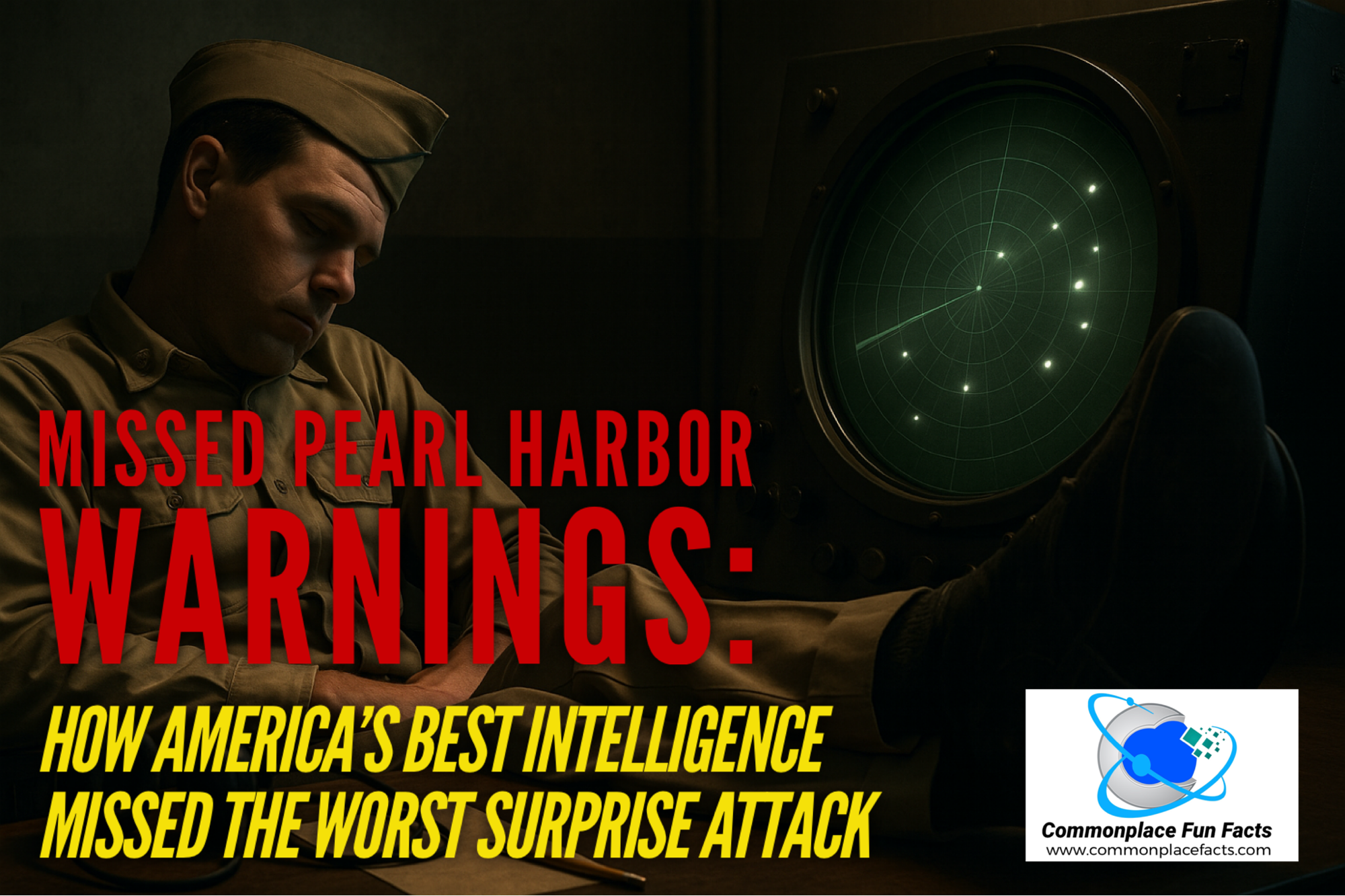
It’s the early hours of Sunday, December 7, 1941. The sun is creeping up over Oahu, birds are chirping, and two U.S. Army privates—Joseph Lockard and George Elliott—are sitting in a lonely little shack at the northern tip of the island. Their job? Stare at a giant green circular screen and report anything that looks suspicious. It’s not glamorous work. Think less Top Gun, more “tech support with an antenna.”

The machine in front of them is an SCR-270 radar set, state-of-the-art by 1941 standards, which is another way of saying “the size of a refrigerator and about as user-friendly as a garage door opener that is programmed in Malbolge.” At around 7:02 a.m., the radar begins lighting up like Uncle Morty’s obnoxious battery-powered tie he insists on wearing every Christmas. The screen shows a massive formation—something like 50 or more planes—closing in fast from the north. Lockard, who has been training on this device for months, blinks, checks the equipment, and decides it’s not a glitch. He calls the information center at Fort Shafter to report it.
Unfortunately, it’s Sunday morning. The information center is running on skeleton staff—two men, one of whom is an officer-in-training named Lieutenant Kermit Tyler. Tyler takes the call, listens to the excited radar operator describing a sky full of incoming planes, and replies with what will go down as one of history’s most unfortunate sentences: “Don’t worry about it.” He assumes the radar crew has picked up the B-17 bombers expected from California that morning.
And just like that, one massive warning that could have changed the course of the day is brushed off like a spam email. Tyler wasn’t lazy or malicious—he was new, under-trained, and operating in a system where “inbound aircraft” usually meant friendly ones. Still, the irony of that “don’t worry about it” echoes louder than the air raid sirens that followed an hour later. The first Japanese bombs began falling at 7:48 a.m.
Tyler was later investigated but cleared of any blame. The Navy concluded he’d been tossed into duty at the Information Center with virtually no training, no guidance, and no staff—a recipe for disaster that wasn’t his to cook. He went on to serve honorably, retiring as a lieutenant colonel in the U.S. Air Force in 1961, earning a business degree, and enjoying a long civilian life before passing away in 2010 at age 96. In the end, history judged him more as a symbol of systemic failure than personal fault.
The 14-Part Message and the Time-Zone Trap
While radar operators were staring at green blips in Hawaii, cryptographers in Washington were hunched over something equally ominous—Japan’s 14-part diplomatic message. This wasn’t a “Merry Christmas” note; it was more like a breakup letter written by someone already packing their suitcase. The tone was unfailingly polite, but the subtext was unmistakable: negotiations were over, friendship was canceled, and “other arrangements” (involving torpedoes) were about to begin.
The message arrived in fragments through the night of December 6 and into the early morning of December 7. American intelligence officers were reading and translating as fast as they could, but bureaucratic wheels grind slowly—especially on a Saturday night. The Army and Navy’s decoding sections each handled portions, trying to distribute copies to the right desks before dawn. By the time analysts pieced it all together, the timing was already disastrous. Washington was groggy, Hawaii was asleep, and Tokyo—eighteen hours ahead—was already living in tomorrow.
The message itself wasn’t a direct declaration of war. Japan had no intention of formally declaring hostilities before striking; the note merely stated that further negotiations with the United States were “useless.” But for anyone paying attention, that was code for “brace yourself.” Unfortunately, by the time the full document reached Washington’s top brass, it was too late to brace for anything except bad news.
Lost in Translation—and Typing
Ironically, the delay that doomed America’s defenses also tripped up Japan’s diplomacy. Tokyo had instructed its Washington embassy to deliver the 14-part note to Secretary of State Cordell Hull precisely at 1:00 p.m. Eastern Standard Time—about 7:30 a.m. in Hawaii, just minutes before the first bombs were scheduled to fall. The timing was intended to give the appearance of a formal break in negotiations before hostilities began. On paper, it would make Japan look honorable—“We told them first!” In reality, it went sideways fast.
At the Japanese embassy, chaos reigned. Staff members had to retype the final section of the message in English—using manual typewriters—while double-checking translations against Tokyo’s original Japanese text. The diplomats worked through the night, their office filled with cigarette smoke and rising panic. Typing errors, formatting issues, and the need for perfect diplomatic phrasing slowed everything to a crawl. Imagine trying to prepare a 14-page memo in your second language while your bosses back home are shouting, “Hurry up! We’re about to start a war!”
By the time the final draft was complete, it was already past the appointed hour. Ambassadors Kichisaburō Nomura and Saburō Kurusu—two men who’d spent months trying to keep peace alive—arrived at the State Department late, envelopes in hand, around 2:00 p.m. Washington time. Cordell Hull received the message and skimmed it; he already knew the attack was underway. With rare, uncharacteristic fury, Hull reportedly told the diplomats that their government’s actions were “the most treacherous in the history of nations.”
In short, Japan’s “diplomatic courtesy” backfired spectacularly. The embassy’s late delivery made the strike on Pearl Harbor look even more deceitful—erasing whatever veneer of honor the Japanese leadership hoped to preserve. It fed American outrage about attacking a nation without any warning that diplomatic relations were ending.
The 14-part message remains a symbol of tragic timing on both sides: a warning hidden in plain sight, and a declaration that arrived only after the shooting started. It was proof that in war, even paperwork can have casualties.
George Marshall and the Morning That Wasn’t Fast Enough
Few names in American military history command the respect that George C. Marshall does. The man later credited with rebuilding Europe after World War II was, in 1941, the U.S. Army’s Chief of Staff—a calm, methodical leader whose default setting was “measured response.” Unfortunately, on the morning of December 7, that measured pace turned out to be the enemy of urgency.

According to one widely circulated account, Marshall began his Sunday morning the way any respectable general might—on horseback. It’s the sort of image that belongs on a recruitment poster: America’s top general, out for a healthy ride while the Pacific Fleet dozes in its berths. The story goes that by the time he returned and entered his Washington office at 11:25 a.m. (that’s 5:55 a.m. in Hawaii), the clock was already ticking down to disaster. He reviewed the latest intercepts, including the ominous “14-part message” from Tokyo, and recognized its meaning instantly: this was no routine diplomatic note. Japan was about to make its move.
To his credit, Marshall acted quickly once he saw the danger. He ordered an alert message sent to all major Pacific commands, warning that hostilities could begin at any moment. Unfortunately, even the fastest bureaucratic lightning in 1941 was still slower than nature. The Army’s radio circuits were congested, so the message to Hawaii had to be routed through a commercial telegraph service—Western Union, of all things—and then retransmitted onward. By the time the warning finally reached Honolulu, the first Japanese planes had already dropped their bombs on Pearl Harbor. The operator delivering the message reportedly apologized for the delay, explaining that he’d taken shelter during the raid. You can’t make this stuff up.
The Three Missed Tactical Warnings
If you ever need proof that Murphy’s Law is an unstoppable force, look no further than the morning of December 7. Everything that could go wrong did—and then politely took a bow. Let’s count the fumbles.
- Pre-dawn periscope sighting. At around 3:40 a.m., the minesweeper USS Condor spotted a submarine periscope near the entrance to Pearl Harbor. They reported it to the destroyer USS Ward. A few hours later, at 6:37 a.m., Ward attacked and sank what turned out to be a Japanese midget submarine—the first American shots of World War II. The problem? Nobody connected the dots. The message reporting the sinking got bogged down in the chain of command. When the attack began just over an hour later, someone was still typing up the report.
- Radar blip north of Oahu. As mentioned earlier, our heroes Lockard and Elliott spotted a massive formation of aircraft. The warning made it to Lieutenant Tyler, who assumed it was friendly. Tyler later said he’d never been told how to distinguish friend from foe, or what to do with an alert of that scale. The man wasn’t incompetent; the system was unprepared.
- Communications delay and net-gate failure. Even after the Ward sank the midget sub, no full alert was sounded. Meanwhile, the anti-submarine nets at the mouth of Pearl Harbor were left open to let friendly ships pass. When the attack began, several of those nets were still wide open—an invitation the Japanese submarines were only too happy to accept.
Individually, these events seem like small oversights. Together, they formed a perfect storm of miscommunication. The U.S. military had all the puzzle pieces—it just never occurred to anyone to assemble them until the explosions did it for them.
The Bang: 7:48 a.m.—Mayday, Mayday, We Should’ve Been Ready
At exactly 7:48 a.m., the first wave of Japanese planes descended on Pearl Harbor. Within minutes, the sky over Oahu was filled with the drone of engines and the flash of explosions. Battleships anchored neatly along Battleship Row became targets in a shooting gallery. The USS Arizona exploded in a cataclysmic blast after a bomb ignited her forward magazine. The Oklahoma capsized. The California sank. The West Virginia was torn open. Even the old Utah, serving as a training vessel, took hits and went down.

In less than two hours, the U.S. lost or severely damaged eight battleships, three cruisers, four destroyers, and nearly 200 aircraft. Over 2,400 Americans were killed. (Read the harrowing story of three sailors who were trapped underwater for 16 days.) Another 1,100 were wounded. Entire families of sailors were wiped out in an instant. The chaos was so intense that one officer described it as “the sound of Hell with a sunrise.”
And yet—amid all the devastation—luck played one strange, saving card. The three Pacific Fleet aircraft carriers, Enterprise, Lexington, and Saratoga, weren’t in port. They were out on maneuvers or deliveries. Those floating airfields would go on to form the backbone of the U.S. Navy’s counterattack and eventual dominance in the Pacific. If they’d been sitting in Pearl Harbor that morning, history might have turned out very differently indeed.
Missed Pearl Harbor Warnings: Intelligence or Human Failure?
So, was Pearl Harbor a failure of intelligence or a failure of humanity? The answer, inconveniently, is both. Intelligence officers had warning signs scattered across their desks like confetti. But human beings are messy creatures. We rationalize. We procrastinate. We assume the worst won’t happen on our shift. Nobody wakes up expecting to start a world war before breakfast.
In retrospect, the clues seem obvious. The destroyed codebooks, the strange radio silences from Japanese fleets, the intercepted messages hinting at “climactic action.” But hindsight is always 20/20—especially when you’re peering through smoke from burning ships. The system wasn’t built for speed, clarity, or imagination. It was built for procedure. And procedures are great—right up until reality refuses to follow them.
Historians like Roberta Wohlstetter later called this “noise in the system.” The signals were there—but buried under so much routine chatter that no one recognized their importance. Everyone was waiting for a smoking gun, while the enemy was already lighting the match.
Lessons for Today
Fast-forward to the modern world. Our radar screens now glow with data instead of blips. We’ve got algorithms, satellites, and AI that can spot a mosquito sneezing in another hemisphere. But the lesson from 1941 still applies: having information isn’t the same as doing something about it.
- Access is not action. You can have all the intel in the world, but if the person who can act on it is asleep—or waiting for a memo—it’s useless. This was true in 1941, and it’s true in every office meeting where someone says, “I thought you were handling it.”
- Assumptions bite you. Tyler assumed the radar blip was friendly. Entire systems are built on assumptions that crumble under pressure. “Probably fine” might as well be carved on the tombstone of unprepared bureaucracies everywhere.
- Too many bosses, not enough doers. The tangle of Army, Navy, and civilian communication channels meant no one had clear authority. The more people share responsibility, the less anyone feels responsible. Sound familiar?
- Noise isn’t signal. Wohlstetter’s point holds true: warnings rarely come with flashing lights and a label that says, “This is the one that matters.” They blend into the background hum until hindsight turns them into neon signs.
Epilogue: The Sunday Morning That Changed Everything
Sunday morning, December 7, 1941, began like any other in paradise. The nets were open, the radar hummed, the messages waited in Washington, and the sailors still slept in their bunks. Then came the drone of engines and the world changed forever.
It’s tempting to roll our eyes at the missed signals and think, “How could they be so blind?” But we’re not much better. We scroll past red flags daily—literal and metaphorical—and tell ourselves, “Probably nothing.” The tragedy of Pearl Harbor isn’t just about bombs and ships; it’s about the danger of complacency. The cost of “probably.”
So the next time your radar screen lights up—whether it’s an email warning, a gut feeling, or a blinking notification from your conscience—maybe take a closer look. Because on that long-ago Sunday, the signals were there. We just weren’t paying attention.
You may also enjoy…

Trapped Underwater for 16 Days: The Tragic End for Three Sailors at Pearl Harbor
Over 2,000 Americans were killed as a result of the attack on Pearl Harbor, Hawaii, on December 7, 1941. For three sailors, their deaths would come after 16 horrifying days of being trapped underwater. Twenty-one ships were damaged or destroyed in the attack. Among them was the USS West Virginia. The Colorado-Class battleship went down…

Harry Truman vs The Generals: A Tale of Feuds and a Shocking Twist of Fate
Harry Truman had feuds with generals. But one of those feuds altered the course of history. Discover how the Marshall Plan shaped Truman’s legacy, Eisenhower’s presidency, and almost put Douglas MacArthur in the White House. Read about the epic battle of Harry Truman vs the Generals!

Was the Hiroshima Bombing the Disastrous Result of a Mistranslation?
A mistranslation during the Potsdam meetings in 1945 significantly impacted Japan’s response to Allied demands for surrender. Japanese Prime Minister Kantarō Suzuki’s ambiguous statement, using the word “mokusatsu,” was interpreted as contempt, leading the Allies to believe Japan rejected diplomacy. This misunderstanding contributed to the decision to drop the atomic bomb on Hiroshima.





Leave a Reply