
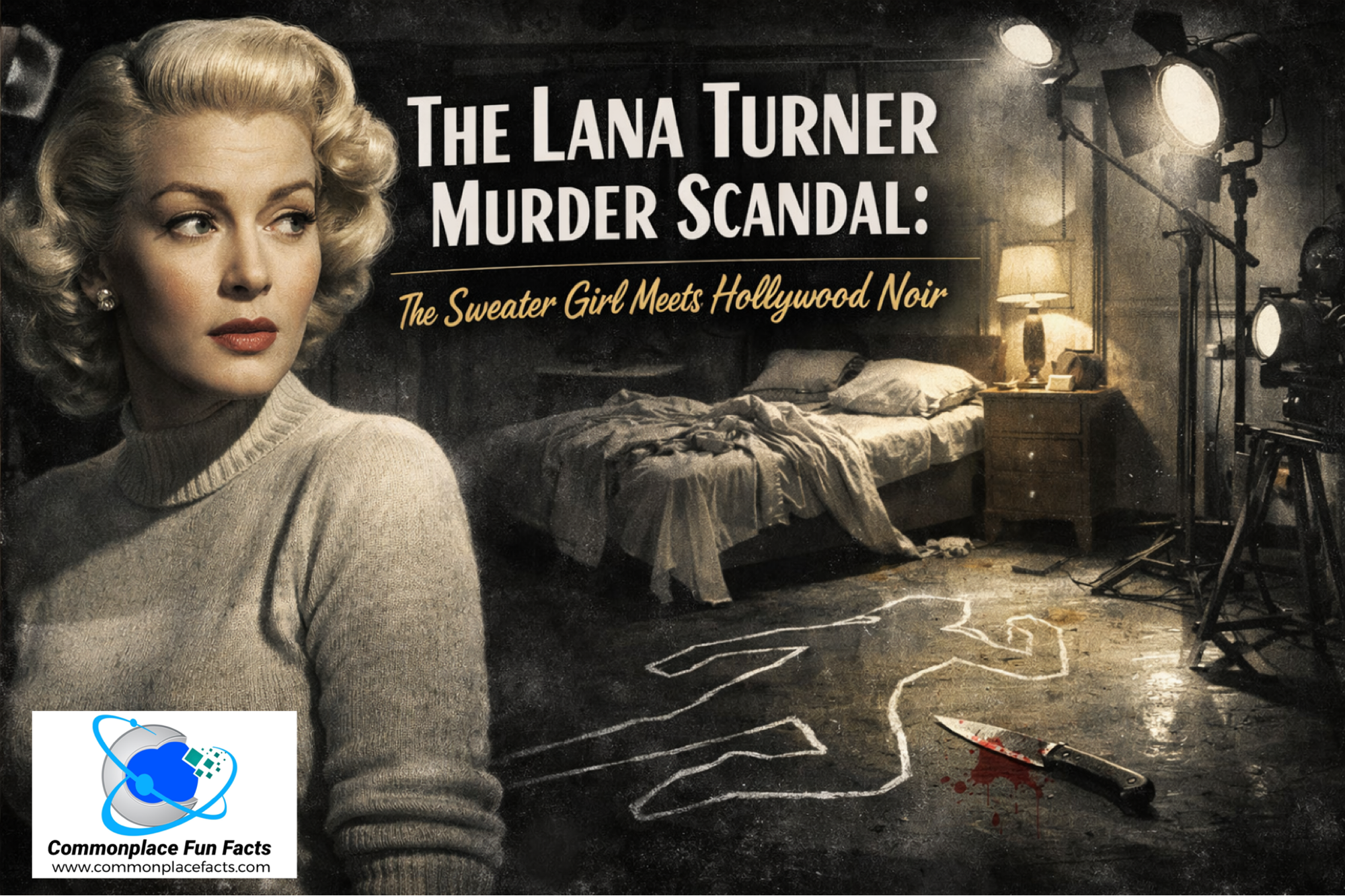

Hollywood loves a story where everything is controlled: the lighting, the angles, the dialogue, and even the carefully-regulated levels of sweat. Real life, meanwhile, has never once been accused of staying on script.
By the time the night of April 4, 1958, reached its uneasy conclusion, Johnny Stompanato—boyfriend of Lana Turner, one of the most famous movie stars in America—was dead from a violent stabbing. Who, exactly, was responsible for the killing was suddenly very much an open question. Before the sun rose over Beverly Hills, the aftermath had already drawn an improbable cast into view: a teenage girl, a terrified actress whose fame ensured there would be no private version of events, nervous studio fixers, an agent accustomed to managing crises, and the lingering shadow of organized crime. The entire episode unfolded with such fevered momentum that it felt less like real life and more like a dress rehearsal for a grim noir film—one in which everyone involved wished there had been a script, and wished even more fervently that it ended differently.
This is not a tidy tale. This is not a “one bad night” story. This is a story about fame colliding with control, about a teenager trying to protect her mother, about a culture that loved Lana Turner as long as she stayed safely on-screen, and about the way the public can treat a violent relationship like a spectator sport—as long as the people involved have good cheekbones.
Editor’s Note: This article discusses historical events involving domestic violence. While no gratuitous scenes are described, the subject matter may be difficult for some readers. If you or someone you know may be experiencing an abusive relationship, support is available through the National Domestic Violence Hotline.
Contents
Lana Turner: The Sweater Girl Meets the Full-Body Headline
Lana Turner’s rise is the kind of Hollywood origin story that studios used to bottle and sell like perfume: discovered as a teenager, transformed into a star, and promoted the way Detroit once rolled out new car models—with relentless repetition, engineered desire, and no discussion of what happened if something went wrong under the hood. In Turner’s case, the branding came wrapped in wool.

In 1937, while appearing in the melodrama They Won’t Forget, Turner wore a fitted sweater in a way that critics and publicists seized upon with unsettling enthusiasm. The phrase “sweater girl” followed almost immediately, becoming shorthand for a very specific mid-century fantasy: wholesome, approachable, and conspicuously curvaceous, but framed as if none of this had been intentional. Turner was just sixteen—an age that allowed Hollywood marketers to lean heavily into sex appeal while insisting, with straight faces, that what audiences were seeing was perfectly innocent. The label implied purity even as it invited inspection, a contradiction the industry did not just tolerate but exploited eagerly.
Turner was hardly alone. The sweater girl category would later absorb other actresses like Jane Russell, Jayne Mansfield, and Anita Ekberg—women whose bodies were treated as marketing copy while their talent was politely acknowledged from across the room. But Turner was the prototype, the one whose image hardened into an expectation. She became famous not just for acting, but for being Lana Turner, which turned out to be a full-time occupation with an extensive rulebook. Among its requirements: look effortless at all times, project desirability while remaining wholesome, and never acknowledge that you possess normal human problems such as fear, exhaustion, or being preyed upon by lecherous studio executives, producers, directors, casting agents, etc.
Following her sweater girl debut, Turner’s career turned into two decades of steady, relentless stardom. She moved briskly from ingénue roles into leading parts, becoming one of MGM’s most reliable box-office attractions through the 1940s. Films like Ziegfeld Girl, The Postman Always Rings Twice, and Peyton Place allowed her to prove, repeatedly, that the sweater had never been the point. She could carry drama, project menace, and command sympathy, even as the studio system continued to market her as a carefully styled ideal. Success, in this case, did not loosen the rules. It tightened them.
By the mid-to-late 1950s, Turner was still a major star, still a symbol, still a carefully maintained product shaped by studio publicists, photographers, and the general assumption that glamour should be attractive but docile. Her personal life, however, had begun to look less like a studio romance and more like a cautionary tale that kept getting renewed for another season, regardless of audience fatigue.
That’s the problem with being an icon. The public doesn’t mind when you suffer quietly, preferably off-camera. What it doesn’t like is when the illusion cracks—when real danger intrudes and forces everyone to confront the fact that glamour is not armor, and it does not chase away tragedy the way garlic is rumored to repel vampires.
Johnny Stompanato: When a “Boyfriend” Comes with Alleged Mob Baggage
Johnny Stompanato was not a Hollywood leading man. He was not even a Hollywood supporting man. He was, by most accounts, a man who moved through Los Angeles with the expectation that doors would open—because he had friends who could explain, in menacing detail, why doors should open.

He had served in the Marines during World War II. After the war, he landed in Los Angeles and became associated with Mickey Cohen’s orbit, most often described as a bodyguard or enforcer. Cohen was much more than a colorful underworld footnote. He was the face of postwar organized crime in Los Angeles: a former associate of Bugsy Siegel who built a reputation on rackets, extortion, and a flair for publicity that made him a tabloid regular. Cohen enjoyed reminding the public—and the police—that he was dangerous, connected, and extremely difficult to intimidate. Working for someone like that came with obvious drawbacks, but it also conveyed a certain blunt authority. People paid attention.
That kind of résumé narrows your legitimate career options while simultaneously opening doors to shadier opportunities. Stompanato cultivated connections in Hollywood society, which sounds stranger than it is. Hollywood has always had a soft spot for danger, provided it wears a well-tailored suit, behaves politely in public, and looks convincing in flash photographs. Gangsters and movie stars shared similar economies: image, intimidation, and the ability to make problems disappear—at least temporarily.
Stompanato’s relationship with Turner began roughly a year before his death. Many accounts describe it as turbulent and abusive. The word “stormy” appears in a lot of celebrity writing, as if the main inconvenience were spoiled weekends or tense dinner parties. This was not that. This was reportedly a relationship defined by jealousy, intimidation, and violence. The real question was never “Will they break up?” It was “How much damage will occur before the break finally becomes irreversible?”
The London Episode: Sean Connery Briefly Becomes Real-Life Security
Every story like this has at least one scene where you pause and think, “No one would put this in a script because it sounds made up.” For Lana Turner and Johnny Stompanato, that scene happens in London in 1957 during the filming of Another Time, Another Place.
Stompanato showed up on set angry, jealous, and in no apparent mood to respect international boundaries, triggering a disruption that reportedly included threatening Turner’s co-star, Sean Connery, with a gun. Connery—still years away from being officially licensed to kill, but already auditioning for the role through sheer personal confidence—disarmed him. One can be forgiven for wishing that scene had been preserved on film, if only as an early preview of what audiences would later accept without question when Connery appeared as James Bond. Turner contacted authorities soon afterward, and Stompanato was deported from the United Kingdom, presumably with less enthusiasm and even more resentment than he had brought with him.
The incident has lived on in Hollywood lore because it contains every element of a classic noir vignette: a glamorous star, a jealous mob associate, a film set, a gun, and a future James Bond responding decisively. What tends to get glossed over is the less cinematic part—the pattern. Abusive relationships are not defined by isolated explosions but by the need for control that grows more brittle over time. Control does not age well. Control reacts badly to limits, and it reacts worst of all to being told “no” in front of witnesses.
Turner and Stompanato reconciled after the London episode, if one is willing to stretch the word “reconciled” to include returning to a relationship that had already demonstrated how it handled conflict. The relationship continued. So did the volatility.
The Oscars, the Argument, and the Countdown Feeling
In March 1958, Turner attended the Academy Awards. She had recently been nominated for Peyton Place. The awards ceremony is supposed to be a celebration of artistry. Real life, again, was not committed to the theme.
Accounts describe Stompanato being angry that Turner attended without him. Some reports say he assaulted her afterward. If you are looking for the moment where the audience wants to stand up and shout “Please leave this man,” you are not alone. The problem with watching someone else’s life is that the choices always look simpler from the outside. The problem with living it is that fear, love, habit, reputation, and hope all sit in the same room and argue over what to watch on television.
Turner had moved into a rented home at 730 North Bedford Drive in Beverly Hills only about a week earlier—a temporary address meant to offer distance, privacy, and perhaps the illusion of a reset. It did none of those things. Whatever geography had changed, the dynamics had not. Tension followed her through the front door, settled into the rooms, and waited. And on the night of April 4, 1958, that pressure finally condensed into a moment where fear, proximity, and control collapsed inward—leading to Lana Turner being thrust into an unwelcome leading role in a homicide that still raises troubling questions nearly seventy years later.
April 4, 1958: The Bedroom Argument That Turned Into a Death
On the evening of April 4, 1958, Stompanato arrived at Turner’s home and began arguing with her in the bedroom. In the house with them was Turner’s fourteen-year-old daughter, Cheryl Crane, who had already spent enough of her adolescence absorbing the background noise of adult volatility.

The argument escalated quickly. Accounts describe threats—against Turner, against her daughter, against her mother—as Turner tried to get Stompanato to leave. The bedroom door was initially closed, voices raised, the tone violent enough that Crane, listening from an adjacent room, became convinced her mother was in danger. At some point in the struggle, the confrontation moved toward the doorway as Turner attempted to push Stompanato out of the room and out of the house.
Crane ran to the kitchen and grabbed a knife. She later said she intended only to frighten Stompanato and protect her mother. In the chaos near the bedroom doorway, as Turner and Stompanato struggled, Crane lunged forward. Stompanato was stabbed once in the abdomen—one wound, one knife, one moment that irreversibly altered the lives of everyone involved.
What followed only deepened the sense that this was not going to be treated as an ordinary domestic tragedy. Before the story had fully settled into official channels, phone calls were made, lawyers were consulted, and the familiar machinery of Hollywood crisis management began to turn. Stompanato’s association with Mickey Cohen—Los Angeles’s most visible mob figure—hovered over the scene almost immediately, lending the aftermath an air of underworld menace even where no documented intervention occurred. Cohen would later involve himself publicly, paying funeral expenses and speaking to the press, ensuring that the case arrived in newspapers already wrapped in mob intrigue and whispered speculation.
Turner and Crane’s account was that Crane acted to protect her mother during an attempt to force Stompanato out. Turner reportedly wanted to take responsibility herself, which makes emotional sense even if it makes legal sense only in the way panic often does. Crane ultimately surrendered herself to authorities in the early hours of April 5 and was placed in juvenile hall. Turner, meanwhile, stepped into the part of celebrity life no studio ever promoted: the moment when your face fills every newspaper and the story is no longer about your work, but about survival—and about which version of events the public would believe.
The Coroner’s Inquest: Hollywood on the Witness Stand
The legal process here was not a criminal trial in the way many people imagine. The key public proceeding was a coroner’s inquest held on April 11, 1958. Coroner’s inquests can feel old-fashioned now, like something from a black-and-white courtroom drama where everyone wears hats indoors and the microphones look like desk lamps. In 1958 Los Angeles, however, this inquest became an event.
Much like the first big Hollywood murder trial half a century earlier (which also inspired the creation of the fictional attorney Perry Mason), the Johnny Stompanato homicide inquest became a media sensation. Reporters swarmed the story. Cameras arrived. Commentary poured in. Turner testified, and a significant portion of the public reaction focused less on the facts and more on the idea that an actress must be acting—because apparently the only acceptable emotion for a movie star is the emotion she delivers on cue. A coroner’s jury heard hours of testimony and then deliberated briefly before ruling the killing a justifiable homicide.

That phrase—justifiable homicide—lands with a strange thud. It is both clinical and enormous. It says, in effect, that a person is dead, a knife was used, and the law does not consider it a crime. It also says nothing about the trauma that led to the moment, or what it does to a fourteen-year-old to watch her mother in danger and decide that the only tool available is something pulled from a kitchen drawer.
Crane remained under court supervision for a time. She was ultimately released and placed under the guardianship of her grandmother, with court-ordered psychiatric visits. That detail matters, because it’s the quiet part of the story. The headlines want the stabbing. The real cost shows up afterward, in the long work of trying to live normally after your name becomes shorthand for a scandal.
The Civil Suit: When the Verdict Doesn’t End the Story
The coroner’s ruling ended the criminal proceeding, but it did not end the legal ripples. In June 1958, Stompanato’s ex-wife filed a wrongful death lawsuit on behalf of herself and her son, seeking $750,000 (about $8.5 million in 2025 dollars) in damages from Turner, Crane, and Crane’s father. Civil court has its own logic. Civil court does not need to prove guilt beyond a reasonable doubt. Civil court asks, “Who should pay?” and then invites everyone to argue about it while the lawyers all bill by the hour.
The lawsuit eventually settled out of court in 1962 for $20,000 (about $220,000 in 2025 dollars). The difference between the amount sued for and what was agreed upon in settlement tells you several things at once, including the value of a strong legal defense, the unpredictability of sympathetic juries, and the way time can drain momentum from even the most sensational case.
The Conspiracy Theories: Hollywood Never Met a “What If” It Didn’t Like
As time moved on, conspiracy theories moved in, as they tend to do when a story has fame, violence, and a mother-daughter dynamic that the public can’t stop poking with a stick. One persistent rumor claimed Turner actually stabbed Stompanato and Crane took the blame to protect her. Crane repeatedly denied that. Turner maintained the story that her daughter acted in defense.
Conspiracy theories are often built on a misunderstanding of trauma. People assume the “logical” choice would be to do X, so anyone who did Y must be hiding something. Real human beings do not behave like chess pieces. Real human have a stubborn insistence upon behaving like real human beings: frightened, confused, loyal, and desperate for the situation to stop getting worse.
Turner herself later claimed Stompanato had drugged her on one occasion and taken nude photographs while she was unconscious, potentially for blackmail. That detail, whether one believes it fully or not, fits the broader pattern described by many sources: control, humiliation, and the weaponization of intimacy. The Hollywood part of this story is the fame. The human part is the fear.
The Media Part: America Watches a Domestic Crisis Like a Matinee
The public response was divisive, which is the polite way of saying people behaved exactly like people behave when a famous woman is involved in violence: they judged her. They judged her testimony. They judged her romantic choices. They judged her facial expressions as if the correct response to chaos is always photogenic composure.
Some coverage treated Turner like a tragic figure. Some coverage treated her like a villain in mascara. Many outlets treated the entire situation as entertainment. The coroner’s inquest became less a search for truth and more a cultural moment, the kind where the audience thinks it is watching a story but is actually revealing its own values in real time.
Hollywood in the 1950s had strict rules about image. The public liked stars who looked perfect and suffered quietly. Turner’s problem was that she suffered loudly—by circumstances, not by choice. The case ripped a hole in the fantasy. The fantasy, as always, retaliated by blaming the person who made it uncomfortable.
Aftermath: Lana Keeps Working, Cheryl Keeps Living, and the Story Refuses to Die

Turner returned to her career, because careers do not pause politely while your personal life detonates. She continued to act, continued to exist in public, and continued to carry a story that the world would never let her set down. The case became part of her biography in the way a scar becomes part of a face: always there, always noticed, always prompting people to ask questions that feel personal and yet get asked as if they’re merely inquiring about what’s on the menu.
Cheryl Crane grew up with the kind of notoriety that adults struggle to handle, let alone a teenager. Her name became inseparable from that night, even though her life contained far more than one moment of fear and one impulsive act. She later wrote a memoir, Detour: A Hollywood Story, which is a title that sounds clever until you remember that detours are often taken because the main road has become dangerous.
The larger cultural legacy is uncomfortable. The story still gets told as “Hollywood’s most sensational inquest” or “the night Lana Turner’s daughter killed her mother’s gangster boyfriend,” as if the primary appeal is shock value. The primary reality was domestic violence in a famous house, with a child in the next room listening to threats and deciding she had to act.
A Hollywood Life, on Federal File
For anyone tempted to think the Stompanato killing was a sudden rupture in an otherwise orderly life, Lana Turner’s FBI files offer a useful correction. Turner had been on the Bureau’s radar well before April 1958, not because she was suspected of crimes, but because celebrity, scandal, and proximity to people of interest tend to generate federal paperwork whether one consents or not. Her files span roughly fifteen years—from 1945 to 1960—and amount to about sixty discernable pages.
The early material paints a picture of vulnerability rather than intrigue. In 1945, Turner was the target of an extortion attempt involving threatening letters—serious enough that an FBI memo reports she obtained a gun for personal protection. That same year, another memo records Turner being turned away from the Waldorf Astoria in New York because of her association with a Black musician. The incident was notable enough that MGM reportedly considered canceling her contract, a reminder that studios expected not just box-office appeal from their stars, but strict adherence to social boundaries of the era.
After Johnny Stompanato’s death, the files shift tone. They include summaries of press coverage, notes on Stompanato’s background, and accounts of Mickey Cohen’s behavior and remarks in the aftermath. The Bureau’s interest extended less to solving a crime than to tracking how information moved—through reporters, intermediaries, and underworld figures who understood how scandal could be leveraged.
One particularly revealing thread involves columnist Walter Winchell, who attempted to provide the FBI with letters Turner had written to Stompanato. According to the files, Mickey Cohen played a role in helping funnel those letters to the press, reinforcing how little control Turner had over her own narrative once powerful men decided it was useful. Taken together, the files don’t reveal a secret criminal life. They reveal something quieter and arguably worse: a woman whose fame repeatedly made her subject to surveillance, exploitation, and judgment—long before the night that finally turned her private life into public record.
What This Story Looks Like Now
Modern readers tend to recognize patterns that earlier coverage avoided naming. The relationship, as described by many sources, reads like a textbook cycle of abuse: intimidation, violence, reconciliation, escalation, and the constant feeling that danger could show up at the door whenever it pleased. The celebrity element didn’t protect Turner. It probably made everything worse, because fame creates pressure to keep problems hidden until they become impossible to hide.

Public fascination also plays a role. People love the idea that fame is a kind of shield. People love it because it makes the world feel fair: beautiful, successful people get beautiful, successful lives. Stories like this ruin that comforting lie, which is why the reaction often becomes moral judgment. Moral judgment lets the audience believe the victim “invited” the problem, which conveniently means the audience will not have to imagine the problem happening to someone they love.
The facts of April 4, 1958 are tragic enough. The part that lingers is what the spectacle reveals: an America hungry for scandal, a legal system trying to process trauma through procedures, and a young girl whose life became a headline because she tried to stop something she feared would end in her mother’s death.
In the end, the most unsettling thing about the Lana Turner story is not the violence, the mob shadows, or even the spectacle. It’s how ordinary the underlying mechanics are once the glamour is stripped away: fear escalating in private, control masquerading as devotion, and a child forced into an impossible decision because the adults around her failed to stop the danger in time. Hollywood liked to tell itself this was a freak scandal—an aberration, a one-off tragedy starring famous faces. It wasn’t. It was a domestic crisis that happened to unfold under brighter lights, where the costumes were better tailored but the rules of human behavior were no different. The sweater girl myth promised safety. Reality did not honor the warranty.
You may also enjoy…

The First Hollywood Murder Trial and the Fictional Lawyer It Inspired
The scandal captured the headlines of newspapers around the world. The Los Angeles celebrity was accused of trying to kill his wife. The evidence against him was overwhelming. It seemed only a matter of time before he would trade his wealth and fame for a prison cell and disgrace. Every lawyer recommended that he take…

Hedy Lamarr: Much More Than Just Another Pretty Face
The Lesser-Known Side of Hedy Lamarr Hedy Lamarr (November 9, 1914 – January 19, 2000) was once billed as the World’s Most Beautiful Woman. The Austrian-born actress landed a contract with MGM in 1937 and achieved stardom with her performance in the 1938 film Algiers. Her role in the 1949 movie Samson and Delilah was her…

Jimmy Stewart: The WWII Pilot Who Became a Legend In and Out of War
Learn about the largely unknown military heroics of Jimmy Stewart during WWII.





Leave a Reply to Commonplace Fun FactsCancel reply