

London has a mayor most people recognize. That mayor deals with buses, transit maps, housing shortages, and the ongoing philosophical question of whether anyone actually understands how roundabouts work. This mayor gives interviews, wins elections, and appears regularly in newspapers looking concerned.
This article is not about that mayor.
This article is about the other mayor. The one who governs exactly one square mile. The one who does not run London so much as preside over it with a level of ceremonial confidence that suggests the job was invented back when people thought hats were serious business.
This mayor is the Lord Mayor of London. That person does not get elected by most of London, does not run transport systems, and does not manage housing policy. The Lord Mayor does, however, outrank foreign ambassadors at formal banquets, ride in a gold coach, and wear a hat whose resale value could probably fund a modest used-car lot.
Contents
Two Mayors, Two Very Different Jobs
London is unusual in that it has two mayors who both use the word “London” in their title and then proceed to do entirely different things.
The Mayor of Greater London is a modern political office. That mayor is elected by millions of voters, presides over the entire metropolitan region, and is concerned with public transportation, housing policy, policing strategy, and all the other problems that come with trying to keep one of the world’s largest cities from collapsing into mild chaos.
The Lord Mayor of London does none of that.
The Lord Mayor governs only the City of London, an area of about one square mile, and serves not as a domestic administrator but as a representative and ambassador. The role is ceremonial in form but strategic in function. While the Mayor of Greater London manages the city’s daily life, the Lord Mayor promotes the City of London’s commercial and financial interests to the rest of the world.

In practice, this means that the two mayors operate in almost entirely separate orbits. One deals with buses and zoning disputes. The other spends much of the year traveling internationally, attending state functions, and explaining—politely and repeatedly—why the Square Mile remains a reliable place to do business.
The contrast between the two offices becomes especially clear when you look at what they are paid. The Mayor of Greater London earns a modern public salary—roughly £170,000 a year. The Lord Mayor of London, by contrast, receives no salary at all. The office is unpaid, with the unspoken assumption that anyone taking it on has both the personal means and the institutional backing to absorb the cost. One role comes with a paycheck and a pension. The other comes with banquets, a gold coach, and an impressive reminder that prestige and compensation are not always the same thing.
The shared title is misleading. These are not parallel offices. They are products of different centuries, designed for different purposes, and accountable to entirely different constituencies. One is a modern executive role shaped by democratic politics. The other is a surviving artifact of medieval civic government, still very much in use.
The Square Mile: Where This Is Actually Happening
The confusion between the Mayor of London and the Lord Mayor of London is understandable, because everything else about this story is also confusing.
Before any of this makes sense, it helps to know where the City of London actually is, and just as importantly, what it is not.
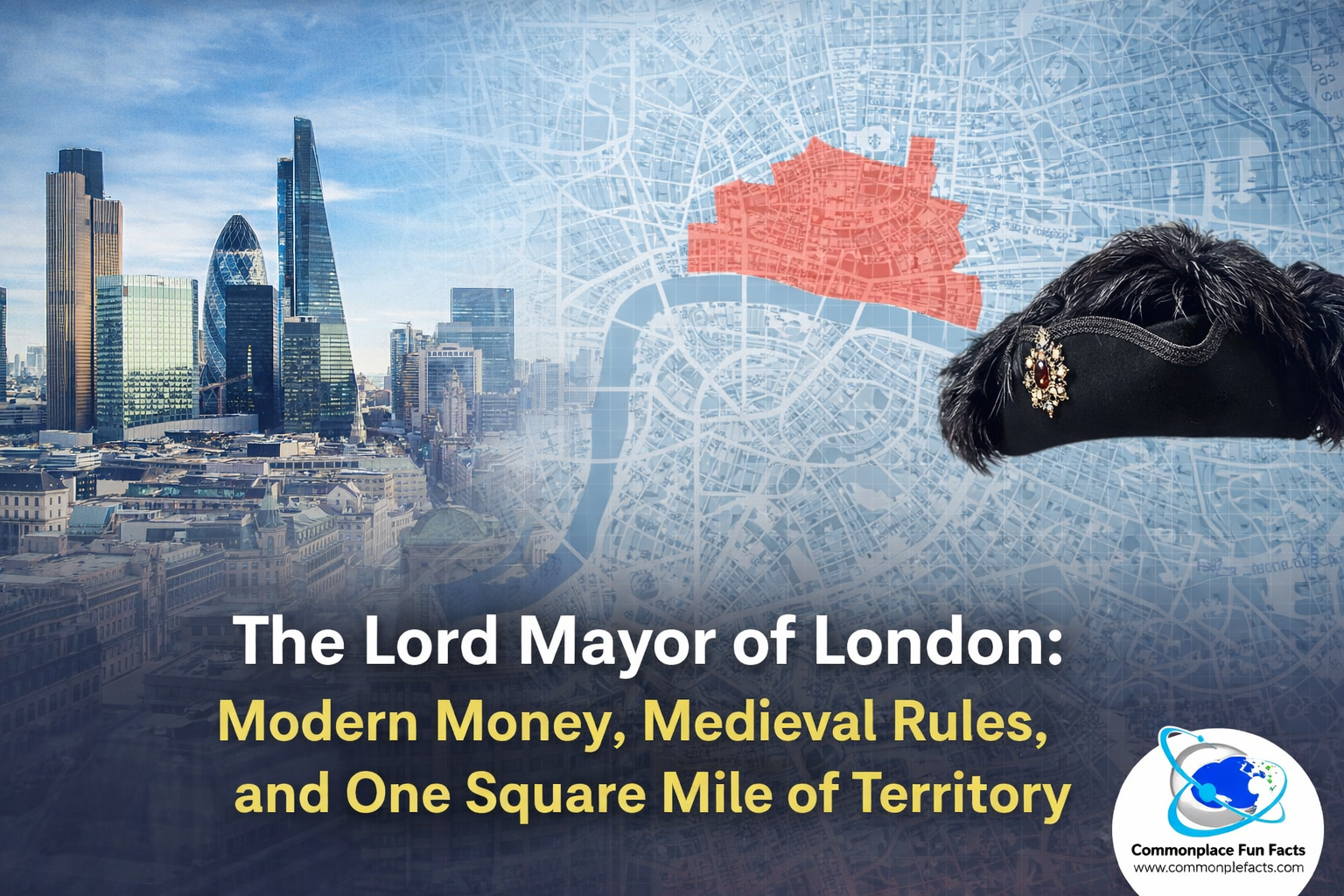
The City of London occupies roughly one square mile on the north bank of the River Thames. It is the historic core of what was once Roman Londinium, and it still follows boundaries that would look surprisingly familiar to someone who last checked a map in the Middle Ages.

This is not “central London” in the way most visitors understand the term. It does not include Westminster, Buckingham Palace, Soho, Camden, or anywhere tourists tend to stay on purpose. Those places grew up around the City over centuries, eventually merging into the vast urban sprawl now called Greater London.
The City did not merge.
As London expanded outward, absorbing villages, boroughs, and parishes like an increasingly polite blob, the Square Mile remained administratively intact. It kept its charters. It kept its courts. It kept its privileges. When modern municipal structures were created to govern the wider metropolis, the City politely declined and carried on governing itself.
The result is a geographical oddity: a tiny, densely packed financial district embedded inside one of the largest cities on Earth, yet legally distinct from it. It has its own police force, its own elections, its own ceremonies, and its own mayor. The surrounding city eventually decided this was easier than fighting about it.
The size matters. With only a small residential population and an enormous daily influx of commuters, the City developed institutions designed to serve commerce rather than neighborhoods. It is less a place where people live than a place where things happen, mainly involving money, contracts, and calm voices saying “yes, of course” across polished tables.
Once you picture the Square Mile clearly on the map, everything else about the Lord Mayor begins to feel less bizarre and more inevitable.
The City of London: A Government Powered by “Because We’ve Always Done It This Way”
The Lord Mayor governs the City of London, a place that is technically London, physically London, but administratively doing its own thing with the calm detachment usually reserved for cats and medieval institutions. It is a city inside a city inside a country, complete with its own police force, its own elections, its own legal traditions, and an unspoken understanding that complexity is not a flaw but a heritage.
The surrounding metropolis did not elect a modern mayor until the year 2000. The City of London, by contrast, has been governed by mayors—of one title or another—since the late 12th century. It does not regard modern municipal structures as improvements so much as recent fashion choices that may or may not age well.
The City is the oldest continuously governed municipal entity in Britain and among the oldest in Europe. It predates Parliament. It predates the modern form of the monarchy. It predates the idea that governments should routinely justify their existence to anyone. Legally speaking, it has existed “since time immemorial,” which is just a fancy way of saying that it has been around since before July 6, 1189. (Read “Human Memory Began on Thursday, July 6, 1189” for more about that.)
Unlike modern states, the City of London does not have a single dramatic founding moment. There is no declaration, no manifesto, no parchment triumphantly waved at future generations. Its authority emerges gradually in historical records, already established, already functioning, and clearly not interested in explaining how it got there.
When later documents attempted to define royal authority or formalize rights across England, the City appears in them the way an old neighbor appears in property records: already present, already owning things, and entirely uninterested in renegotiation. The mayoralty itself can be documented from 1189 onward, and the title “Lord Mayor” was formally granted in the 14th century. Since then, the office has existed without interruption.
This continuity matters more than myth. The City does not rely on vague antiquity or lost origins to justify itself. It relies on records, charters, and the deeply irritating fact that it never stopped. Eight centuries of uninterrupted civic government turn tradition into infrastructure.
The result is a style of governance less concerned with novelty than with continuity. Traditions are not decorative; they are structural. Change is approached carefully, incrementally, and ideally after long observation confirms that nothing important will break.
If this sounds stubborn, that is because it is. In the City of London, stubbornness is not a personality flaw. It is a governing principle.
The Only Democracy Where Corporations Get More Votes Than Humans
The office of Lord Mayor is an elected position. The election, however, doesn’t look like any you’ve ever experienced.
In City elections, people vote. Corporations also vote. Corporations vote far more.
Approximately three-quarters of the votes cast in City elections come from businesses, not residents. The system is called the business franchise, and it treats companies as electoral participants based on their size and presence within the City.
The larger the company, the more votes it receives. Those votes are then assigned to individual employees who work in the City but usually do not live there. The employees cast the ballots, but the voting power itself belongs to the company.

This arrangement is startling if you are accustomed to modern democratic ideals that place residents at the center of political power. It feels less startling if you consider the City’s demographics.
The City of London has only a few thousand permanent residents. On a typical workday, several hundred thousand people commute into it. They work there, depend on its infrastructure, generate its revenue, and leave again by nightfall. The City’s services exist primarily to serve commerce, not neighborhood life.
The voting system reflects that reality with minimal sentimentality.
Rather than pretending that a tiny residential population should govern a massive financial ecosystem, the City formalized the economic truth: those whose livelihoods depend on the City’s functioning should have a say in how it is run.
This effectively turns corporate governance logic into civic governance logic. It is difficult not to notice the resemblance between City elections and shareholder meetings, except with better outfits and fewer pie charts.
The result is a political system optimized for stability, predictability, and business continuity. Radical reform is not encouraged. Sudden change is politely discouraged. The goal is not passion. The goal is calm competence.
Meet the Common Council, the Part That Actually Does the Work
The true governing body of the City of London is the Common Council. If the Lord Mayor is the ceremonial face, the Common Council is the nervous system.
The Council handles budgets, infrastructure, policing, courts, environmental services, education charities, and international strategy. It manages local issues and global responsibilities with equal seriousness, often at the same meeting.
Its members are elected through the same business-heavy franchise system that governs other City elections. Most councilors are chosen by corporate voters. A minority represent the City’s small resident population.
This technically means residents have representation. It does not mean residents drive policy.
The Common Council does not spend much time courting public attention. It produces very little drama. Meetings are orderly. Debates are understated. The tone is that of an institution deeply invested in not becoming a headline.
In an era when political visibility is often mistaken for effectiveness, the Common Council’s obscurity is intentional. Its success is measured by the absence of crisis.
This body is the reason the City works. It is also the reason most people have never heard of it.
Becoming Lord Mayor: A Simple Process With Only Eight Preliminary Quests
At this point, you might reasonably ask how one becomes Lord Mayor of London.
The short answer is that you do not apply. You advance as if you were a character in a role-playing game.
The longer answer involves a carefully layered sequence of offices, approvals, and ceremonial checkpoints that feel less like a career ladder and more like a medieval board game.

The path to the mayoralty has four major stages:
You must first become a Freeman of the City.
Then you must be elected as an Alderman of a ward.
After that, you must serve as a Sheriff.
Only then may you be considered for Lord Mayor.
Each step unlocks the next. Each step is controlled by people who have already completed the steps themselves. This creates a system of polite circularity in which advancement requires approval from those you hope to one day join.
No part of this process is hurried. No part of it is casual. The system is designed to ensure that anyone who reaches the top has already demonstrated patience, commitment, and an impressive tolerance for ceremony.
This is not a flaw. It is the point.
All that’s missing is the part where you encounter a troll under a bridge who rewards you with a key if you solve his riddle.
Freeman Status: Or How Medieval Guilds Are Still Running the Show
The journey begins with becoming a Freeman of the City of London.
This status can be granted directly by the Court of Aldermen, but the traditional route runs through one of the City’s livery companies—the modern descendants of medieval trade guilds.
There are more than a hundred livery companies, and they vary wildly in character. Some still regulate professions. Some operate primarily as charitable organizations. Some seem to exist to preserve institutional memory, traditions, and banquet menus.
Their names read like a catalog of human civilization frozen at different moments in time: Fishmongers, Goldsmiths, Apothecaries, Mercers, Butchers, Bakers, Wheelwrights. There are two separate companies devoted to candlestick making, a detail that feels less like redundancy and more like a suspicion that the new-fangled electric lightbulb may not be here to stay.
Modern trades have been added over time. The inclusion of Chartered Accountants is often cited as the moment when medieval tradition finally acknowledged spreadsheets.
Membership requirements are inconsistent by design. Some companies require professional qualifications. Others require sponsorship from existing members. Some do not advertise requirements at all, reinforcing the impression that mystery itself is part of the tradition.
Once admitted, a member gains Freeman status, unlocking access to the City’s political structure. What began as professional guilds have become constitutional gatekeepers.
Medieval institutions, it turns out, do not fade away. They rebrand.
Aldermen, Sheriffs, and the Art of Being Elected by People Who Already Know You
Having achieved Freeman status, the aspiring Lord Mayor must next become an Alderman. This is where the City’s governance model really begins to show its personality.
The City of London is divided into wards, each represented by an Alderman. These Aldermen collectively form the Court of Aldermen, a body that functions simultaneously as a governing authority, a supervisory board, a vetting committee, and a kind of living memory for how things are supposed to be done.
Aldermen are elected within their wards, which means that some are elected by residents and most are elected by businesses. The franchise system still applies. The process is calm, understated, and largely devoid of campaign theatrics.
The Court of Aldermen occupies a peculiar role. It is both gatekeeper and electorate. It approves candidates for office, evaluates eligibility, and ultimately selects the Lord Mayor from among its own members. This structure means that the people responsible for preserving the City’s traditions are also the ones deciding who is allowed to inherit them.
This is not accidental.

The Court values experience over enthusiasm, restraint over originality, and continuity over change. Aldermen are expected to understand the City not as a collection of policies but as a long-running institution with habits that deserve respect.
Once an Alderman has established himself or herself—and demonstrated the ability to operate effectively without drawing attention—he or she may pursue the next step: Sheriff.
The election of Sheriffs marks a subtle shift in who holds power. Sheriffs are not elected by residents or corporate voters. They are elected by the livery companies themselves.
This process places institutional memory front and center. The livery companies are deeply invested in tradition, hierarchy, and continuity. They are not looking for bold reformers. They are looking for people who understand the rhythms of the City and can represent it without improvising.
The general public does not meaningfully participate in this process. There are no rallies. There are no debates. There is no sense of exclusion, because everyone involved appears perfectly content with the arrangement.
The City has made peace with the idea that enthusiasm is overrated.
Election Day: When the Aldermen Pick One of Their Own
The selection of the Lord Mayor is not an election in the modern sense. There are no public ballots. There are no campaign slogans. There is no manifesto promising sweeping change.
The Court of Aldermen selects the Lord Mayor from among its own members, typically choosing someone who has demonstrated long service, deep familiarity with the City’s institutions, and a proven commitment to not upsetting anything important.
Popularity matters, but only within a very small circle of peers who already know one another. Seniority matters. Reliability matters. Most of all, the candidate must inspire confidence that they will represent the City competently, predictably, and without innovation.
The term lasts one year.
There is no salary.
This detail alone ensures that the office self-selects for individuals of considerable personal means. The costs associated with serving as Lord Mayor are substantial, covering international travel, ceremonial obligations, hosting duties, and the general expense of maintaining appearances at a level the City considers appropriate.
This financial barrier is not discussed openly. It simply exists, quietly narrowing the field without the need for written rules.
Those selected accept the costs as part of the honor. Complaining would suggest a misunderstanding of the role.
The Job Itself: Traveling Salesman for the City of London
Once sworn in, the Lord Mayor begins a year-long sprint disguised as a ceremonial stroll.
The core function of the office is promotion. The Lord Mayor acts as an ambassador for the City of London, representing it to governments, financial institutions, investors, and business leaders around the world.
This involves hundreds of speeches, countless meetings, constant travel, and a level of networking that would exhaust most people by mid-February.
The Lord Mayor does not negotiate treaties or pass laws. Instead, it’s all about selling an idea: that the City of London is stable, trustworthy, historic, and open for business.
This is done politely. Persistently. Often over banquets.
The workload is intense and largely self-funded. There is an unmistakable resemblance to an unpaid internship, except that interns are not typically required to wear robes or pose next to ceremonial swords.
The City views this labor as an investment in its global reputation. The Lord Mayor’s year is a rolling advertisement for continuity, expertise, and institutional depth.
The fact that this advertising campaign is conducted by someone dressed like a character from an epic fantasy novel is treated not as a contradiction, but as reinforcement.
About That Outfit: The Hat, the Coach, and the Accidental Fantasy Novel
No discussion of the Lord Mayor is complete without addressing the regalia.

The hat alone is legendary, a broad-brimmed object that appears designed to command attention before a word is spoken. It is paired with robes, an elaborate chain of office, and other ceremonial elements that suggest the City never missed an opportunity to add ornamentation.
The gold coach, still used for formal processions, completes the effect. It is not subtle. It is not modern. It is not trying to be either.
The purpose of the pageantry is not nostalgia. It is authority.
Ritual creates legitimacy. Spectacle signals continuity. The visual language of the Lord Mayor’s office communicates that the City is older than trends and unmoved by fads.
No one involved can point to a specific moment when these elements were deemed necessary. That uncertainty is part of their power. Tradition that cannot be rationally dismantled becomes tradition that cannot be challenged at all.
Modern finance, paradoxically, functions better when framed by medieval symbolism. The contrast reassures participants that behind the complexity of contemporary markets stands an institution that has been doing this longer than anyone alive.
Precedence, Protocol, and That Seat at the Coronation
The Lord Mayor’s importance is not just theatrical. It is written directly into Britain’s formal order of precedence, the elaborate hierarchy that decides who stands where, enters first, and sits closest to the sovereign at state occasions.
Within the City of London, the Lord Mayor outranks everyone except the monarch. Outside the City, the Lord Mayor still ranks above most senior officials, nobles, and government ministers. At formal events, ambassadors defer. Dukes wait their turn.
This is not ceremonial exaggeration. It is protocol.
The point becomes clearest at a coronation. While much of the ceremony revolves around hereditary nobility and royal office, the Lord Mayor occupies a distinct and privileged place as the civic representative of the City of London. The role is explicitly recognized, not as a courtesy, but as a constitutional survivor—an acknowledgement that the City is not merely another locality, but a unique corporate body with ancient rights.
This arrangement confuses modern observers for a simple reason: the Lord Mayor is not powerful in the way we usually measure power. He does not command armies or pass legislation. What he represents instead is continuity—an institution older than Parliament itself, still treated as an essential participant in the life of the state.
In a system that prizes tradition, longevity counts. The Lord Mayor’s precedence is not a reward for influence. It is a recognition of endurance.
When the City shows up, it is not as a guest. It is there because it always has been.
The Current Lord Mayor (Who Happens to Be a Lady Mayor)

In a twist that delights anyone who enjoys subtle subversions of tradition, the current holder of the office is a woman — the third such female office holder. For those keeping score, that makes her not just Lord Mayor but Lady Mayor. Dame Susan Langley serves as the 697th Lord Mayor (for 2025–2026). Calling her “Lady Mayor” seems a bit patronizing, until you remember that “lady” is the counterpart to “lord.”
Her role is exactly the same as it has been for generations: she travels the world, meets with business and government leaders, and serves as the ambassador for the City of London’s financial and commercial interests. She wears the robes, she rides in the coach, and she presides over ceremonies with the same solemn confidence that her predecessors cultivated back when knights were still worrying about helmets.
If you want to see how the City presents the office and learn more about her current initiatives, you can visit the official City of London Corporation page on the Lord Mayor’s role.
The Lord Mayors You May Have Actually Heard Of (And Why That’s Rare)
For an office that has existed for more than eight centuries, the list of Lord Mayors most people recognize is surprisingly short. This is not because the role lacks importance. It’s because the office does not exist to make its holder famous.
Most Lord Mayors are remembered, if at all, within the narrow confines of civic history. Their fame begins and ends with the year they wore the robes. The exceptions—the ones whose names survived—are people who were already notable before the gold chain went on.
The most famous example is Richard Whittington, better known as “Dick” Whittington, the medieval merchant whose real financial success slowly mutated into a fairy tale involving cats, bells, and improbable optimism (Read about “Dick Whittington and His Cat”). Long before pantomime producers got involved, Whittington was a serious political and economic figure, serving multiple terms as Lord Mayor and funding major public works across London. The legend survived because the underlying career was already remarkable.
Thomas Gresham belongs to the same category. He was a financier and adviser to the Crown, the founder of the Royal Exchange, and the namesake of Gresham’s Law (“bad money drives out good”)—still taught in economics courses centuries later. His year as Lord Mayor is almost incidental compared to the impact he had on English finance and economic thought.
Later centuries produced figures like William Beckford, a wealthy merchant and outspoken political reformer who famously challenged royal authority directly, even in ceremonial settings where such things were deeply frowned upon. Beckford is remembered not for being polite, but for being bold—an unusual strategy in an office built on continuity.
What ties these figures together is not their time in office, but the fact that the office intersected with a much larger story. They were merchants, financiers, reformers, and philanthropists whose influence extended beyond the Square Mile.
The pattern is telling. The Lord Mayor does not create celebrity. It attracts people who have already achieved prominence elsewhere and then places them briefly at the center of an ancient machine designed to carry on regardless of who is standing inside it.
That, ultimately, is why so few Lord Mayors are household names. The office was never meant to produce them.
So Why Keep Any of This?
From the outside, the City of London’s system looks absurd. It is layered, ceremonial, opaque, and resistant to reform. It appears to defy modern democratic sensibilities at nearly every turn.
And yet, it works.
The City has positioned itself as a center of global finance precisely by offering what most modern systems cannot: continuity. Stability. Predictability.
The persistence of medieval institutions within a modern economy is not a failure to evolve. It is a strategic choice. Tradition becomes a form of soft power, signaling reliability in a world obsessed with disruption.
Historians encounter this discomforting truth frequently. The systems that look the strangest on paper often endure the longest.
The City does not confuse novelty with improvement. It adds layers rather than replacing foundations.
The Strangest Mayor You Will Ever Not Vote For
The Lord Mayor of London is not a relic gathering dust. The holder of the office is a living fossil, actively employed.
The office presides over a global financial hub using rituals developed before forks were common household items. It represents modern commerce wrapped in medieval ceremony. It exists not despite the anachronisms, but because of them.
History, in this case, has not been replaced. It has been maintained, polished, and put to work.
Somewhere beneath the robes, the hat, and the gold coach, spreadsheets hum quietly. Deals are made. Money flows.
And the City of London carries on, calmly convinced it got this right centuries ago.
You may also enjoy…

Royal Right to Summer Snowballs
The British royal family’s real estate agreements can be peculiar, as exemplified by the obligations of Scotland’s Clan Munro. In 1608, King James VI granted disputed lands to Hector Munro’s son, with a unique proviso: the owner must provide a snowball to the reigning monarch on any day, even in midsummer. This tradition continues today.

It is Illegal to Resign from the British Parliament
Those who hold national elected office typically consider it a high honor, difficult to achieve, and easy to lose. This has not always been the case. Evidence of this can be seen in the fact that it is illegal to resign from the Parliament of the United Kingdom. The inability of a Member of Parliament…

The Hilarious Parliamentary Blunder That Saved Habeas Corpus in 1679
Discover how a miscounted vote in 1679 — involving one oversized lord counted as ten — accidentally secured the Habeas Corpus Act. A hilarious parliamentary blunder that shaped one of Britain’s most important legal protections.





Leave a Reply to Commonplace Fun FactsCancel reply