
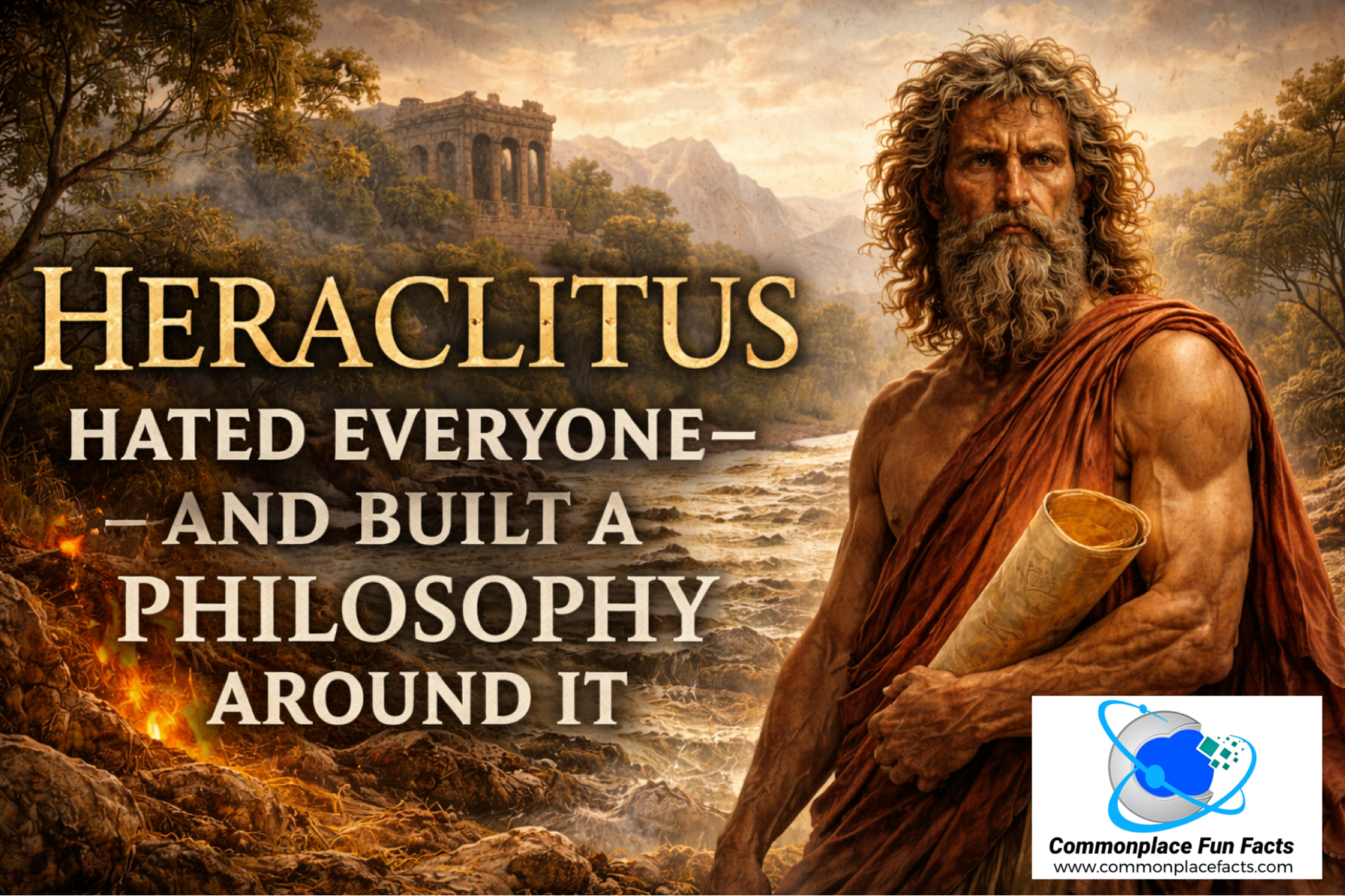

Most ancient philosophers tried, at least in theory, to be helpful. They explained the world, offered advice on how to live in it, and often founded schools so other people could learn their ideas without having to decode them like ransom notes.
Heraclitus did none of that.
He believed reality was in constant change, that an underlying order governed everything, and that most people were spectacularly bad at noticing either fact. He wrote his ideas in dense, cryptic fragments that seemed designed less to educate the reader than to test whether the reader deserved to understand them in the first place. When confusion followed, Heraclitus did not revise. He nodded, having apparently expected this outcome.
This is the story of a philosopher who distrusted clarity, avoided people, antagonized his intellectual peers, and became immortal anyway—largely through quotations that still manage to be simultaneously famous and unclear. Heraclitus would have hated that. Which makes it feel appropriate.
Contents
Meet Heraclitus: Philosophy’s First Problem Child
Heraclitus is one of those historical figures who somehow manages to feel both essential and personally hostile.

He was a Greek philosopher from Ephesus (an Ionian city on the western coast of what is now Turkey), living roughly around 535–475 BC. That puts him in the pre-Socratic era, when philosophers were still doing what philosophers love most: inventing big theories about reality while having absolutely no agreed-upon standards for how to explain them to normal humans.
Heraclitus did not respond to that problem by becoming clearer. He responded by becoming Heraclitus.
Almost everything we “have” from him survives only in fragments—short quotes and paraphrases preserved by later writers who either admired him, hated him, or admired him in a deeply irritated way. We do not possess his original book, which is sometimes described as a single work (often called On Nature) that he supposedly deposited in the temple of Artemis at Ephesus. Whether that happened exactly as later stories tell it is hard to prove. The vibe is unmistakable: Heraclitus was not the sort of man who hands you a neatly labeled binder.
In other words, if you’ve ever encountered a thinker whose entire reputation can be summarized as “important, influential, and impossible,” you are already in the Heraclitus neighborhood. Please keep your arms inside the vehicle.
“The Obscure One”: A Nickname Earned, Not Given
Ancient readers did not merely find Heraclitus challenging. They found him so stubbornly difficult that he picked up a nickname: “the Obscure One.”
This is not the same thing as “misunderstood genius.” Plato may have described Diogenes as “Socrates gone mad,” but the title “The Obscure One” isn’t even a half-respectful label. It is what happens when your writing style makes people feel like you are deliberately hiding the meaning in a locked cabinet and then swallowing the key.
Heraclitus wrote in short, aphoristic bursts—dense little sentences that look like they should be profound, and very often are, but also feel like they were designed to punish the reader for expecting a normal explanation. His fragments tend to operate like philosophical fortune cookies, except the fortune cookie actively resents you for opening it.
Consider, for example, these snippets of wisdom:
- “The way up and the way down are one and the same.”
- “Much learning does not teach understanding.”
- “Those who hear without understanding are like deaf people.”
- “Character is destiny.”
- “The thunderbolt steers all things.”
- “We step and do not step into the same rivers; we are and are not.”
- “Nature loves to hide.”
There is a particular kind of genius involved in writing something that has been quoted for 2,500 years while still making people argue about what you meant.
To be fair, part of the issue is that we are reading scraps. We are not seeing the full argument, the sequence, the context, the connective tissue. Still, even the scraps show his personality. Heraclitus does not sound like someone who wanted to be broadly accessible. He sounds like someone who believed most people were not qualified to understand reality, and he was not going to lower the bar just because they had feelings.
It helps to understand what he thought he was doing. Heraclitus seems to have believed that truth is hard, hidden, and not something you obtain through casual consensus. In his world, most people sleepwalk through life, mistaking their habits and opinions for actual understanding. That belief can lead a philosopher in two directions:
- Teach patiently and build a school.
- Write like a riddle carved into a stone and then act surprised that people bleed on it.
Heraclitus chose door number two.
Universal Flux, or: You Can’t Step in the Same River
If Heraclitus has a headline idea, it is this: reality is constant change. Everything is in motion. Nothing stays put. Stability is the illusion we cling to because we enjoy waking up with the comforting belief that our coffee mug will still be a coffee mug.

This is often summarized with the famous river image. The general idea is that you cannot step into the same river twice because the water is always flowing and changing. Even if the river looks the same, it is made of different water at every moment. The “same” river is only the name we give to a process.
The irony, which Heraclitus would probably appreciate if he had any interest in being appreciated, is that the river quote itself survives in multiple versions and paraphrases. Scholars debate the exact wording. Some formulations suggest you cannot step into the same river twice. Others suggest you both can and cannot, depending on what you mean by “same.”
That messy survival history is not a problem for Heraclitus’s core point. It is almost an endorsement. The quote about change changes. The river keeps moving. The fragment refuses to sit still. This is either the universe being poetic or the universe trolling us, and the line between those two things is often thinner than we’d like.
Heraclitus’s emphasis on flux was not just a cute observation about rivers. It was metaphysical. The world is not a collection of fixed things; it is a set of processes and transformations. Day becomes night. Winter becomes spring. Life becomes death. People become new versions of themselves. Cities rise and fall. Empires age like milk. Reality is not a museum exhibit; it is a fire.
That last image matters. Heraclitus famously uses fire as a metaphor for the world’s underlying activity—always consuming, always transforming, never static. Fire is not “a thing” in the same way a rock is a thing. Fire is an event. It exists by changing other things.
Which is a wonderfully unsettling thought when you remember that he is not talking about campfires. He is talking about everything.
Logos: The Cosmic Rule Everyone Ignores
Heraclitus is sometimes presented as the philosopher of chaos because he leans so hard into constant change. That is only half the story. He also believed there is an underlying order to the turbulence—a rational structure behind the apparent mess. This is where his concept of logos comes in.

Logos is a slippery word. Depending on context, it can mean something like “word,” “account,” “reason,” or “principle.” In Heraclitus, it is often treated as the rational pattern that governs the world: the rulebook reality is following even when we are not reading it.
He did not think the world is random. He thought the world is structured, but in a way most people fail to notice because they are busy arguing about their personal opinions like those opinions are the center of the cosmos.
This is one of Heraclitus’s most consistent themes: the universe has a logic to it, and humans are spectacularly bad at paying attention. The logos is common, shared, public—available to everyone. That does not mean everyone grasps it. In fact, Heraclitus seems convinced that most people live as if they have private understandings disconnected from the larger pattern.
He is not saying, “Truth is subjective.” He is saying almost the opposite: there is a truth built into reality itself, and the tragedy is that people keep missing it while feeling extremely confident that they have nailed it.
That dynamic is the engine of his tone. Heraclitus does not sound like a man offering gentle suggestions. He sounds like a man reporting on a world where the instructions are posted on the wall in large letters and everyone insists they have never seen them.
Heraclitus’s universe is ordered, but it is ordered through tension and opposition. Day and night. Hot and cold. Life and death. Stability and change. He treats opposites not as embarrassing contradictions but as the very mechanism by which reality functions. The world hangs together through strife the way a lyre produces music through taut strings. Harmony is not the absence of conflict; it is conflict held in balance.
Which is a disturbingly mature idea for someone who otherwise seems temperamentally committed to being a walking argument.
So far, we have Heraclitus in his natural habitat: declaring that everything changes, insisting that there is a rational pattern behind the change, and sounding mildly offended that anyone would require further explanation. Unfortunately for all of us, he does not become more agreeable from here.
He Hated People. Like, Institutionally.
It is tempting to think that Heraclitus was merely impatient or socially awkward. This would be charitable. Ancient sources paint a picture of something closer to full-spectrum misanthropy, philosophically justified.
Heraclitus did not trust the judgment of crowds. He did not trust political leaders. He did not trust poets, whom other Greeks treated as near-sacred conveyors of wisdom. He dismissed popular opinion as noise generated by people who mistook familiarity for understanding. The majority, in his view, lived as if asleep—awake enough to function, but not awake enough to grasp how the world actually worked.
This disdain was not subtle. Heraclitus reportedly mocked Homer—yes, that Homer—and suggested he deserved to be beaten with a stick and expelled from public contests. When one of your intellectual hot takes is “the foundational poet of our civilization should be physically removed,” you are not aiming for consensus.
Unlike later philosophers who gathered students and founded schools, Heraclitus appears to have opted out of civic life almost entirely. Some accounts say he deliberately withdrew from politics in Ephesus, despite being eligible for high office. Others go further, describing him as retreating from public life altogether and choosing solitude over society.
Whether this withdrawal was principled resistance or aggravated sulking depends on your generosity. From Heraclitus’s perspective, public life was run by people who did not understand the logos, and participating in that system would amount to endorsing collective confusion.
There is also the lingering impression that he enjoyed his isolation. Heraclitus does not come across as a philosopher yearning to be misunderstood. He comes across as someone who found misunderstanding predictable.
If he believed most people were incapable of grasping reality, then retreating from them was not bitterness. It was consistency.
The Death of Heraclitus: An Ending That Feels Personal
The ancient world, which often struggled to resist narrative irony, preserved a death for Heraclitus that feels almost too appropriate.

According to later accounts, Heraclitus developed dropsy, a condition involving severe fluid retention—what we would now recognize as edema, often related to organ failure. The story that follows is strange enough that scholars debate its accuracy, but not strange enough for ancient biographers to reject it.
Rather than seeking ordinary treatment, Heraclitus allegedly attempted to cure himself through symbolic reasoning. If his body was filled with excess moisture, then it needed to be dried out. He reportedly asked doctors riddling questions instead of accepting their advice, then took matters into his own hands.
The solution he devised was to coat himself in dung and lie in the sun, apparently believing this would draw out the excess moisture. Accounts vary on the exact details. Some versions claim he became trapped beneath the dung as it hardened. Others suggest animals attacked him. Still others imply he simply died during the process, unrescued and unrepentant.
Much like the case of Pythagoras, who is said to have died because of his extreme phobia of beans, it doesn’t really matter whether every detail is true. Ancient writers agreed on the theme: Heraclitus died as he lived—pursuing an abstract, metaphor-driven solution to a physical problem, distrustful of conventional wisdom, and entirely unwilling to explain himself in plain terms.
It is difficult not to see this ending as antiquity’s way of editorializing. The philosopher who insisted that most people misunderstood reality, who spoke in riddles, and who rejected ordinary explanations, was remembered as someone whose final act was a self-designed cure no one else thought was a good idea.
Even if the story is exaggerated, it stuck because it felt right.
Posterity’s Revenge: Everyone Quotes Him, No One Explains Him
Heraclitus did not fade quietly into obscurity. Instead, he became the kind of thinker everyone felt obligated to reference, often without committing to what he actually meant.
Later philosophers treated him with a mixture of admiration and irritation. He was impossible to ignore because his ideas were foundational, yet impossible to pin down because he refused to cooperate. Plato treated him cautiously. Aristotle criticized his obscurity while borrowing from his insights. The Stoics embraced his emphasis on order and fire, folding his ideas into a more systematic worldview.
And then there is modern reception, which may be the most ironic development of all.
Heraclitus believed most people failed to understand the underlying structure of reality. Two and a half millennia later, his work is most commonly encountered as inspirational snippets: the river quote, the change quote, the vaguely reassuring reminder that nothing stays the same. These lines circulate without context, stripped of their confrontational edge, repurposed to decorate corporate seminars and motivational posters.
The philosopher who openly despised superficial understanding has been reduced to a slogan factory.
This is not entirely fair to him, but it is extremely on-brand for history.
Why Heraclitus Still Annoys Us (and Why That’s Useful)
Heraclitus remains uncomfortable because he refuses to give us what we want from a thinker.
He does not offer clarity on demand. He does not flatter the reader. He does not pretend that confusion is a temporary glitch that will vanish with the right bullet points. He insists that reality is difficult, structured through tension, and misunderstood by confident people who believe they have already figured things out.
He also refuses optimism. Change is constant, not progress. Order exists, but it is not gentle. Harmony emerges from opposition, not agreement. Stability is something we impose with language while the world carries on doing what it was always going to do.
In a culture that rewards certainty, instant explanations, and performative clarity, Heraclitus remains deeply inconvenient. He asks us to sit with ambiguity, to accept that contradiction is not failure, and to recognize that understanding is harder than having opinions.
That stance is not comforting. It is clarifying.
Heraclitus did not leave us a system. He left us a provocation. Reality changes. Order exists. Most people miss it. The task is not to simplify the world until it fits our preferences, but to sharpen our perception until we can see what is already there.
He would probably be annoyed that anyone found that inspiring.
You may also enjoy…

Jeremy Bentham: The Philosopher Who Taught Everyone How to Face Death By Having Everyone Look at His Dead Face
Jeremy Bentham: Finding Happiness in Life and Death English philosopher Jeremy Bentham (1748-1832) was the founder of utilitarianism. The philosophy espouses the idea that each one should do the things that will result in the most total happiness. Considering that was his belief, one has to question his insistence about how this would play out…

Aeschylus and the Falling Tortoise: The Most Unusual Death in Ancient Greece
Discover the unbelievable true story of Aeschylus, the father of Greek tragedy, who was famously killed when an eagle dropped a tortoise on his head. Explore the prophecy he tried to escape, the ancient sources behind the tale, and the fascinating history surrounding his remarkably strange death.

The Tragic Tale of Pythagoras and the Deadly Beans
How Did Beans Cause the Death of Pythagoras Pythagoras (c. 570 – c. 495 B.C.) is most-commonly remembered for the geometric formula that bears his name. What is less-well remembered about him is the way beans contributed to his untimely death. During his life, Pathagoras developed a cult following. Known more for being a philospher…






Leave a Reply