

It is, of course, a work of fiction.
Except—like so many things that seem entirely fictional—it turns out reality got there first, albeit with fewer superheroes and considerably more concern about the weather.
There are moments in military history when one has to stop, stare into the middle distance, and appreciate the sheer confidence of people who looked at the known laws of physics and said, “Yes, but what if we made it much larger and then hung airplanes inside it?” The USS Akron was one of those moments.
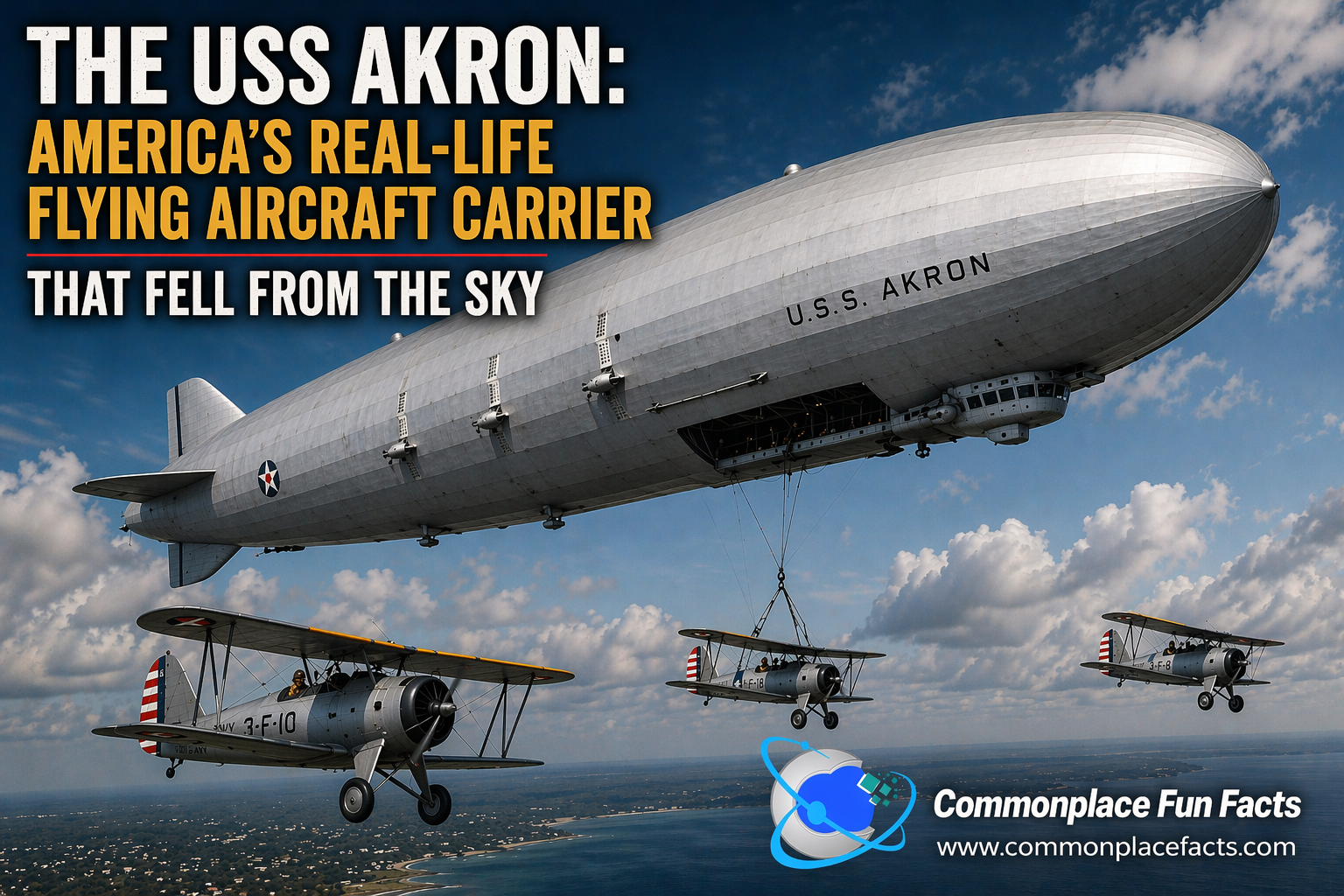
This was not a comic book. This was not an abandoned sketch from a rejected Jules Verne sequel. This was an actual U.S. Navy warship: a giant rigid airship, nearly 800 feet long, filled with helium, armed with scouting planes, and designed to serve as an airborne aircraft carrier. If that sentence sounds as though several nouns were not meant to be in the same paragraph, that is only because reality occasionally likes to show off.
The USS Akron represented one of the boldest, strangest, and most ambitious experiments in American military history. It was the product of a brief period when lighter-than-air travel still seemed as though it might become the future of long-range naval warfare. It was brilliant. It was complicated. It was fragile. It was, in a sense, a technological marvel built on the assumption that the weather might kindly mind its own business.
The weather, as history records, declined the invitation.
Contents
The Basic Idea Was Somehow Even Wilder Than It Sounds
The USS Akron was a rigid airship commissioned by the United States Navy in 1931. Built by the Goodyear-Zeppelin Corporation in Akron, Ohio, it was one of the largest flying machines ever created. At approximately 785 feet in length, it was longer than many ocean-going ships and only slightly shorter than the Titanic. It held around 6.5 million cubic feet of helium and looked less like an aircraft than like an ocean liner that had been given career advice by a science fiction magazine.

Unlike ordinary blimps, which rely on internal gas pressure to keep their shape, rigid airships had an internal metal framework. Think of them as giant skeletal whales of the sky, wrapped in fabric, full of gas cells, and propelled by engines. The USS Akron was not a casual Sunday balloon ride with a basket and a bottle of champagne. It was a fully engineered military machine with a control car, internal passageways, crew compartments, engines, and even a hangar for airplanes.
Yes, airplanes. Inside the blimp.
The Navy’s idea was actually logical—at least by the standards of an era still sorting out what aviation could become. The biggest problem facing fleets in the early twentieth century was seeing far enough. Warships could only spot so much from the horizon. Aircraft could scout farther, but their range and endurance were limited. A giant airship, on the other hand, could stay aloft for long periods and roam vast distances over the ocean. Give that airship its own small aircraft, and suddenly one had an aerial scouting platform with eyes far beyond the horizon.
Unlike modern aircraft carriers, which are essentially floating launchpads for projecting overwhelming force, the USS Akron had a far less explosive job description. The airplanes it carried were not intended to rain destruction on enemy fleets—largely because aircraft of the early 1930s were not yet particularly good at doing that on a large scale. Instead, their primary value lay in seeing things before anyone else did. The Akron was designed to extend the Navy’s eyes, not its fists. Its Sparrowhawk fighters functioned as long-range scouts, fanning out from the airship to locate ships, map positions, and report back. In an era before radar and satellite surveillance, simply knowing where the enemy was could make the difference between victory and an unpleasant surprise. The Akron’s mission, therefore, was less about striking first and more about spotting first—which, in naval warfare, is often the more important trick.
That was the theory, anyway. In theory, a great many things work beautifully. In theory, a cat can be reasoned with.
A Flying Aircraft Carrier, Because the Navy Was Feeling Adventurous
The feature that made the Akron famous was its role as a flying aircraft carrier. That’s not too much more far-fetched than the Navy’s plan to build an aircraft carrier out of ice, but it comes close.

It carried small biplane fighters known as Curtiss F9C-2 Sparrowhawks. These aircraft were not simply lashed to the outside in hope and prayer. They were launched and recovered in midair using a trapeze system.
That is not a typo. The Navy built a giant airship with a trapeze inside it and used it to catch airplanes in flight.
The Sparrowhawk would approach from below, align itself carefully, and attach to a hook on the trapeze. Once secured, it would be hoisted up into the belly of the airship and stored in an internal hangar. To launch, the process was reversed. The airplane was lowered out into the open air, released, and sent on its way to scout the surrounding area.
One hesitates to say this too enthusiastically because of how the story ends, but it was objectively cool.
It was also surprisingly effective. This was not merely a stunt to impress congressmen and make newspaper illustrators very happy. The system worked. The aircraft could be launched and recovered, and the Akron really did function as an airborne mothership. In an age before radar had matured and before aircraft carriers had fully proven what they would become in World War II, the idea made genuine strategic sense.
If the Navy could send a giant, long-endurance airship far ahead of the fleet and allow it to dispatch scouting planes in all directions, then it might locate enemy forces long before being seen itself. In naval warfare, that sort of thing matters. Surprise has a way of improving one’s day.

Why the Navy Thought This Was a Good Plan
To modern eyes, the USS Akron can look like a technological cul-de-sac: fascinating, ornate, and clearly not the future. That is easy to say in hindsight, with the benefit of radar, jet aviation, satellites, and a long list of historical disasters helpfully arranged behind us. In the late 1920s and early 1930s, however, the future of military aviation was still very much up for debate.
Aircraft carriers existed, but they were still evolving. Long-range patrol aircraft were improving, but they had limits. Airships offered endurance that fixed-wing aircraft of the period could not match. They could remain aloft for long stretches, travel great distances, and theoretically provide a mobile observation post over the sea.
The Navy also had reason to believe it could do airships more safely than Europe had managed. The Akron used helium instead of hydrogen, which greatly reduced the risk of catastrophic fire. This is one of the most important points about the ship. The USS Akron was not a flying bomb waiting for a spark. It was not another Hindenburg. Its danger lay less in flammability and more in the grim fact that very large objects full of lifting gas still have to obey weather, gravity, and structural limits.
The designers were not fools. They were trying to solve real engineering problems. The ship incorporated a robust internal framework and reflected lessons learned from earlier airship failures. It was, in many respects, the product of serious, thoughtful design. This was not pseudoscience with a propeller attached. It was advanced technology of its day—just technology operating closer to the edge than one might prefer.
Life Aboard a Giant Airborne Whale
Serving aboard the USS Akron must have been a surreal experience. Imagine reporting for duty on what was technically a ship, except your ship floated in the sky, housed airplanes in its interior, and depended on a volume of helium roughly equivalent to several million cubic feet of “please do not let anything go terribly wrong.”

The ship had a crew of sailors and officers, passageways within the hull, sleeping areas, operating spaces, and engine rooms. Unlike the romantic image of a few intrepid aeronauts waving scarves in a gondola, rigid airships were complicated industrial organisms. They required large crews and constant coordination. Handling one in the air was demanding. Handling one on the ground often required entire teams. Operating it at sea, in military conditions, while also integrating parasite aircraft, only added to the degree of difficulty.
This was not the sort of vessel where one misplaced wrench caused mild inconvenience. This was the sort of vessel where the sentence “We are experiencing a small problem” could very quickly develop into a situation in which a reporter is yelling, “Oh, the humanity!” into his microphone.
The Trouble With Being Enormous and Full of Optimism
The Akron’s greatest strength was also its greatest weakness. Its size gave it tremendous lift, endurance, and internal capacity. Its size also made it vulnerable to weather in ways that were difficult to overcome. A rigid airship was, in essence, a massive structure moving through an atmosphere that did not feel even slightly obligated to cooperate.
This was especially dangerous over water and in storms. A modern airliner can punch through weather that would have made earlier aviators write their wills in pencil. A rigid airship could not do that. It needed room, caution, and favorable conditions. It could be controlled, but not bullied through the sky by sheer force. When storms introduced violent downdrafts or abrupt shifts in wind, the ship’s size and handling characteristics could become liabilities very quickly.
That vulnerability did not mean the entire concept was absurd. It did, however, call for extraordinary discipline, careful planning, and probably more respect for meteorology than most humans bother to consider.
The Crash That Ended the Dream
On the night of April 3, 1933, the USS Akron encountered severe weather off the coast of New Jersey. The ship flew into storm conditions near the Barnegat Lightship. What followed was not a dramatic inferno but something more mercilessly ordinary: a loss of control in violent weather, a rapid descent, impact with the sea, and destruction.
Investigations concluded that the ship was driven downward by a powerful downdraft during a thunderstorm. Its lower fin struck the water, and the resulting damage led to the airship’s breakup. That distinction matters. The Akron was not undone by a fiery explosion; it was undone by the air and sea combining to remind everyone that nature does not care how innovative one’s procurement program may be.
The loss of life was staggering. Of the 76 people aboard, 73 died. Among them was Rear Admiral William A. Moffett, one of the Navy’s leading advocates of naval aviation. At the time, the USS Akron disaster was the deadliest airship crash in history.
Part of the tragedy involved an almost painfully preventable detail: there were too few life jackets aboard. Survivors who escaped the wreckage faced cold water, darkness, storm conditions, and very little chance of rescue. It is the sort of detail that turns a disaster from tragic to infuriating. One can accept that storms happen. One becomes less philosophical when basic survival equipment has apparently been treated as a decorative suggestion.
Why the USS Akron Still Matters
It is tempting to look at the Akron and dismiss it as a weird blind alley in military history, a giant helium-powered footnote with a trapeze. That would be unfair.
The Akron mattered because it represented a real attempt to solve a difficult strategic problem: how to see farther, stay aloft longer, and extend reconnaissance beyond the limits of conventional aircraft. In that respect, it was not foolish at all. The Navy correctly understood that information wins battles. Finding the enemy first matters. Extending vision matters. Building flexible scouting systems matters.
The ship’s designers and operators were trying to invent a new form of naval reach. They were pursuing endurance, mobility, and distributed observation. Those ideas did not die with the Akron. They merely found more durable homes in other technologies. Radar, long-range patrol planes, aircraft carriers, airborne early warning systems, drones, and satellites all pursued the same broad goal: see more, know more, know it sooner.
In that sense, the USS Akron was less a dead end than an early draft. A very large, very elegant, somewhat doomed early draft.
The Sister Ship and the End of the Era
The Akron had a sister ship, the USS Macon, which also served as a flying aircraft carrier. The Macon likewise demonstrated that the parasite aircraft concept could work. It too was lost, crashing in 1935 off the coast of California. More of its crew survived, but by that point the Navy had seen enough giant rigid airships meet unfortunate ends to begin reconsidering whether the sky really wanted to host naval architecture on this scale.
That effectively ended the Navy’s rigid-airship ambitions. Conventional aircraft carriers were improving rapidly. Naval aviation was coming into its own. Radar would soon transform detection and fleet operations. The giant scouting dirigible, for all its imagination and elegance, was overtaken by technologies that were generally less vulnerable to being swatted by bad weather like an expensive aluminum moth.
The Strange Brilliance of the Whole Thing
There is something deeply charming about the USS Akron, even in tragedy. It belonged to that rare class of historical project that was both visionary and a little bit unhinged. It was the product of serious minds thinking big, reaching beyond conventional assumptions, and producing something that still sounds improbable nearly a century later.

This was not reckless fantasy masquerading as strategy. It was strategy reaching for a solution with the tools available at the time. The solution happened to involve a colossal helium-filled warship carrying tiny biplanes in its stomach and launching them from a trapeze over the ocean, which admittedly makes it difficult to describe with a straight face. Still, the underlying ambition was real. The engineering was real. The operational promise was real. So was the danger.
The USS Akron is a reminder that innovation is often glorious right up until the moment it collides with reality. History is full of ideas that were not stupid, merely premature. Some technologies fail because they never worked. Others fail because they worked just well enough to lure intelligent people into trusting them farther than circumstances allowed.
The Akron belongs firmly in the second category.
Final Approach
So yes, the United States really did build a flying aircraft carrier. It was enormous, sophisticated, and conceptually ahead of its time. It carried fighter planes inside a rigid airship and launched them in flight. It was meant to scout for the fleet across vast reaches of ocean. For a brief moment, it suggested a future in which the sky might host floating naval bases hunting for enemy ships below.
That future did not arrive. Instead, the USS Akron became a monument to both ingenuity and fragility, to the seductive power of big ideas, and to the enduring truth that one should never underestimate weather. The atmosphere is, at heart, an anarchist.
Still, one cannot help admiring the audacity of it all. The Navy wanted eyes in the sky and decided the best answer was to build a giant airborne hangar and stuff it with airplanes. It was magnificent. It was improbable. It was tragically short-lived.
And it remains one of the most fascinating “they actually did that?” moments in military history—which, as categories go, is one of our favorites.
You may also enjoy…

Zeppelin Construction Took a Lot of Guts
Find out the curious link between cow intestines and zeppelin construction in World War I.

Geoffrey Pyke: The Man Who Tried to Win WWII with an Iceberg Aircraft Carrier, Snowmobiles, and a Vacuum Tube
Meet Geoffrey Pyke, the eccentric genius behind WWII’s wildest ideas—including an aircraft carrier made of ice and a plan to launch soldiers through giant pneumatic tubes.

How Did the Hindenburg Disaster Nearly Destroy Marvel Comics?
What was the unlikely connection between the Hindenburg disaster and Marvel Comics? Find out in this amazing tale.






Leave a Reply