
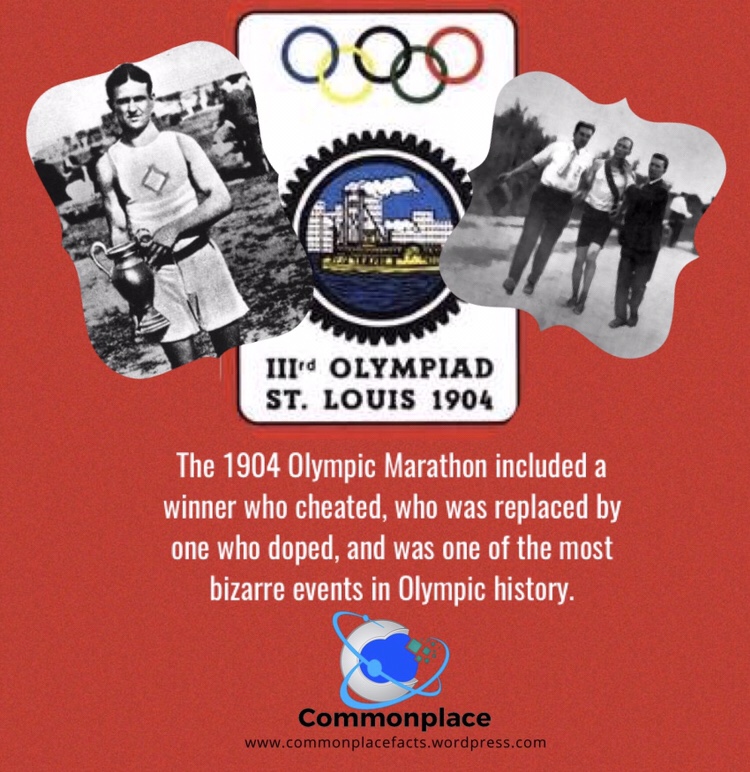

The Olympic Games have seen some strange things, including the embarrassing time when two countries showed up with the same flag. But when it comes to the most bizarre Olympic event, the gold medal has to go to the 1904 Olympic marathon in St. Louis.
Contents
Welcome to St. Louis, Where the 1904 Olympic Marathon Came to Suffer
The third Summer Olympics took place in St. Louis, Missouri, USA. It was the first time the Olympics were held outside Europe, and expectations were running high. A total of 651 athletes from 12 nations participated in 95 different events.
The marathon took place on August 30. It was the last Olympic marathon to be less than 26.2 miles in length. The course was 24.85 miles, and the distance would be changed at the 1908 Games to what eventually became the current standard.
Thirty-Two Started. Fourteen Finished. Everyone Else Had Sensible Priorities.

Thirty-two athletes representing four nations competed, but only 14 managed to finish. The race began in the afternoon, because apparently someone looked at Missouri in August and thought, “Yes, let’s run a marathon in that.” Temperatures during the race reached 33°C, or 92°F, and humidity climbed into the 90s.
The race began and ended in the stadium, but the rest of the course was on dusty country roads. Race officials rode in vehicles ahead of and behind the runners, creating clouds of dust for the athletes to breathe, because why merely dehydrate runners when you can also season their lungs like barbecue?
The only source of water for the competitors was a well near the 11-mile mark. That was it. One water stop. For an Olympic marathon. In August. In Missouri. This was less a sporting event than a federal investigation waiting to happen.
William Garcia of San Francisco nearly lost his life because of the conditions. He was found lying in the road along the marathon course with severe internal injuries caused by breathing the clouds of dust kicked up by the race officials’ cars.
Andarín Carvajal: Marathon Runner, Gambler, Improviser, Questionable Apple Consumer

Andarín Carvajal of Cuba ran the race, but only after arriving at the last minute. His trip was delayed when he lost all his money in New Orleans while playing craps. As one does, apparently, when preparing for Olympic competition.
Carvajal hitchhiked to St. Louis and stopped along the way at an orchard to get something to eat. He was so hungry that he devoured some apples, even though they turned out to be rotten. The resulting food poisoning left him weakened, which is generally considered a disadvantage in marathon running, along with broken legs, bear attacks, and being actively on fire.
Even so, Carvajal managed to cross the finish line in fourth place. He did it while wearing his regular street clothes, which he cut with scissors to make into running gear. It was not exactly cutting-edge sports science, but given the rest of this race, it may have been the most sensible thing that happened all day.
Fred Lorz and the Bold New Strategy of Taking a Car

The first person to cross the finish line was Fred Lorz. He finished with an impressive time of 3 hours and 13 minutes, which was especially impressive considering that much of his race strategy involved not running.
Lorz was declared the winner and was about to have his picture taken with Alice Roosevelt, daughter of President Theodore Roosevelt, when someone pointed out that there might be a slight problem with his performance. Upon investigation, race officials determined that Lorz had dropped out of the race after 9 miles and hitched a ride in a car back toward the stadium.
The car broke down near the 19-mile marker, so Lorz jumped out and completed the rest of the route on foot. This is the sort of thing that sounds less like a marathon victory and more like a man whose Uber canceled.
Lorz was disqualified and given a lifetime ban from further competition. That “lifetime ban” was lifted after one year, proving that even in 1904, the word “lifetime” had some flexibility if everyone agreed not to look too closely. Lorz went on to win the 1905 Boston Marathon.
Thomas Hicks: Olympic Champion, Technically Alive
The man who was ultimately awarded first place was Thomas Hicks. After 15 miles, Hicks was in the lead, but he was exhausted. He tried to drop out, but his trainers would not let him. Instead, they gave him the first of several small doses of strychnine and brandy.

For those keeping score at home, strychnine is a deadly poison commonly used to kill rats. In small doses, however, it stimulates the nervous system and was once believed to be beneficial for athletic performance. This was sports medicine in the same way that falling down stairs is chiropractic care.
Whether because of overexertion, dehydration, or the deadly neurological poison in his system — and really, why choose just one? — Hicks was barely able to complete the race. He was hallucinating and had to be physically helped across the finish line by two of his trainers.
Under modern rules, the performance-enhancing drug and the assistance at the finish line would have disqualified him. At the time, however, this was apparently considered acceptable, because the early Olympics operated with the regulatory confidence of a county fair pie-eating contest.
Hicks won the gold medal and narrowly avoided death thanks to the timely intervention of physicians at the finish line. He lost eight pounds during the race, which is a dramatic result but not one recommended by nutritionists, physicians, or people who enjoy living.
Len Taunyane, Jan Mashiani, and the Dogs Who Apparently Missed the Rulebook

The marathon also included the first two Black Africans to compete in the Olympics. Len Tau, whose real name was Len Taunyane, and Yamasani, whose real name was Jan Mashiani, were both from the Tswana people of the Orange Free State, now part of the Republic of South Africa.
Taunyane finished ninth, despite being chased nearly a mile off course by a pack of dogs. Mashiani finished twelfth. Considering the heat, dust, lack of water, organizational chaos, and surprise canine participation, finishing at all should have earned both men medals, a medical exam, and possibly an apology from the city of St. Louis.
The French Runner Who Wasn’t French Enough on Paper
One person present who was not allowed to run was Albert Corey. Corey came all the way from France but did not have the proper documents with him, so he was not permitted to join the French team.
It was one more odd footnote in an Olympic marathon already stuffed with heatstroke, rotten apples, dust inhalation, hitchhiking, poison, and dogs. In other words, the 1904 marathon was not merely a race. It was a warning label with shoes.
You may also enjoy…

The 1988 Seoul Olympics Dove Fire: The Reason Doves Are No Longer Used in the Opening Ceremony
The Olympics dove fire at the 1988 Seoul games put an end to the tradition of releasing live doves during the opening ceremonies. Learn the details of this BBQ disaster!

Olympic Competition Couldn’t Divide This Eternal Friendship
What happens when two highly-competitive friends go head-to-head in the biggest competition in the world? Something has to give; will it be friendship or Olympic-sized dreams? When the world’s top athletes gathered in Berlin for the 1936 Olympic games, two Japanese pole vaulters proved that friendship was something more precious than a medal. When American…

The Unsolved Mystery of the 1900 Olympics: The Unknown Boy Who Was the Youngest Gold Medal Olympian
The Unknown French Boy, a mysterious figure from the 1900 Olympics, may be the youngest Olympic champion ever. He served as a coxswain for Dutch rowers, leading them to victory before vanishing. Historian Hilary Evans has attempted to uncover his identity but remains frustrated by conflicting clues, keeping the mystery alive.




Leave a Reply