
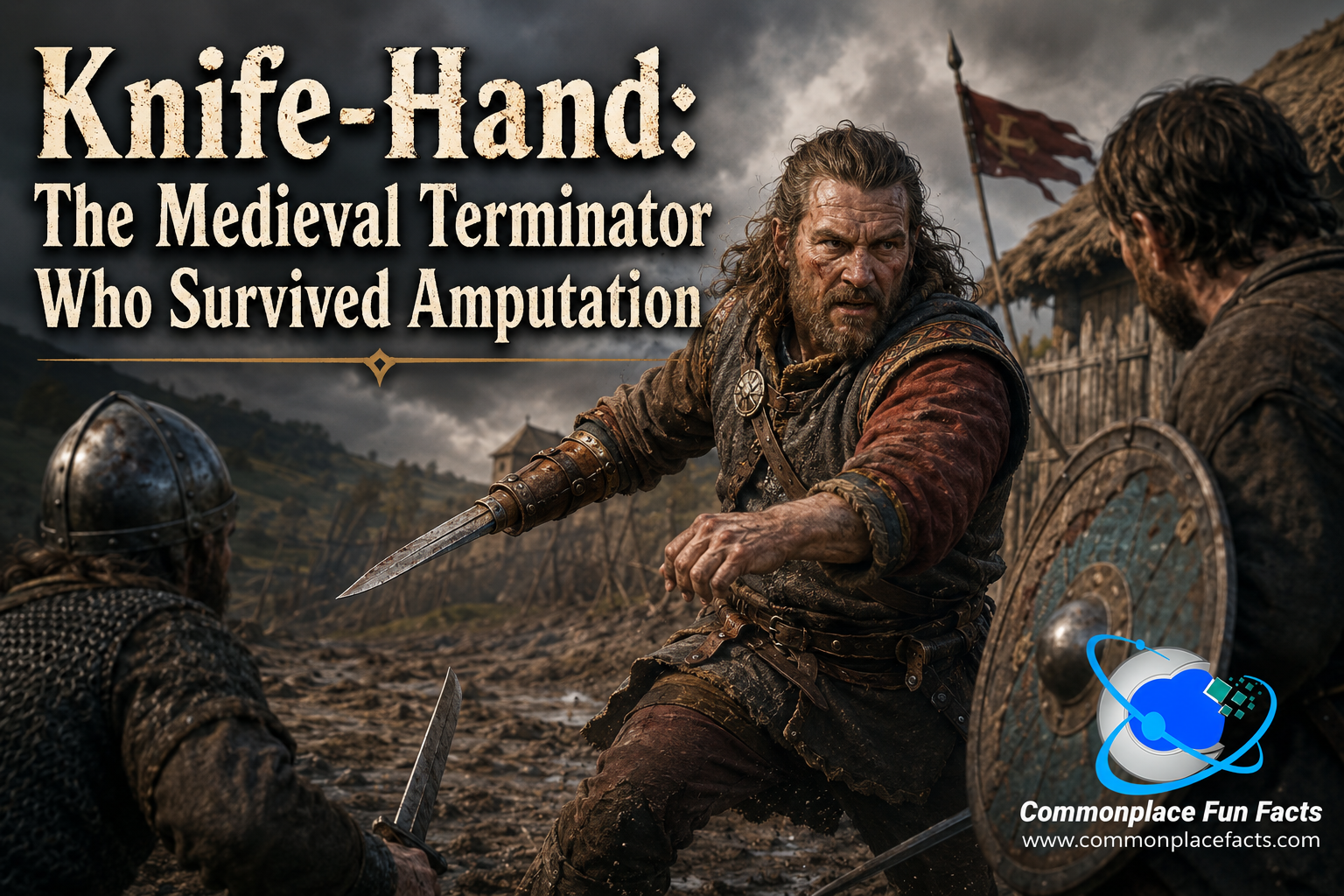

Every so often, archaeology gives us a discovery that sounds less like a peer-reviewed study and more like something created by an unsupervised 10-year-old boy with too much access to action figures, kitchen utensils, and processed sugar.
This is one of those discoveries.
In northern Italy, researchers studied the remains of an early medieval man whose right forearm had been amputated. That alone would be remarkable enough. Surviving an amputation in the early Middle Ages was an achievement that, by itself, might have earned the patient minor celebrity status, assuming anyone was keeping track between outbreaks of everything.
But this man survived. More than that, the evidence suggests he may have used a prosthetic device attached to the stump of his right arm.
And that prosthetic may have involved a knife.
Yes. A knife.
Not a carved wooden hand. Not a dignified hook. Not some tasteful medieval assistive device that whispers, “I have overcome adversity with quiet grace.” A knife. Because apparently, when life took this man’s hand, he responded by becoming the kind of person who made everyone at the village market suddenly remember they had somewhere else to be.
His official archaeological designation is T US 380, which is accurate but has all the warmth of a printer cartridge. For purposes of this article, we will call him Knife-Hand, because history occasionally hands us a gift and it would be rude to pretend otherwise.
Knife-Hand has been described, understandably, as a sort of medieval terminator. That phrase may be a little dramatic, but only a little. After all, we are talking about a man from early medieval Italy who lost part of his arm, survived, and may have gone through life with a blade strapped to the stump as a prosthetic hand. Sometimes the past does not merely whisper. Sometimes it kicks open the door wearing chainmail.
Contents
Meet Knife-Hand, Also Known as T US 380
The man archaeologists call T US 380 was found in a Longobard cemetery at Povegliano Veronese, near Verona in northern Italy. The cemetery dates to the early medieval period, roughly the sixth through eighth centuries A.D. That puts Knife-Hand in the world of the Longobards, also known as the Lombards, a Germanic people who entered Italy in the late sixth century and established a kingdom that lasted for about two centuries.

We do not know Knife-Hand’s real name. We do not know whether he was funny, cranky, respected, feared, kind to animals, bad at small talk, or the sort of man who insisted he could predict the weather because his shoulder ached. Archaeology is generous with bones and stingy with personality details.
What we do know is that he was an adult male, probably between forty and fifty years old when he died. In early medieval terms, that was not exactly ancient, but it was old enough to have seen some things, complained about younger people, and possibly shaken his remaining fist at those darn kids who wouldn’t stay out of his yard.
Knife-Hand was buried among his community. His grave contained several clues that, taken together, suggest a life shaped by serious trauma and even more serious adaptation. His right forearm had been amputated. The bones had healed. A knife was found near the stump. A bronze buckle and possible traces of leather were nearby. His teeth and shoulder showed signs that he may have repeatedly used his body to fasten or operate a device.
That is the basic story: T US 380 lost part of his arm, survived long enough for the bones to heal, and may have used a knife-based prosthetic. It is also the kind of story that makes one wonder why archaeology classes do not begin with this sort of thing instead of pottery fragments, which are important, yes, but rarely make anyone say, “Wait, did you say knife-hand?”
The Longobards: Early Medieval Italy’s Armed Houseguests
To understand Knife-Hand, we need to spend a moment with the Longobards. They entered Italy in 568 A.D., after the collapse of the Western Roman Empire had turned the peninsula into a complicated political rummage sale. Various groups were fighting, ruling, negotiating, migrating, and generally making future historians regret choosing this specialty.
The Longobards established control over much of Italy and built a kingdom that lasted until the eighth century, when Charlemagne and the Franks arrived to reorganize things in the usual Charlemagne fashion: with armies, crowns, and paperwork that would haunt students forever.
Longobard society had a strong warrior culture. Male burials often included weapons, and grave goods could say something about status, identity, and social role. That does not mean every man buried with a weapon was necessarily a professional warrior, just as owning running shoes does not make that person a marathoner. Still, weapons mattered. Identity mattered. Physical ability mattered.
This context matters because Knife-Hand’s injury could have happened in several ways. He may have lost his hand in combat. He may have suffered a severe accident. He may have undergone amputation after infection or injury. He may even have been punished, since physical punishments were not unknown in early medieval law. The past, inconveniently, did not include incident reports with attached photographs and witness statements.
So we should be careful. Knife-Hand may have been a warrior. He may not have been. He may have used the prosthetic for practical daily tasks, self-defense, symbolic reasons, or some combination of the three. What we should not do is immediately turn him into a fully armored medieval terminator stomping across northern Italy while villagers dive behind hay carts.
Tempting? Absolutely. Proven? No.
The Amputation That Did Not Kill Him
The most important feature of Knife-Hand’s skeleton is not the knife. It is the healing.
His right forearm bones, the radius and ulna, had been cut. The amputation was not a random break or damage caused after burial. Researchers found evidence that the bones had been deliberately severed at an angle. More importantly, the bones showed remodeling and callus formation, meaning he lived for a significant period after the injury.

That detail changes everything.
If Knife-Hand had lost part of his arm and died immediately, the story would still be sad and historically interesting. But the healed bone tells us he survived. He lived with the injury. He had to adapt to it. His body had time to respond to the trauma, rebuild around it, and record the aftermath.
In the early medieval world, surviving an amputation was no small achievement. Blood loss could kill. Infection could kill. Shock could kill. A bad wound dressing could kill. A good wound dressing could also kill, because everyone was doing their best in a world that had not yet discovered antibiotics and still had suspiciously high confidence in things whose primary medical trait was that they smelled ghastly.
Knife-Hand’s survival suggests that he received care. Someone likely helped stop the bleeding. Someone may have treated the wound. Someone may have helped him eat, dress, move, recover, and eventually adapt to life with one hand. Unless this man was the most aggressively self-reliant patient in medieval Europe, his survival was not just his own achievement.
It was a community achievement.
That is easy to miss because the knife is waving for attention from the front row. But the healed amputation is the deeper story. Knife-Hand lived in a world that could be violent and harsh, but he also appears to have lived among people who did not simply abandon him after a catastrophic injury.
The Knife, the Buckle, and the Prosthetic Possibility
Now let us return to the part of the story that made everyone sit up straighter.
Knife-Hand’s grave contained an iron knife near the end of his amputated right arm. Nearby, researchers also found a D-shaped bronze buckle and possible traces of leather. His right arm was positioned unusually across his torso, bringing the stump into close relationship with the knife and fastening materials.
That combination led researchers to suggest that the knife may have been attached to the stump with a leather cap, strap, or binding system. In other words, it may have functioned as a prosthetic arm.
This does not mean archaeologists found a fully preserved medieval knife-hand sitting there like a prop from a low-budget action movie. Organic materials such as leather rarely survive in perfect condition. Archaeology often works with fragments, stains, positions, wear patterns, and the kind of clues that require a trained expert to say, “This dirt is suspicious.”
But the evidence is suggestive. The knife was in the right place. The buckle could have helped secure a strap. The possible leather traces fit with a fastening system. The unusual arm position was different from typical male burials where knives were placed along the side of the body. Put together, those details point toward the possibility that Knife-Hand used a blade attached to his amputated forearm.
That is the careful version.
The less careful version is: Medieval Terminator.
Naturally, it’s the less careful version that captures our attention and imagination.
His Teeth May Have Helped Fasten the Device
The strongest evidence that Knife-Hand actually used the prosthetic may come from his mouth, which is not where most of us would expect the knife-hand story to go, but here we are.

Researchers found unusual wear on his right upper second incisor. The tooth was heavily worn and polished in a way that did not match ordinary chewing. It was also different from the corresponding tooth on the other side of his mouth. That suggests he was using the tooth for some repeated non-dietary activity.
The likely explanation is that he used his teeth to tighten or adjust the leather straps that secured the prosthetic device to his arm.
Before judging him, consider how many modern people have used their teeth to open a package, hold a nail, tear a tag, loosen a knot, or perform some other small act of dental foolishness. Knife-Hand was doing the medieval version, except instead of opening a bag of pretzels, he may have been fastening a knife to the stump of his arm.
The tooth wear also appears to have caused problems. The tooth showed signs of damage and infection. That means the adaptation may have helped him function while also creating new health issues. This is often how human solutions work. We fix one problem, create two smaller ones, and call it progress.
Still, the dental evidence is powerful because it suggests habit. Knife-Hand did not merely have a knife placed in his grave as a symbol. His body appears to show repeated use of a device. The tooth wear gives us a glimpse of a daily routine: tightening straps, adjusting the prosthetic, making the device usable, and getting on with life.
His Shoulder Also Had Receipts
Knife-Hand’s shoulder and arm bones also showed signs of altered use. Researchers noted changes in the right shoulder socket and upper arm that may reflect repeated movement connected to wearing or securing the prosthetic.
This matters because bodies remember habits. A skeleton is not a diary, but it does keep notes. Repeated motions, injuries, stress, and adaptation can leave traces in bone. In Knife-Hand’s case, those traces appear to support the idea that he was not simply buried near a knife by coincidence. His body had adapted to a new way of moving.
That is one of the most fascinating things about this discovery. The grave goods say one thing. The teeth say another. The shoulder adds its own little deposition. None of these clues alone gives us the full story, but together they begin to form a picture.
A man lost part of his right arm. He survived. He used his teeth and body to manage an adaptive device. He may have worn a knife as a prosthetic. He lived long enough for his bones to show the consequences.
History may be frustratingly incomplete, but sometimes it knows how to leave a trail.
Was Knife-Hand Really a Medieval Terminator?
Now we arrive at the obvious question: was Knife-Hand really a medieval terminator?
The responsible answer is: no, not literally. He was not a time-traveling machine sent from the future to alter the fate of early medieval Italy. That would have shown up in the archaeological record, probably as unexplained sunglasses and a troubling amount of chrome.

But as a metaphor? The phrase has some appeal. Knife-Hand survived an injury that could easily have killed him. He adapted to disability in a dangerous world. He may have worn a blade attached to his arm. He is, at minimum, one of the more intimidating archaeological case studies to ever make modern readers sit up and mutter, “Excuse me?”
Still, we need to keep the evidence in view. We do not know that he used the knife in combat. We do not know that he was a warrior. We do not know exactly how the prosthetic worked. We do not know whether the knife was primarily practical, defensive, symbolic, or some combination of those things.
For all we know, the knife was merely the only surviving piece of an extensive interchangeable collection of prosthetic attachments: fork, spatula, flyswatter, fishing rod, comb, and whatever else a practical Longobard gentleman needed for daily life and mild public intimidation. We would probably have a very different understanding of him—although he absolutely still would have been covered here at Commonplace Fun Facts—if archaeologists had found him with a prosthetic cat toy attached to his arm.
The medieval terminator label is fun. The human story is better.
Knife-Hand was not merely a dramatic skeleton with excellent branding. He was a person who endured catastrophic bodily change and found a way to continue living. That is more interesting than pretending he spent his afternoons menacing villagers and saying medieval equivalents of “I’ll be back.”
What We Know and What We Should Not Pretend to Know
Stories like this are especially vulnerable to headline inflation. “Medieval man may have used a knife prosthetic” is fascinating. “Ancient cyborg assassin discovered in Italy” is not accurate, though one can understand how the internet might try to get there before breakfast.
Here is what the evidence supports:
- T US 380 was an adult male buried in a Longobard cemetery near Verona, Italy.
- His right forearm had been amputated.
- The bones showed healing, meaning he survived the amputation.
- An iron knife was found near the amputated limb.
- A bronze buckle and possible leather traces suggest a fastening system.
- His tooth wear suggests he may have used his teeth to tighten straps.
- His shoulder and arm bones suggest altered movement and adaptation.
- Researchers proposed that the knife may have functioned as part of a prosthetic device.
Here is what we do not know:
- Knife-Hand’s real name.
- Exactly how he lost his hand.
- Whether the amputation resulted from battle, accident, infection, surgery, or punishment.
- Whether he used the knife in combat.
- Exactly what the prosthetic looked like.
- How comfortable, useful, or symbolic the device may have been.
- Whether he suffered any injuries while adjusting to life with a sharp object attached to the end of his arm. One shudders to imagine the learning curve, especially the first few times nature called and he had to answer with a knife-hand.
That distinction matters. Good history requires a delicate balance. Too much caution and the story becomes unreadable sludge: “osteological indicators suggest adaptive post-traumatic behavior involving metallic grave goods.” Too little caution and suddenly Knife-Hand has a movie franchise, a tragic backstory, and a rival named Axe-Foot.
The evidence is already extraordinary. We do not need to improve it by making things up.
The Real Miracle Was Survival
As entertaining as the knife-hand idea is, the most important part of the story is not the blade. It is the survival.
Knife-Hand lived in a world without modern surgery, antibiotics, sterile operating rooms, or cheerful physical therapists with laminated exercise sheets. Losing part of an arm could have been fatal in several different ways, most of them unpleasant. The fact that he survived long enough for the bones to heal is remarkable.
Even more remarkable is the evidence that he adapted. He may have used a prosthetic. He may have learned to fasten it with his teeth. His shoulder and arm changed in response to repeated movement. His body tells the story of a man who did not merely survive an injury and then vanish into helplessness. He kept going.
That almost certainly required help.
Someone cared for him after the injury. Someone may have helped treat the wound. Someone may have helped him during recovery. Someone may have made, repaired, adjusted, or improved the prosthetic device. Someone buried him in a way that preserved the evidence of that altered life.
This is the part of the story that pushes past the gimmick. Knife-Hand is memorable because of the knife. He is important because he shows us something about disability, care, and human resilience in the early medieval world.
People in the past were not merely plague statistics with hats. They were problem-solvers. They improvised. They loved, helped, endured, complained, adapted, and occasionally strapped knives to themselves because the human species has always been a complicated little project.
Ancient Prosthetics Were About Life, Not Just Appearance
Knife-Hand also fits into a broader history of ancient and medieval prosthetics. Human beings have been trying to replace, support, strengthen, and compensate for damaged bodies for thousands of years. Some prosthetics were practical. Some were symbolic. Some restored movement. Some restored appearance. Some probably did a little of everything, while also pinching terribly.
Ancient Egypt produced some famous early prosthetic examples, including artificial toes that may have helped people walk and wear sandals. Other cultures developed braces, artificial limbs, replacement devices, and adaptive tools. The materials varied. The comfort level probably varied even more.
Knife-Hand wasn’t quite Götz von Berlichingen, the Iron Hand, who lost a hand and came back with articulated metal hardware that made him look like medieval Europe’s least cooperative cyborg. Nor was he Tycho Brahe, who lost part of his nose in a duel over mathematics and solved the problem with a brass replacement. But he fits comfortably beside them: a man whose body was permanently altered, whose solution was partly practical and partly unforgettable, and whose legacy reminds us that history has always had a soft spot for people who looked at serious injury and said, “Fine. We’ll accessorize.”
That makes the prosthetic less of a curiosity and more of a biography written in metal, leather, bone, and enamel.
It also reminds us that adaptation is rarely tidy. If Knife-Hand used a knife prosthetic, it may have helped him work, defend himself, or maintain social identity. It may also have been awkward, uncomfortable, dangerous, and hard on his teeth. Human solutions often arrive with side effects. We invented chairs and then back pain. We invented cars and then traffic. Knife-Hand may have gained a useful prosthetic and lost a perfectly good incisor in the bargain.
Knife-Hand Gets the Headline. The Community Gets the Credit.
It is easy to remember this man only as Knife-Hand, the medieval terminator of northern Italy. That is the hook, and frankly, it is an excellent hook. If archaeology insists on giving us a man who may have worn a knife as a prosthetic limb, we are allowed to notice.
But the better story is not just about the blade. It is about survival after trauma. It is about disability in a world that demanded physical labor. It is about care in a society we too often imagine as nothing but violence, mud, and poor dental outcomes.
Knife-Hand’s bones show healing. His teeth show adaptation. His shoulder shows repeated movement. His grave shows that his community buried him with objects connected to the life he lived after his injury.
That is not merely strange. It is moving.
The knife gets our attention because it is dramatic. The healed bone holds our attention because it reveals survival. The prosthetic possibility fascinates us because it shows ingenuity. The community care matters because it reminds us that even in a harsh world, people helped one another keep going.
So yes, call him Knife-Hand. Call him the Medieval Terminator if you must. History has certainly earned the nickname in this case.
But remember that behind the nickname was T US 380: a real man who suffered a devastating injury, survived it, adapted to it, and left behind one of the most unforgettable archaeological stories of the early Middle Ages.
The knife gets the headline.
The survival gets the last word.
You may also enjoy…

Götz von Berlichingen of the Iron Hand: How a One-Handed Knight Became a Legend
Meet Götz von Berlichingen, the Iron Hand—one-armed knight, professional feud enthusiast, literary icon, and medieval problem for authority.

Horrendous Fraud or Major Dentistry Breakthrough? The Curious Case of the Gold-Toothed Boy
When Dr. Jakob Horst heard the reports of the 7-year-old boy with the gold tooth, he wasted no time getting there to investigate. The year was 1593. In the village of Weigelsdorf (today Ostrowiec), a community in Silesia, at the southwestern border of today’s Poland, a boy by the name of Christoph Müller attracted the attention of people…

Was Tycho a Psycho? Weird Facts About Tycho Brahe, One of History’s Greatest Astronomers
Tycho Brahe: Eccentric Genius and a Bit Bonkers Tycho Brahe (1546-1601) was one of the greatest astronomers to ever live. He was also probably at least a little bit off his gourd if history is to judge. The Danish astronomer who brought a new level of exactitude to astronomical observations and applied that specificity to…





Leave a Reply