

There are many moments in life when a person pauses, reflects on recent events, and thinks, “Well, that was unfortunate.”
The bureaucratic world of healthcare and insurance has a different approach. It pauses, reflects on recent events, and thinks, “That was unfortunate. Let’s assign it a number so future statisticians can determine whether it was turtle-related.”
That is how we end up with the International Classification of Diseases, Tenth Revision, Clinical Modification — known to its friends, enemies, and exhausted billing departments as ICD-10-CM. It is a massive system used to classify diagnoses, injuries, symptoms, causes, complications, and the many creative ways human beings interact poorly with gravity, reptiles, machinery, relatives, and employment.
We have previously looked at some of these funny medical codes, including such masterpieces as being bitten by a duck, walking into a lamppost, suffering an injury at an opera house, and experiencing the unforgettable paperwork category of “burn due to water-skis on fire.” See “The Wackiest Medical Codes For The Strangest Conditions” for an introduction to what happens when healthcare meets red tape.
But the more you look at ICD-10-CM, the more you realize the funny part is not merely that the system contains bizarre codes. The funny part is that it has to. Somewhere, somehow, the full range of human behavior had to be translated into tidy little combinations of letters and numbers so that a doctor, hospital, insurer, researcher, or government agency could say, “Ah yes, the turtle incident. We have a place for that.”
This is not simply a list of oddities. It is a filing cabinet for civilization’s bad decisions.
Contents
A Brief Refresher for Those Who Do Not Spend Their Evenings Reading Medical Coding Manuals, Which Is Probably Healthy
ICD-10-CM is the system used in the United States to classify medical diagnoses. It is based on the broader international ICD system, but the “CM” part stands for “Clinical Modification,” because even disease classification needed an American edition. Probably with more cup holders.
These medical codes are used for medical records, billing, research, public health tracking, and the general administrative need to convert real human suffering into something that fits inside a database field. Medicine treats the wound. Coding explains to the computer why the wound happened, where it happened, whether it has happened before, and whether the patient has learned anything from the experience. The answer to that last part is often implied.
Some ICD-10-CM codes describe diseases. Some describe symptoms. Some describe injuries. Some describe the external cause of an injury. And some describe circumstances so specific that they raise immediate follow-up questions that medical billing personnel are wisely not paid enough to ask.
Which brings us, naturally, to turtles.
The Animal Kingdom Has Entered the Chart
Human beings like to think of ourselves as the dominant species. ICD-10-CM takes a more balanced view. It recognizes that the animal kingdom has been filing counterclaims for some time.

There are codes for being bitten by various animals, struck by various animals, crushed by various animals, and otherwise involved in disagreeable incidents with creatures who probably did not consent to being part of the medical record.
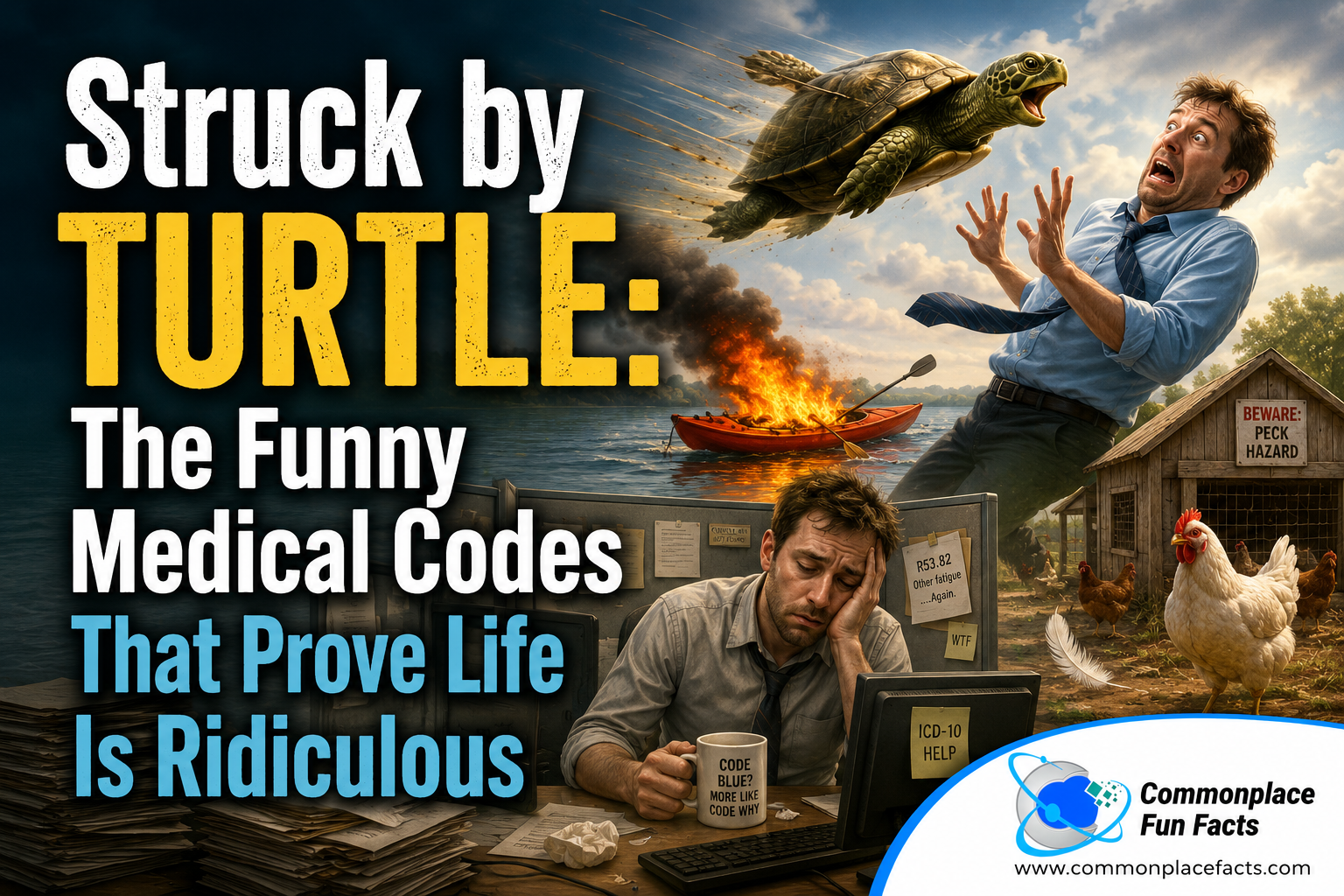
Consider W59.22XA — Struck by turtle, initial encounter.
This is a real code. It does not say “bitten by turtle,” though that is also available for the person who learns too late that slow does not mean harmless. This one says struck by turtle. That word choice is doing magnificent work.
A turtle is not, by reputation, an ambush predator. It is not known for sudden offense. No one has ever watched a nature documentary and whispered, “Look out. He’s winding up.” Yet somewhere in the coding universe, there is room for the possibility that a turtle can become a projectile, a bludgeon, or at least a participant in a regrettable meeting between shell and skull.
And because medical coding understands that life is rarely finished humiliating us the first time, there are separate designations for an initial encounter, a subsequent encounter, and a sequela. In ordinary language, that means:
- the turtle hit you;
- you are still dealing with the turtle-related consequences;
- the turtle incident has left a lasting effect.
Somewhere out there is a patient whose medical history can be summarized as, “It all changed after the turtle.”
There are also codes for being bitten by a crocodile, crushed by a crocodile, and crushed by other nonvenomous reptiles. That last one deserves a moment of silence. Venomous reptiles are alarming. Nonvenomous reptiles seem like they should be the compromise option. And yet ICD-10-CM knows better. It understands that even without venom, a reptile can still ruin your afternoon through the ancient technique of being extremely heavy.
This is the genius of the system. It does not judge. It merely records. You show up with a reptile-related injury, and ICD-10-CM does not say, “How did this happen?” It says, “Initial or subsequent?”
Watercraft: Because Fire Was Apparently Not Dramatic Enough on Land
The great thing about boats is that they are surrounded by water, which one might naïvely assume would reduce the fire risk. ICD-10-CM, however, is not naïve. ICD-10-CM has seen things.
There is, famously, V91.07XA — Burn due to water-skis on fire, initial encounter. This code has haunted medical trivia pages for years, and for good reason. It combines two activities that should not overlap: water-skiing and combustion.
Water-skis are meant to skim across lakes, not reenact the Book of Revelation. A person injured by flaming water-skis has not merely suffered an accident. He has participated in a physics demonstration that got out of hand.
But the system does not stop there. Oh no. It also makes room for V91.05XA — Burn due to canoe or kayak on fire, initial encounter.
This may be even better. A canoe is already a floating argument with balance. A kayak is what happens when someone looks at a boat and says, “Can we make this smaller, wetter, and more dependent on core strength?” Adding fire to either vessel feels less like an accident and more like a rejected Olympic event.
“Burn due to canoe or kayak on fire” suggests a story with too many variables. Was there a campfire involved? A lantern? A poorly secured grill? A dramatic escape? A youth pastor? The code does not say. It simply stands there, clipboard in hand, prepared to receive the facts.
Then there is V91.06XA — Burn due to nonpowered inflatable craft on fire, initial encounter.
“Inflatable” and “on fire” are not words one wants to see in the same sentence. Inflatable craft already operate under a delicate social contract with the universe: please remain full of air until we get back to shore. Once flames are introduced, that contract is being renegotiated under pressure.
These codes are funny, yes. But they are also oddly reassuring. Someone, somewhere, anticipated the possibility that your flaming kayak adventure would need to be recorded with dignity. Not much dignity, obviously. But some.
The Place of Occurrence Codes: Crime Scene Investigation, But With More Chicken Coops
ICD-10-CM does not merely want to know what happened. It wants to know where it happened. This is reasonable. An injury at a factory may suggest one kind of risk. An injury at a school may suggest another. An injury at a circus raises different questions, most of which begin with, “Were there clowns?”
The system includes place-of-occurrence codes, which identify the location where the external cause took place. These can be ordinary: home, school, street, office, farm. But because life refuses to remain ordinary, the system gets more specific.
For example: Y92.72 — Chicken coop as the place of occurrence of the external cause.
This is not a code for being injured by a chicken. That would be a different question, possibly involving pride, pecking, and whether the rooster had priors. This code merely tells us that the chicken coop was the scene of the incident.
That may sound excessive until you think about it for more than three seconds. Chicken coops contain animals, feed, wire, tools, droppings, uneven ground, heat lamps, eggs, and humans who are often wearing footwear selected more for optimism than traction. Frankly, the surprise is not that “chicken coop” has a code. The surprise is that it does not have its own federal task force.
There are also codes for barns and farm fields. Which means ICD-10-CM can tell a remarkably complete rural tragedy:
- what injured you;
- whether it had feathers, hooves, claws, or a shell;
- where it happened;
- whether this is your first time explaining it to a medical professional.
At that point, the only thing missing is a code for “patient refuses to make eye contact while describing incident.” Give it time.
When Work Becomes a Medical Factor, Which Will Shock Absolutely No One Who Has Had a Job
Not all noteworthy medical codes involve animals, fire, or farm outbuildings. Some involve the ordinary daily experience of being employed, which is less visually dramatic but often produces the same expression in the eyes.

ICD-10-CM includes codes for circumstances affecting health that are not diseases or injuries themselves but may still matter medically. These include employment problems. That makes sense. Work can affect health. It can affect stress, sleep, eating habits, relationships, blood pressure, and the likelihood of muttering at a printer.
Among the relevant codes are:
- Z56.3 — Stressful work schedule
- Z56.4 — Discord with boss and workmates
- Z56.5 — Uncongenial work environment
- Z56.6 — Other physical and mental strain related to work
“Discord with boss and workmates” is a phrase that deserves respect. It sounds like something from a Victorian personnel file.
Mr. Pemberton reports continued discord with boss and workmates, aggravated by proximity to the copier and repeated misuse of the phrase “circle back.”
“Uncongenial work environment” may be even better. It is a beautifully sterile way of saying, “Everyone here is terrible, but we have selected a phrase that will fit neatly on a claim form.”
The nice thing about these codes is that they give you an opportunity to subtly communicate that you recognize the abysmal circumstances of your work environment without doing something career-limiting, such as saying out loud that the boss runs the place like a dystopian prison camp with casual Fridays. Just have a T-shirt printed with the ICD-10 codes relevant to your situation, and protest your workday in smug silence.
Problems Related to Life Management Difficulty, Also Known as Tuesday
The employment-related codes are only part of the story. ICD-10-CM also includes codes under the broader category of problems related to life management difficulty. This is one of those phrases that sounds official until you realize it describes roughly 87 percent of adulthood.
Consider Z73.0 — Burn-out.
There it is. Short. Plain. Devastating. Burn-out. Not “temporary enthusiasm depletion.” Not “motivational underperformance.” Just burn-out. The chart has looked into the soul of modern life and written down the obvious.
There is also Z73.1 — Type A behavior pattern. This is for the person who treats relaxation as a deliverable, schedules fun between 2:15 and 2:40, and experiences moral injury when a vacation lacks measurable outcomes.
Then we have Z73.2 — Lack of relaxation and leisure.
This one feels less like a medical code and more like a national anthem. Lack of relaxation and leisure may be the defining condition of modern life. We have invented machines to save time and then filled the saved time with password resets, software updates, school portals, unread emails, streaming-service decision fatigue, and remembering which appliance is beeping.
And let us not forget Z73.4 — Inadequate social skills, not elsewhere classified.
Imagine one’s entire life reduced to one letter, three digits, and a decimal point. At last, middle school has a billing code.
The phrase “not elsewhere classified” is doing merciful work here. It allows the system to acknowledge that some social interactions do not fit into existing categories, perhaps because the patient started a conversation with, “You look tired,” or told a cashier, “You too,” after being told to enjoy the movie.
Inadequate social skills, not elsewhere classified, is the kind of code that could follow you from middle school into adulthood, wearing a little backpack and whispering, “Remember when you waved back at someone who was waving at the person behind you?”
Yes. We remember. The chart remembers too.
The Serious Side: Social Determinants of Health
It would be easy to treat all of this as nothing more than a carnival of bureaucratic absurdity. And to be fair, when a code exists for being struck by a turtle or burned by a flaming kayak, the carnival is open and the funnel cakes are fresh.

But ICD-10-CM also captures something genuinely important: health is not limited to germs, bones, organs, and lab results. A person’s health can be affected by housing, employment, education, family circumstances, transportation, economic hardship, food insecurity, social isolation, and unsafe environments.
These are often described as social determinants of health. That phrase is not as funny as “struck by turtle,” but it is more important. It recognizes that a person may be medically vulnerable not only because of what is happening inside the body, but also because of what is happening around the body.
A patient who cannot afford medication has a health problem. A patient who has no reliable transportation to appointments has a health problem. A patient who is unsafe at home has a health problem. A patient who cannot read discharge instructions has a health problem. A patient who is unemployed, isolated, underfed, unhoused, or trapped in an unstable family situation may arrive at the clinic carrying more than symptoms.
This is where the system’s obsessive specificity starts to look less ridiculous and more humane. A code can never solve poverty, loneliness, hunger, or family dysfunction. But it can make those realities visible in the record. It can say, in effect, “This matters too.”
That does not make the weird codes less weird. It just reminds us that the same system broad enough to classify a flaming inflatable raft is also broad enough to notice that life outside the examination room follows the patient inside.
Malingerer: The Code With Side-Eye
Among the miscellaneous Z codes is one that deserves its own tiny spotlight: Z76.5 — Malingerer.
That is a bold little code. Most codes are neutral. They describe. They classify. They stand at a respectful distance. But “malingerer” walks into the chart wearing sunglasses and carrying a tiny clipboard labeled “Nice Try.”
To be clear, malingering has a real meaning in medical and legal contexts. It refers to the conscious simulation or exaggeration of symptoms for some external benefit. It is not the same thing as being anxious, confused, misunderstood, difficult to diagnose, or medically unlucky. Doctors have to be careful with it, because writing “malingerer” in a chart is not exactly a compliment. It is less “get well soon” and more “we have concerns about the performance.”
Still, the existence of the code is fascinating. It means the classification system has room not only for injuries and circumstances, but for the possibility that the human being in front of the doctor may be engaging in a little theater.
Medical coding: now with drama criticism.
Why the Funny Medical Codes Exist
It is tempting to imagine a committee sitting around a conference table inventing bizarre codes for entertainment.
“Do we have one for being hit by a turtle?”
“No, but we should.”
“What about a burning kayak?”
“Excellent. Add three: initial encounter, subsequent encounter, and lifelong shame.”
That is probably not how it happened, but we can still dream.
The real reason is more practical. Medical coding systems need structure. They need categories broad enough to handle ordinary cases and specific enough to capture unusual ones. External cause codes can help describe how an injury happened, where it happened, and what activity was involved. Public health researchers can use that kind of information to spot patterns. Insurers and providers use codes for claims. Medical records use them to organize information. Systems like order, and human beings provide chaos.
The strange codes are not necessarily evidence that the events are common. They are evidence that the classification system is built to be ready. ICD-10-CM is the friend who packs for every possible vacation scenario, including rain, snow, formal dinner, reptile encounter, and inflatable-craft combustion.
It may never need all those items. But if it does, it will be smug about it.
At some point, one begins to wonder whether ICD-10-CM should include a special explanatory code for why women, on average, tend to live longer than men. Something like Z99.997 — Male patient attempted activity that seemed reasonable for approximately four seconds would cover a surprising amount of ground.
This is not to say women never make questionable decisions. They do. But men have a distinctive gift for looking at a ladder, a roofline, a riding mower, a frozen pond, a flaming kayak, or a turtle of uncertain trajectory and thinking, “Yes, this is probably fine.”
The Real Comedy Is the Human Condition, Unfortunately
The great charm of these codes is that they sound absurd while pointing to something very real: people are endlessly inventive in the ways they get hurt, stressed, overwhelmed, embarrassed, and professionally trapped in meetings that should have been emails.
There is a code for being struck by a turtle because the world contains turtles, motion, and humans standing in the wrong place. There is a code for a flaming canoe because fire has a long history of appearing where it was specifically not invited. There is a code for chicken coops because rural life contains many opportunities for slapstick with medical consequences. There are codes for burnout, stressful work schedules, bad workplace relationships, and lack of leisure because modern life sometimes resembles an obstacle course designed by an anxious committee with access to Outlook.
In that sense, ICD-10-CM may be one of the most honest documents humanity has produced. It admits that life is messy. It admits that bodies are fragile. It admits that workplaces are stressful. It admits that animals are unpredictable. It admits that people sometimes make choices involving watercraft and fire that future generations will struggle to understand.
And then it gives those things codes.
That may be the most human part of all. Faced with chaos, pain, confusion, bad luck, and the occasional turtle-based impact, we do what civilization has always done.
We make a form.
Then we assign it a number.
Then someone, somewhere, argues with insurance.
You may also enjoy…

The Wackiest Medical Codes for the Strangest Conditions
Discover the strangest ICD-10 medical codes—from being struck by a duck to injuries in prison swimming pools. Explore the weird, funny, and baffling side of healthcare bureaucracy.

The Shocking Hidden Medical History of JFK: Illnesses, Surgeries, and Hidden Health Struggles
Explore the hidden medical history of JFK—from Addison’s disease to Dr. Feelgood’s shots—and how he led the nation while battling chronic illness.

Paruria Erratica: The Weird Medical Case of the Woman Who Urinated from Eyes, Ears, Nose & Navel
Discover the bizarre 18th-century case of Maria Burton, a woman who urinated from her eyes, ears, nose, and navel — a rare condition known as Paruria Erratica.




Leave a Reply