
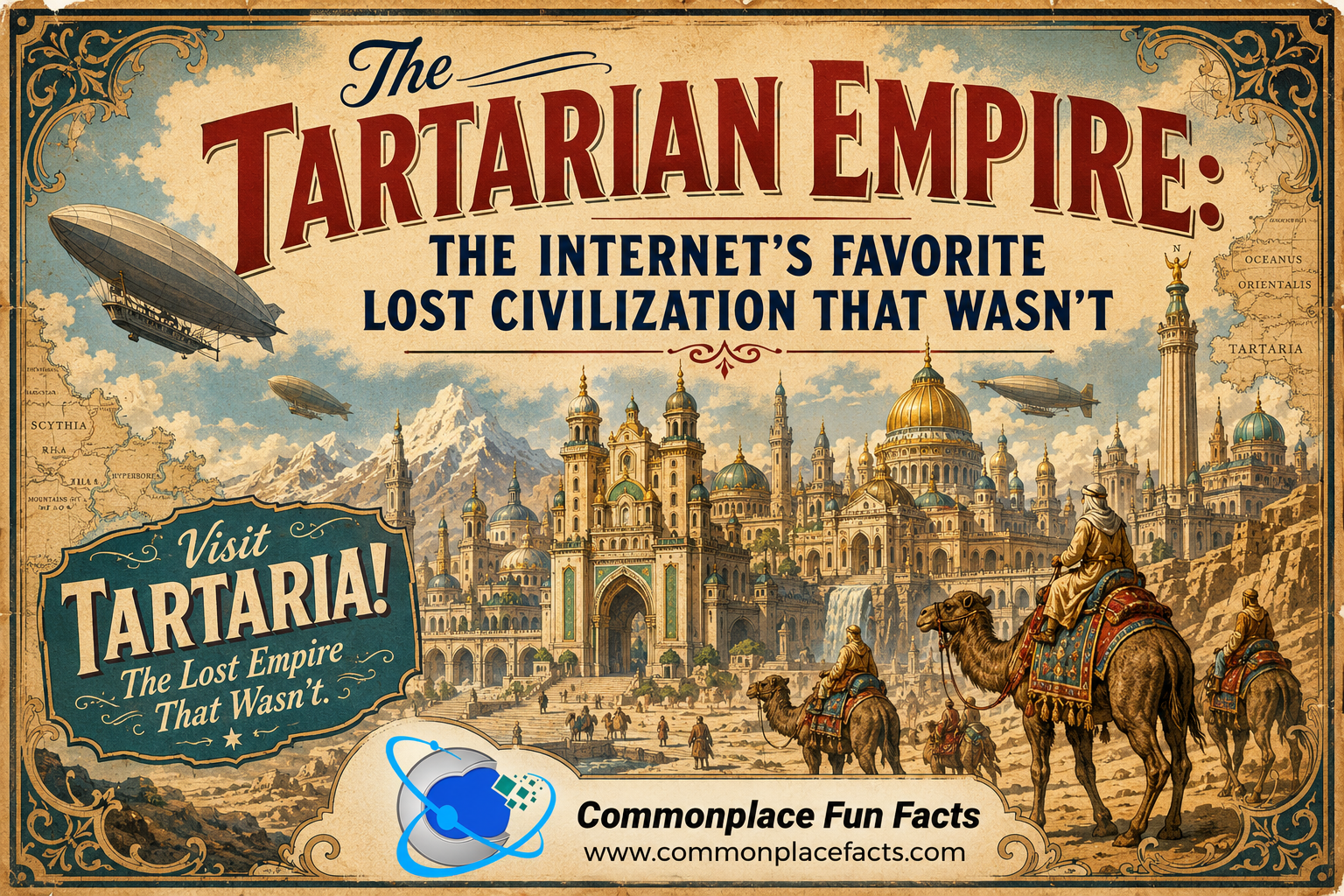

Old maps are wonderful things. They are beautiful, mysterious, and occasionally about as reliable as a preschooler with a crayon and clipboard. They can show us how earlier generations understood the world, what they feared, what they hoped to find, and what they confidently labeled despite having only the faintest idea what was actually there.
Which brings us to the Tartarian Empire.
If you spend enough time on certain corners of the internet — the places where old photographs, ominous music, and architectural close-ups gather in small digital mobs — you will eventually encounter the claim that a vast, advanced civilization called Tartaria once ruled much of the world. According to the theory, this mighty empire built magnificent cities, harnessed mysterious energy, constructed grand domed buildings, and was then erased from history by shadowy elites, catastrophic mud floods, and a very aggressive filing department.
It is the kind of theory that begins with a reasonable question and then drives that question off a historical cliff while shouting, “Wake up, sheeple!”
The reasonable question is this: Why do so many old maps include a place called Tartary or Tartaria?
The unreasonable answer is this: a technologically superior global civilization was erased from history, and the proof is that old buildings had too many columns.
Contents
What Is the Tartarian Empire Theory?
The modern Tartarian Empire theory claims that Tartaria was not merely a region on old maps, but a lost super-civilization. Depending on which video, forum, or social media thread you stumble into, Tartaria may have been an advanced global power, a peaceful utopia, a race of giants, the source of “free energy,” or the real builders of many of the world’s most impressive structures.
The theory often points to grand public buildings from the 1800s and early 1900s — train stations, courthouses, capitols, churches, world’s fair palaces, and skyscrapers — and says, in effect, “There is no way people with horses, elaborate mustaches, and inconvenient underwear built all this.”
That argument has a certain emotional appeal. Anyone who has compared a demolished Beaux-Arts train station to its modern replacement — usually a low concrete rectangle that appears to have been designed during a committee meeting about printer toner — can sympathize with the feeling that something has gone terribly wrong.
But there is a difference between saying, “We used to build beautiful things,” and saying, “Therefore, a secret civilization with aether technology built Cleveland.”
The Tartarian Empire theory usually comes bundled with another claim known as the “mud flood.” This version says that a global catastrophe buried cities under layers of mud, leaving behind lower-level windows, half-submerged doorways, and mysterious basements. The survivors, or perhaps the villains, then supposedly rewrote history, reassigned the buildings, and persuaded everyone that ordinary architects, engineers, masons, and laborers had done the work.
It is history by way of suspicious basement windows.
The Real Tartary: A Map Label, Not a Secret Empire
Here is where things get interesting: Tartary was real. Sort of.
For centuries, European mapmakers used the words Tartary or Tartaria to describe large areas of northern and central Asia. The term appeared on maps roughly from the medieval period into the nineteenth century. It could include parts of Siberia, Central Asia, Mongolia, Manchuria, and other territories that European cartographers understood imperfectly, which is a polite way of saying they looked eastward, squinted, and wrote something in Latin.

The name was connected to the Tatars, a real group of Turkic-speaking peoples associated historically with regions of Russia, Kazakhstan, western Siberia, and the legacy of the Golden Horde. Some Tatars were connected with the Mongol armies. The Golden Horde itself was the western part of the Mongol world, a powerful medieval force that shaped Russian and Eurasian history for generations.
So yes, there were Tatars. Yes, there were khanates. Yes, there were empires, conquests, trade routes, battles, and political structures in the broad region labeled Tartary. That much is history.
What there was not, however, was a single globe-spanning Tartarian Empire secretly responsible for every building with a dome, arch, or column that makes modern architecture look like it has unresolved childhood issues.
Why Did Old Maps Show “Tartary”?
Old maps often used broad regional labels in ways that can confuse modern readers. A map might show “Tartary” across a huge stretch of Asia, but that does not mean there was a single political state called Tartary ruling the entire area. It could mean the mapmaker was using a loose geographic or ethnic term inherited from older sources.
Think of labels such as “the Middle East,” “the Balkans,” “the Midwest,” or “Sub-Saharan Africa.” These terms are useful, but they are not empires. No one imagines that the Midwest is governed by a hereditary Corn Emperor seated upon a throne of casserole, even though that would be a wonderful sight to behold.
European cartographers divided Tartary into different categories over time: Chinese Tartary, Independent Tartary, Muscovite Tartary, Little Tartary, Great Tartary, and other variations. These names shifted depending on the map, the era, and the mapmaker’s sources. That inconsistency is important. Empires tend to prefer borders, capitals, governments, armies, records, taxes, and other annoying administrative details. Tartary, as used on many Western maps, was more of a geographic shrug.
There is also a wonderfully odd linguistic twist. The word “Tatar” picked up an extra “r” in Western languages, becoming “Tartar,” partly because Europeans associated the people with Tartarus, the underworld of Greek mythology. In other words, medieval Europe looked at a steppe people it feared, thought of hell, and said, “Yes, that spelling feels right.”
This is not evidence of a hidden civilization. It is evidence that Europeans could be dramatic.
The Map Is Not the Territory, Especially When the Mapmaker Is Guessing
One of the strongest pieces of “evidence” offered for the Tartarian Empire is the presence of Tartary on old maps. That is understandable. A map looks official. It has lines, names, decorative sea monsters, and enough Latin to intimidate a substitute teacher.
But maps are not neutral photographs of reality. They are arguments. They reflect what the mapmaker knew, what the mapmaker thought he knew, what previous mapmakers had copied, what travelers reported, what rulers wanted emphasized, and what everyone involved was willing to guess while wearing a magnificent wig.
Some early modern maps showed enormous regions labeled Tartaria. Abraham Ortelius, one of the great mapmakers of the sixteenth century, included Tartaria in his famous atlas. But by the time some of these maps were printed, the Mongol Empire had already fragmented. The label remained, but the political reality had changed.
This happens all the time in historical geography. Names linger. Labels drift. Old terminology survives long after the conditions that created it have changed. If future archaeologists find a twenty-first-century map that says “Silicon Valley,” we should hope they do not conclude that California was ruled by a literal valley full of sentient laptops.
Besides, the mere appearance of a place on a map does not automatically make it real, as history has repeatedly demonstrated while quietly wondering why we keep needing this lesson. Gregor MacGregor managed to sell investors and settlers on the imaginary country of Poyais with the help of official-looking documents, maps, currency, and enough confidence to qualify as a public health hazard. More than a century later, a forged Nazi map helped convince President Franklin Roosevelt that Germany had designs on South America. Maps can inform, illuminate, and occasionally decorate a wall with great dignity. They can also lie through their tiny printed teeth.
The Architecture Problem: When Every Pretty Building Becomes Tartarian
The global version of the Tartarian Empire theory is really an alternative history of architecture wearing a conspiracy-theory hat and standing too close to the corkboard. According to this view, many of the grand buildings of the nineteenth and early twentieth centuries were not designed by known architects, funded by known patrons, built by known laborers, and documented in known records. No, that would be far too convenient. Instead, they were supposedly inherited from a vast, advanced Tartarian civilization whose existence was later suppressed by shadowy forces who were apparently very committed to both global domination and poor recordkeeping.

Demolished landmarks are especially popular exhibits in this imaginary courtroom. The Singer Building in New York, completed in 1908 and demolished in the 1960s, is often treated as suspicious because it was elaborate, beautiful, and later destroyed.
The original Pennsylvania Station in New York receives similar treatment, because its demolition remains one of America’s great architectural crimes, right up there with “let’s put fluorescent lighting everywhere” and “what if this public building looked like a filing cabinet with windows?” The temporary grounds of the 1915 World’s Fair in San Francisco also get recruited into the theory, because they looked spectacular, appeared quickly, and vanished afterward. To historians, this is called exposition architecture. To Tartaria believers, it is apparently evidence of an empire with a very aggressive teardown clause.
From there, the theory expands with the enthusiasm of a toddler given permanent markers. Sumptuously styled Gilded Age buildings become “Tartarian.” Domed courthouses, ornate train stations, grand hotels, capitol buildings, and anything with enough columns to make a modern architect break out in hives are absorbed into the story. Some versions go even further, claiming the Great Pyramids and the White House as Tartarian constructions, because once you have decided that old maps prove a hidden world empire, “George Washington’s housewarming committee” is not where one draws the line.
The theory also tends to assign Tartaria a level of technological achievement that would make Nikola Tesla raise an eyebrow. Proponents often claim the Tartarians had developed unlimited wireless energy, sometimes called “aether” energy, which supposedly powered their buildings and cities. This is why towers, domes, spires, antennas, and decorative roof features are sometimes reinterpreted as components of a lost energy grid rather than, say, architectural ornamentation, ventilation, lightning protection, religious symbolism, civic vanity, or architects doing architect things.
The awkward question, which the theory rarely answers with anything approaching clarity, is how such a vast and advanced civilization supposedly achieved world peace, built magnificent structures across the globe, mastered unlimited energy, and then somehow disappeared so completely that it left behind no coherent archives, no recognizable government records, no surviving institutions, no language trail sufficient to support the claim, and no explanation for why everyone else got credit for its work. This is not a minor footnote. This is the historical equivalent of misplacing the elephant and asking everyone to focus on the suspicious peanut.
The simpler answer is less cinematic but much more persuasive: people in the nineteenth and early twentieth centuries really did build astonishing things. They had trained architects, engineers, industrial steel, railroads, stonecutters, masons, sculptors, immigrant labor, civic ambition, and wealthy patrons who wanted their buildings to announce, “Behold, our bank has columns.” The results could be magnificent. The fact that later generations tore many of them down does not prove a cover-up. It proves that beauty has often lost arguments with real estate values, maintenance costs, changing tastes, and men in suits saying the phrase “highest and best use” without being immediately chased from the room.
World’s Fairs: The Tartaria Theory’s Favorite Playground
No subject feeds the Tartarian imagination quite like world’s fairs.
The great expositions of the late nineteenth and early twentieth centuries produced astonishing temporary cities. The 1893 World’s Columbian Exposition in Chicago created the famous White City, a dazzling collection of neoclassical buildings, lagoons, electric lights, sculptures, and civic grandeur. The 1915 Panama-Pacific International Exposition in San Francisco featured the Tower of Jewels and other spectacular structures that looked as though an ancient empire had decided to host a trade show.
To Tartaria believers, the photographs are suspicious. How did these buildings appear so quickly? Why did so many disappear afterward? Why would anyone tear down such magnificent structures?

The answer is painfully ordinary: many of them were temporary. World’s fair buildings were often constructed as theatrical architecture — magnificent on the outside, but not intended to stand for centuries. They used materials such as “staff,” a mixture involving plaster and fiber applied over frames. It could be shaped into grand classical details, painted to look like stone, photographed beautifully, and then removed after the fair ended.
In other words, some of these “ancient palaces” were the architectural equivalent of a movie set: glorious from the front, less convincing if you wandered behind it with a flashlight and a building inspector.
The Tower of Jewels in San Francisco is a perfect example. It was enormous, glittering, and unforgettable. Then the fair ended, and it was dismantled. That was not a cover-up. That was event planning.
The Mud Flood: When Basements Become Evidence
The mud flood theory deserves special attention because it is one of the more visually persuasive parts of the Tartarian Empire story. Believers point to buildings with windows partly below street level, doors that seem oddly positioned, or older structures whose lower floors are now underground. They argue that these are signs of a global catastrophe that buried civilization in mud.

There are several problems with this.
First, basements exist.
Second, cities change grade. Streets are raised. Drainage is improved. Flood-prone areas are filled. Older buildings are adapted to new infrastructure. Entrances are moved. Ground levels shift over decades of construction, demolition, paving, and municipal enthusiasm. In some places, entire streets have been elevated for practical reasons. Urban history is full of layers because cities are living things, and living things accumulate scars, repairs, additions, and regrettable decisions.
A buried window may be interesting. It may tell us something about how a city developed. It may even point to a specific local engineering project. But it does not automatically prove that a worldwide mud apocalypse erased Tartaria while somehow leaving behind enough paperwork for everyone else’s property taxes.
Why the Tartarian Empire Theory Works So Well Online
The Tartarian Empire theory thrives because it is visual. It does not require readers to study Central Asian history, compare chronicles, analyze archaeological evidence, or learn the difference between a khanate and a casserole. It only requires a person to look at an old photograph and feel that something is off. We explored the same phenomenon in Time Travel Claims: The Wildest Stories, Photos, and Legends People Still Swear Are Real, where photographs that look “not quite right” become evidence that someone has slipped through time itself, rather than evidence that old photographs, like old maps, occasionally need adult supervision.
That makes it perfect for the internet. A video can show a grand old building, zoom in on a basement window, add ominous music, flash an old map labeled “Tartary,” and ask, “What are they hiding?”
That question is powerful because it flatters the viewer. It suggests that you are not merely watching a video in sweatpants while avoiding laundry. You are uncovering the hidden truth. You are smarter than the historians, architects, archivists, engineers, and librarians who were foolishly distracted by evidence.
Conspiracy theories often work this way. They turn confusion into revelation. They take complexity and replace it with villains. They make the believer feel brave for noticing patterns that experts allegedly refuse to see.
And, to be fair, some of the patterns are real. Beautiful buildings were demolished. Public architecture did become plainer in many places. Urban renewal did destroy historic neighborhoods. Modern cities often sacrificed beauty for efficiency, profit, traffic flow, or whatever it is we were thinking when we invented brutalist parking garages.
The sadness is legitimate. The conclusion is not.
The Real Story Is Better Than the Conspiracy
The greatest problem with the Tartarian Empire theory is not merely that it is wrong. It is that it makes real history smaller.
It takes the achievements of actual people — architects, masons, carpenters, sculptors, engineers, metalworkers, immigrants, laborers, planners, and artists — and hands the credit to an imaginary civilization. It looks at human skill and says, “No, that must have been someone else.”
That is a shame, because the real story is extraordinary enough. The real story includes Mongol conquests, Tatar khanates, European mapmakers filling in vast unknown regions, city builders transforming skylines, world’s fairs creating temporary dream cities, and generations of people who built astonishing things without needing hidden aether machines or global mud-based amnesia.
History does not need Tartaria to be strange. History is already strange. It contains empires that rose and fell, maps that mislabeled continents, buildings designed to look eternal but built to last a season, and Europeans who heard “Tatar” and somehow dragged the Greek underworld into the spelling.
That should be enough weirdness for anybody.
So, Did the Tartarian Empire Exist?
If by “Tartarian Empire” we mean a hidden global super-civilization that built the world’s grand architecture and was erased by mud floods and secret elites, the answer is no.
If by “Tartary” we mean a historical map label used by Europeans for vast and shifting regions of Asia associated with Tatars, Mongols, Central Asian peoples, Siberia, and neighboring territories, then yes. That term absolutely existed.
The mistake is confusing a label with a state, a beautiful building with a mystery, and a basement with the end of the world.
The Tartarian Empire theory is fascinating not because it reveals a hidden civilization, but because it reveals something about us. We distrust institutions. We mourn lost beauty. We are suspicious of official explanations. We want history to feel grander than zoning records, construction invoices, and urban redevelopment plans.
And sometimes, when we look at what previous generations built, we find it easier to believe in a lost super-civilization than to admit the more uncomfortable truth:
They built magnificent things.
Then we tore many of them down.
No mud flood required.
You may also enjoy…

Albert K. Bender: The UFO Investigator Who Helped Create the Men in Black Legend
Albert K. Bender founded one of the first UFO investigation groups, tried to contact aliens by telepathy, and helped launch the Men in Black legend.

The Glitter Conspiracy: How a WWII Secret Invention Sparked a Sparkly Crisis
What is the Glitter Conspiracy? From WWII secrecy and ultra-precise manufacturing to environmental fallout and internet suspicion, this deep dive explores how glitter became permanent, pervasive, and just suspicious enough to worry everyone.

Oak Island: A $50 Million Treasure Hunt—But How Much Has Been Found?
How much treasure has actually been found on Oak Island, and how does it compare to the millions spent searching for it? Explore the costly mystery of the Money Pit, the discoveries made, and why treasure hunters keep digging despite the odds.





Leave a Reply